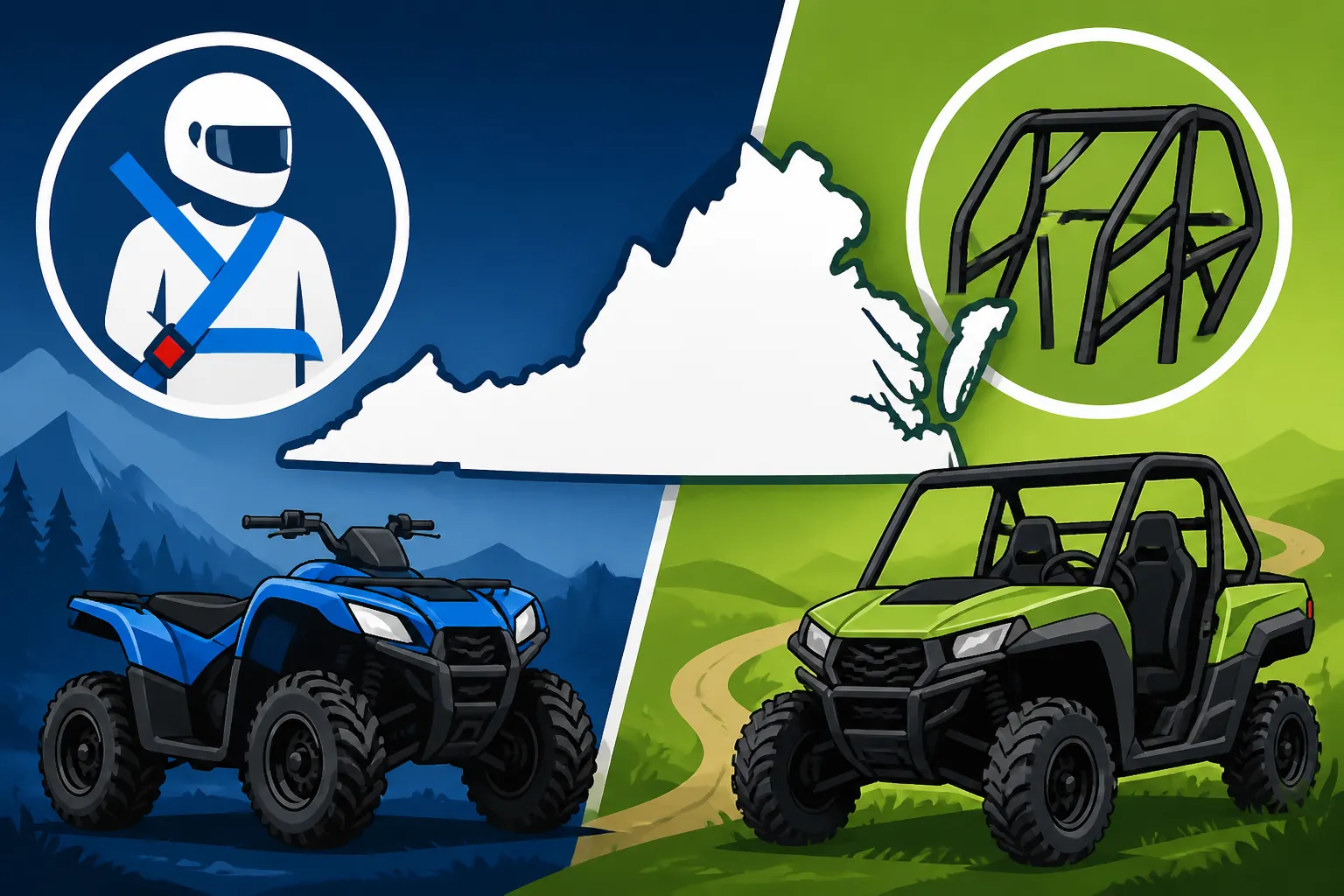
Virginia Seatbelt and Roll Cage Rules
Virginia seatbelt and roll cage rules can be confusing because a requirement at one riding area is not automatically a statewide rule. If you plan to bring a side-by-side to a Virginia trail system, the key is knowing what that destination requires before you load up. This article explains the factory-cage and working-seatbelt expectations, how they affect riders and visitors, and what to check before departure.
Where the roll cage and seatbelt rule applies
Virginia’s trail requirements depend on where you ride. The factory roll cage and working-seatbelt rule is especially important for side-by-sides using the Spearhead Trails system. It is a trail-system condition, not a rule to assume applies identically to every public road, forest trail, farm, or private riding park.
Spearhead expects a side-by-side to have its factory-installed roll cage and working seatbelts. Riders should plan to use a belt for each occupied seat. A machine without the required equipment, with a damaged belt, or with a structure that does not meet the system’s requirements may be turned away. Self-built machines are not a workaround: a homemade frame or cage is not automatically treated as equivalent to factory equipment.
That distinction matters because riders often hear “Virginia ATV rules” and treat them as one set of requirements. In practice, there can be several layers:
- State law governs conduct on roads and other places covered by state rules.
- A trail operator can set access conditions for its own system.
- A private park can set its own equipment and admission requirements.
- A landowner can impose conditions on permission to use private property.
So a vehicle that is legal to own or use in one setting might not meet the entry rules at a specific riding area. Before heading to Spearhead, read Spearhead Requires a Factory Cage and Working Seatbelts and check the current requirements with the trail operator. For broader permit details, see Virginia Spearhead Trail Permits.
The rule is also a practical safety requirement, not just a paperwork detail. A roll cage is part of the vehicle’s protective structure. Seatbelts help keep occupants within that protected area if the vehicle tips or hits an obstacle. The cage and belts work as a system; having one does not make the other unnecessary.
| Riding location | What to assume about a cage and belts | What to verify |
|---|---|---|
| Spearhead Trails | Side-by-sides are expected to have a factory cage and working belts for occupants | Current trail rules, vehicle eligibility, and permit requirements |
| National forest OHV routes | Do not assume Spearhead’s rule is the exact rule; forest equipment requirements may differ | Applicable forest rules, machine requirements, and seasonal closures |
| Private riding park | The park may set its own cage, belt, helmet, and passenger conditions | The park’s current rules before arrival |
| Private land | The landowner’s permission and conditions matter, along with applicable law | Written permission and any site-specific safety conditions |
| Public roads | Trail-system access rules do not make a side-by-side street legal | Road-use restrictions and any applicable state or local rules |
A useful starting point is Virginia Trails That Allow Side-by-Sides. The fact that a system allows UTVs does not mean every UTV configuration is eligible. Width limits, machine types, age rules, permits, safety equipment, and other conditions can still apply.
What counts as acceptable equipment
The practical question is not only whether a machine has something that looks like a cage and belts. It is whether the equipment is the kind the trail system accepts and whether it is in working condition.
A factory roll cage is not just a bar overhead
A roll cage is part of a side-by-side’s occupant-protection system. A factory-installed structure is designed for the vehicle’s layout and intended use. A decorative bar, accessory rack, windshield frame, or added tubing should not be treated as a substitute.
Do not assume that an aftermarket cage is acceptable simply because it is strong, professionally installed, or marketed as a safety upgrade. Trail operators can distinguish between a factory-equipped machine and a machine with a changed or self-built structure. If the vehicle’s cage has been removed, modified, cut, welded, or replaced, ask the operator whether the machine is eligible before traveling.
This is especially important after a rollover or collision. A cage can be bent or damaged even if the vehicle still runs. A repair that changes its shape or attachment points may also affect how it performs. Have damage assessed by a qualified technician and confirm trail eligibility rather than relying on a visual check alone.
Working belts should match the vehicle’s seating layout
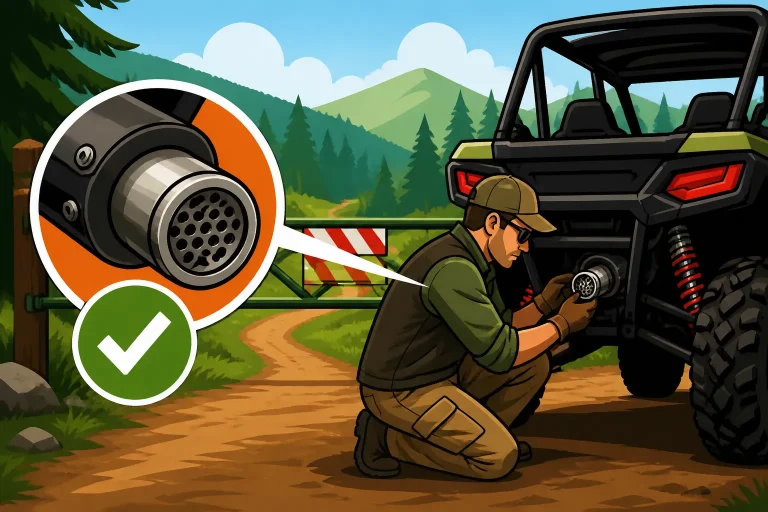
A belt that is present but frayed, stuck, cut, badly worn, or unable to latch is not a working restraint. Check every belt, buckle, retractor, and mounting point. If a belt will not pull out or retract normally, has a damaged webbing edge, or does not latch and release correctly, address the problem before riding.
Seatbelts should also correspond to the seating positions. Do not assume that a belt arrangement is acceptable if someone has added a seat, changed the bench, moved a seat, or altered the original restraint layout. Avoid carrying more people than the machine was designed to seat. A belt is not a substitute for a proper passenger seat, and an extra passenger should not be squeezed into a space without a suitable restraint.
The system’s rule is often summarized as belts matching the seats. Treat that as a reason to keep the original occupant arrangement intact, not as permission to improvise a belt installation. If the machine has been modified, ask the trail operator what documentation or configuration it accepts.
Repairs need to restore safe operation
For a damaged or missing belt, use a replacement intended for the exact make, model, and seating position. A generic strap that can be bolted into place may not be designed for the vehicle’s anchor points or restraint system. Follow the manufacturer’s repair guidance, and use a qualified shop if the work affects mounting hardware or vehicle structure.
If comparing replacement parts through Amazon or another retailer, verify the exact model-year fitment and part specifications rather than relying on a similar-looking listing. For safety-critical components, manufacturer-approved parts and installation guidance are the safer reference. Keep receipts or part information if you need to explain a repair, but do not assume that a receipt proves the machine meets a trail operator’s requirements.
After a repair, test each belt before loading the machine. Confirm that it latches, holds, releases as intended, and is not trapped under a seat or trim panel. If the cage or belt mounts were involved in a collision or structural repair, a routine driveway check may not be enough; get a qualified inspection.
How the rule affects passengers and trip planning
The belt and cage requirements apply to the machine and the people riding in it. A driver should not treat the belt rule as a box to check only at the gate. Every occupant should be seated in a proper position and restrained according to the vehicle’s design.
Before a ride, go over three basics with the group:
- Use only the seats the vehicle was designed to carry.
- Buckle each occupant into the correct belt before moving.
- Keep belts fastened while riding, and do not let passengers ride on a fender, cargo area, or other unseated spot.
That routine can be particularly important with children and teenagers. Do not assume that a child can use an adult-sized belt safely just because the belt clicks into the buckle. Follow the vehicle manufacturer’s guidance for occupant size and seating, along with the trail operator’s rules for minors. Related requirements are covered in Virginia Trail Rules for Riders Under 18 and Virginia Rules for a Side-by-Side Driver.
A helmet and eye protection are separate safety issues. A roll cage does not replace a helmet, and a seatbelt does not protect a rider’s head from every hazard. Check the trail system’s protective-equipment rules as well as its machine requirements. See Virginia Helmet and Eye Protection Rules on Trail for the separate trail-safety topic.
Inspect before loading, not at the trail entrance
A basic check at home can prevent a long trip with an ineligible or unsafe machine. Inspect the cage and belts before loading, then check the vehicle’s other condition and required documents. If a machine recently changed hands or was modified, verify its configuration and eligibility rather than assuming the prior owner’s setup is acceptable.
A pre-trip check can include:
- Looking for bent, cracked, loose, or altered cage components.
- Checking that cage attachments are secure and have not been changed.
- Inspecting belt webbing for cuts, fraying, burns, or contamination.
- Testing each buckle and release.
- Confirming that belts retract or adjust as designed.
- Checking that each belt is available for the corresponding seat.
- Confirming there are no added seats or improvised passenger positions.
- Reviewing the destination’s current equipment rules and permit conditions.
This check does not certify a machine as safe or guarantee admission. It helps identify obvious problems early. For other trip preparations, including system conditions and access planning, see Virginia Trail Conditions Before You Haul.
Ask the operator when the vehicle is unusual
Some machines are not straightforward: they may have a replacement cage, repaired rollover damage, a modified seating arrangement, or a belt system that differs from the factory setup. Rather than trying to interpret an uncertain case at the gate, contact the trail operator with the make, model, year, and a clear description of the modification.
If possible, ask a specific question: “Is this machine eligible with this replacement cage and belt arrangement?” A general question such as “Are UTVs allowed?” may not resolve the issue. Keep the answer available during trip planning, but understand that the operator may still inspect the vehicle and apply its current rules when you arrive.
Do not rely only on a seller’s assurance that a machine was accepted elsewhere. Another park or trail network may use different requirements. A permit for one system also does not establish that the machine meets another system’s equipment rules.
How this differs from Virginia law and other trail rules
The Spearhead cage-and-belt condition should not be confused with a statewide declaration that every ATV or UTV must have a roll cage and seatbelts wherever it is used. Virginia law, trail-operator requirements, and private-property conditions are separate questions.
This is not a loophole around road restrictions. A machine that meets Spearhead’s safety requirements is not thereby authorized for public-highway use. Likewise, the fact that a side-by-side is not on a public road does not automatically mean it can be ridden anywhere without permission. Check the rules for the specific place and route.
The same caution applies when moving between riding systems. A Spearhead permit does not automatically cover a different network, and a permit from a neighboring state does not automatically establish access in Virginia. Hatfield-McCoy and Spearhead Still Sell Separate Permits explains the permit distinction for those nearby systems. For permit types and purchase considerations, see Virginia Annual vs Three-Day Permits.
Equipment requirements can also differ between a managed trail system and federal forest land. A machine accepted on one network may face different requirements on another, and a route may have separate width, sound, seasonal, or operator-license rules. Check the exact destination rather than transferring assumptions from a previous trip.
| Question | Why it matters |
|---|---|
| Does this system allow side-by-sides? | A general UTV-friendly label does not confirm that every machine or configuration is eligible. |
| Does it require a factory cage and working belts? | The requirement may be specific to a particular trail operator. |
| Is a modified cage acceptable? | The operator may not treat an aftermarket or self-built structure as equivalent to factory equipment. |
| Does each occupied seat have a usable belt? | A belt that is absent or inoperable can make the machine noncompliant and unsafe. |
| Does the permit cover this network? | Permits are not necessarily interchangeable between systems. |
| Are there separate rules for minors or passengers? | Age, seating, and supervision conditions can apply in addition to equipment rules. |
| Is the route open and suitable for this machine? | Closures and vehicle restrictions can change the plan even when the machine meets equipment rules. |
If your trip involves public roads, crossings, or travel between trail sections, check the road-use rules separately. Virginia’s road restrictions are not superseded by a trail permit or by safety equipment on the machine. Can You Ride an ATV on the Road in Virginia? covers the distinct road-access question.
A practical checklist before you ride
Use this sequence when preparing a side-by-side for a Virginia riding trip:
- Identify the exact destination. Determine whether you are riding Spearhead, a national forest route, a private park, or private land. Do not treat “Virginia trails” as one operator or one rule set.
- Confirm that the machine type is allowed. Check the system’s current rules for side-by-sides, including any restrictions on width, configuration, or vehicle type.
- Check the cage. Confirm that the factory-installed roll cage is present, secure, and not visibly damaged or altered. If it has been replaced or modified, ask the operator about eligibility.
- Check every seat and belt. Test each buckle and belt, inspect the webbing and mounts, and make sure the restraint layout corresponds to the original seating arrangement.
- Use every restraint correctly. Make sure each occupant has an appropriate seat and belt. Do not carry extra passengers in cargo areas or improvised seating.
- Review the rest of the requirements. Verify permits, identification, age conditions, helmets, operating hours, and other rules that apply to the chosen system.
- Ask about uncertainty before departure. Contact the operator if the machine has unusual equipment, repairs, or modifications.
- Recheck close to the trip. Rules, trail conditions, and closures can change. Confirm current details before hauling a machine a long distance.
If a machine fails one of these checks, do not assume that a waiver, a trail permit, or an explanation at the gate will make it acceptable. Resolve the issue first. When the machine’s eligibility is uncertain, postponing the trip is usually easier than arriving with a vehicle that cannot be ridden.
The broader point is simple: a factory cage and usable belts are part of a side-by-side’s protective setup, and at Spearhead they are also an access condition. Keep the equipment in its intended configuration, buckle everyone into a proper seat, and verify the rules for each trail system independently.
Frequently Asked Questions
Do all Virginia ATVs and UTVs need a roll cage and seatbelts?
Do not assume there is one statewide equipment rule for every machine and every riding location. Spearhead’s factory-cage and working-seatbelt condition applies to side-by-sides using its system. Other locations can set different requirements.
Can an aftermarket cage replace the factory roll cage?
Do not assume it can. A trail operator may require the factory-installed cage and may reject a self-built or modified structure. Ask the operator about a specific replacement or modification before traveling.
Does every passenger need a working seatbelt?
Plan for every occupant to use a working belt in a seat designed for that person. Do not carry more people than the machine was built to seat or use cargo areas as passenger seats.
Does meeting the cage and belt rule make a side-by-side street legal?
No. Trail access equipment requirements do not authorize public-road use. Check road restrictions and any separate local rules before using a road.
Does a Spearhead permit cover another trail system?
Do not assume permits transfer between networks. Confirm the permit requirements for each system separately, including when planning to ride outside Virginia.
Disclaimer
This article is for general informational purposes only and does not constitute professional advice. Laws, prices and regulations vary by location and change over time. Consult a qualified professional for guidance on your specific situation.