Spark Arrester Checks at a Trailhead Gate
A spark arrester can be easy to overlook until you reach a trailhead gate and someone checks your machine. On Virginia National Forest routes, the practical question is whether your exhaust system has a suitable, properly maintained arrester—not just whether the quad sounds quiet. Here’s how to check your equipment, what a gate inspection may involve, and what to do if your setup is uncertain.
What a spark arrester check is meant to confirm
A spark arrester helps keep hot particles from escaping an engine’s exhaust and starting a fire. It is a fire-prevention device, not simply another name for a muffler. A quiet machine can still have an exhaust system that lacks a spark arrester, while a machine with an arrester can still be too loud or have a damaged muffler.
On Virginia National Forest routes, spark arresters are part of the equipment requirements riders should check before heading out. The details belong alongside the other forest rules, not in place of them: a valid permit, operating requirements, sound limits, and seasonal closures can all matter too. See Virginia Forest Equipment Requirements and Why Your Quad Needs a Spark Arrester at Peters Mill Run for related equipment considerations.
A trailhead gate does not necessarily mean every machine will receive the same inspection. The process can vary by location and circumstances. A ranger or other authorized staff member may look at the exhaust system, ask about its equipment, or check compliance as part of a broader trail visit. Do not assume that passing through a gate without being stopped proves the machine meets the rules.
The essential distinction is between having a functioning, appropriate arrester and merely having an exhaust part that looks similar. A screen or insert might be missing, damaged, clogged, or not designed for that exhaust. A seller’s description or a machine’s quiet sound is not a reliable substitute for confirming the part and its fit.
A spark arrester check also does not answer every question about the machine. Riders using Peters Mill Run and Taskers Gap should separately confirm permit, operator, and equipment rules. For example, Virginia National Forest OHV Permits covers the permit side, while Virginia Forest Noise Limits addresses a separate issue. One requirement does not cancel out another.
| What you are checking | Why it matters | A practical way to prepare |
|---|---|---|
| Whether an arrester is installed | The machine may not meet forest equipment rules if the required device is absent | Check the owner’s manual and inspect the exhaust system |
| Whether the part fits the machine | A generic or incorrect insert may not be suitable for that exhaust | Match the part to the exact make, model, and year |
| Whether it is intact and maintained | Damage, missing parts, or heavy deposits can affect function | Inspect it while the machine is cool and follow the maker’s maintenance instructions |
| Whether the exhaust is also within applicable noise rules | A spark arrester and a muffler serve related but different purposes | Review the current forest requirements separately |
| Whether the route is open and the ride is permitted | Equipment compliance alone does not establish access | Check current trail and permit information before traveling |
How to check your machine before you haul it
Start with the owner’s manual and the exhaust components currently installed on the machine. If the quad or side-by-side has its original exhaust, the manufacturer’s documentation may identify the spark-arresting equipment or maintenance procedure. If the exhaust has been modified, do not assume the original equipment description still applies. A replacement muffler or altered exhaust may have changed what is installed.
- Identify the exact exhaust setup. Note the machine’s make, model, and year, then check whether the exhaust is original or aftermarket. If a previous owner changed it, ask what parts were installed and look for any available documentation.
- Find the arrester information. Consult the owner’s manual, exhaust manufacturer’s instructions, or the relevant product documentation. Look for information specific to the exhaust system, rather than relying on a general claim that a part is “spark arresting.”
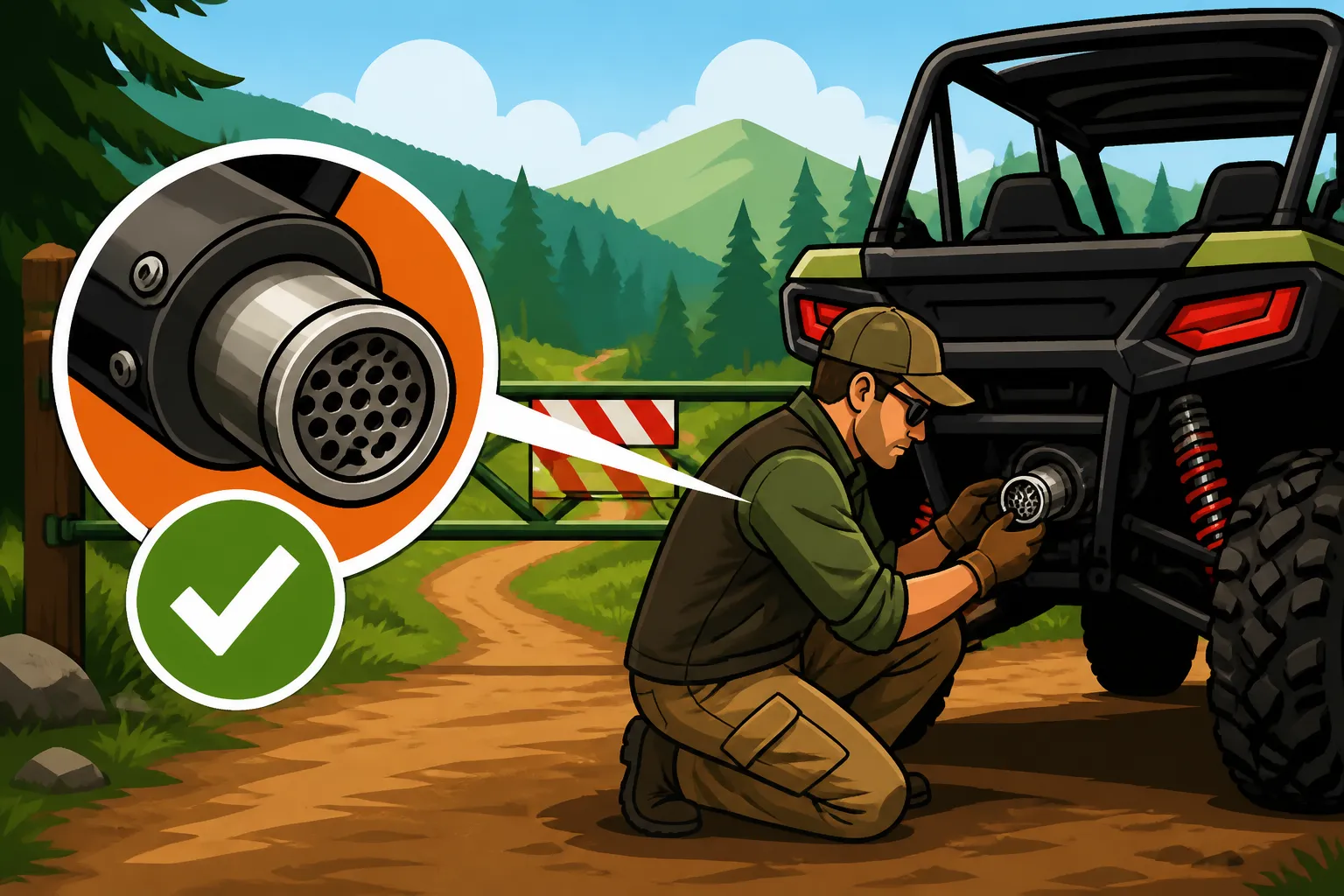
- Inspect only when the machine is cool. Exhaust parts can remain hot after riding. Follow the manufacturer’s directions for any inspection or removal; do not reach into a hot exhaust or dismantle components without knowing how they fit.
- Look for obvious problems. Check for a missing insert, loose or damaged components, heavy buildup, or signs that the exhaust has been altered. A visual check can catch obvious issues, but it cannot confirm every technical requirement.
- Make sure the installed part matches the documentation. A manual for the original exhaust may not describe a replacement system. Confirm that the part number and instructions correspond to what is actually on the machine.
- Resolve uncertainty before departure. Contact the machine or exhaust manufacturer, a qualified service shop, or the relevant trail office. A trailhead is a poor place to learn that a part is missing or incompatible.
Be cautious with removable inserts and screens. They may be serviceable components, but removing one for cleaning or maintenance and then forgetting to reinstall it can leave the machine out of compliance. Store small parts safely during maintenance and make a final check before loading the machine.
If the arrester has a screen or other serviceable element, follow the manufacturer’s cleaning schedule and method. Do not drill, cut, enlarge, or replace components with a part that merely appears similar. Changes can affect function, fit, and compliance. If deposits are difficult to remove or a component is damaged, have a qualified shop inspect it rather than guessing.
Aftermarket exhausts need particular care. A louder or more open system may have been installed for performance, but that does not establish that it has an appropriate arrester. Likewise, a product listing that uses broad terms such as “off-road” or “race” does not, by itself, show that the system satisfies the requirements for a forest trail. Check the exhaust maker’s documentation for the exact system and machine.
If you are ordering a replacement, use the exact model information and part number to narrow the search. A marketplace such as Amazon may list parts, but a listing is not proof of suitability or approval. Check the manufacturer’s product documentation, compatibility details, and return conditions before ordering. If the part’s status remains unclear, ask the manufacturer or a service professional rather than relying on a seller’s short description.
What may happen at the gate
There is not one universal gate procedure that riders should expect at every forest access point. A check may be brief, part of a wider equipment review, or not occur during a particular visit. The important preparation is to arrive with the machine in compliant condition, not to plan around whether someone will inspect it.
If staff ask about the arrester, answer clearly and avoid claiming certainty you do not have. If the part is identifiable, you can explain what is installed and refer to the machine or exhaust documentation. Keep the information easy to find on your phone or in your hauling paperwork if you have it. Documentation can help explain the setup, but do not treat it as a substitute for having the required equipment physically installed and working.
A visual check is not necessarily conclusive. Some exhaust components are not readily identifiable from the outside, and a screen can be hidden inside a muffler assembly. Do not remove parts at the gate unless staff direct you and the machine is safe to handle. If you cannot establish that the setup meets the requirement, ask what to do next and be prepared not to ride until the uncertainty is resolved.
Spark arrester checks may be discussed alongside noise or general machine condition, but these are separate questions. A compliant arrester does not make an excessively loud exhaust acceptable, and a quiet exhaust does not prove it has an arrester. Riders should check both the applicable equipment requirements and the forest’s current noise rules. Passing a 99-Decibel Sound Check on Forest Land explains the sound-related side of preparation.
Do not rely on informal assurances from another rider, a previous owner, or a seller. They may be mistaken or may have been describing a different machine or exhaust configuration. If the system has been modified, ask for the manufacturer’s documentation and verify the details before making a long trip.
A gate check is also only one part of trail readiness. Riders should verify the permit and any current access restrictions before leaving home. Forest routes can have conditions or closures that affect access even when a machine’s equipment is correct. See Virginia Trail Conditions Before You Haul and Planning Around the Winter Closure at Taskers Gap when planning a trip.
If the arrester is missing, damaged, or unclear
If you discover a problem at home, postpone the ride until you have a suitable repair or confirmation. Do not try to solve it by installing a loose screen, improvised mesh, or an unrelated insert. A part that does not fit securely or is not designed for the exhaust may fail to work as intended, and a quick fix can create more problems than it solves.
For a missing or damaged component, use the machine or exhaust manufacturer’s instructions to identify the correct replacement. If the exhaust is aftermarket, contact that manufacturer or a qualified repair shop. Give them the exact machine details and the exhaust model or part number, and explain that the machine will be used on a National Forest route with a spark arrester requirement.
If you are already at the trailhead, do not assume that you can ride while waiting to verify the part. Ask the appropriate staff member or trail office about the applicable requirement and next steps. If the machine cannot be confirmed as compliant, the safest practical choice is to leave the trail and resolve the issue before returning.
Keep a record of the final setup after a repair. A photo of the installed component and a saved copy of the manufacturer’s instructions can make later maintenance easier. They are useful references when you prepare for another trip or when a future owner asks what is installed. Still, check the machine itself before each ride; a photo cannot show whether a part has since loosened, been removed, or become damaged.
The same routine applies when buying a used machine. Ask whether the exhaust is original, whether it includes a spark arrester, and whether the seller has the manual or parts information. Inspect the system before money changes hands, especially if the machine has been modified. For a broader used-machine checklist, see What Virginia Buyers Check First on a Used Quad and Building a Paper Trail When You Buy a Used Quad.
A few minutes of preparation can prevent a wasted drive and reduce the chance of riding with an unsuitable exhaust system. Confirm the part, inspect it while cool, keep the relevant documentation accessible, and recheck the current trail rules before setting out. If any detail is uncertain, resolve it before the machine reaches the gate.
Disclaimer
This article is for general informational purposes only and does not constitute professional advice. Laws, prices and regulations vary by location and change over time. Consult a qualified professional for guidance on your specific situation.