Can You Ride an ATV on the Road in Virginia?
It's a common dilemma for ATV and UTV owners in Virginia: you’ve got this powerful machine, perfect for navigating rugged terrain, and sometimes you just need to get from point A to point B on a public road. Perhaps it’s to reach another section of a trail, get to a gas station, or simply connect two properties. The reality, however, is that Virginia's laws around riding ATVs and UTVs on public roads are quite strict and often misunderstood, leading to confusion, frustration, and sometimes costly penalties. This guide will thoroughly explain when and where you absolutely cannot ride your off-road machine on Virginia's roads, along with the very few, specific exceptions that exist, so you can ride confidently and legally.
The General Rule: No ATVs on Virginia's Public Roads
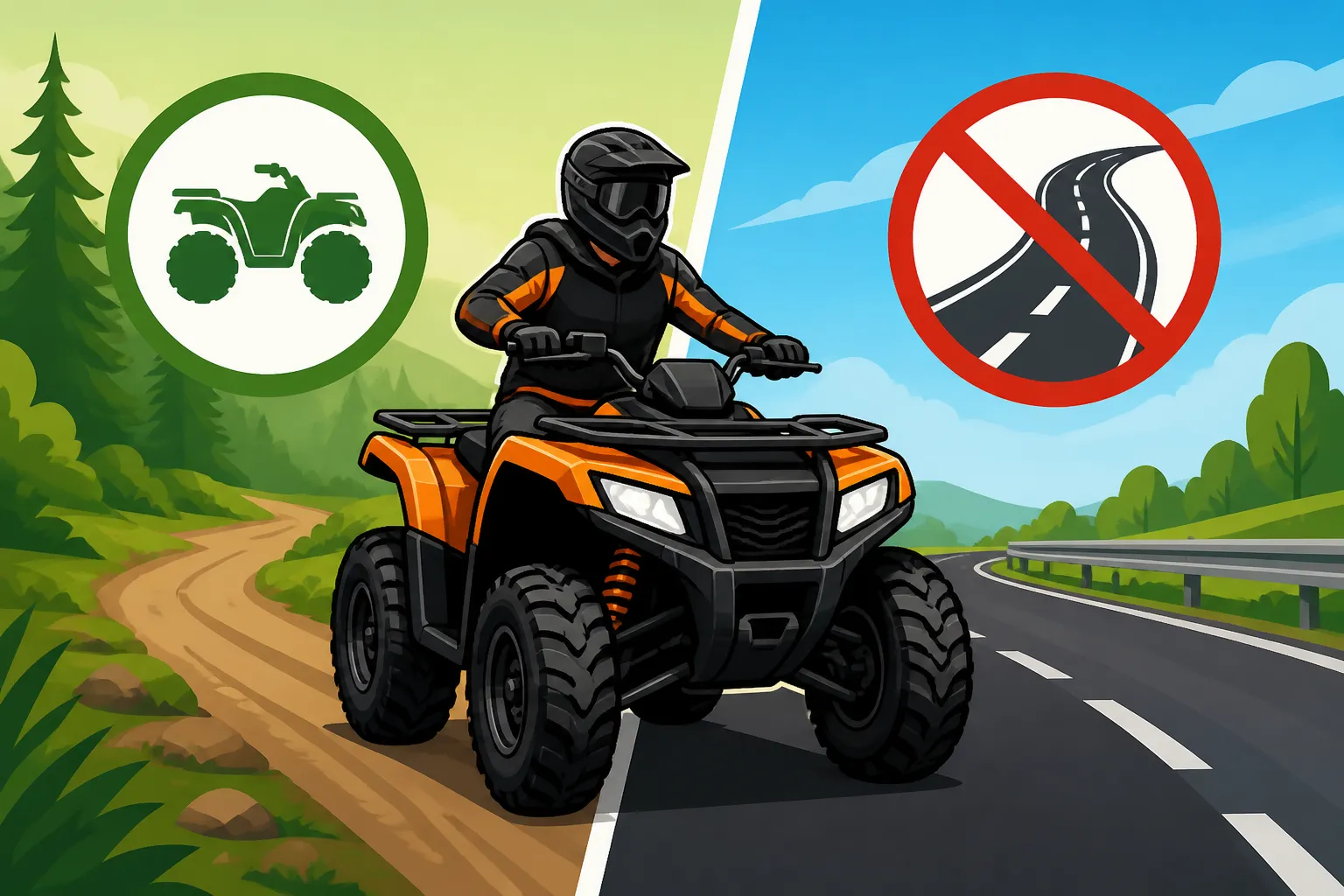
Let's get straight to the point: for the vast majority of cases, operating an all-terrain vehicle (ATV) on Virginia's public roads is against the law. This isn't just a suggestion or a guideline; it's a firmly established legal boundary designed to ensure safety for everyone on the road, including the ATV operator. It’s a harsh reality for many riders who might have moved from other states with more lenient rules or who simply wish for the convenience of using their machine for short road stints. But understanding this fundamental prohibition is the first step to avoiding serious legal and financial headaches.
Understanding Virginia's ATV Definition
To truly understand why ATVs are restricted from public roads, it's essential to know how Virginia's legal code defines them. An all-terrain vehicle, or ATV, is specifically categorized as a motor vehicle that is:
- Primarily designed for off-road use.
- Equipped with three or more wheels.
- Steered with handlebars.
- Features a seat designed to be straddled by the operator.
- Has a width of 50 inches or less.
- Weighs less than 900 pounds.
- Intended for use by a single operator.
This definition highlights the key characteristics that differentiate an ATV from a car, truck, or even a street-legal motorcycle. The crucial phrase here is "designed for off-road use." This design impacts everything from tire type and suspension travel to overall stability and braking capabilities, none of which are optimized for the demands of paved roads and shared traffic. Even if you've added some fantastic aftermarket upgrades like robust suspension components or specialized tires from a brand like SuperATV, these modifications don't alter the vehicle's fundamental classification or magically grant it street-legal status in Virginia.
Why the Ban Exists: Safety and Vehicle Classification
The underlying reason for Virginia's strict ban on ATVs on public roads boils down to safety and the inherent differences in vehicle design and purpose. Unlike cars, trucks, or motorcycles, ATVs are simply not engineered for road use. Consider these critical factors:
- Stability and Handling: ATVs have a high center of gravity and suspension systems built for absorbing rough terrain, not for stable, high-speed cornering or quick maneuvers on smooth pavement. Sudden turns or braking on asphalt can easily lead to rollovers or loss of control, especially when encountering unexpected road hazards.
- Visibility: ATVs are typically smaller and sit lower than most other vehicles on the road, making them incredibly difficult for other drivers to see, particularly in heavy traffic, at intersections, or during low-light conditions. This lack of visibility is a major contributor to accidents.
- Tires: The aggressive, knobby treads on ATV tires provide excellent traction off-road but perform poorly on pavement. They offer reduced grip, wear down quickly, and can contribute to instability and extended stopping distances on hard surfaces.
- Lack of Road-Specific Safety Features: Standard ATVs generally lack essential safety equipment required for street-legal vehicles, such as DOT-compliant headlights and taillights, turn signals, proper rearview mirrors, and advanced braking systems designed for road speeds. They also typically don't have the robust occupant protection (like seatbelts or roll cages) found in cars.
- Regulatory Framework: Street-legal vehicles are subject to specific licensing, registration, inspection, and insurance requirements. ATVs generally bypass many of these regulations, and integrating them into the public road system would create significant enforcement and liability challenges. This is why [Virginia Titles ATVs but Never Registers Them] for road use.
Common Misconceptions About Road Use
Many riders operate under incorrect assumptions about ATV road legality, often leading to violations. One widespread misconception is that unpaved public roads or quiet county roads are fair game. In Virginia, "public road" generally refers to any road maintained by the state or a local municipality, regardless of its surface type or traffic volume. So, that peaceful gravel road connecting two private properties is likely still off-limits.
Another common belief is that if you're just "crossing" a road, it's fine. While specific, highly restrictive rules exist for crossing, simply riding down the shoulder for a short distance to get to another trail system is almost certainly illegal unless it falls under one of the extremely narrow exceptions. Lastly, equipping your ATV with basic headlights and taillights, while good for off-road safety, does not mean it meets the legal requirements for visibility and lighting on public highways. It's crucial not to confuse basic illumination with full street-legal lighting standards.
Specific Exceptions to the Road Ban
While the general prohibition against ATVs on Virginia's public roads is firm, the law does carve out a few very specific and limited exceptions. These are not open invitations for recreational road riding but rather allowances for practical, often essential, purposes under strict conditions. Understanding these nuances is critical for staying within the bounds of the law.
Farm and Agricultural Use
Farmers and individuals engaged in bona fide agricultural or horticultural operations have a significant exception. Virginia law acknowledges the utility of ATVs and UTVs as essential tools for farm work, allowing them to be operated on public highways for specific agricultural purposes. This includes activities such as:
- Moving between different fields or sections of the same farm.
- Traveling from one tract of land to another, provided both are part of the same farming operation.
- Transporting produce, livestock, or farm equipment directly related to agricultural activities.
However, this exception is not a blanket permit. The ATV or UTV must be genuinely used for farming purposes. You can't just claim agricultural use to take your machine on a joyride. The intent and the actual activity must be directly linked to the farm. Even within this exception, operators are expected to exercise caution, avoid unnecessary travel on busy roads, and ensure safe operation. [Virginia Machines Used Only on a Farm] provides more details on this specific use case.
Emergency and Public Service Operations
Emergency responders, including fire departments, volunteer rescue squads, and law enforcement agencies, are also exempt from the general ban when operating ATVs or UTVs in the course of their official duties. These machines are invaluable for accessing remote areas, navigating difficult terrain, or responding to incidents where traditional vehicles cannot go. For instance, a rescue squad might deploy an ATV to reach someone injured on a remote trail, or police might use one to patrol large outdoor events or disaster zones. These allowances are strictly for official, emergency, or public service functions and do not extend to personal use by these personnel. [Virginia Rescue Squad Title Exemptions] highlights this important carve-out for public safety.
Limited Crossings of Highways
This exception is one of the most frequently misunderstood and, consequently, violated rules. Virginia law permits an ATV or UTV to cross a public highway or road, but only under extremely stringent conditions:
- Most Direct Route: The crossing must be made using the most direct path possible. You cannot travel parallel to the road for any distance to find a "better" crossing spot.
- Perpendicular Angle: The machine must cross the roadway at an angle of approximately 90 degrees to the direction of traffic. This minimizes exposure to other vehicles.
- Yield to Traffic: The operator is legally required to yield the right-of-way to all oncoming traffic and ensure the crossing can be completed safely without obstructing or interfering with other vehicles.
- Clear Visibility: The crossing should only be attempted at locations where there is clear and unobstructed visibility in both directions along the highway.
The intent of this rule is to allow riders to connect legal off-road riding areas that are directly separated by a public road, not as a way to travel along the road itself. Think of it as a quick, precise maneuver to bridge two sections of a trail, not a means of transportation on the road. For more on this, check out [Virginia Crossings by the Most Direct Route].
Designated Coalfield Routes in Buchanan and Tazewell Counties
Perhaps the most significant and celebrated exception for recreational riders exists in Buchanan and Tazewell counties in Southwest Virginia. In an effort to boost outdoor tourism and provide economic benefits to the region, the local Boards of Supervisors in these counties have the authority to designate specific sections of public highways for legal ATV and UTV use. These routes are designed to connect riders to the extensive [Spearhead Trails in Virginia Explained] system, allowing them to travel directly from towns, lodging, or staging areas to the trails without needing to trailer their machines for every segment.
However, even on these designated routes, strict rules apply:
- Explicitly Designated Roads: Only those roads clearly marked and designated by the counties are open to ATVs and UTVs. Riders must not assume all public roads in these counties are accessible. Look for official signage.
- Speed Limit: A specific speed limit of 25 mph is enforced on these designated road sections, emphasizing caution and safety.
- Daylight Hours: Operation is generally restricted to daylight hours, further enhancing safety and visibility.
- Helmet Law: [Virginia Helmet Law Applies to Every Rider] on an ATV, and this rule is particularly critical when operating on or near public roads, even designated ones.
- Trail Permits: While the road connectors themselves don't require a state DMV permit, accessing the Spearhead Trails mandates a valid trail permit, such as those discussed in [Virginia Spearhead Trail Permits].
- Insurance: Although Virginia does not require ATV insurance, it is highly recommended when operating on these road sections to protect against potential liabilities in case of an accident.
Riders planning to utilize these coalfield routes must consult the latest maps and regulations provided by Spearhead Trails or the respective county offices. These unique routes are a fantastic amenity for riders, but strict adherence to the rules is non-negotiable.
Consequences of Illegal Road Riding
Disregarding Virginia's ATV road laws can lead to consequences far more severe than just a slap on the wrist. Many riders underestimate the potential penalties, which can include hefty fines, the impoundment of your valuable machine, and significant personal liability in the event of an accident. The state enforces these regulations with serious intent, primarily due to the safety risks inherent in operating off-road vehicles on public highways.
Penalties and Fines
Operating an ATV or UTV illegally on a public highway in Virginia is not just a minor traffic infraction; it carries a substantial civil penalty. Virginia law stipulates that such violations can result in a civil penalty of up to $500. This is a significant sum that can quickly deplete your riding budget. It's important to understand that while this is a civil penalty (meaning it won't result in a criminal record), it is still a serious legal and financial consequence. When you factor in potential court costs and administrative fees, the total out-of-pocket expense can easily exceed the initial $500 fine. [Virginia Penalties for Illegal Riding] provides further detail on these repercussions.
Impoundment and Recovery
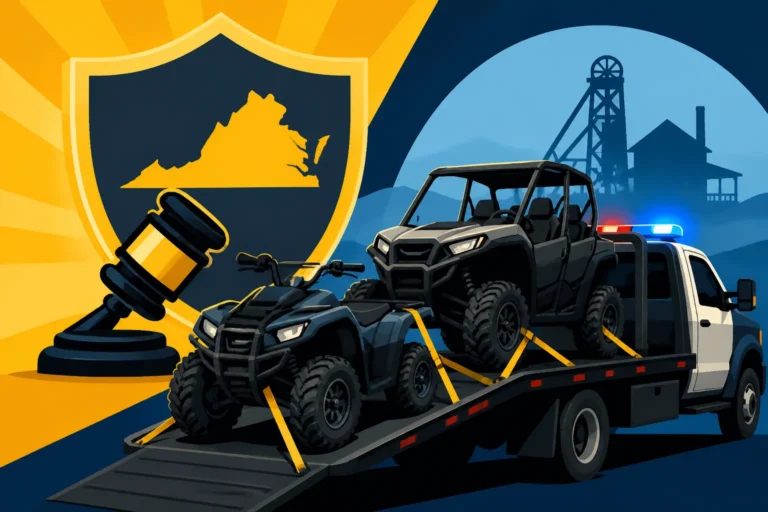
Beyond the financial penalty, one of the most immediate and distressing consequences of illegal road riding is the impoundment of your ATV or UTV. Local law enforcement has the clear authority to seize and tow any off-road vehicle found operating unlawfully on a public highway. Imagine being pulled over and then watching your expensive machine being loaded onto a tow truck – it's a major disruption to your day and an emotional blow.
Retrieving an impounded ATV or UTV is neither simple nor cheap. You will be responsible for a series of escalating costs, including:
- Towing Fees: The initial charge for transporting your ATV from the roadside to an impound facility.
- Storage Fees: Daily fees for keeping your machine at the impound lot, which can accrue rapidly, adding hundreds of dollars to your bill over just a few days.
- Administrative Fees: Additional charges levied by the impounding agency or the court for processing the paperwork required to release your vehicle.
These cumulative costs can easily amount to thousands of dollars, on top of any fines incurred. The inconvenience, stress, and logistical challenges of reclaiming your impounded machine can turn a fun day of riding into an absolute nightmare. For more on this, refer to [Getting an Impounded ATV Back From a City].
Insurance and Liability Implications
Perhaps the most devastating long-term consequence of illegal road riding relates to insurance and personal liability. While [Virginia Requires No ATV Insurance], many responsible riders choose to carry comprehensive policies for their machines. However, if you are involved in an accident while operating your ATV on a public road where it is legally prohibited, your insurance provider may deny coverage. Insurance policies often contain clauses that exclude coverage for incidents occurring during illegal activities or uses outside the vehicle's intended purpose.
Without insurance coverage, you could be held personally liable for:
- Property Damage: The full cost of repairs or replacement for any other vehicles, private property, or public infrastructure damaged in the accident. These costs can quickly soar into tens of thousands of dollars.
- Medical Expenses: The medical bills for anyone injured in the accident, including yourself, any passengers, or individuals in other vehicles. Serious injuries can lead to medical costs that run into hundreds of thousands or even millions of dollars.
- Legal Fees: The expense of hiring an attorney to defend yourself in a civil lawsuit, even if you believe you were not at fault.
The potential for financial ruin from an uninsured accident on a public road is an immense risk. The peace of mind offered by an off-road insurance policy is invaluable, but its protection hinges on operating your machine legally. While aftermarket products from SuperATV can enhance your machine's capabilities, they offer no legal shield from the consequences of illegal road operation.
What About Utility Vehicles (UTVs) and Side-by-Sides?
There's often confusion about whether UTVs or side-by-sides (SxS) have different road rules than traditional ATVs. Given their typically larger size, steering wheels, and seatbelts, many assume these machines are closer to street-legal vehicles. Unfortunately, for most general road use in Virginia, UTVs and side-by-sides face the same restrictions as ATVs, with the same limited exceptions.
Virginia's UTV Definition and Road Legality
Virginia law defines a "utility vehicle" (which encompasses most side-by-sides) with characteristics similar to ATVs, but with key differences:
- Designed for off-road use.
- Equipped with four or more wheels.
- Has a width of 50 inches or more (this is a primary differentiator from ATVs, which are 50 inches or less).
- Steered with a steering wheel.
- Features side-by-side seating for two or more persons.
- Is not classified as a golf cart.
Crucially, like ATVs, the defining characteristic is "designed for off-road use." Despite their car-like amenities, UTVs are not generally classified as "motor vehicles" for public highway use under Virginia law in the same way cars, trucks, or motorcycles are. Therefore, they are subject to the same general prohibition against operation on public roads. This means your Polaris RZR, Can-Am Defender, or similar side-by-side cannot typically be driven down a state route for errands. The exceptions for farm use, emergency services, limited crossings, and the designated coalfield routes apply equally to UTVs as they do to ATVs. If you're looking into the paperwork side of things, [Titling a Side-by-Side in Virginia] might offer some clarity, and [Why Your Side-by-Side Counts as an ATV] further explains the classification.
Aftermarket Modifications and Their Limits
It's a common misconception that by outfitting your ATV or UTV with certain aftermarket accessories, you can legally make it street-legal in Virginia. Many riders consider adding items like turn signals, proper rearview mirrors, a horn, a windshield, or DOT-approved tires. While these modifications can certainly enhance safety and usability off-road, and might even be required for limited road use in some other states, they absolutely do not change the fundamental classification of your ATV or UTV in Virginia.
Virginia's legal framework for ATVs and UTVs is based on the vehicle's original design and its statutory definition, not on added accessories. You could install every conceivable street-oriented accessory – a full cab, wipers, even an advanced lighting system and a rugged lift kit from a company like SuperATV – and your machine would still not be considered street-legal for general road use in Virginia. The law looks at the core identity and intended purpose of the vehicle, not just its customizable features.
Dirt Bikes and Street-Legal Conversions
It's important to distinguish ATVs and UTVs from dirt bikes, as Virginia offers a specific, though limited, pathway for converting certain off-road motorcycles (dirt bikes) into street-legal machines. This process involves meeting stringent equipment requirements, passing specific inspections, and obtaining a special "converted off-road motorcycle" title and registration. [Virginia Dirt Bike Conversion Rules] outlines this detailed procedure.
However, this option is exclusively for dirt bikes and does not extend to ATVs or UTVs. Currently, there is no equivalent legal process in Virginia to convert an ATV or utility vehicle into a street-legal machine for general public road use. This distinction is vital for anyone considering purchasing an off-road vehicle with the hope of eventually riding it on public roads. If your goal is a street-legal, off-road capable machine, a converted dirt bike might be an option, but an ATV or UTV is not.
To help clarify the differences between these types of vehicles regarding road legality in Virginia, here's a comparative table:
| Feature/Condition | ATV (All-Terrain Vehicle) | UTV (Utility Vehicle/Side-by-Side) | Converted Dirt Bike (Off-Road Motorcycle) |
|---|---|---|---|
| Designed for | Off-road use | Off-road use | Off-road use (originally) |
| Wheels | 3 or more | 4 or more | 2 |
| Steering | Handlebars | Steering wheel | Handlebars |
| Seating | Straddle (single operator) | Side-by-side (2+ persons) | Straddle (single operator, sometimes passenger) |
| General Road Legal? | No | No | Yes (after successful conversion & registration) |
| Farm Use Exception | Yes (under strict agricultural purposes) | Yes (under strict agricultural purposes) | N/A (farm motorcycles handled differently) |
| Emergency Use Exception | Yes (for official duties) | Yes (for official duties) | Yes (as motorcycles for official duties) |
| Limited Highway Crossing | Yes (under strict, direct, 90-degree conditions) | Yes (under strict, direct, 90-degree conditions) | Yes (as motorcycles, observing road rules) |
| Coalfield Routes | Yes (Buchanan & Tazewell only, designated & signed) | Yes (Buchanan & Tazewell only, designated & signed) | Yes (as motorcycles, observing special rules) |
| Street-Legal Conversion | No | No | Yes (with specific state process & inspection) |
| Virginia Title Required? | Yes, if bought new after July 2006, or if a lender requires | Yes, if bought new after July 2006, or if a lender requires | Yes, for conversion and all registered motorcycles |
This comprehensive table should clearly illustrate the legal landscape for different off-road machines in Virginia. It's evident that for general road use, ATVs and UTVs are largely excluded, with only very specific, limited exceptions applying. Always prioritize safety and legal compliance to ensure your riding experience remains enjoyable and free from unforeseen troubles.
Disclaimer
This article is for general informational purposes only and does not constitute professional advice. Laws, prices and regulations vary by location and change over time. Consult a qualified professional for guidance on your specific situation.