Winches for a Steep Coalfield Climb
A steep climb in Virginia’s coalfields can turn from a fun challenge into a stuck machine surprisingly quickly. Loose rock, slick clay, and a narrow trail leave little room to improvise. This guide explains how to choose and use an ATV or UTV winch more safely, prepare a recovery kit, and make better decisions before attempting a difficult climb.
Choose a Winch That Fits Your Machine and the Terrain
A winch is useful only if it can handle the load and you can operate it safely. Engine size alone doesn’t tell you what to buy: a utility ATV carrying gear, a two-up machine, and a loaded four-seat UTV can have very different recovery needs.
Match the winch to the fully loaded machine
Start with the machine’s weight, then account for the people, fuel, accessories, cargo, and other equipment you carry on a ride. A common sizing guideline is to choose a winch rated for at least 1.5 times the machine’s fully loaded weight. Treat that as a starting point, not a substitute for the winch and vehicle manufacturers’ instructions.
A winch’s published rating is not a promise that it can pull any load in every situation. Pulling capacity can change as more rope winds onto the drum, and a steep, muddy, or obstructed pull may demand far more effort than moving a machine on level ground. When in doubt, check the winch maker’s specifications and ask a qualified installer to confirm that the winch, mounting plate, bumper, wiring, and battery are suitable for your machine.
The difference between an ATV and a UTV matters, too. A side-by-side may be substantially heavier than a small quad, particularly with passengers and cargo aboard. Choose equipment based on the actual machine and its loaded condition—not simply on what fit a previous vehicle. For trail and vehicle considerations, see Virginia Trails That Allow Side-by-Sides.
Understand the recovery equipment you’re buying
A complete setup includes more than a winch. You may need a compatible mounting plate, a suitable electrical connection, a winch line, gloves, a tree-saver strap, and rated connectors. A snatch block can help redirect a pull or reduce the load on the winch when used correctly, but it also changes the forces on the anchor and recovery equipment. Read its rating and instructions before relying on it.
Winch lines are generally either steel cable or synthetic rope. Steel cable is durable but can develop sharp broken strands, so gloves are essential whenever you handle it. Synthetic rope is lighter and easier to handle, but it needs protection from abrasion, sharp edges, heat, and contamination. Either type needs regular inspection and proper care.
Before buying, check that the mounting hardware is designed for your specific machine. A winch bolted to a weak or unsuitable mount can damage the vehicle during a hard pull. If you’re also preparing for rough surfaces, Skid Plates for Coalfield Ledge and Tires for Appalachian Rock cover other parts of a practical trail setup.
Compare the basics before you purchase
| What to check | Why it matters | What to do |
|---|---|---|
| Rated capacity | A machine’s weight increases with passengers, fuel, and cargo | Use the loaded weight and manufacturer guidance to size the winch |
| Mount and fit | A poor fit can damage the machine or prevent safe operation | Confirm compatibility with your make, model, and mounting plate |
| Winch line | Steel and synthetic lines need different handling and care | Choose a line you can inspect, maintain, and handle properly |
| Controls | You need to control the pull without standing in a hazardous position | Learn the control setup and follow the manufacturer’s directions |
| Recovery accessories | Straps, connectors, and blocks must be appropriate for the load | Check each item’s rating and condition before the ride |
| Electrical system | A winch draws power from the vehicle | Have the wiring and battery setup checked for compatibility |
Prepare Before You Reach a Difficult Climb
Good recovery planning starts well before a wheel spins. A winch can help with a controlled recovery, but it cannot turn an unsafe line into a safe one or make every trail passable.
Assess the route, not just the hill
A steep section may look manageable from the bottom, but the approach and exit can matter just as much. Look for loose rock, ruts, water, unstable edges, blind turns, and places where the machine could slide sideways. Consider whether there is enough room to stop, reposition, or turn around without putting the vehicle or another rider at risk.
Check the route’s current access rules, closures, and machine restrictions before hauling to the trailhead. Conditions can change after heavy rain, and a route that is open to one type of machine may not suit another. Planning resources such as Virginia Trail Conditions Before You Haul, Virginia Trail Difficulty Ratings, and Virginia Trail Closures After Rain can help you build a more informed plan.
A map can help you understand where a trail goes, but it doesn’t tell you whether a specific slope is safe to climb on the day you arrive. If you use onX Offroad for route planning, download the information you’ll need before entering areas with weak or no cell service, and confirm that your planned route is authorized. It can be useful to compare your intended route with local signage and trail information rather than treating a map line as permission to ride.
Pack for recovery before the ride
A winch is only one piece of a recovery kit. At a minimum, think through the equipment needed to attach the line safely, protect a suitable anchor, and keep people clear of the pull. Pack sturdy gloves and inspect your recovery gear before each ride. A damaged strap, bent connector, frayed rope, or compromised cable is not something to discover halfway up a hill.
Carry basic tools and supplies for the machine as well. A small shovel may help clear loose material from around a tire, while a tire repair kit and first-aid supplies can be useful if a ride takes longer than expected. The right kit depends on the route, group, machine, and rider experience. See First Aid on a Long Coalfield Loop and Packing for Mountain Weather when preparing for a longer day.
Don’t depend on phone coverage to ask for help. Coalfield routes can include dead zones, so save useful map information offline and tell someone where you’re riding and when you expect to return. Cell Dead Zones in the Coalfields and Carrying a Paper Map in the Coalfields offer practical planning ideas. If you use onX Offroad, check your saved maps before leaving service rather than assuming a map will load once you’re already out of coverage.
Decide whether to climb before committing
Stop and assess the slope before driving into it. Ask whether the surface is firm enough for traction, whether the machine can turn around if the attempt fails, and whether a recovery point is available if it gets stuck. If the line looks beyond the capability of the machine or the group, choose another route. Walking away from a questionable climb is often the best recovery decision of the day.
Keep the group organized. Riders should know who is operating the winch, where everyone else should stand, and how to communicate if the machine starts moving unexpectedly. Avoid crowding the vehicle or standing downhill from it. If a climb requires people to stand in a dangerous place to guide the attempt, that’s a strong reason to stop and reassess.
Use the Winch With a Deliberate Recovery Plan
A winch recovery involves a vehicle, a line under tension, an anchor, and people nearby. Every part of that system matters. If you’re unsure about the anchor, equipment, or direction of pull, don’t proceed just because the winch is installed.
Choose a sound anchor and a clean line
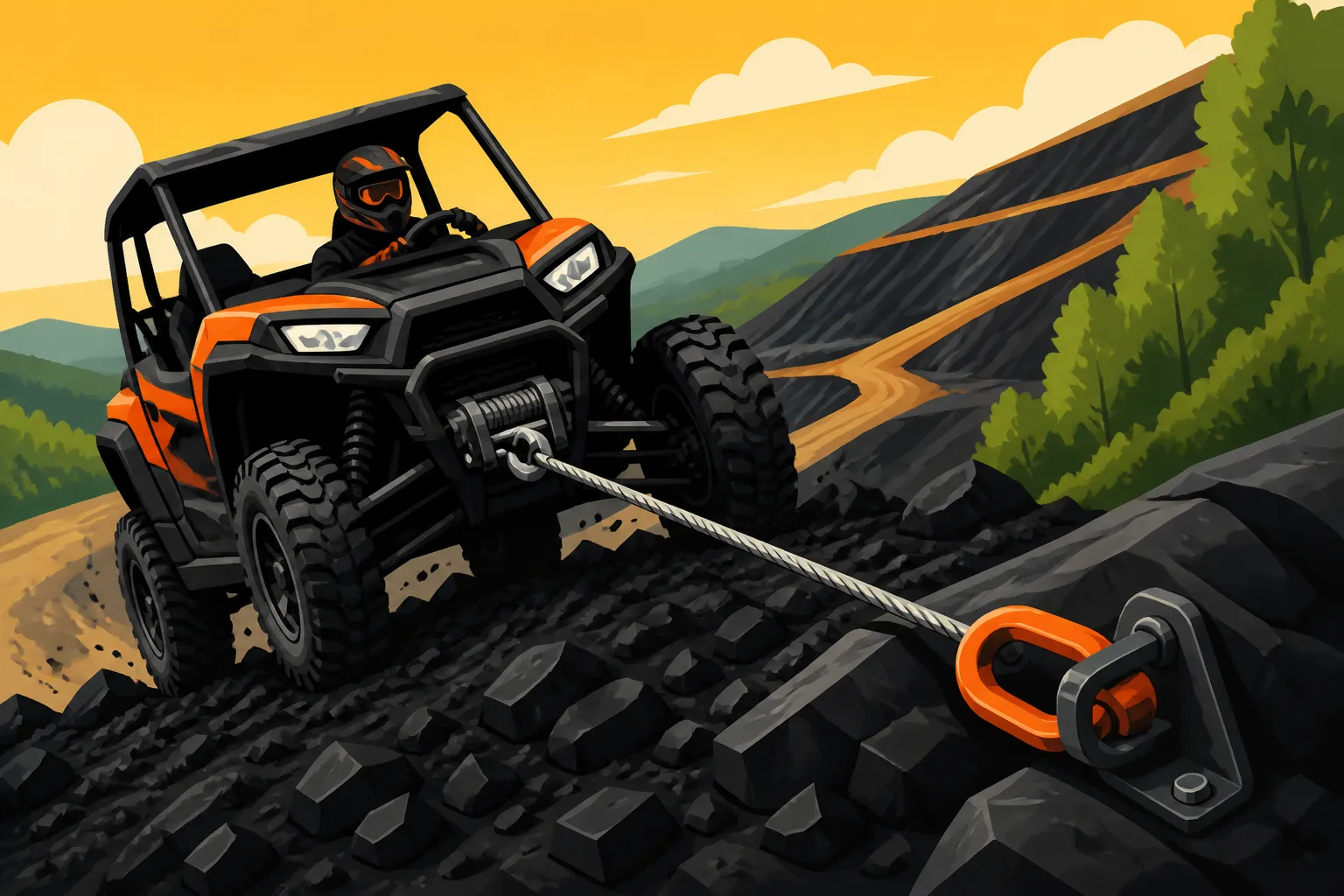
Use only an anchor that is appropriate for the load and that you can assess confidently. A suitable tree, when one is available and permitted, should be protected with a tree-saver strap rather than having the winch line wrapped directly around its trunk. Avoid using a tow ball or improvised attachment as a recovery point. Use the recovery points specified for your machine and the connecting hardware designed for the job.
Plan the line so it doesn’t run over sharp rock, pinch against the machine, or pull at an angle that could make the vehicle slide sideways. Keep the line as straight as practical, and check that the machine is stable before applying tension. If you use a snatch block, follow its instructions and account for the changed forces on the anchor and connections. More equipment does not automatically mean a safer recovery.
Before pulling, have everyone move well away from the line and the machine. Don’t step over a tensioned line or stand where it could strike you if something fails. Use a recovery dampener if your equipment instructions call for one, and never handle a line under tension. The winch operator should be able to stop the pull immediately if the machine shifts, the anchor moves, or the line begins to bind.
Keep the pull controlled and stop when conditions change
Follow the winch manufacturer’s operating instructions, including guidance about the motor, line, and duty cycle. Use steady, controlled pulls rather than repeatedly yanking at the load. If the line is winding unevenly, the machine is shifting, or the anchor looks unstable, stop and reassess. Continuing to pull can damage equipment or cause the vehicle to move in an unpredictable direction.
A winch may help reposition a machine, but it should not be used to drag riders or pull a person. Keep hands clear of the fairlead and drum, and don’t try to guide the line while the winch is moving. The operator should use the controls from a position that does not place them in the line of pull or beside a likely vehicle path.
After the machine is free, don’t rush straight into the next obstacle. Inspect the line, mount, connectors, and anchor strap. Look for damage, heat, unusual noise, or signs that the pull overloaded something. If the machine is still on a steep grade, secure it and decide how to move it to safer ground before disconnecting the recovery setup.
Know when a winch is not enough
Some conditions call for a different response. A machine sliding toward an edge, a damaged mount, an unstable anchor, a badly tangled line, or a recovery that would put people in the vehicle’s path may be too risky to attempt with the equipment on hand. A winch does not remove the danger of a rollover or prevent a machine from sliding sideways.
If the recovery requires a second machine, make sure the added vehicle has a safe position and an appropriate recovery point. Don’t attach a line to an unapproved part of another ATV or UTV, and don’t place people between two machines under tension. If you cannot clearly explain where the pull will go and how both machines will remain stable, pause and seek help from someone with the right equipment and experience.
Respect posted rules, landowner instructions, and trail closures while choosing a recovery route. Virginia Trail Etiquette Locals Expect is a useful reminder that safe riding includes looking after the trail and the people who use it—not just getting your own machine moving again.
Maintain the Winch and Make Better Trail Decisions
A winch that worked last season may not be ready for the next ride. Regular checks help catch damage before you’re depending on the equipment on a steep slope.
Inspect the winch before and after riding
Check the winch line from end to end for fraying, cuts, flattened sections, broken cable strands, or other damage. Inspect the hook or connector, fairlead, mounting hardware, controls, and visible wiring. If you find damage, follow the manufacturer’s guidance and replace or repair the affected part before relying on it.
After a muddy or wet ride, clean and maintain the line according to the winch maker’s instructions. Synthetic rope and steel cable need different care, so don’t assume one maintenance routine works for both. Store recovery straps and connectors so they aren’t left wet, contaminated, or exposed to damage between rides.
Testing the winch in a controlled setting can help you confirm that the controls and line work as expected. Do this before a difficult ride, following the manufacturer’s directions, and keep people clear of the line. A brief check in a safe area is far better than learning that a control is faulty when the machine is stuck on a slope.
Practice before you need the equipment
If you have never used a winch, practice with an experienced person in a flat, open area. Learn how to spool the line evenly, attach it to an approved recovery point, connect an anchor strap, and communicate with other riders. Practice the stop procedure, too. Everyone in the group should know what to do if the vehicle shifts or the pull needs to end.
Practice can also reveal gaps in your kit. Maybe your gloves are difficult to use with the controls, your strap is too short for the anchors you may encounter, or your recovery points are hard to access. Discovering that at home is much less stressful than discovering it on a narrow trail.
If you use onX Offroad or another mapping tool to plan a ride, use it as one part of preparation: review the route, save the information you’ll need offline, and verify access before you depart. A map cannot judge traction or anchor stability from the screen, so make the on-the-ground assessment before each climb.
Let the trail condition guide the decision
Coalfield riding can involve changing surfaces and sharp grades, and the same trail may feel very different after rain or heavy use. A winch might help recover a machine that has lost traction, but it is not a reason to attempt a climb that is beyond your group’s ability. A safer route, a turnaround, or a decision to wait for better conditions may be the most sensible choice.
Before heading out, review local access details and consider whether the route fits your machine, passengers, and experience. For more planning context, see Virginia Spearhead Trail Permits and Virginia Trail Difficulty Ratings. On the trail, follow posted directions, give other riders room, and avoid blocking a route while you work through a recovery.
Disclaimer
This article is for general informational purposes only and does not constitute professional advice. Laws, prices and regulations vary by location and change over time. Consult a qualified professional for guidance on your specific situation.