Virginia Trail Etiquette Locals Expect
A ride can go sideways before the engine even starts: a trail may be muddy, a gate may be closed, or a faster group may come around a blind mountain corner. Good Virginia trail etiquette helps prevent damage, conflict, and avoidable close calls. This guide covers how to prepare, share narrow routes, protect the land, and leave a trailhead in better shape than you found it.
Before You Ride, Learn the Trail’s Rules
Confirm that the route is open and suitable
Virginia riding areas do not all operate under the same rules. A route may be part of a managed trail system, a national forest, a private park, or land where access depends on permission. Rules can differ for permitted areas, vehicle types, age limits, hours, and seasonal closures. Don’t assume that because a route appears on a map, it is open to your machine today.
Before loading up, check the riding area’s own information for closures, weather-related changes, permitted vehicle widths, and any required permits. This is especially important if you’re driving to an unfamiliar trailhead or planning a long day in the Appalachian mountains. A quick check of [Virginia Trail Closures and Seasons] and [Virginia Trail Conditions Before You Haul] can help you plan for conditions that affect the ride itself—not just the drive there.
Map apps such as onX Offroad can help you understand where a route appears to go and plan a general itinerary. Treat any app as a planning aid, not proof that a trail is open or that you have permission to ride it. Compare the route with current information from the land manager, and follow posted signs and barriers on the ground. When directions, an app, and a sign seem to disagree, don’t ride through the gate to find out which one is right.
Match the route to your group and machine
A trail that looks manageable on a screen may feel very different when it narrows, climbs over loose rock, or crosses a muddy section. Check the route’s difficulty guidance before setting out, then make an honest assessment of your experience, tires, ground clearance, and recovery gear. [Virginia Trail Difficulty Ratings] is a useful topic to review when choosing a ride that fits your group.
Talk through the plan before leaving the staging area. Agree on a destination, regrouping spots, and what you’ll do if someone gets separated or has a mechanical problem. Keep the least experienced rider in mind when choosing the route and pace. If the group includes first-time riders, a short, familiar loop may make for a better day than a long route with difficult climbs and few easy turnarounds.
| Before the ride | Why it matters | A good habit |
|---|---|---|
| Check the land manager’s updates | Routes can close or have vehicle-specific rules | Confirm access shortly before departure |
| Review vehicle and permit requirements | Not every machine is allowed on every route | Match your machine to the posted rules |
| Look at the difficulty and conditions | Mud, rocks, and grades can change the ride | Choose for the least experienced rider |
| Set a group plan | Riders may lose sight of each other | Pick regrouping points and a turnaround plan |
| Carry navigation and essentials | Mountain terrain can limit cell service | Save route information and carry a backup |
Share the Trail With Patience and Awareness
Slow down where visibility is limited
Virginia’s wooded trails and mountain routes can have blind corners, steep grades, loose gravel, and narrow sections. A speed that feels comfortable on an open stretch may be unsafe as you approach a bend, crest, gate, or intersection. Ease off early enough to stop within the distance you can see, and be ready for another rider, a hiker, an animal, or a work vehicle around the corner.
Dust is another reason to leave room. If you can’t see the rider ahead clearly, you’re too close. Back off until the dust settles, especially on dry gravel roads and exposed stretches. Passing too closely can make it harder for the person ahead to see, hear, or react to hazards. Keep your speed controlled near trailheads, campsites, homes, and places where people may be walking.
Navigation can help you anticipate junctions and stay oriented, but it doesn’t replace watching the trail. onX Offroad may be useful for following a planned route, yet riders should still slow down at intersections and check signs rather than turning automatically because a screen shows a line continuing ahead. A route line is not a signal that every connected track is open.
Communicate clearly and make room
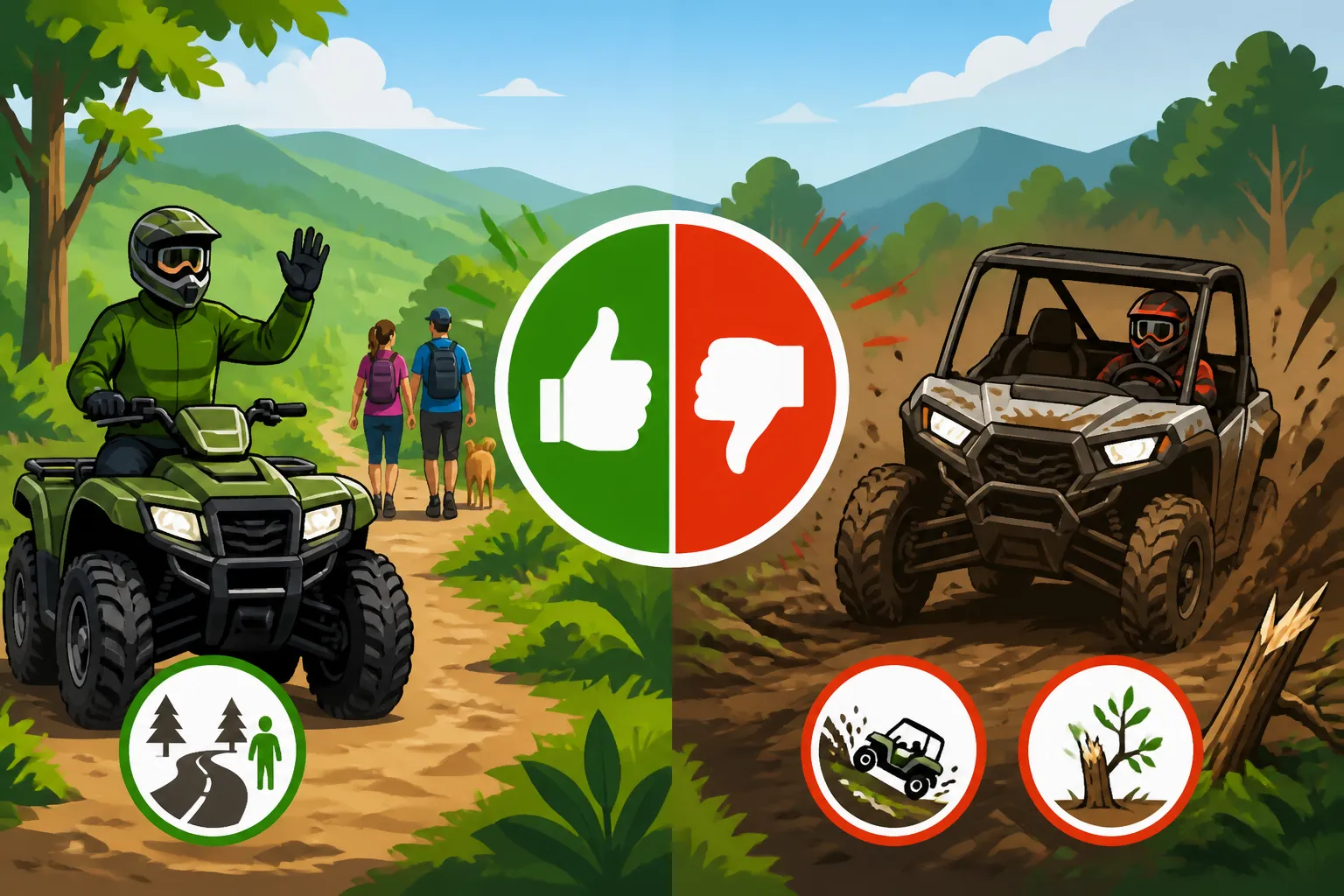
On narrow trails, a little courtesy can prevent a tense encounter. If you meet another group, slow down, make eye contact where possible, and communicate calmly about who will move and where. Avoid revving aggressively or crowding someone while they look for a safe place to pull over. Where a route is too narrow for a comfortable pass, wait for a wider spot rather than squeezing by at the edge of a drop, ditch, or unstable slope.
Common trail etiquette is to give uphill riders space when stopping or passing can be done safely, since restarting on a steep or loose grade may be difficult. But don’t treat a general courtesy as a rule that overrides posted instructions or immediate safety. Use judgment, communicate, and avoid forcing another rider into a risky position.
If your group is large, ride in a way that leaves space for others to pass or pull off. Keep the group together without stretching it into a long, dusty line. Agree in advance to stop at safe places after junctions, not in the middle of a narrow route where following riders and oncoming traffic may be surprised.
Protect the Land, Wildlife, and Nearby Communities
Stay on the designated route
Cutting a corner, riding around a mud puddle, or making a new bypass can widen a trail and damage vegetation. What looks like a small detour can become a second track that other riders follow, increasing erosion and making the original route harder to maintain. If a section is muddy or rutted, don’t create a new path around it unless the land manager has marked an approved bypass.
Use designated routes and respect signs, gates, and barriers. Never assume that an unmarked road, timber track, power-line cut, or path beside a trail is available for riding. Access may depend on ownership and permission. If you’re unsure, stop and verify rather than crossing onto land because the route looks connected.
onX Offroad can help riders review mapped routes before they arrive, which is useful when planning where to turn around or regroup. Still, an app cannot grant access or interpret every current closure. Check the land manager’s information and obey on-site signs. For more on the importance of route conditions and closures, see [Virginia Trail Closures After Rain].
Keep noise, trash, and camp areas in mind
A riding area is often close to homes, campsites, working land, or other recreation. Avoid unnecessary revving, especially early or late in the day, and use a muffler that is in good working order. Don’t block gates, access roads, or parking areas while unloading. If the staging area is busy, unload efficiently and move your truck and trailer so others can use the space.
Pack out everything you bring in, including food scraps, drink containers, broken parts, and zip ties. A small piece of litter can become a larger cleanup problem, and leaving trash can affect access for everyone. Keep campfires and other activities within the rules of the site, and don’t assume that a place beside the trail is an approved camping spot.
If you see a maintenance issue, such as a fallen tree or damaged sign, don’t make a risky repair or move a barrier yourself. Note the location as accurately as you can and report it to the appropriate land manager or trail office. Local trail groups and volunteers also help keep riding areas usable; [Virginia Trail Volunteer Days] explains why that work matters. A considerate rider can support those efforts by following closures and leaving work zones undisturbed.
Make Group Rides Safer and More Enjoyable
Set expectations before the group rolls out
A group ride goes more smoothly when everyone knows the plan. Before starting, share the route, estimated ride length, planned breaks, and any sections that may be challenging. Make sure each rider knows who is leading and who is sweeping at the back. The lead rider should avoid pushing the pace beyond what the group can safely handle; the sweep rider should let the leader know if someone needs to stop.
Choose regrouping points that are visible and out of the way, such as a wide pull-off rather than a blind bend. Ask riders not to leave a junction until the group behind has caught up or has been clearly directed. If someone takes a wrong turn, stopping at the next safe point is usually better than having the whole group scatter in different directions.
For a larger outing, planning deserves extra attention. [Virginia Group Ride Planning] can help you think through the logistics, while [Virginia Trailhead Parking With Trailer Space] is relevant when your group needs room to unload and stage vehicles. Before departure, tell someone outside the ride where you’re going and when you expect to return, particularly where cell coverage may be limited.
Handle breakdowns, delays, and trail conflicts calmly
A breakdown can be frustrating, especially when the group is far from the trailhead. Move the machine only if it’s safe to do so, and avoid blocking the route or placing riders in a blind corner. Let the group know what’s happening, keep people clear of traffic, and use your pre-agreed plan to decide whether anyone should go for help. Don’t leave a rider alone without checking that they have what they need and understand the plan.
When a disagreement happens—about who should yield, whether a route is open, or how quickly a group is moving—keep the conversation calm and brief. Don’t turn a trail encounter into a confrontation. If the issue involves a closure, a damaged route, or a serious safety concern, follow the land manager’s reporting process rather than trying to settle it on the trail.
Finally, leave the staging area orderly. Load without blocking other vehicles, gather trash, and check that no gear has fallen from a trailer. A courteous departure matters just as much as courteous riding: trail access depends on riders showing respect for other users, land managers, volunteers, and nearby communities.
Disclaimer
This article is for general informational purposes only and does not constitute professional advice. Laws, prices and regulations vary by location and change over time. Consult a qualified professional for guidance on your specific situation.