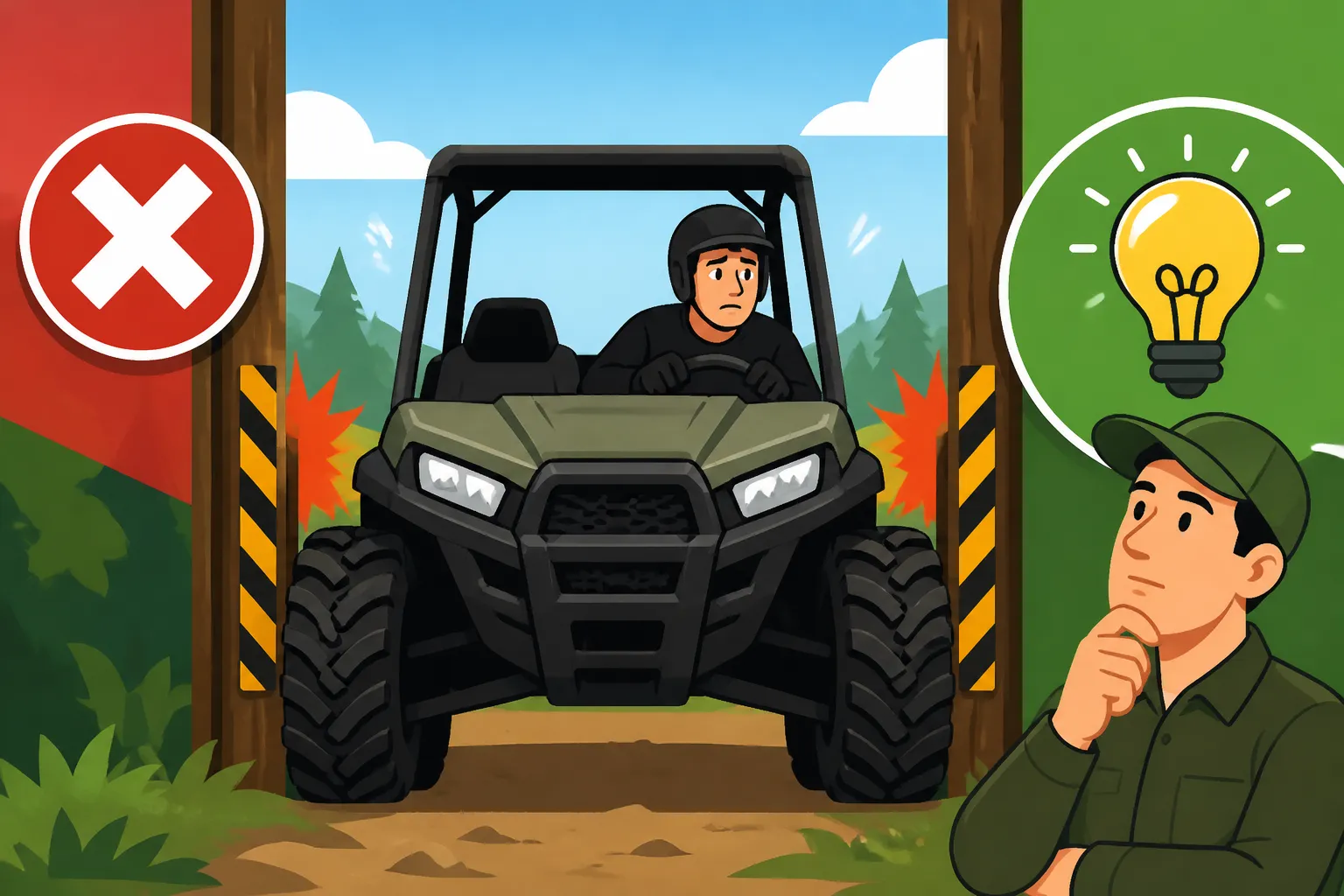
What to Do When Your Machine Is Too Wide
A machine that is too wide for a Virginia trail can turn a planned ride into a wasted haul. The fix is to check the trail’s vehicle limit before you leave, measure the ATV or UTV as it is actually equipped, and choose a route that accepts it. A permit alone does not make an oversized machine eligible.
Check the trail’s width limit before planning the ride
Trail access depends on the rules for the specific trail system, not simply on whether a machine is an ATV or UTV. Some trails have a firm maximum width. For South Pedlar, the Forest Service requires permitted vehicles to be less than 50 inches wide and no heavier than 1,500 pounds unloaded dry weight. A vehicle that measures exactly 50 inches does not meet the “less than 50 inches” rule.
That limit applies to the vehicle you bring, not just the model name on its paperwork. A machine described as trail-ready may still be too wide once you account for its tires, wheels, spacers, or installed accessories. If you are considering a side-by-side, do not assume it qualifies because it can travel off-road. Check its actual width against the rules for your intended route. Virginia Trails That Allow Side-by-Sides can help you focus on that question.
The South Pedlar ATV Trail System is a 19-mile network designed for recreational ATV riders, according to the Forest Service. That does not make it suitable for every machine. Its width and weight restrictions are eligibility rules, not suggestions about how carefully to ride.
| What to check | Why it matters |
|---|---|
| Trail system’s vehicle-width rule | A machine over the limit may not be allowed on the system |
| Width of your equipped machine | Tires and installed parts can change the overall measurement |
| Unloaded dry weight, if specified | South Pedlar has a separate weight limit |
| Permit and purchase arrangements | A required permit does not override vehicle restrictions |
| Current access information | Closures or rule changes can affect a trip |
If a trail page is unclear about how width is measured, ask the responsible ranger district or trail contact before you travel. In particular, confirm whether the system uses a manufacturer’s stated width or a measurement across the widest point of the equipped machine. Do not guess based on a catalog description when a few inches could determine whether you can ride.
Also distinguish between “the trail permits ATVs” and “this trail permits my ATV.” Those are different questions. The first describes a general type of use; the second depends on the specific system’s limits, vehicle rules, and any conditions for that particular route. For other systems, use current trail-specific information rather than assuming that a limit from South Pedlar applies everywhere—or that another system has no limit. The Virginia ATV Trail Map Downloads and Virginia Trails That Allow Full-Size Rigs are useful starting points for narrowing your options, but verify the rules for the destination before loading up.
Measure the machine in the condition you plan to ride it
A width check is most useful when it reflects the vehicle you are actually taking. Start with the owner’s manual or manufacturer specifications, but treat those figures as a starting point. The published dimension may not include every tire, wheel, spacer, or accessory fitted to your machine.
For a practical pre-trip check:
- Park the machine on level ground and make sure it is in the same general configuration you intend to ride.
- Identify the parts that extend farthest on each side. Depending on the setup, those may be the tires, wheels, fenders, or installed accessories.
- Measure across the machine at its widest point. Keep the measuring tape straight and note where each end of the measurement touches.
- Repeat the measurement to check for a simple positioning error. If the result is close to a trail’s limit, do not rely on rounding down.
- Compare the result with the trail’s stated rule and ask the trail manager how it defines vehicle width if the measurement method is not clear.
A basic tape measure from a hardware store or Amazon can help with a home check. The important part is not the brand of tool; it is measuring the same widest points the trail authority uses. If the official method is not published, ask before you set off rather than treating your own measurement as an official inspection.
Make a note of the machine’s configuration when you measure it. If you later change tires, wheels, spacers, or other parts that affect the vehicle’s overall width, measure again. A spec sheet from when the machine was new may no longer describe the machine in your garage.
Do not try to make a close fit work by driving along the edge of a trail, squeezing past a barrier, or using an unmarked route. Forest Service rules limit off-highway vehicles to areas, roads, and trails designated as open to OHVs. Leaving the designated route to get around a restriction is not a workaround; it can take you outside the area authorized for motorized use.
If the machine’s width is near the published limit, ask the trail contact two direct questions: what measurement method applies, and whether the vehicle configuration you have described is allowed. Be ready to provide the machine’s make and model and the dimensions you measured. Getting a clear answer before the trip is more useful than hoping a gate or trailhead check will accept a borderline measurement.
If the machine is too wide, pick a different solution
If your machine exceeds a trail’s limit, the safest practical choice is to leave it off that system. Do not expect a permit, careful riding, or another rider’s smaller vehicle to make it eligible. Instead, look for a destination whose written rules allow your machine’s dimensions and type.
That may mean finding a different trail system, using a private riding area whose rules fit the machine, or choosing a smaller vehicle for the planned trip. For a side-by-side, check both width restrictions and any separate requirements for equipment or passengers. Virginia Forest Equipment Requirements and Virginia Rules for a Side-by-Side Driver are relevant places to continue your planning, but the destination’s own rules remain the key check.
Avoid removing a component or changing the setup just to get below a limit unless the change is safe, appropriate for the machine, and allowed by the trail authority. A measurement that barely meets a posted threshold may leave little room for a mistaken reading, and trail conditions can make a narrow pass harder to manage. Ask the trail contact whether the measured configuration qualifies before relying on a close result.
It is also worth checking the route map and access details, not just the vehicle limit. The Forest Service says motorized use is permitted only on designated open roads, trails, and areas. Its Motor Vehicle Use Map shows National Forest roads, trails, and designated areas open to public motor vehicle use. A trail appearing on a general map does not necessarily mean every segment is open to every vehicle.
Virginia’s road rules are a separate issue from trail width. According to the Virginia General Assembly, all-terrain vehicles are generally prohibited on public highways and public property, subject to specific exceptions. A road or unpaved connector is not automatically a legal detour around a trail restriction. Check the rules that apply to the route itself; Can You Ride an ATV on the Road in Virginia? covers that distinction.
If you decide to leave the wide machine at home, do not assume you can borrow or rent another one at the trailhead. Confirm vehicle availability and the riding area’s rules in advance. If you transport a different machine, check its dimensions too—especially if it has aftermarket parts or a wider setup than the original specification.
Confirm permits and other rules before hauling
Vehicle eligibility and permits are separate checks. According to the USDA Forest Service, operators of specified vehicles on designated trails and roads within the Peters Mill Run/Taskers Gap OHV complex must possess and display a permit. That requirement does not establish that every vehicle will fit every trail system or satisfy its separate equipment limits.
South Pedlar also requires a permit for each ATV operator, according to the USDA Forest Service, Glenwood and Pedlar Ranger Districts. Permits are not sold on site there, so arrange one through an authorized local vendor before you arrive. Check the current purchase options and instructions in Virginia Forest Permit Purchase Options. Do not treat a permit purchased for one riding area as proof that a different area accepts your machine; confirm both the permit’s coverage and the destination’s vehicle rules.
Before you load, use a short checklist:
- Confirm that the trail is open and that your vehicle type is allowed.
- Check any width and weight limits against your measured, equipped machine.
- Find out how the trail authority measures width if your result is close.
- Confirm where to purchase the required permit and what it covers.
- Review the trail map so you know which routes are designated for motorized use.
- Check the riding hours and any other requirements that apply to the system.
- Recheck the setup if you have changed tires, wheels, spacers, or accessories since measuring.
At South Pedlar, trail users must also follow the system’s other operating requirements. For example, the Forest Service requires operators and riders to wear a DOT-approved protective motorcycle helmet, and prohibits carrying a passenger unless the ATV is manufactured for multiple passengers. Those rules do not change the width limit, but they are part of planning a compliant ride.
If a trail contact cannot confirm that your machine fits the stated rule, choose another destination rather than assuming you will be allowed through. A little checking at home can prevent an unnecessary drive, avoid a dispute at the trailhead, and keep your ride on designated routes that are appropriate for your vehicle.
Sources
- USDA Forest Service — George Washington and Jefferson National Forests | Recreation OHV Trail Permits | Forest Service (checked November 3, 2026)
- Virginia General Assembly — § 46.2-915.1. All-terrain vehicles and off-road motorcycles; penalty (checked November 3, 2026)
- Forest Service — George Washington and Jefferson National Forests | Peters Mill Run/Taskers Gap Trail System | Forest Service (checked November 3, 2026)
- Forest Service — George Washington and Jefferson National Forests | South Pedlar ATV Trail System | Forest Service (checked November 3, 2026)
- USDA Forest Service, Glenwood & Pedlar Ranger Districts — South%20Pedlar%20ATV%20Permit%20Order%20Form.pdf (checked November 3, 2026)
- Forest Service — George Washington and Jefferson National Forests | Off-Highway Vehicles (OHV) | Forest Service (checked November 3, 2026)
- Forest Service — George Washington and Jefferson National Forests | Back Creek Gorge (Forest Trail #516) | Forest Service (checked November 3, 2026)
Disclaimer
This article is for general informational purposes only and does not constitute professional advice. Laws, prices and regulations vary by location and change over time. Consult a qualified professional for guidance on your specific situation.