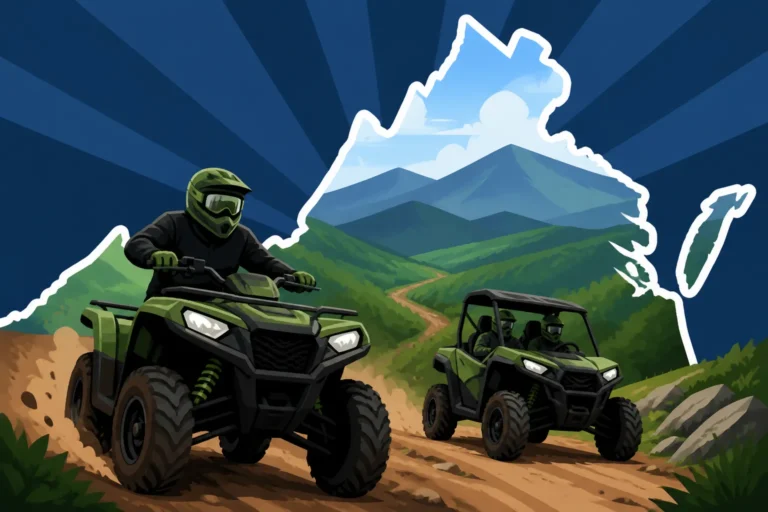
Virginia Trails That Allow Full-Size Rigs
A full-size side-by-side can turn a Virginia trail day into a frustrating dead end if the route is too narrow, the system excludes your machine, or you arrive without the right permit. The good news is that some Virginia riding areas accommodate larger rigs—but access depends on the specific trail, vehicle type, and current rules. This guide explains where to look and what to confirm before hauling out.
What “full-size rig” means on Virginia trails
“Full-size rig” is an informal term, not a universal trail category. One rider may mean a wide, two-seat side-by-side; another may mean a four-seat UTV, a Jeep, or a registered four-wheel-drive truck. That difference matters because a trail system can allow one type of vehicle without allowing the others.
Before planning a trip, check the machine’s width and the exact vehicle category the trail operator permits. A route that welcomes ATVs and some side-by-sides may still exclude a wider UTV. A route that allows Jeeps may have separate rules for side-by-sides, too.
Measure the machine, not just the advertised model
Look up the width of your exact machine, including any changes that could make it wider. Oversized tires, wheel spacers, aftermarket fenders, or other modifications can affect clearance. If you have a four-seat machine, do not assume its rules are the same as those for a two-seat model from the same manufacturer.
Width is only one part of the fit. A trail may have tight turns, steep ledges, narrow bridges, or obstacles that are difficult for a long or heavy vehicle, even when it meets a posted width limit. Think about wheelbase, turning room, ground clearance, and how confidently you can reverse or turn around on a narrow mountain route.
Separate side-by-sides from Jeeps and trucks
A trail system’s permission for “four-wheel drives” does not automatically mean every UTV can use every route. Likewise, a side-by-side being allowed on an ATV trail does not mean a full-size truck or Jeep is permitted. Look for rules that identify the vehicle class or describe the permitted routes, rather than relying on a general statement that the area is “open to off-road vehicles.”
This distinction is especially important around the Spearhead trail network in Southwest Virginia. Systems and routes can have different access rules, and some designated routes may serve vehicles that are not allowed throughout the network. Read [Virginia Systems That Allow Jeeps] and [Registered Trucks on One Side Only] before assuming a full-size four-wheel-drive vehicle can follow the same route as a UTV.
Virginia riding areas to investigate for larger machines
The strongest starting point for a full-size UTV trip is Southwest Virginia’s Spearhead trail network. Its systems connect to trail towns such as Grundy, Coeburn, and Richlands, but access is not a blanket yes for every rig on every route. Check the system map and the operator’s machine requirements for the specific ride you have in mind.
Virginia also has riding opportunities on private land and designated forest routes, but those areas can have very different width, equipment, and vehicle rules. A trail that works well for a compact quad is not necessarily a good choice for a wide side-by-side.
Start with the Spearhead systems in Southwest Virginia
Spearhead systems are worth investigating if you want a substantial trail outing near towns such as Grundy or Richlands. Before leaving home, identify the system, trailhead, and route you plan to ride, then check whether your exact machine is allowed. Do not rely on a friend’s experience from a different trail, a different system, or a previous season.
The route details matter as much as the system name. A marked route may have different restrictions from nearby trails, and trail connections can lead riders toward sections with different access rules. If you are planning with a mixed group—say, a two-seat UTV, a four-seat side-by-side, and a Jeep—confirm each vehicle separately. The page on [Virginia Trails That Allow Side-by-Sides] can help you think through that distinction, while [Jawbone at Richlands Lets Jeeps on the Trail] is useful background if your group includes a Jeep.
Use the official system information as your main reference. A mapping app such as onX Offroad can help you review route options and orient yourself, but a map display should not be treated as proof that a trail is open to your vehicle. Check the trail operator’s current access information before you ride, and keep a backup route in mind in case a connector or trail section is closed.
Treat National Forest routes as a separate category
Virginia’s National Forest riding opportunities are not a default option for full-size machines. Peters Mill Run and Taskers Gap, in the George Washington National Forest area, have specific vehicle requirements; Taskers Gap is known for a width limit that rules out many larger side-by-sides. A machine fitting the limit is not the only consideration, so check the current forest rules and route details before towing out.
Forest routes also have operating requirements that differ from a regional trail system or private park. Permits, equipment rules, seasonal closures, and sound requirements may apply. See [Virginia's Taskers Gap Width Limit] and [Virginia National Forest OHV Permits] when comparing these routes with Southwest Virginia options.
| Riding area or route type | Why it may suit a larger rig | What to confirm before you go |
|---|---|---|
| Spearhead systems in Southwest Virginia | Some routes and systems may accommodate larger off-road vehicles | Machine class, width, route-specific restrictions, permits, and closures |
| Designated routes open to Jeeps or registered four-wheel drives | May be relevant for a Jeep or truck-based off-road vehicle | Whether the permission applies to your specific vehicle and route |
| Peters Mill Run and Taskers Gap | A forest riding option, but with distinct requirements | Width limit, vehicle eligibility, permit, equipment rules, and seasonal access |
| Private off-road parks | The operator sets access rules and may offer routes for different vehicle sizes | Vehicle dimensions, reservation or waiver rules, trail difficulty, and current opening status |
This comparison is a planning aid, not an access guarantee. A site may change its rules or close a section, so confirm directly with the land manager or park before your trip.
Do not assume Virginia state parks allow ATVs
Virginia state parks are not a general substitute for an OHV trail system. Check the rules for the specific park and activity rather than expecting to unload a quad or side-by-side on a park road or trail. The overview [Virginia State Parks Ban ATVs] is a useful reminder to verify access before planning around a state park.
If a private park seems like a better fit for a wide machine, contact the operator with the make, model, width, and number of seats. Ask whether the park permits your vehicle class and whether the suitable routes are open. [Virginia Private Off-Road Parks] is a helpful next step when comparing managed riding locations.
How to confirm a route fits your machine
A little advance checking can save a long drive, a wasted permit purchase, or an uncomfortable argument at a trailhead. When calling or messaging a trail office, be specific: “Is this trail open to ATVs?” is less useful than “Is this named route open to a four-seat side-by-side that is this wide?”
Check these details before loading the trailer
Use this checklist before you leave:
- Confirm the vehicle class. Ask whether the route allows your specific kind of vehicle: ATV, side-by-side, Jeep, or registered four-wheel-drive truck.
- Confirm the machine’s width. Use the manufacturer’s specifications for your model and account for modifications.
- Ask about route-level limits. A system may contain trails with different widths or access rules.
- Check closures and seasonal restrictions. Weather, maintenance, or scheduled closures can change where you can ride.
- Verify permits and identification requirements. Confirm what you need to carry or show at the trailhead.
- Ask about equipment rules. Requirements may cover helmets, seatbelts, roll cages, lights, or other safety equipment.
- Confirm the trailhead and parking plan. A suitable route is no help if the staging area cannot accommodate your tow vehicle and trailer.
- Save a backup plan. Choose another permitted route or riding area in case your first choice is unavailable.
If you are using onX Offroad to explore possible routes, treat it as a navigation and planning aid rather than the final authority on access. Cross-check what you see against the land manager’s rules. Save the relevant map or route details before you enter an area where cell service may be unreliable.
Read maps carefully and watch for route boundaries
A trail map can help you understand how routes connect, where trailheads sit, and how far you may be from fuel or services. But map lines alone do not explain every restriction. A route can be shown on a map while being closed temporarily, limited to a particular vehicle type, or subject to a permit requirement.
Pay attention to where a route ends. A legal trail may meet a public road, private property, or a restricted section. Do not assume that a visible connection is an invitation to continue. Review [Virginia Trail Closures and Seasons] and [Virginia Trail Rules for Riders Under 18] if you are coordinating a trip with younger riders, and make sure the route and the people in your group meet the relevant requirements.
Plan for the whole group, not just the biggest machine
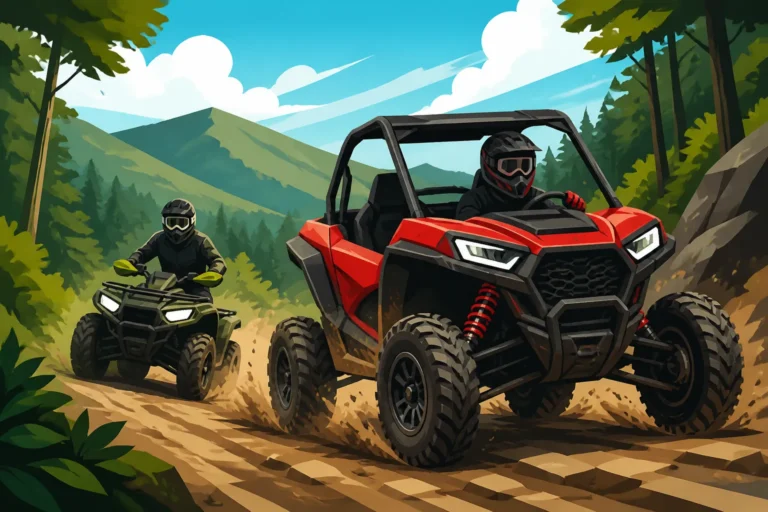
A ride can be technically open to a large side-by-side but still be a poor match for a group with different machines and experience levels. A narrow, rocky route may feel manageable to a skilled rider on a short ATV and stressful to a newer driver in a long four-seat UTV. Agree on a route that fits the least-capable machine and rider in the group.
Before the ride, discuss pace, spacing, hand signals, and what the group will do if someone has a mechanical issue. In remote areas, arrange a meeting point and carry navigation that does not depend on cell coverage. onX Offroad can be one tool for reviewing the route ahead of time, but it is still wise to carry a backup navigation option and know how to use it.
Common mistakes that strand full-size rigs
The most avoidable problem is treating “open to UTVs” as a promise that every UTV fits. It may refer to smaller machines, specific routes, or particular trail conditions. Confirm the machine’s dimensions and route eligibility together.
Another common mistake is planning around a trail name instead of a specific trail segment. One route can be wide enough while a connecting route is not. Ask where the permitted route begins and ends, and whether you can complete your intended loop without entering a restricted section.
Arriving without checking permits or closures
Permit rules differ between riding areas. A permit for one network does not necessarily cover another, and forest requirements are not automatically interchangeable with Spearhead requirements. Check the relevant details in [Virginia Spearhead Trail Permits] and [Virginia Forest Permit Purchase Options] before setting out.
Closures can also disrupt a carefully planned ride. Check for updates close to departure, especially after heavy rain or during a seasonal shutdown. If you are towing a large trailer from another part of Virginia, it is worth confirming access before the trip rather than trying to improvise at the trailhead.
Confusing public roads with off-road trails
An off-road trail map does not mean you can ride the machine on any nearby public road to reach another section. Virginia has specific restrictions on ATV use on public highways, with limited exceptions. Review [Virginia ATV Road Rules Under 46.2-915.1] and do not use a road connection unless it is clearly allowed for your situation.
If your route approaches a road, stop and check the rules instead of following the group ahead. The same caution applies to private roads, timber roads, and land beyond a trail boundary: access depends on the owner’s permission and the applicable rules.
Picking a route that is too demanding
A machine that fits through a trail does not automatically make the trail a sensible choice. A long wheelbase can make tight switchbacks harder. A heavy rig can be difficult to recover from a steep or muddy section. And a route that feels comfortable in dry weather may be much more challenging after rain.
Be honest about the driver’s experience and the machine’s setup. If the trail operator publishes difficulty ratings, read them before choosing a route. For a first trip with a full-size side-by-side, pick a route with room to maneuver, clear access information, and an easy way to turn back if conditions are not what you expected.
Disclaimer
This article is for general informational purposes only and does not constitute professional advice. Laws, prices and regulations vary by location and change over time. Consult a qualified professional for guidance on your specific situation.