Virginia Has No Safety Course Requirement
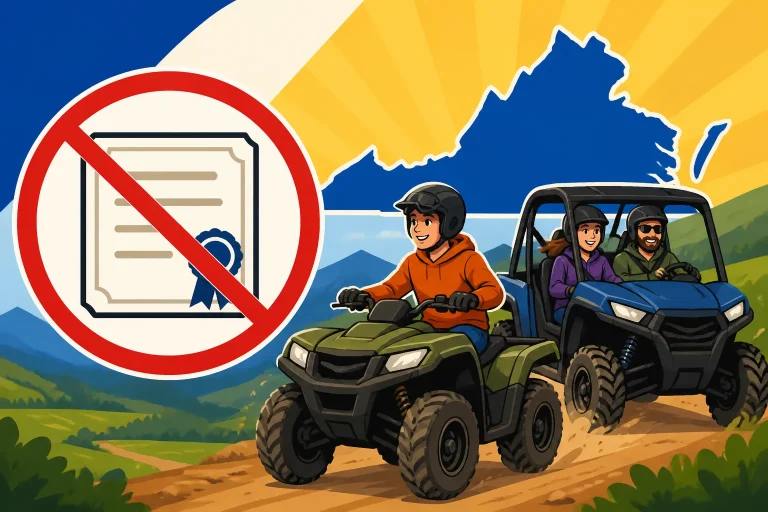
Virginia does not generally make ATV or UTV riders complete a safety course before operating a machine or buying a trail permit. That does not mean every trail, forest road or private park has the same rules, or that training is unnecessary. This guide explains what the lack of a statewide course requirement means, what it does not mean, and how to check before you ride.
What “No Safety Course Requirement” Means in Virginia
For ordinary ATV and UTV riding in Virginia, there is no general statewide rule requiring every operator to pass an approved safety course before riding. A course-completion card is not a standard prerequisite simply because you own a machine, ride on private property with permission, or want to use an established riding area.
That answer is useful, but it has limits. “Virginia does not require a course” is not the same as “you may ride anywhere without meeting other conditions.” State law, landowner rules, trail-system requirements and the machine manufacturer’s age guidance can all apply independently of a safety course.
A course is also different from a permit. Some riding areas require a trail permit or other authorization. Buying one does not necessarily mean you have completed training, and having a course card does not give you permission to use land or a trail. Treat those as separate questions:
- Training: Does the law or riding area require a safety course or certificate?
- Access: Do you have permission, a permit or another authorization to ride there?
- Eligibility: Do the rules allow you, at your age and with your machine, to ride that route?
- Equipment: Does your machine meet the site’s requirements, and are you wearing the required gear?
For example, a rider may not need a safety certificate to use a permitted trail system but still need to buy the correct permit, follow age and supervision rules, wear required protective equipment, and keep within the system’s operating rules. A course card cannot substitute for any of those things.
The distinction matters especially for parents, first-time riders and visitors. Someone may hear that Virginia has no safety-course mandate and assume the rule is the same at every trailhead. It is safer to read that statement narrowly: Virginia does not impose a general ATV safety-course requirement, but specific sites can set their own conditions, and other legal requirements still apply.
When planning for a particular system, read the rules for that system rather than relying on a general summary. Virginia Safety Course Options can help you think through training even when it is not compulsory. For a broader look at riding-area permit conditions, see Virginia Permit Questions Riders Ask.
State Law, Trail Permits and Site Rules Are Separate
A safety course is only one possible entry requirement. Before loading the machine, work through the rules in layers. This avoids the common mistake of checking the statewide rule and stopping there.
State rules still apply
Virginia’s ATV and UTV laws may regulate matters such as rider age, helmets, where a machine may be operated and whether a road crossing is allowed. Those requirements do not disappear because a rider has taken a course, and a course does not create an exception to them.
Likewise, having no course requirement does not make an ATV street legal. Virginia’s road-access rules are a separate issue from training. Before planning a route that includes a public road, check Can You Ride an ATV on the Road in Virginia? and the rules for that specific road or route. Do not rely on an assumption that a short connector, a quiet county road or a road near a trailhead is automatically open to ATVs.
Age is another separate question. The machine’s engine size, the rider’s age, the location and the applicable rule can all matter. A parent should not treat a safety course as a substitute for checking those limits. See Virginia Rules for a Rider Under 18 before bringing a child or teenager to ride.
Trail permits grant access, not a safety qualification
A trail permit generally addresses access to the system covered by that permit. It does not automatically prove that the operator has passed a course, and it does not necessarily cover other properties or networks. When a permit process asks for personal or machine information, provide it accurately and keep a copy of the confirmation or permit available as directed.
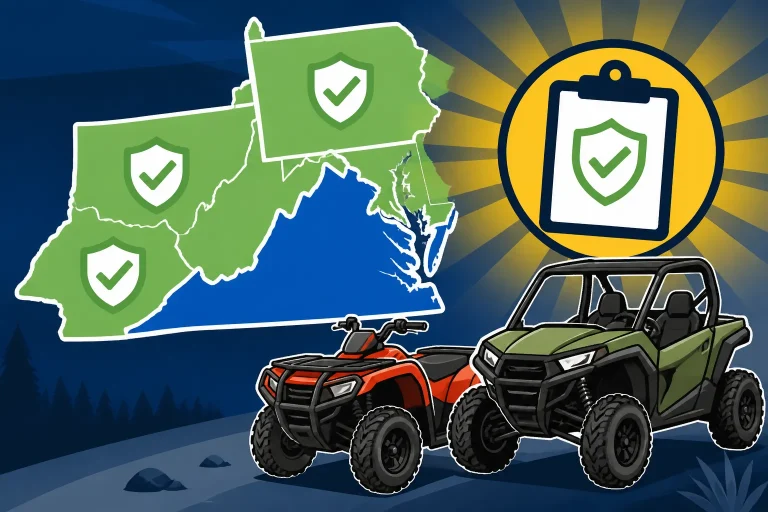
Virginia’s trail networks can have separate permit arrangements. Do not assume that a permit bought for one network works at another, or that a permit from a neighboring state is accepted in Virginia. Virginia Has No Permit Reciprocity explains why an out-of-state permit should not be treated as a replacement for the Virginia system’s own requirements.
Private parks can set their own conditions
A privately operated riding park may impose conditions beyond the statewide baseline. It might require a waiver, set a minimum age, require an adult to accompany a minor, restrict certain machine types, or establish its own helmet and equipment rules. A park may also provide guidance or training without making a formal course card a condition of entry.
Check the park’s current rules before traveling, particularly if you are bringing a youth rider, a passenger, a side-by-side or a group. The fact that Virginia does not require a state course does not prevent a private operator from setting reasonable participation conditions. For related details, see Virginia Private Park Waivers and Rules.
Forest land and trail systems may have operator conditions
Public-land rules are not automatically the same as state ATV law or private-park policy. A forest road or riding area may require a valid operator credential, limit vehicle types, impose seasonal restrictions or apply equipment standards. A driver’s license requirement, where one applies, is not the same thing as a safety-course requirement. Nor does a course certificate take the place of a required license.
Before you go, identify the managing agency or operator and read its current rules for the exact route or area. If the rules are unclear, ask the office responsible for that site. Don’t assume that a rule you followed at one trailhead applies at another.
| Requirement | What it answers | What it does not prove |
|---|---|---|
| Safety course or certificate | Whether an operator has completed specified instruction | Permission to ride on a particular property |
| Trail permit | Whether the rider has access under that system’s permit rules | Course completion or compliance with every riding rule |
| Driver’s license, if required | Whether the operator meets a site’s licensing condition | That the rider has an ATV-specific course certificate |
| Landowner permission | Whether riding is authorized on that property | That the machine or rider meets age and equipment rules |
| Helmet and other gear | Whether required protective equipment is being used | That the route is open or the rider is eligible |
What Riders Still Need to Check Before Going
If there is no statewide safety-course hurdle, preparation shifts to the conditions that actually determine whether your ride is allowed. A few minutes of checking can prevent a wasted trip, a denied entry or an unsafe situation.
Confirm the exact place you plan to ride
Start with the destination, not just the county or nearby town. A region may contain several trail systems, private properties, forest roads and public roads with different rules. Confirm that the route is open to the kind of machine you intend to bring, and check whether the system has width, age, passenger or equipment restrictions.
If your group plans to cross between areas, ask whether the connector is legal and whether each section requires separate authorization. A trail map can show a route without answering every question about current access, closures or permit coverage. Confirm current conditions with the managing organization before hauling a machine a long distance.
Check the rider’s age and the machine’s fit
For a young rider, check the applicable age rules and the manufacturer’s minimum-age guidance for the particular machine. The absence of a state course requirement does not mean a child can safely or legally ride any size ATV. A machine that is too powerful, heavy or difficult to control can be dangerous even on a familiar property.
Parents should look at more than engine size. Can the rider reach and operate the controls while seated? Can they stop the machine reliably? Do they understand how to use the throttle, brakes and kill switch? Can they turn and maintain control without leaning too far or being pulled off balance? If the answer is uncertain, choose a smaller machine or delay the ride.
The site may have its own rules for minors, including adult accompaniment or permit procedures. Virginia Youth Permit Rules is a useful starting point, but verify the rules of the specific riding area as well.
Check gear requirements and fit
A course is not a substitute for protective equipment. At a minimum, learn what the state and site require for helmets and eye protection, then consider additional protection based on terrain, weather, speed and the rider’s experience. A helmet should fit correctly and be suitable for the activity; a loose or damaged helmet is not a reliable safety measure.
If you are buying a helmet or goggles through Amazon or another retailer, check the product’s standards, fit guidance, condition and return policy rather than choosing by appearance alone. A listing title or customer review is not proof that a helmet meets the rule that applies to your ride. For trail-specific requirements, review Virginia Helmet and Eye Protection Rules on Trail.
Other useful equipment may include gloves, boots that cover the ankles, long sleeves and pants, and protective gear appropriate to the machine. A side-by-side’s occupants may need to use its seat belts and remain inside the protective structure where required. Follow the machine’s manual and the site’s directions rather than improvising a different setup.
Understand the permit and identification process
Some permit systems use digital documents, identity checks or permit records that can be looked up by name. Others may have different procedures. Check how the system expects riders to show proof of authorization. If you will be riding where cell service is unreliable, save the confirmation or instructions in a way you can access offline, while following the system’s rules for proof.
Do not assume that a screenshot is acceptable just because you can display it. Confirm what the operator accepts. Similarly, do not assume that a permit issued to one person automatically covers each rider in the group. Permit rules can vary by site and rider.
Virginia Permit Checks on the Trail covers what to expect when an operator checks authorization. If you are visiting from outside the state, check the applicable visitor rules as well as permit requirements; a home-state certificate, license or permit should not be assumed to satisfy Virginia site rules.
Inspect the machine and plan the ride
Before leaving home, inspect the machine for working brakes, tires, steering, controls and lights where needed. Check fuel, fluid levels and load security. Make sure the machine is appropriate for the trail’s width and terrain. For a group, agree on a meeting point, a pace and a simple plan for what to do if someone is separated or breaks down.
Take weather and terrain seriously. Appalachian routes can change quickly with rain, mud, loose rock, steep grades and fallen branches. A rider who has not practiced on similar terrain should start with an easier route, even if the trail is legally open. A beginner can benefit from riding with an experienced person who knows the area, but supervision should never be mistaken for a legal exception to a rule.
Training Is Optional by Law, Not a Bad Idea
There is a real difference between “not required” and “not worthwhile.” ATV and UTV operation involves skills that are easy to underestimate, especially for someone whose experience is limited to riding in a yard or following another machine on a familiar trail. A safety course can teach basic control and decision-making in a structured setting before a rider encounters a steep descent, a blind corner or an unexpected obstacle.
Good instruction usually covers a mix of practical and judgment skills, such as:
- How to use the controls and stop smoothly
- How to shift body position and keep balance
- How to turn without carrying too much speed
- How to approach hills and uneven ground
- How to recognize when a trail is beyond the rider’s ability
- How to ride with spacing and communicate in a group
- How to use protective equipment and perform basic checks
- What to do after a breakdown, injury or close call
A course is especially worth considering for a new rider, a young operator, someone moving up to a larger machine, or a rider who has not been on the terrain they plan to tackle. It can also help an experienced adult notice habits that have become unsafe through repetition.
A rider may learn from family or friends, but informal instruction can leave gaps. An experienced relative might be comfortable on a machine yet not know how to explain braking, cornering or hill technique to a beginner. A formal course can provide a consistent sequence and practice exercises. If an in-person course is not available nearby, ask a recognized training organization whether it offers another format and what practical instruction it includes.
Online videos can be useful for orientation, but they cannot watch a rider’s posture, correct a poor habit in real time or confirm that the rider can control the machine. Reading the owner’s manual is valuable too, but it is not the same as supervised practice. Use those resources as supplements, not as proof of competence.
When shopping for a course, ask what machines it covers, whether the rider gets hands-on practice, what age group it is designed for and whether the course is recognized by the riding site you plan to visit. If you need a certificate for a particular event or organization, confirm the accepted provider and documentation before paying or enrolling. A course that is excellent general preparation may not meet a particular organizer’s paperwork rule.
Training gear and basic supplies can be purchased from many retailers. If you use Amazon to find a printed riding guide, gloves or a first-aid kit, verify that the item is suitable for your activity and that the description matches what you receive. For protective equipment, fit and recognized safety standards matter more than convenience. Do not treat an online purchase, a completed video or a product manual as a replacement for hands-on practice.
Riding With Children and Less-Experienced Operators
The lack of a universal course requirement can create a false sense of simplicity for families. A parent may reason that if the state does not require training, a child is ready to ride. That conclusion skips the most important questions: Is the rider legally eligible? Is the machine appropriate? Is the location suitable? Can the adult provide safe supervision?
Match the machine to the rider
Choose a machine that the rider can operate confidently, not the largest one the family owns. A youth model is not automatically safe for every child, and a small adult may also struggle with a machine that is heavy or difficult to control. Consider the rider’s size, strength, coordination, attention and experience.
Before the ride, let the child sit on the machine with the engine off and become familiar with the controls. Show how the throttle returns, where the brakes are, how to shut the engine off and how to get off safely. Have the rider practice in a controlled, open area at low speed before entering a trail. If the rider cannot stop consistently or follow simple directions, do not move on to more challenging terrain.
A child’s ability can change from day to day. Fatigue, excitement, cold, heat or frustration can affect judgment and control. Keep the first rides short enough that the child can stay focused, and stop when their attention slips.
Supervision is not a course certificate
An adult’s presence can help a young rider, but it does not necessarily satisfy a site rule or change the law. Check whether the trail system requires a parent or guardian to ride with a minor, whether that adult needs a separate permit, and whether there are additional rules for particular ages. Read Virginia Rules for a Rider Under 18 alongside the system’s own minor-rider instructions.
Do not assume that a parent can waive every restriction by signing a form. A waiver may acknowledge risk or set park conditions, but it does not automatically override legal limits, machine-manufacturer guidance or a trail operator’s eligibility rules.
When riding as a family, have the adult lead at a pace the youngest operator can maintain. Keep enough space to avoid dust and collisions, but not so much that the child feels pressured to speed up to catch the group. Stop before difficult features to explain the route and let the rider decide whether they are comfortable attempting it. Turning around is a sound decision, not a failure.
Teach a routine, not just throttle control
Young riders need repeatable habits. Before each ride, make a short check together: helmet fit, eye protection, footwear, controls, brakes, tires, fuel, route and weather. Agree on a signal for stopping and a rule that the child does not leave the adult’s sight or follow another group without permission.
Explain that trails can have traffic moving in both directions, even when they feel remote. Riders should slow near corners, intersections, campsites and other blind spots. They should not assume that the person ahead has seen an obstacle or that a group behind them knows they are stopping.
Also discuss when not to ride. A child who is upset, overtired, sick or distracted may not be ready that day. If a machine develops a problem, stop in a safe location and do not ask a young rider to continue because the destination is close. The goal is to build sound judgment alongside basic operating skill.
Visitors and Out-of-State Course Cards
Visitors often have documents from another state: a safety-course card, a trail permit, an operator credential or a driver’s license. These can be useful, but their acceptance depends on the requirement in question.
A Virginia-wide safety course requirement is generally not what determines whether a visitor can ride. The visitor still needs to meet Virginia’s applicable laws and the specific site’s access rules. If the trail requires a permit, obtain the permit recognized by that system. If the site requires a particular license or sets an age condition, check whether the visitor meets it. Do not assume an out-of-state document automatically transfers.
The reverse is also true. A Virginia rider going elsewhere should not expect Virginia’s lack of a general course requirement to control another state’s rules. A neighboring jurisdiction, a private park or an organized event may require a course even if Virginia does not. Contact the destination before traveling and ask exactly what documentation is accepted.
For a rider coming from West Virginia, Kentucky, Tennessee or North Carolina, the practical checklist is the same:
- Identify the specific Virginia riding area.
- Ask whether it requires a permit, course card, license or other document.
- Confirm the rules for minors and accompanying adults.
- Check machine eligibility, passenger conditions and protective gear.
- Verify whether any permit or authorization covers the full route.
- Save the confirmation and make it available offline if needed.
A course card may still be worth carrying if you already have one, particularly if a park, event organizer or group leader asks about experience. But carry it as supporting information, not as a substitute for the required permit or permission. For permit coverage, see Virginia Has No Permit Reciprocity and Virginia Permit Checks on the Trail.
If you are uncertain whether a site recognizes a particular course, ask before your trip and describe the document precisely: the issuing organization, course name, whether it involved hands-on instruction and the rider’s age. “I took a safety course” may not answer the operator’s question if it has a specific credential in mind.
A Practical Before-You-Ride Checklist
Because a course is not a general statewide gate, riders should use a deliberate checklist rather than treating the absence of a certificate requirement as the end of planning. Keep this list with your trip notes and tailor it to the machine, rider and destination.
Before you leave home
- Confirm the exact riding area and whether it is open.
- Read the current permit and access requirements for that area.
- Check whether the route permits your ATV or UTV type and size.
- Review applicable rules for age, passengers, helmets and other equipment.
- Confirm whether a driver’s license or other operator credential is required.
- Check whether minors need an accompanying adult and whether the adult needs a permit.
- Make sure the machine is in safe working condition.
- Check the weather and plan for the terrain you expect to encounter.
- Tell someone where you are going and when you expect to return.
- Save directions, permit confirmation and key contact details.
At the riding area
- Follow posted signs and instructions from staff or rangers.
- Keep proof of permit or authorization available as required.
- Stay on routes open to your type of machine.
- Use required protective equipment and occupant restraints.
- Ride at a speed that allows you to stop within the distance you can see.
- Give other riders space and slow down where visibility is limited.
- Stop if the machine, weather or rider condition changes.
- Do not enter a closed route because another rider says it is passable.
- Ask staff when a sign, map or rule is unclear.
When training would be a smart next step
Consider taking a course or getting supervised practice before the ride if:
- You have never operated an ATV or UTV.
- You are moving from a small youth machine to a larger one.
- You have only ridden on flat, open ground and plan to ride steep or rocky trails.
- You are responsible for teaching a child.
- You are returning after a long break.
- You are uncertain how to handle hills, turns, braking or group spacing.
- Your riding area, club or event recommends or requires a particular course.
A rider who has completed training should still use this checklist. A certificate cannot tell you whether a trail is open today, whether your permit covers it, whether your machine fits a width limit or whether a storm has made the route unsafe.
Finally, remember that safety equipment and instruction work together. A helmet does not prevent every injury, a course does not guarantee perfect decisions, and an experienced riding partner cannot control another operator’s machine. The most reliable approach is to combine suitable training, a machine matched to the rider, protective gear, legal access and conservative decisions on the trail.
Disclaimer
This article is for general informational purposes only and does not constitute professional advice. Laws, prices and regulations vary by location and change over time. Consult a qualified professional for guidance on your specific situation.