Virginia Visitors From North Carolina
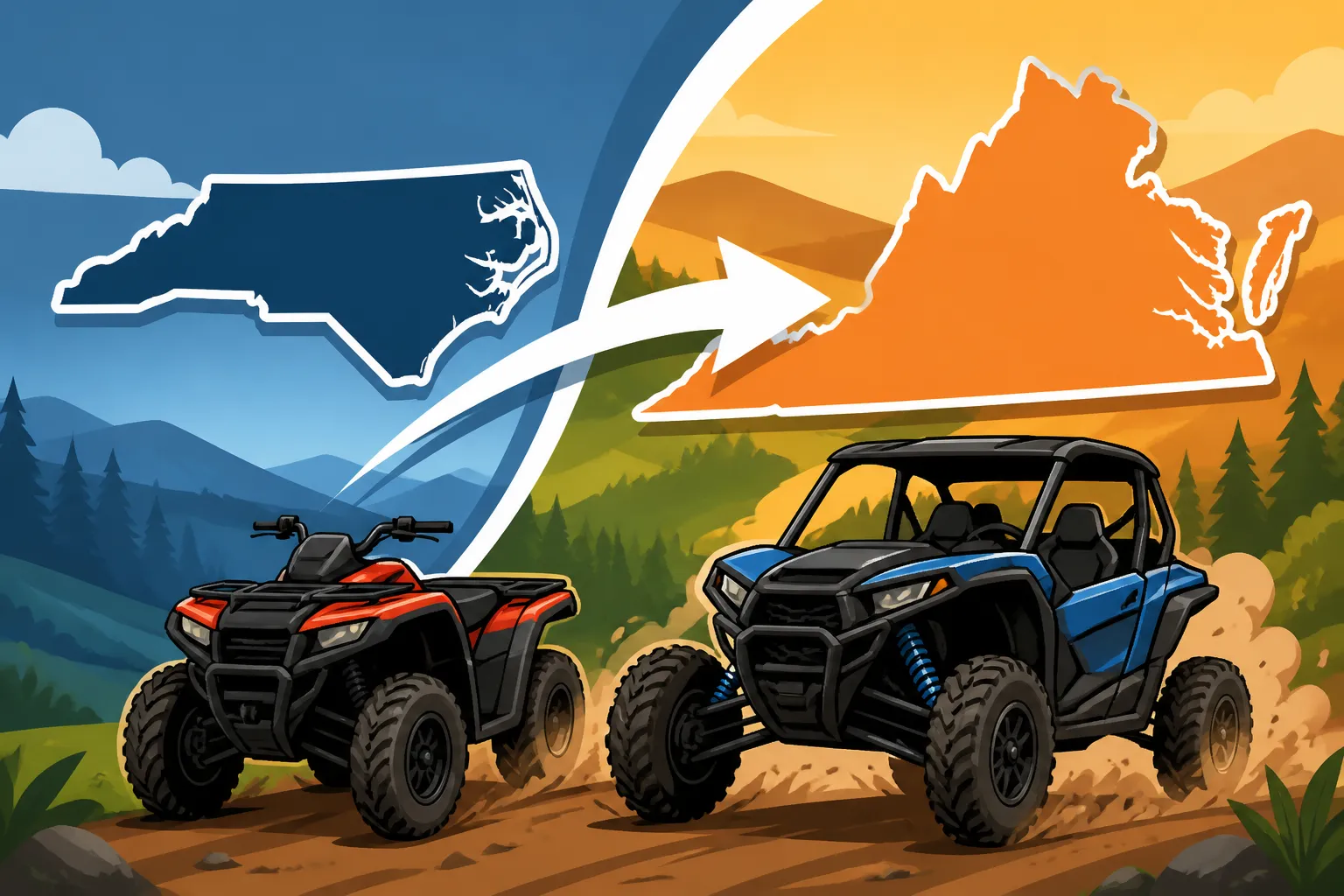
North Carolina paperwork does not automatically give you permission to ride in Virginia. The rules depend on where you plan to ride: a trail network may require its own permit, while public-road access and private-land use follow separate rules. Here’s how to sort out permits, machine requirements and key checks before hauling your ATV or UTV across the state line.
What North Carolina Visitors Need to Know
The short answer: treat your Virginia riding area as a separate destination with its own access rules. A permit, registration document or other paperwork from North Carolina does not, by itself, serve as a Virginia trail permit or make a road legal to ride.
Start by identifying the exact place you plan to ride. Virginia has different arrangements for managed trail networks, national forest routes, private riding parks and private land. Requirements at one location may not apply at another, and buying a permit for one network does not automatically grant access to another.
For example, the Spearhead trail systems have their own permit process. Peters Mill Run and Taskers Gap, in the national forest, have a separate permit and set of equipment requirements. A private park can impose its own rules as well. Check the relevant operator or land manager before you leave, rather than assuming one Virginia permit covers the whole trip.
| Where you plan to ride | What to check before traveling | Does North Carolina paperwork replace the local requirement? |
|---|---|---|
| Spearhead trail system | Current permit, identity and rider requirements, and trail rules | No. Follow Spearhead’s permit process |
| Peters Mill Run or Taskers Gap | Applicable national forest permit, machine requirements, and closures | No. Check the forest requirements |
| Private riding park | Admission or riding permit, waiver, age rules, and equipment restrictions | No. Follow that park’s rules |
| Private land | Permission from the landowner and any applicable Virginia requirements | No. Get the required permission |
| Public road | Whether that specific road or crossing is legally open to ATVs or UTVs | No. Home-state paperwork does not create road access |
If your trip includes more than one riding area, plan for each one individually. A Spearhead permit does not cover a national forest route, and a national forest permit does not cover Spearhead. Virginia Spearhead Trail Permits and Virginia National Forest OHV Permits explain the separate permit systems.
It also helps to separate three different questions:
- Can you enter the riding area? That depends on its permit, permission and operating rules.
- Can your machine use that trail? Width, equipment, vehicle type and other restrictions may apply.
- Can you ride on a road to get there? Trail access does not mean nearby roads are open to ATVs or UTVs.
A route that appears on a map may cross land with a different owner or manager, or may connect to a road that is not open to off-road vehicles. Check the specific access instructions rather than relying on a general map pin or an old online post.
For a broader look at visiting machines and Virginia rules, see Virginia Rules for an Out-of-State Machine. If your trip involves a UTV, also check Virginia Rules for a Side-by-Side Driver; a UTV’s size or enclosed cab does not automatically give it the same access as a road-registered vehicle.
Match the Permit to Your Riding Area
Spearhead trails
If you are heading to a Spearhead trail system, plan to obtain the required Spearhead permit. Being from North Carolina does not waive the permit requirement, and a permit from another trail network is not a substitute. Check current purchase instructions and eligibility details with the trail operator before you travel.
Spearhead permits are digital. Make sure the confirmation is available on your phone before entering an area where cell service may be unreliable. Keep your phone charged, and bring the identification needed to verify the permit. The name on your permit should match your identification, so check for spelling mistakes when you buy it. If you are riding with other people, confirm who needs an individual permit and how the rules apply to minors.
Do not plan a ride around a permit that has not been purchased yet. A long drive to the trailhead can end with a frustrating delay if you discover that you cannot complete the purchase or identity checks at the gate. Review the current process and trail status before loading up.
Spearhead also has rules beyond the permit itself. Check the system’s limits for machine type, rider age, safety equipment and operating hours. A permit is permission to use the network under its rules; it is not a general authorization to ride anywhere in Virginia. For details about the permit system, see Virginia Spearhead Trail Permits.
Peters Mill Run and Taskers Gap
Peters Mill Run and Taskers Gap are not part of Spearhead, so a Spearhead permit will not cover them. Check the applicable national forest permit and current restrictions for the route you intend to ride. These areas can have seasonal closures, equipment requirements or other conditions that differ from a managed regional trail system.
Pay particular attention to machine specifications. Width limits can apply on some routes, and a machine that is allowed on one trail may not be allowed on another. Check sound limits and required equipment as well, especially if you have modified the exhaust or added accessories. Do not assume that a machine accepted at a private park will meet national forest requirements.
A valid driver’s license may be required for particular routes or uses, so verify the exact rule for the trail you plan to ride. A North Carolina license does not mean every route is open to you, and a permit does not override an age or equipment restriction.
Private parks and private land
A private riding park sets its own operating conditions. It may require a waiver, impose age or passenger limits, restrict certain machine types, or have rules about helmets, alcohol, pets and camping. Check the park’s current information directly and ask about anything unclear, especially if you are bringing children or a UTV with multiple seats.
Private land is not automatically open to riders just because it is away from a public road. Get permission from the landowner before riding, and confirm where that permission applies. Virginia’s rules may call for written landowner consent, so do not rely on an informal assumption that access is allowed. Virginia Written Consent on Private Land explains why clear permission matters.
If you are joining a group ride, ask the organizer which land or trail system the route uses and whether every section has been confirmed. One person’s permit or permission may not cover the rest of the group.
Check Your Machine and Riders Before You Go
The permit is only one part of trip preparation. Virginia’s rules and the riding area’s rules can affect the machine, operator and passengers even when the vehicle was lawfully used at home.
Confirm the machine is allowed
Check the trail system’s definition of an ATV, UTV or side-by-side and compare it with your machine. Width, seating, roll cage, seatbelts and other features may determine whether it can use a particular trail. A side-by-side that fits on a route is not necessarily allowed on every route in the system.
Do not assume that registration or equipment from North Carolina makes a vehicle street legal in Virginia. The ability to ride a managed off-road trail is different from permission to travel on a public highway. Virginia generally restricts ATV and UTV use on public highways, with limited exceptions and specific route provisions. A trail connection or local road should not be treated as open unless you have confirmed that it is.
The rules for road access in the coalfields are specific, not a statewide pass for riding from town to town. If your planned trip involves a road section, verify that exact section before you use it. Virginia Road Access in Coalfields is useful background, and Virginia Bans ATVs on Public Highways covers the general restriction.
Check helmets, age rules and passengers
Use helmets and eye protection for everyone riding, and check both Virginia requirements and the rules of the riding area. Do not assume an adult is exempt or that a UTV’s cage and seatbelts replace a helmet requirement. Virginia Helmet Law Applies to Every Rider explains the state rule.
Age limits can depend on the machine and the rider’s age, and an operator’s experience does not necessarily change the legal limit. Trail operators may also set their own minimums or require a parent or guardian to accompany a minor. Review the rules for the exact vehicle and system before bringing a young rider. The relevant background is in Virginia ATV Age Requirements.
For UTV passengers, confirm that the machine is designed for the number of people you plan to carry and that everyone can use the intended seating and restraints. Do not add a passenger to a machine that was not built for one. A trail system’s passenger rule and Virginia law both matter.
Carry useful paperwork and trip information
Keep the permit confirmation and required identification accessible. You may also want to carry proof of ownership or other documents that help identify your machine, particularly if you are traveling far from home. Requirements differ by situation, so check the trail operator’s instructions rather than assuming that a North Carolina document will answer every question.
Before you haul out, save the trail system’s contact details, check closures and confirm the address of the correct entrance. Some trail areas have weak or no cell service. Download or print useful information in advance where the operator makes that available, and do not rely on a map application to show current restrictions.
A paper map can be useful as a backup, but it is not a substitute for current closure and access information. If buying basic trip gear online, Amazon may be convenient for items such as a phone mount or dry bag; choose safety equipment for fit and suitability rather than convenience alone. A helmet in particular should fit properly and meet the relevant requirements.
A Pre-Trip Checklist for North Carolina Riders
Use this sequence before loading your machine:
- Name the exact riding area. Do not plan around “Virginia trails” in general. Identify the network, forest route, park or private property.
- Check its current permit process. Confirm where and when to buy, who needs a permit, what identification is required and how to display or verify it.
- Confirm that your machine is eligible. Check width, vehicle type, seating, safety equipment and any other trail-specific limits.
- Review rules for every rider. Verify age, helmet, passenger and supervision requirements, including rules for children.
- Check the approach route. Do not ride an ATV or UTV on a public road merely because it leads to a trailhead. Confirm each road section or crossing.
- Get landowner permission where needed. Make sure permission covers the actual land and route, not just the property where you parked.
- Check closures and conditions close to departure. Weather, maintenance and seasonal restrictions can affect access.
- Prepare for weak cell service. Save permit information and contact details before leaving home, and keep identification available.
- Ask about anything unclear. Contact the trail operator or land manager rather than relying on a forum comment, an old map or a friend’s experience from another system.
The most common planning mistake is treating a home-state document as a universal pass. Instead, think of your North Carolina paperwork as documentation for the machine’s home situation, then meet the separate requirements of the Virginia place where you intend to ride. That approach also helps avoid a second mistake: assuming that permission to use an off-road trail includes nearby roads.
If the trip includes more than one system, make a short list of each system’s permit, access point and machine rules. Keep those details together with the route plan. A few checks before departure are much easier than discovering at a gate that the permit is wrong, the machine is too wide or the road to the trailhead is not open to your vehicle.
Disclaimer
This article is for general informational purposes only and does not constitute professional advice. Laws, prices and regulations vary by location and change over time. Consult a qualified professional for guidance on your specific situation.