Virginia Rules for an Out-of-State Machine
Moving your beloved ATV or UTV to Virginia, or even just planning a visit, often comes with a heap of questions about what laws apply to your machine. It’s easy to feel lost trying to figure out if your out-of-state title or registration means anything here, especially since Virginia has some pretty unique rules for off-road vehicles. This guide is here to cut through the confusion and help you understand exactly what you need to do, or know, when bringing your machine into the Commonwealth, whether you're a new resident or just passing through.
Navigating Virginia's Rules with an Out-of-State ATV or UTV
Virginia has a distinct way of handling ATVs and UTVs compared to many other states, and this can be a real head-scratcher for folks coming from elsewhere. The biggest difference you'll encounter right off the bat is how Virginia treats titles and registration for these machines. Many states might register an ATV for off-road use, issuing a sticker or plate, but Virginia doesn't do that. Instead, it focuses primarily on titling. This means your machine gets a certificate of ownership, much like a car, but it doesn't get a tag for the road or a yearly registration fee. This is a crucial distinction that impacts how your out-of-state paperwork translates once you’re here.
Think about it: if your home state requires you to register your side-by-side annually and display a sticker, you might assume Virginia will want the same. But that's not the case. The Commonwealth is far more concerned with establishing legal ownership. So, while you might be used to a yearly trip to your local DMV equivalent for renewal, that particular chore won't be on your Virginia ATV to-do list. However, understanding what does apply is key to avoiding any headaches down the road, whether that's with law enforcement or when it comes time to sell your machine. [Virginia Titles ATVs but Does Not Register Them] goes into much more detail on this specific point, but for an out-of-state machine, knowing this upfront helps set expectations.
Another point of potential confusion is how Virginia defines these machines. What your state calls an "off-highway vehicle" or "recreational vehicle" might not perfectly align with Virginia's legal definitions for an ATV or UTV. These definitions are what dictate which rules apply to your machine, from titling requirements to where you can legally ride. For instance, some states might lump certain smaller utility vehicles into a different category, but Virginia’s definitions are quite specific. It’s always a good idea to quickly review [Virginia ATV and Utility Vehicle Definitions] to ensure your machine fits neatly into one of the established categories in Virginia law, which helps clarify the applicable regulations.
The Titling Requirement for New Residents
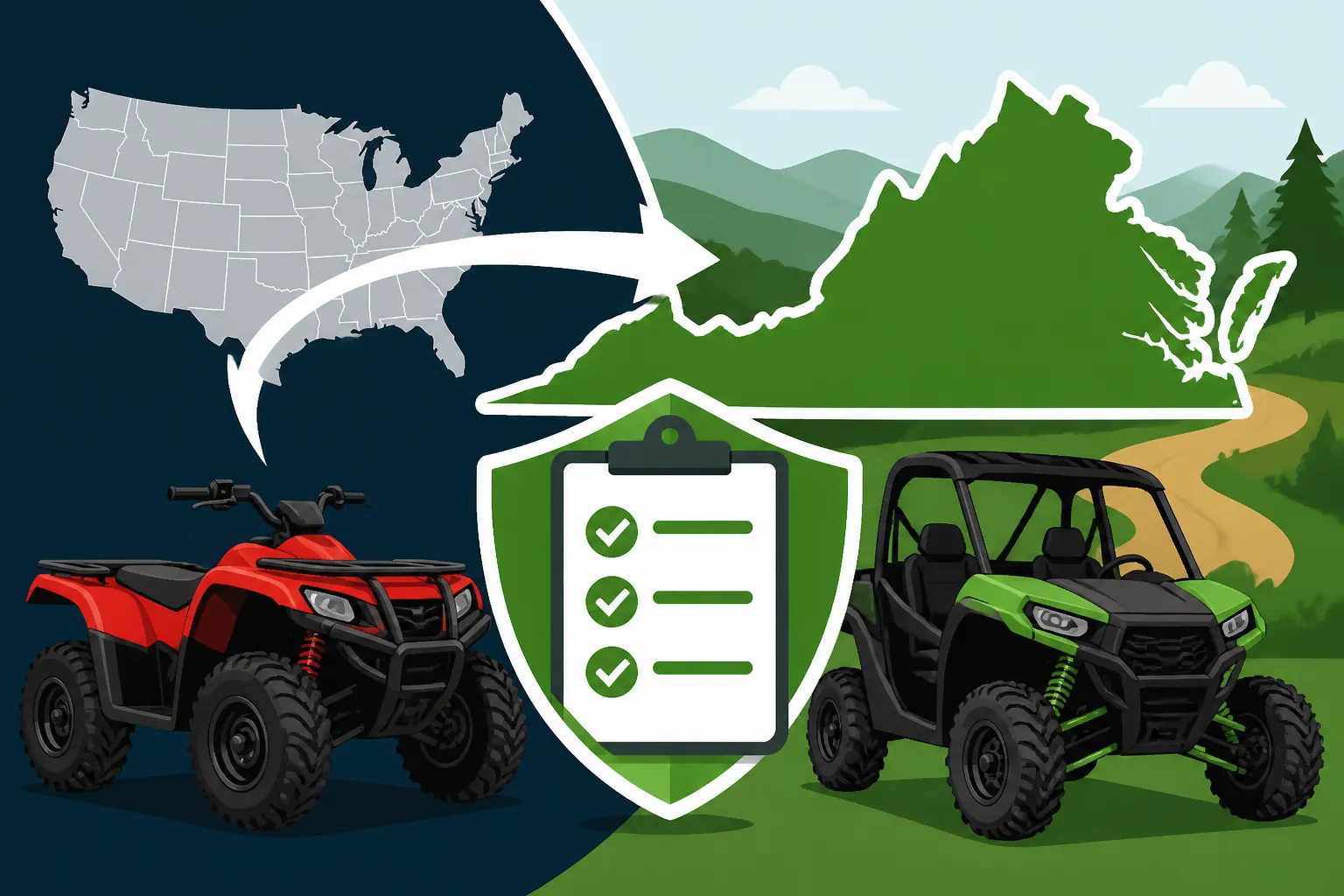
If you're making Virginia your new home, your out-of-state ATV or UTV title isn't automatically recognized as a Virginia title. Just like with a car, you’ll need to transfer your existing title to a Virginia title. This process is generally straightforward but requires a visit to the Department of Motor Vehicles (DMV) or processing by a licensed dealer. You'll need your out-of-state title, proof of identification, and usually proof of your new Virginia address. The DMV will then issue you a Virginia ATV title.
Now, here's where it gets interesting: Virginia titles ATVs but never registers them for annual road use, nor does it issue plates. So, while you're getting a Virginia title, you won't be walking out with a new sticker or metal plate to affix to your quad or side-by-side. The state is simply recording your ownership within its system. This is a critical step for new residents because it officially establishes your ownership under Virginia law, which is essential for things like proving ownership, selling the machine later, or dealing with insurance claims. It also ensures that if your machine is ever involved in an incident, its ownership is clearly documented within the Commonwealth. You can find more specific guidance on this in [Virginia Title for a New Resident].
Sales Tax Considerations for Out-of-State Purchases
Bringing a machine into Virginia that you recently purchased out-of-state? Get ready for Virginia's use tax. If you paid sales tax in another state, Virginia might give you credit for that, but you might still owe the difference if Virginia's sales tax rate is higher. This isn't just a concern for brand-new machines; it applies to used ones too, especially if you bought it in a private sale. The goal here is for Virginia to collect its fair share of tax on goods consumed within the state, regardless of where they were purchased.
Imagine you bought a beautiful side-by-side in a neighboring state with a lower sales tax rate, thinking you dodged a bullet. When you bring it to Virginia to title it, the DMV will assess the Virginia sales tax rate on the purchase price you paid, and if there's a difference, you'll owe it. They won't usually double-tax you, but they'll make sure Virginia gets its percentage. This is a common surprise for new residents or those who purchase machines across state lines, so it's best to be prepared. For a deep dive into how this works, especially for out-of-state purchases, check out [Virginia Tax on an Out-of-State Purchase]. It outlines the nuances of this often-overlooked cost.
Titling and Paperwork for New Virginia Residents with Out-of-State Machines
Okay, so you’ve moved to Virginia, and your beloved ATV or UTV has come with you. The good news is, transferring your existing out-of-state title to a Virginia title is a pretty straightforward process, but it requires you to be proactive. This isn't something that happens automatically. The state needs to know you're now a resident and that your machine is now domiciled here. This formalizes your ownership in Virginia and ties your vehicle to your new state of residence.
It’s tempting to just keep riding on your old state's title, especially since Virginia doesn't issue annual registrations for ATVs. However, having a Virginia title is crucial for several reasons: it simplifies any future transactions like selling the machine, helps with insurance claims, and most importantly, it properly establishes your legal ownership within the Commonwealth. While ATVs don't get plates, the title is still the official record.
Required Documents for Titling Transfer
When you head to the DMV to get your Virginia title, make sure you have all your ducks in a row. The process is designed to be efficient, but missing one document can send you home to gather more paperwork, wasting precious time. Here’s a rundown of what you’ll likely need:
- Your Out-of-State Title: This is the most critical document. It proves you are the legal owner of the machine. Make sure it's in your name and signed correctly if it's a multi-owner title.
- Proof of Virginia Residency: This could be your Virginia driver’s license, a utility bill, or another official document showing your new address. The DMV needs to confirm you live in the Commonwealth. [Virginia Title and Proof of Address] covers the types of documents they accept.
- Identification: A valid government-issued photo ID, typically your driver's license.
- Application for Certificate of Title and Registration (Form VSA 17A): Even though ATVs don't register in the traditional sense, this is the standard form for titling vehicles in Virginia. You’ll fill out the relevant sections for your ATV or UTV. [Virginia Form VSA 17A Explained] provides a helpful walkthrough of this form.
- Proof of Purchase Price (Bill of Sale): If you purchased the machine recently, especially if sales tax wasn't paid in your previous state or was lower, you’ll need this for sales tax assessment. Even if you've owned it for a while, having some proof of value can be helpful.
- Payment for Fees: There will be a titling fee and potentially sales tax, as discussed earlier. Make sure you have appropriate payment methods.
It’s always a good idea to double-check the Virginia DMV website or even call ahead to confirm any specific requirements, as rules can sometimes have subtle variations or updates.
What if Your Out-of-State Machine Has No Title?
This is a trickier situation that new residents sometimes face, especially with older machines from states that didn't title ATVs or UTVs at all, or if the title was lost years ago. Virginia's general rule is that machines over 50cc bought new since July 1, 2006, require a title. If your machine is older or from a state with different rules and you legitimately don't have a title, you might need to go through a more involved process.
This often involves submitting an affidavit of ownership, like Form VSA 12M, where you declare under oath that you are the rightful owner and explain why a title isn't available. You might also need to provide additional evidence of ownership, such as a bill of sale, old registration documents, or even a sworn statement from the person you bought it from. This is definitely one of those situations where "having all your ducks in a row" takes on an even greater importance. For specific steps and forms, [Virginia Form VSA 12M Affidavit] is an invaluable resource that explains how to navigate this complex scenario.
Riding Your Out-of-State Machine as a Visitor in Virginia
So, you're not moving to Virginia, but you're planning a trip to hit some of our incredible trails, like those in the Spearhead Trails system. Great! You're likely wondering if your out-of-state registration or title will cut it here. The short answer is generally yes, for visiting purposes, as long as your home state considers your machine legally owned and, if applicable, properly registered for off-road use. However, you still need to abide by all of Virginia's riding rules and permit requirements for trail access.
Virginia's focus on titling, but not registering, for ATVs means that if your home state has an off-road registration system, Virginia typically recognizes that for visitors. What Virginia cares about most when you're on public trails or land is that you're operating a legally owned machine and that you have the appropriate trail permits. They're not going to try to force you to get a Virginia title if you're just visiting for a week. However, this leniency does not extend to the actual rules of the trail or the road.
Trail Permits and Requirements
Whether you're from Virginia or out-of-state, if you plan to ride on designated trail systems like Spearhead or in national forests, you absolutely need a permit. Your out-of-state paperwork doesn't exempt you from this. These permits are crucial for funding trail maintenance and operations.
For example, if you're heading to the Spearhead Trails in Southwest Virginia, you'll need to purchase either a three-day or an annual permit. These permits are typically digital, tied to your name and machine, and easily verifiable by trail rangers. Similarly, if you're exploring the Peters Mill Run OHV Trails in the George Washington National Forest, you'll need a National Forest OHV permit. These permit systems are uniform for all riders, regardless of residency. [Spearhead Trails in Virginia Explained] provides an excellent overview of the Spearhead system and its permit structure, and you'll find similar details for forest lands in [Virginia National Forest OHV Permits]. Always purchase your permits before you arrive at the trailhead to avoid delays.
Virginia's Riding Rules Apply to Everyone
This is where many out-of-state riders sometimes get into trouble. While your ownership paperwork might be valid from your home state, Virginia's laws regarding how and where you operate your ATV or UTV apply to every single rider within its borders. This means:
- Helmets are mandatory: [Virginia ATV Helmet Law Explained] details that every rider and passenger, regardless of age or experience, must wear a DOT-approved helmet. No exceptions for adults on private land, for example.
- Age and engine size restrictions: Virginia has specific rules about rider age and the maximum engine size they can operate. A 10-year-old on a 125cc quad might be fine in your home state, but it could be illegal in Virginia.
- No public road riding: Unless specifically designated, ATVs and UTVs are generally banned from public highways and roads. There are very limited exceptions, mainly in two specific counties in the coalfields and for agricultural purposes on private property with [Virginia Written Consent on Private Land]. You cannot simply ride your machine down a public road to get to a gas station or connecting trail, even if it's common practice in your home state. [Can You Ride an ATV on the Road in Virginia?] covers this critical point thoroughly.
- Equipment requirements: While not as stringent as street-legal requirements, machines often need basic safety equipment like working brakes and a spark arrester, especially on federal lands. It's not uncommon for officers or trail rangers to conduct [Virginia Equipment Checks by Officers].
Familiarize yourself with these rules before you arrive. Ignorance of Virginia law is not a defense, and penalties for violations can be substantial, including significant fines. You wouldn't want your great riding trip to turn into a costly court appearance.
Staying Compliant: Equipment, Safety, and Common Misconceptions
Whether you're moving to Virginia or just visiting, ensuring your out-of-state machine meets Virginia's safety and operational standards is crucial. This goes beyond just paperwork and delves into the practical aspects of riding here. Many frustrations arise from differing state laws, so a proactive approach to understanding Virginia's unique landscape will serve you well.
A common misconception is that if your side-by-side is street legal in your home state, it's also street legal in Virginia. This is almost never the case for ATVs and UTVs. Virginia has a very strict interpretation of what constitutes a "motor vehicle" for highway use, and ATVs/UTVs generally do not meet those criteria. [Virginia Has No Street-Legal UTV Path] clearly outlines why attempting to make a side-by-side street legal in Virginia is a dead end. Even if your machine has turn signals, a horn, and a windshield – modifications often found with brands like SuperATV – it still won't cut it for public road use in Virginia outside of very specific, limited exceptions.
Essential Equipment for Virginia Trails
While Virginia doesn't demand street-legal conversion for off-road machines, certain equipment is universally recommended, and sometimes required on specific trail systems. Your machine should be in good working order, with functional brakes and lights, especially if you plan to ride anywhere near dusk or dawn. A working spark arrester is often a non-negotiable requirement for national forest trails to prevent wildfires.
Consider the terrain you'll be tackling. Virginia's coalfield trails, for instance, are known for their rocky sections, steep climbs, and potential for mud. Having appropriate tires, skid plates, and even a winch can make your riding experience safer and more enjoyable. Brands like SuperATV offer a vast catalog of aftermarket accessories designed to enhance durability and capability in challenging conditions. Investing in a robust set of A-arm guards or a heavy-duty front bumper from SuperATV, for example, can protect your machine from damage on rocky trails, making your out-of-state machine ready for whatever the Appalachian landscape throws at it. Don't forget basic safety items like a first-aid kit, a small tool kit, and plenty of water, regardless of where you ride.
Why Insurance Is Still a Smart Idea
Virginia does not require ATVs or UTVs to carry liability insurance for off-road operation. This is another area where Virginia differs from some states that might mandate insurance for recreational vehicles. However, just because it's not required by law doesn't mean it's a good idea to skip it. Accidents happen, and injuries or property damage can be incredibly costly.
Even if you're just visiting, having an insurance policy that covers your ATV or UTV is wise. Your homeowners' policy might offer some limited coverage, but a dedicated off-road vehicle policy provides much more comprehensive protection. This can cover everything from damage to your machine in a rollover, to medical expenses if you or a passenger are injured, to liability if you accidentally damage someone else's property. Protecting your investment and your finances with an appropriate insurance policy, even if not legally required, is simply good practice, regardless of your home state or Virginia residency status.
Summary of Key Virginia Rules for Out-of-State Riders
To help keep everything clear, here’s a quick reference table outlining the key differences and requirements for out-of-state machines and riders in Virginia:
| Feature/Requirement | For New Virginia Residents (Out-of-State Machine) | For Out-of-State Visitors (Out-of-State Machine) |
|---|---|---|
| Titling | Required to transfer to a Virginia Title | Not required, home state title is recognized |
| Registration | Not applicable (Virginia does not register ATVs) | Not applicable (Virginia does not register ATVs) |
| Sales/Use Tax | Likely due on any prior purchase if unpaid/lower | Generally not applicable, unless newly purchased |
| Trail Permits | Required for designated trail systems | Required for designated trail systems |
| Helmet Law | Mandatory for all riders/passengers | Mandatory for all riders/passengers |
| Age Restrictions | Virginia's rules apply by engine size | Virginia's rules apply by engine size |
| Public Road Use | Generally prohibited (very limited exceptions) | Generally prohibited (very limited exceptions) |
| Insurance | Not legally required, but highly recommended | Not legally required, but highly recommended |
| Equipment Checks | Subject to checks by law enforcement/rangers | Subject to checks by law enforcement/rangers |
This table should give you a good snapshot of what to expect and what to prioritize. The most important takeaway is that while your ownership might be recognized, Virginia's operating rules apply to everyone within its borders. Preparing for these differences will ensure your time riding in the Old Dominion is both enjoyable and legal.
Disclaimer
This article is for general informational purposes only and does not constitute professional advice. Laws, prices and regulations vary by location and change over time. Consult a qualified professional for guidance on your specific situation.