Hauling a Machine to a Coalfield Trailhead
Getting your ATV or UTV from your driveway to the rugged, breathtaking trails of Virginia's Coalfields is often more involved than just hooking up a trailer and hitting the road. Riders frequently face frustrations figuring out not just the best way to secure their machine, but also navigating the unique challenges of mountain roads and ensuring they have all the right paperwork for the trails themselves. This guide will walk you through everything you need to know to safely and legally haul your machine to a Coalfield trailhead, ensuring your adventure starts smoothly.
Understanding Virginia's Rules for Towing Your Off-Road Machine
Before you even think about setting rubber to pavement, you need to make sure your setup is legal and safe. Virginia has specific expectations for how you transport vehicles on its roads, and ignoring them can quickly turn a fun trip into a headache, or worse, a dangerous situation. It's not just about avoiding a ticket; it's about protecting yourself, your passengers, and fellow motorists on the road.
Securing Your ATV or UTV for the Journey
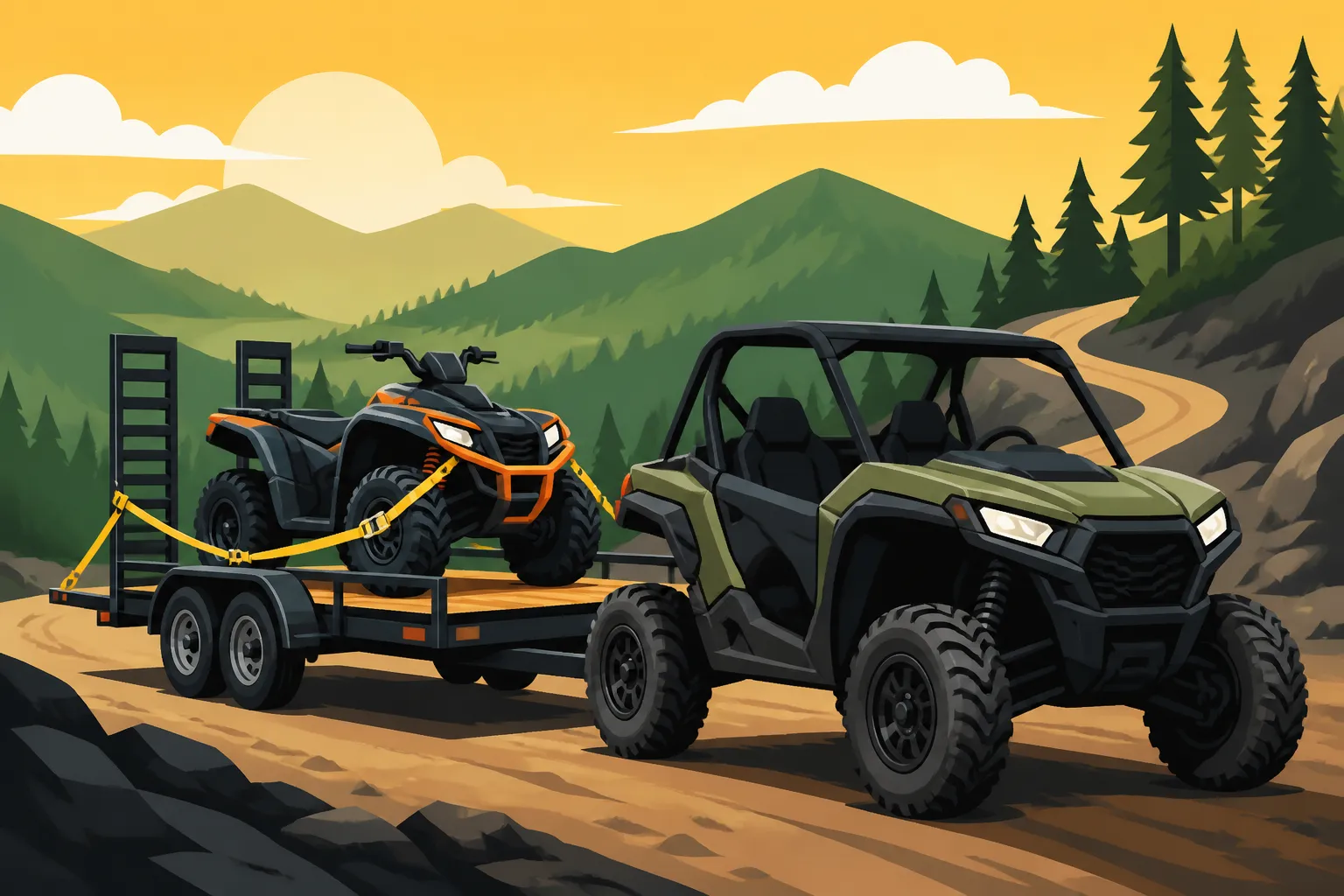
One of the biggest mistakes riders make is underestimating the forces at play when hauling a heavy off-road machine. A typical ATV or UTV weighs hundreds, if not over a thousand, pounds. When you hit a bump, swerve, or brake suddenly, that weight shifts with incredible force. Simply throwing a couple of straps over your quad and calling it good is a recipe for disaster. You need proper tie-downs, and they need to be applied correctly. Think about using heavy-duty ratchet straps rated for more than the weight of your machine. You'll want to secure the machine at all four corners, pulling down and slightly outward to prevent any side-to-side or front-to-back movement. Many riders like to compress the suspension slightly when strapping down, which helps prevent the machine from bouncing and putting extra stress on the straps.
Beyond just the straps, consider how the machine sits on the trailer. Is the weight distributed evenly, or is there too much tongue weight (which can cause sway) or too little (which can lift the hitch)? Always double-check your tie-downs after driving a few miles, especially on rougher roads, as straps can sometimes loosen. It's a small precaution that can prevent a much larger problem down the line. Remember, a properly secured machine won't shift at all, even during aggressive maneuvers.
Trailer Requirements and Safety Checks
Your trailer itself is another critical piece of the hauling puzzle. Virginia requires trailers to meet certain safety standards, especially regarding lighting and braking. For instance, your trailer must have working tail lights, brake lights, turn signals, and often side marker lights, especially if it's a larger or wider unit. Before every trip, do a quick walk-around. Check the tires for proper inflation and any signs of wear or damage. Underinflated tires can lead to blowouts, especially on a long haul through the mountains where heat can build up. Examine the wheel bearings for any signs of grease leakage or excessive play. A catastrophic wheel bearing failure on a mountain road is something you absolutely want to avoid.
If your trailer is heavy enough, it might also be required to have its own braking system. Consult your trailer's manual or a local trailer expert to ensure it complies with Virginia's regulations for its weight class. Don't forget the hitch and safety chains. The hitch ball should be the correct size for your trailer coupler, and the safety chains should be crossed under the tongue and connected securely to your tow vehicle. This creates a cradle in case the coupler detaches, preventing the trailer from careening off. Also, ensure your license plate is properly displayed and lit, and you have a spare tire for the trailer – because mountain roads are not the place to be stranded with a flat.
Virginia Road Laws and Mountain Driving
Hauling a heavy load changes the dynamics of your tow vehicle significantly. You'll experience longer braking distances, reduced acceleration, and a higher center of gravity, which affects cornering. This is especially true when you're [Trailering Over Appalachian Grades]. When driving through the mountains to reach a Coalfield trailhead, you'll encounter steep ascents and descents, sharp curves, and sometimes narrow roads. You need to drive defensively and cautiously. Downshift on descents to let your engine help slow the vehicle, preventing your brakes from overheating and fading. This is often called "engine braking" and it's a lifesaver on long, steep grades. On ascents, don't be afraid to take it slow and stay in the right lane if you're holding up traffic; it's safer than pushing your vehicle past its limits.
Be mindful of posted speed limits, which are often lower for vehicles towing trailers. Pay extra attention to your mirrors, as your blind spots will be larger with a trailer attached. High winds, common in mountain passes, can also cause trailer sway, so reduce your speed and maintain a firm grip on the steering wheel. Remember, the goal is to arrive safely, not quickly. Also, keep in mind that while your trailer needs a plate, your quad itself does not get one. [Your Trailer Needs a Plate but Your Quad Does Not] clarifies this distinction.
Navigating the Unique Challenges of Coalfield Roads
The journey to Virginia's Coalfield trails isn't just a straight shot down an interstate. These areas are characterized by winding mountain roads, often with limited services, and weather that can change in a heartbeat. Being prepared for these specific conditions is key to a stress-free trip.
Anticipating Mountain Weather and Road Conditions
Appalachian weather is notoriously unpredictable. A sunny morning at home can quickly turn into a torrential downpour, or even snow, in the higher elevations near the trailheads. Always check the local forecast for your destination, not just your starting point, before you leave. Heavy rain can make gravel access roads slick and muddy, impacting your towing vehicle's traction and potentially causing your trailer to slide. Fog is also a common occurrence in the mountains, reducing visibility to mere feet. If you encounter fog, slow down, turn on your low-beam headlights (and fog lights if you have them), and increase your following distance.
Beyond weather, the roads themselves present challenges. Many secondary roads leading to trailheads can be unpaved, narrow, and include sharp turns with blind spots. Be alert for wildlife, which is abundant in these rural areas, especially at dawn and dusk. [Dust and Blind Corners on a Mountain Gravel Road] highlights some of these specific concerns. The infrastructure might also be less developed; expect fewer gas stations, रेस्ट stops, and cell phone service areas. Having a full tank of fuel and planning your stops strategically is wise.
Planning Your Route to Remote Trailheads
A GPS is invaluable, but don't rely on it exclusively, especially if it's prone to directing you down unmaintained forest roads. Cross-reference your GPS directions with a physical map or a reliable mapping app that shows actual road conditions or reviews. Websites for the [Spearhead Trails in Virginia Explained] systems, like Coal Canyon, Mountain View, and Original Pocahontas, often provide specific directions to their trailheads and suggest tow-friendly routes. These remote trailheads might not have prominent signage until you're very close.
Consider potential [Cell Dead Zones in the Coalfields]. Having downloaded maps or even a printed map can save you from getting lost without a signal. If you're planning a trip with a group, share your route and estimated arrival time with someone who isn't traveling with you. This is an important safety precaution for any backcountry travel. Also, be aware that some trail systems might have multiple parking areas; make sure you're navigating to the one that best suits your needs for unloading and accessing the specific trails you intend to ride.
Packing Essentials for a Long Haul and Trail Day
Your packing list needs to cover both the journey and the riding itself. For the haul, make sure you have essential roadside emergency gear: jumper cables, a basic tool kit, a first-aid kit, a flashlight, and emergency flares or reflective triangles. Since you're traveling through rural areas, a full-size spare for your tow vehicle (and your trailer, if applicable) is a must. Don't forget water and snacks for everyone in the vehicle. [Packing for Mountain Weather] is critical; have layers of clothing, rain gear, and sturdy footwear for everyone, even if the forecast looks clear.
For the actual trail riding, ensure you have all the necessary permits, such as [Virginia Spearhead Trail Permits], and proof of ownership for your machine. While Virginia doesn't require ATV insurance, it's always a good idea to have some coverage, and your insurer might ask for proof of ownership if you need to file a claim. Beyond that, pack for the trail itself: water, snacks, a small backpack with a basic tool kit for your ATV/UTV, extra fuel (if you're going on a long ride), and any safety gear like [Virginia Helmet Law Applies to Every Rider]. A printed copy of your permits, along with photo ID, is crucial as trail rangers will often perform [Virginia Permit Checks on the Trail].
What to Expect at Virginia's Coalfield Trailheads
Arriving at a Coalfield trailhead is exciting, but it's also where the rules of the road give way to the rules of the trail. Knowing what to expect regarding parking, amenities, and required paperwork will help you transition smoothly from hauling to riding.
Parking, Amenities, and Local Etiquette
Virginia's Coalfield trail systems, like those managed by Spearhead Trails, generally offer ample [Virginia Trailheads With Trailer Parking]. These parking lots are usually large and designed to accommodate vehicles with trailers, but during peak seasons or busy weekends, they can fill up quickly. Arriving early can help you secure a good spot for unloading. Amenities can vary significantly from one trailhead to another. Some might have restrooms (often vault toilets), picnic tables, and perhaps a small visitor center, while others might be more primitive, offering little more than a gravel lot. Always assume you'll need to be self-sufficient.
Local etiquette is also important. These trail systems are often vital to the local economy and community. Be respectful of private property bordering the trails and trailheads. [Virginia Rules for Riding Private Land] are very strict, requiring written consent. Keep noise to a minimum, especially in residential areas surrounding some trail towns. Pack out everything you pack in, including all trash. Leaving a trailhead tidy shows respect for the land and the community, ensuring these trails remain open for everyone to enjoy for years to come.
Essential Paperwork for Trail Access and Ownership Proof
When you reach the trailhead, you absolutely need to have your ducks in a row regarding paperwork. The most important document will be your trail permit. For Spearhead Trails, this means a valid [Virginia Spearhead Trail Permits] that matches the rider's photo ID. Trail rangers are present and do perform checks. They will confirm your identity and that your permit is active. This isn't just a suggestion; it's a requirement for accessing the trails.
Beyond the permit, it's wise to carry proof of ownership for your ATV or UTV. While [Virginia Titles ATVs but Never Registers Them], you should still have a title or a bill of sale handy. This proves the machine belongs to you, which can be critical if there's an incident or if an officer asks questions. [What an Officer Can Ask For at a Trailhead] can include proof of ownership, so being prepared can prevent delays. If you've just bought your machine in a private sale, consider using a template from a service like LawDepot to create a formal Bill of Sale, even if you’re also pursuing a title. This extra layer of documentation can protect you. Similarly, if you're dealing with a complex titling situation or need affidavits, online resources like LawDepot can provide templates for [Virginia Notarized Affidavits in Lieu of Title].
Pre-Ride Checks Before Unloading
Before you unstrap your machine and hit the dirt, perform a quick pre-ride inspection. Check tire pressure, ensure all fluid levels (oil, coolant, brake fluid) are good, and visually inspect for any leaks or damage that might have occurred during transit. Make sure your brakes are responsive and your lights (headlights, taillights) are working, even if you only plan to ride during daylight hours. A properly functioning spark arrester is also crucial, especially in dry conditions, to prevent wildfires.
It's also a good time to double-check your personal safety gear. Helmets, goggles, gloves, long pants, and sturdy boots are essential for every rider. Ensure everyone in your group understands the day's plan, has adequate water, and knows what to do in case of an emergency. This is also a good moment to remind everyone of the [Virginia Helmet Law Applies to Every Rider] and any age restrictions based on engine size. A thorough check now can save you from a breakdown or safety issue miles into the wilderness.
Common Pitfalls and How to Avoid Them
Even with the best intentions, riders sometimes fall into common traps when heading to the Coalfield trails. Being aware of these potential issues can help you avoid them and ensure a more enjoyable, stress-free experience.
Overlooking Basic Maintenance
It's easy to get caught up in the excitement of a trip, but neglecting basic maintenance on your ATV or UTV before you leave can lead to significant problems. A machine that's been sitting for a while, or one that's overdue for an oil change, might not hold up to the rigors of mountain riding. Before your trip, make sure your machine has had its regular service. Check the air filter, inspect brake pads, ensure all nuts and bolts are tight, and lubricate moving parts. This extends to your trailer as well; inspect tire tread, lug nuts, and ensure your wheel bearings are properly greased.
Breaking down miles from the nearest road in the Coalfields can be a serious situation, especially if you're in a [Cell Dead Zones in the Coalfields]. Prevention through routine maintenance is far better than dealing with a costly and inconvenient repair on the trail. Even something as simple as ensuring your spark arrester is clean and functional is critical for both machine performance and wildfire prevention.
Ignoring Local Ordinances and Rules
Each trail system and surrounding county can have specific rules beyond state laws. [Virginia Penalties for Illegal Riding] can be stiff, and ignorance is no excuse. While Virginia does not issue specific vehicle registrations for ATVs, local rules can still impact your visit. Always review the specific rules for the trail system you plan to visit, whether it's Spearhead Trails or a national forest system like Peters Mill Run. These rules often cover things like speed limits on the trail, riding hours, noise limits (some areas have decibel restrictions), and designated riding areas. For example, [Virginia's 25 mph Trail Speed Limit] applies to all Spearhead Trails.
Beyond the trails, be mindful of local town ordinances, especially if you're staying in a nearby community. Don't ride your ATV on public streets or sidewalks unless it's a specifically designated route within an approved Coalfield trail town; [Virginia Bans ATVs on Public Highways]. Respect quiet hours at campgrounds or rental cabins. These are common sources of friction between riders and residents, and local authorities often have the power to enforce these rules with fines or even impoundment. If you're unsure about any local rules, check the trail system's website or contact their office directly.
Underestimating the Appalachian Terrain
The Appalachian Mountains offer some of the most beautiful and challenging riding in the eastern U.S., but they are not to be underestimated. The terrain can be rocky, steep, and muddy, with sudden drops and tight turns. Even trails rated as "easy" can present challenges, especially after heavy rain. Always ride within your skill level and the capabilities of your machine. If you're new to mountain riding, start on easier trails and gradually work your way up. [Virginia Trail Difficulty Ratings] for systems like Spearhead are there for a reason – pay attention to them.
Ensure your machine is properly equipped for the terrain. Good tires with aggressive tread are a must for traction on loose rock and mud. Skid plates can protect vital components from impacts with rocks and roots. And always bring adequate recovery gear if you're tackling more challenging routes. A winch, tow strap, and basic tools can turn a bad situation around. Also, be prepared for [Packing for Mountain Weather] changes throughout the day; even if it starts sunny, a sudden shower can make trails significantly more difficult and slippery. Always ride with a buddy, and let someone know your planned route and expected return time, especially if you're venturing into remote areas.
Disclaimer
This article is for general informational purposes only and does not constitute professional advice. Laws, prices and regulations vary by location and change over time. Consult a qualified professional for guidance on your specific situation.