Taking an ATV Safety Course No Law Requires
Virginia does not require every ATV or UTV rider to complete a safety course, so it can be hard to tell whether training is worth the time. The practical answer depends on who will ride, where the machine will be used, and how comfortable the riders are with its controls. A course is optional under state law, but it can still help prevent avoidable mistakes.
What Virginia’s course rule means
Virginia does not impose a general ATV safety-course requirement on riders. Completing a course is not a substitute for following the rules that do apply, though, and “no course required” does not mean “no rules apply.” Riders still need to understand the age limits, helmet requirements, road restrictions, and land-access rules relevant to where they ride.
A safety course is also separate from a trail permit. A permitted riding area may have its own operating rules, while a private park or landowner can set conditions for using its property. Before hauling a machine to a particular destination, check the current requirements for that place rather than assuming the state’s course rule settles the question.
| Question | What the answer means |
|---|---|
| Does Virginia generally require an ATV safety course? | No general state course requirement applies to ATV riders. |
| Does that make a course useless? | No. Training can help riders build practical skills and make safer decisions. |
| Does taking a course replace a trail permit? | No. Permits and training are separate requirements. |
| Can a riding area or private park set its own conditions? | Yes. Check the destination’s current rules before you go. |
| Does training change age or helmet rules? | No. Riders must still follow the applicable rules. |
For a fuller look at the statewide distinction, see Virginia Has No Safety Course Requirement and Taking an ATV Safety Course No Law Requires. Do not treat the course issue as permission to ride on any road or property. Virginia’s rules prohibit many types of road riding, and access to private land generally depends on permission. The details are covered in Can You Ride an ATV on the Road in Virginia? and Virginia Written Consent on Private Land.
Trail access brings another separate set of considerations. Spearhead Trails and Virginia’s national forest riding areas have distinct permit systems; one permit does not automatically cover another network. A course certificate does not stand in for either. Check Virginia Spearhead Trail Permits and Virginia National Forest OHV Permits when planning a trip.
A course may still be a sensible choice even when neither state law nor the destination requires one. The case is strongest for a new operator, a young rider, someone moving up to a more powerful or heavier machine, or a group that will ride unfamiliar trails together. Training is less likely to feel worthwhile if it only repeats basic information the rider already understands and offers no hands-on practice. Ask what the course actually covers before paying or committing a day to it.
When an optional course is worth considering
A course can help turn general cautions into habits: how to inspect a machine, manage speed, account for changing ground, and communicate with other riders. Those skills matter because an ATV or UTV can behave differently from a car or motorcycle, especially on a slope, in loose material, or when carrying a passenger or cargo.
Consider training when one or more of these situations apply:
- The rider is new to off-road machines. Familiarity with cars, bicycles, or motorcycles does not automatically prepare someone for ATV steering, body position, braking, or traction.
- A child or teen will ride. A parent can explain boundaries and supervise, but a structured lesson may help a young rider hear safety instructions from someone outside the family. Training does not override Virginia’s age limits or machine-size rules; review Virginia ATV Age Requirements and How Big a Machine a Virginia Teen May Ride.
- The machine is new to the rider. A larger, heavier, more powerful, or differently configured ATV or UTV may require a different approach to handling.
- The group expects to ride technical or unfamiliar ground. Hills, mud, rocks, ruts, and changing weather make control and route choices more demanding than riding on a familiar flat field.
- The machine will carry a passenger or gear. Added weight changes how a machine responds. Riders should know whether the machine is designed for a passenger and how to secure cargo without compromising control.
- Several people share one machine. A course can help establish common expectations for controls, signals, speed, and what to do if someone gets separated.
- The rider is returning after a long break. A refresher may be useful if skills have faded, physical ability has changed, or the rider has moved to a different type of machine.
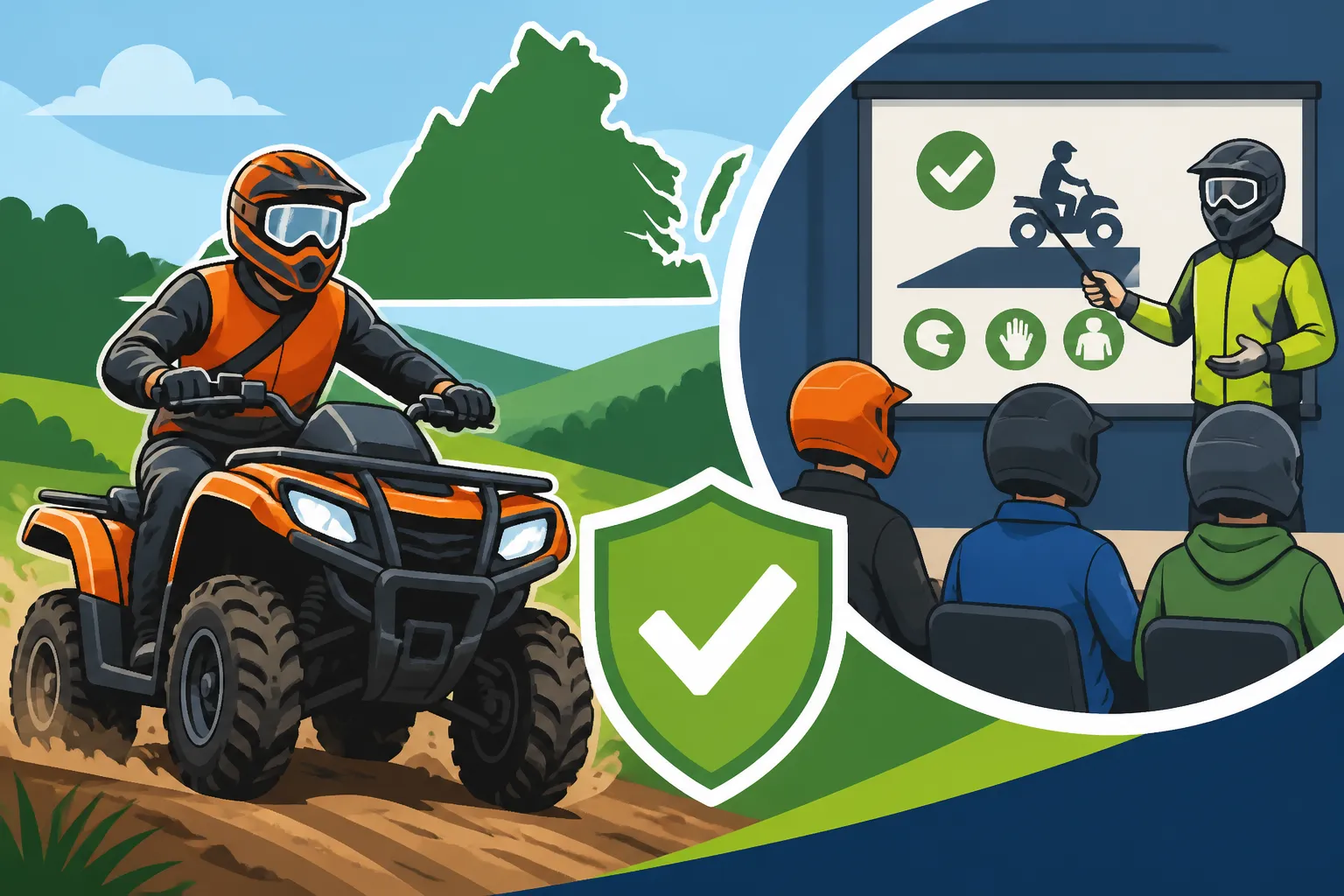
Training is particularly useful when it includes supervised practice, not just a list of rules. A rider might know that a hill requires care but still need practice choosing a safe line, maintaining control, and deciding when to turn back. Likewise, reading about protective gear is not the same as checking that it fits and is suited to the conditions.
Not every rider needs a formal course before the first ride. An experienced adult using a familiar machine on private land with permission may reasonably decide that careful preparation, a responsible practice area, and ongoing learning are enough. That choice should be based on the rider’s actual ability, not simply on confidence or years spent driving a car. Even experienced riders can benefit from a refresher when they change machines or riding environments.
What a useful ATV safety course should cover
Course content varies, so look beyond the word “certified” or “safety” in a listing. First confirm that the training is for the kind of machine being used. A course focused on motorcycles, snowmobiles, or another vehicle may not teach the handling skills an ATV or UTV rider needs.
A worthwhile course should address the practical situations a rider is likely to face. Depending on the provider and format, look for coverage of:
- Pre-ride checks. How to check controls, tires, brakes, lights, and other basic equipment, and what to do if something is not working properly.
- Protective gear. How to choose and use a properly fitting helmet and appropriate eye protection, footwear, gloves, and clothing. Virginia helmet rules still apply whether or not a rider has taken training; see Virginia ATV Helmet Law Explained.
- Basic control skills. Starting, stopping, turning, controlling speed, and maintaining balance or body position for the machine type.
- Terrain and traction. How ground conditions, slopes, obstacles, and weather affect control, and when avoiding a feature is safer than attempting it.
- Passenger and cargo safety. Why a passenger should ride only on a machine designed for passengers, and how added weight can affect handling.
- Riding with others. Safe spacing, communication, regrouping, and ways to reduce the risk of a faster rider leaving someone behind.
- Emergency decisions. How to stop, get help, and respond when a rider or machine is in trouble.
- Local rules and land access. The importance of knowing where riding is allowed and getting required permission before entering private property.
Hands-on practice can be especially valuable for beginners, but it should take place in a controlled setting with an instructor who can supervise safely. A brief online course may be convenient for learning concepts and rules, but it cannot give a new rider the same supervised opportunity to practice machine control. If the course is online, treat it as a learning tool, not proof that you can safely handle every condition.
Ask the provider a few specific questions before enrolling:
- Is the course designed for ATVs, UTVs, or both?
- Does it include supervised riding practice, or is it classroom or online instruction only?
- What age groups and experience levels is it designed for?
- What machine or protective equipment must participants bring?
- Does the provider issue a completion record, and what does that record actually represent?
- Is the course accepted by the particular riding area, employer, insurer, or organization you have in mind?
That last question matters. A provider’s certificate may document that someone completed a course, but it does not automatically qualify the rider for every trail system, job, event, or insurance arrangement. If another organization says training is required, ask which course it accepts and what proof it needs. Get that answer from the organization setting the requirement, not from a general course advertisement.
If you are comparing several options, prioritize clear course objectives, appropriate machine-specific content, qualified instruction, and a format that suits the rider. A cheaper or more convenient course may be a poor fit if it leaves out the practical skills the rider needs. Conversely, a long course may not be necessary if the goal is a basic refresher and the rider already has experience. The useful measure is not the length of the certificate list; it is whether the rider comes away better prepared.
How to prepare and keep learning after the course
Before signing up, decide what problem the course should solve. A beginner may need a broad introduction to controls and trail behavior. A parent may be focused on helping a child ride within legal age and machine limits. An experienced rider may want to improve judgment on hills or learn to operate a UTV with passengers. A clear goal makes it easier to choose an appropriate course and judge whether it delivered.
Then verify the details directly with the provider. Course names can sound similar while covering different vehicles or audiences. Confirm the format, practice opportunities, age eligibility, equipment expectations, location, cancellation terms, and whether the completion record is accepted by the organization that asked for training. Policies and availability can change, so confirm them before making travel plans.
If the rider is a minor, involve the parent or guardian in choosing the course and supervising practice. A course cannot make an undersized machine appropriate or make a prohibited ride legal. Review the rider’s age, the machine’s engine size, and any rules set by the destination. The relevant state requirements are summarized in Virginia Rules for a Rider Under 18 and Virginia Youth Permit Rules.
After the course, build skill gradually. Start in a legal, open area with permission, on terrain suited to the rider and machine. Avoid starting with steep slopes, deep mud, water crossings, or crowded trails. Change only one challenge at a time, and stop if conditions exceed the rider’s ability. Confidence should grow from controlled practice, not from pressure to keep up with someone faster.
A simple preparation routine helps make the training useful:
- Check the machine before riding. Follow the owner’s manual and address defects before setting out.
- Match the ride to the least experienced person. Choose a route and pace that do not force a beginner to attempt unfamiliar obstacles.
- Agree on communication and regrouping. Decide how the group will signal a stop and what to do if riders become separated.
- Carry appropriate protective equipment. A course is not a substitute for wearing gear or following helmet rules.
- Confirm access, permits, and operating hours. Rules differ between trail networks, public land, private parks, and private property.
- Review conditions before departure. Weather, closures, and trail surfaces can change the risk of a planned ride.
- Debrief afterward. Talk through any moment that felt difficult and decide what to practice before the next outing.
Some riders may also want to keep a course completion record with their other machine documents. That can make it easier to show an employer, riding organization, or insurer what training was completed if one asks. But keep the record in perspective: it shows participation or completion according to the provider’s terms; it does not prove that a rider is safe in every situation or exempt anyone from local rules.
Training is one part of risk management, alongside suitable equipment, protective gear, maintenance, permission to ride, and sound decisions about weather and terrain. If a rider is not ready for a feature, turning around is a skill, not a failure. A course is most useful when it helps riders recognize the limits of their ability and machine before those limits become an emergency.
Disclaimer
This article is for general informational purposes only and does not constitute professional advice. Laws, prices and regulations vary by location and change over time. Consult a qualified professional for guidance on your specific situation.