Virginia Private Park Pet Rules
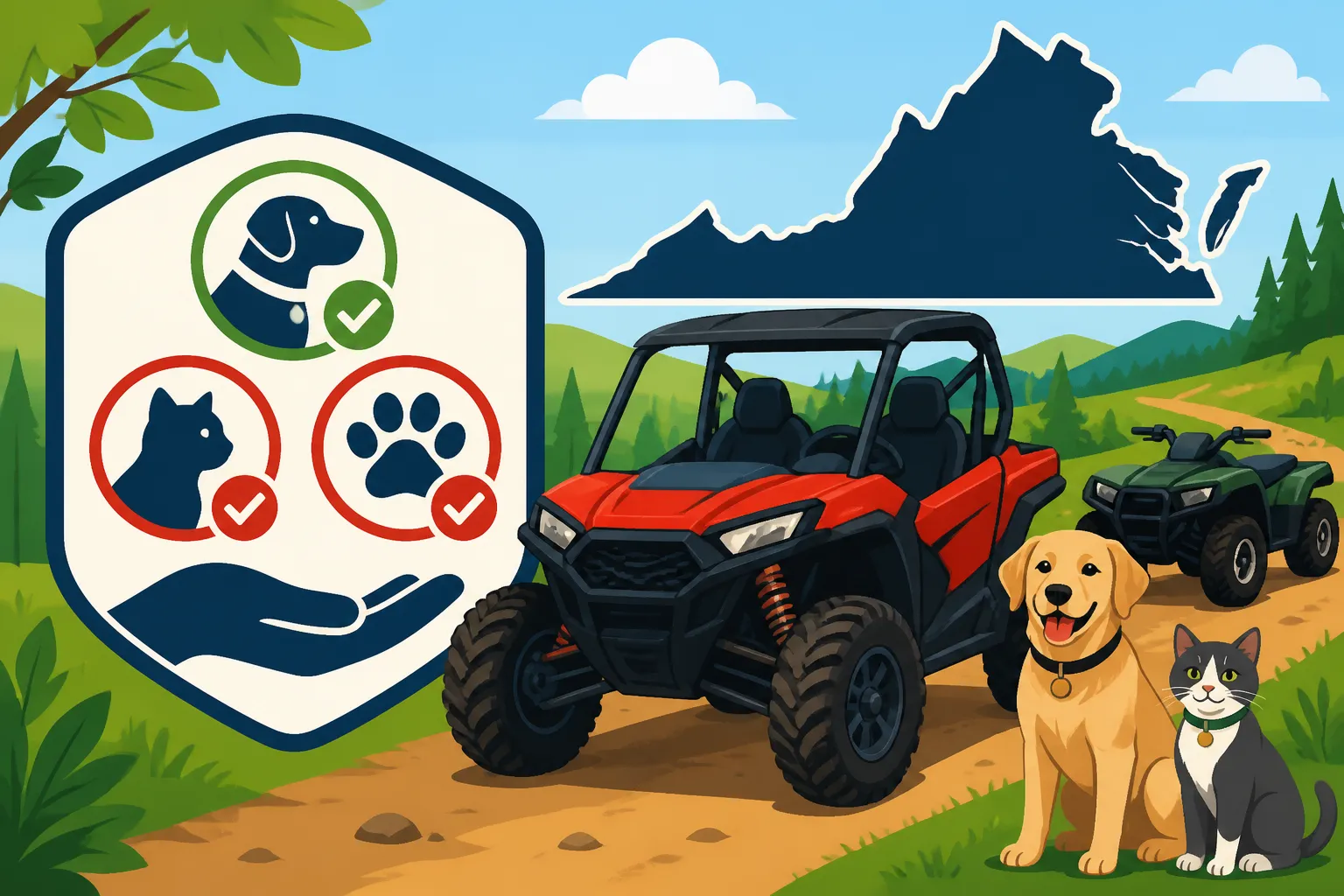
Virginia private park pet rules can be hard to judge before you load up: one property may welcome dogs at its campground but restrict them on trails, while another may not allow pets at all. Policies are set by each park, so a permit or a dog-friendly campground nearby does not guarantee trail access. Here’s what to check before you go.
Private park pet rules depend on the property
Virginia does not have one pet policy that applies to every privately operated off-road park. Each operator can set its own rules for dogs and other pets, including where they may go, whether they must be leashed, and whether they are allowed in camping areas or cabins. Check the specific park’s current rules rather than assuming that a policy at one riding area applies elsewhere.
It also helps to separate park pet policies from ATV riding rules. A trail permit, waiver, or vehicle inspection does not necessarily give a pet permission to enter the park. Likewise, a campground’s pet policy may not cover trails, staging areas, buildings, or shuttle vehicles. Read the park’s rules as a whole, including any separate camping or lodging terms. Virginia Private Park Waivers and Rules can help you understand why a waiver and a property’s other conditions matter.
| Where you want to take your pet | What to check before arrival |
|---|---|
| Trail system | Whether pets are allowed on trails, and whether leash or other restrictions apply |
| Staging or parking area | Whether pets may wait there and whether they must be attended |
| Campground | Pet limits, leash expectations, cleanup requirements, and any restricted areas |
| Cabin or other lodging | Whether pets are permitted in that accommodation and whether approval is needed |
| Event or group ride | Whether event rules differ from the park’s usual policy |
| ATV or UTV | Whether animals may be carried at all; do not assume a pet can ride safely or is allowed |
When a rule is not posted clearly, ask the park directly and get the answer before driving there. A short phone call or message can clarify whether the restriction applies to the entire property or only particular areas. If staff say pets are allowed, confirm whether that means pets on trails, pets at the campground, or both.
Treat vague wording conservatively. “Pets allowed” might refer only to a designated camping area, while “no pets on trails” may still allow a dog to stay at a campsite with a responsible adult. Ask what the policy means for your specific plan, especially if some members of your group intend to ride while another person stays with the dog.
Check the details before bringing a dog
A useful policy check covers more than the simple question of whether pets are allowed. Ask about leash rules, designated areas, supervision, cleanup, and what happens if a pet becomes disruptive. A park may have stricter conditions during a busy event or in certain facilities than it does in an open camping area.
Ask about leash and supervision requirements
Do not assume that a dog may roam freely just because the property is private or rural. A park may require a leash in shared areas, restrict pets from particular trails, or expect an animal to stay with its handler. Even if no leash rule is listed online, bringing a leash is a practical baseline: it gives you a way to keep your dog close around vehicles, other riders, and unfamiliar animals.
Ask how the park defines a controlled pet. Is a leash required everywhere, or only around people and vehicles? Are there any areas where a dog can be off-leash? If an off-leash area is not clearly identified, do not treat an open field, trail, or campsite as permission to let a dog run.
Confirm cleanup and waste rules
Bring bags and plan to remove your dog’s waste promptly. Ask whether the park provides waste bins and where they are located; do not count on finding one at the trailhead or campsite. Leaving waste behind creates an avoidable nuisance for other visitors and may violate the property’s rules.
Water and food need planning, too. A dog may be outside longer than expected while a group is unloading, riding, or waiting for other participants. Bring water and a bowl, and ask whether the park allows pets inside any facilities where you might otherwise refill supplies.
Clarify restrictions on lodging and shared spaces
Pet permission can change from one part of a property to another. A dog might be allowed at a campsite but not inside a cabin, store, dining area, or restroom. Some operators may also set limits for particular accommodations. Check the terms for your specific booking rather than relying on a general statement about pets.
If you plan to camp, review the park’s camping conditions alongside its pet policy. Virginia Private Park Camping Rules covers the kind of property-specific camping requirements riders should check before settling in. For a cabin or other lodging, ask whether the pet must be disclosed or approved when you make the reservation.
Shared spaces deserve extra care even when dogs are permitted. Keep your pet close when people are walking between vehicles, unloading machines, or setting up camp. Give other visitors room, and do not let a dog approach someone, another animal, or a machine without permission. These habits fit the practical expectations described in Virginia Trail Etiquette Locals Expect.
Keep pets separate from the ride
A dog can be welcome at a park and still be a poor fit for a busy riding day. Trail systems bring together engine noise, dust, sudden movement, and unfamiliar machines. A pet that is calm at home may react differently when several vehicles start at once or pass close by.
The safest plan is usually to leave the dog with a responsible person in an area where pets are permitted, or make arrangements for the dog to stay elsewhere. Do not tie a pet to a parked ATV or UTV: a sudden start, a moving machine, or a startled animal can turn a short wait into a serious injury risk. Do not assume that carrying a dog on a machine is allowed or safe. Virginia Passenger Rules on an ATV explains why passenger rules depend on the machine’s design, but a pet should not be treated as an ordinary passenger.
If one person stays behind with the dog, agree in advance on a location and a way to contact the riding group. Some parks have limited cell service, and riders may be away from the staging area for an extended period. A plan that depends on a quick text may not work once the group leaves.
Think through common stressors before you decide to bring the dog:
- Noise: Engine starts, revving, and nearby machines can frighten some animals.
- Traffic: Busy staging areas mean people and vehicles may move in several directions at once.
- Heat and weather: A pet left in a vehicle or exposed at a campsite may become uncomfortable or unsafe. Never assume a parked vehicle will stay cool enough.
- Dust and debris: Riding can stir up dust and loose material, including in areas where pets might wait.
- Wildlife and other dogs: A pet may encounter unfamiliar animals near trails or campsites.
- Limited retreat options: A dog that needs a quiet place may have few options if the campground is crowded or the group is far from the parking area.
If the park allows dogs on a trail, assess whether your particular dog is suited to that environment. Permission is not the same as a recommendation. A nervous, untrained, elderly, or injured animal may be better off staying somewhere quiet, even where the rules allow pets. A dog that is hard to control near unfamiliar people or machines can also create risk for the animal, its handler, and other visitors.
When you do walk a dog through a permitted area, keep it close and avoid placing it in the path of moving vehicles. Do not let it chase wildlife, approach other riders, or wander onto a trail while people are riding. If the park has separate rules for dogs around trail traffic, follow those over any general expectation about what dogs normally do in public outdoor spaces.
Make a plan for the whole visit
Before leaving home, check the park’s website or visitor information for a current pet policy. If the details are missing or unclear, contact the operator. Ask about the exact places you intend to use, not just whether pets are allowed on the property. Save or note the answer so everyone in your group knows the plan.
A practical checklist:
- Confirm pet access. Ask whether pets are allowed at the park, on the trails, in staging areas, and at your specific campsite or lodging.
- Check restrictions. Ask about leash requirements, supervision, restricted areas, cleanup, and any event-specific conditions.
- Plan for the dog’s care. Bring water, food, a leash, waste bags, and a quiet place to rest where permitted.
- Decide who stays with the pet. Do not leave the dog unattended around machines or rely on a rider to come back quickly.
- Prepare a backup plan. If the policy changes, the dog is uncomfortable, or the site is too busy, know where the pet can safely stay instead.
If you are bringing a group, make the pet policy part of the pre-trip conversation. Riders should know whether a dog will be at the campsite or staging area, and someone should be responsible for its care. Avoid making the dog everyone’s assumed responsibility. If the group is large, clarify how people, pets, and machines will share the space; Virginia Group Size on a Trail System is useful context for planning around other visitors.
Ask again if you arrive and the setup differs from what you expected. A crowded event, a temporary closure, or a newly marked restricted area may affect where pets can go. Follow staff directions even if you received different information earlier, and do not take a pet into a closed or restricted area.
A little advance checking prevents the most common problem: arriving with a dog only to discover that the campground allows pets but the riding area does not. The safest approach is to confirm the specific rules, keep the pet away from moving machines, and be ready to leave the dog at home if the visit would be stressful or unsafe.
Disclaimer
This article is for general informational purposes only and does not constitute professional advice. Laws, prices and regulations vary by location and change over time. Consult a qualified professional for guidance on your specific situation.