Virginia Forest Operator License Rules
Virginia Forest Operator License Rules
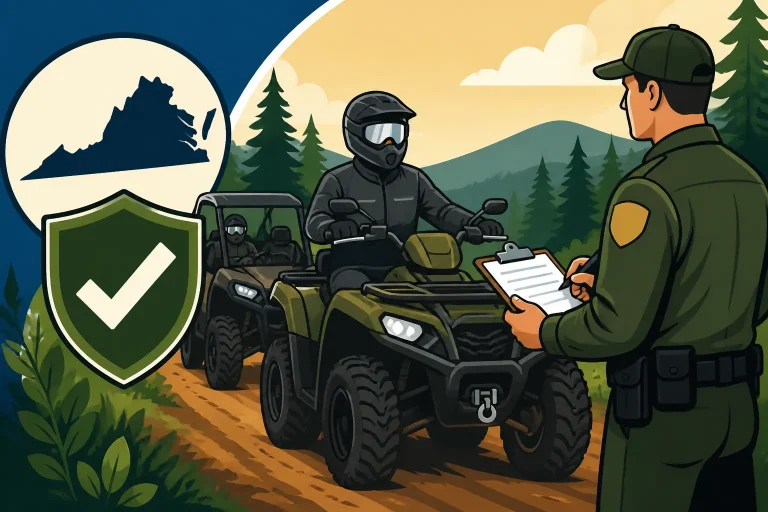
A forest OHV permit and permission to operate are separate requirements, and a driver’s license does not make every forest road legal to ride. If you are planning to use Virginia’s national forest trails, the key is to check the operator rules for the specific route as well as the permit, machine, and seasonal requirements. Peters Mill Run has a valid-driver’s-license rule riders should not overlook.
What the forest operator license rule means
On the Peters Mill Run OHV area, an operator must have a valid driver’s license. That is an operator qualification, not the trail permit itself. A rider may need to satisfy both requirements before using the route: the person must be allowed to operate there, and the machine must have the required permit and meet the area’s other rules.
This distinction matters because “I have a permit” does not answer “May I operate this machine here?” A permit does not replace a driver’s license where the area requires one. Likewise, having a driver’s license does not replace the permit or make an unapproved road or trail open to OHVs. For the permit side of the process, see Virginia National Forest OHV Permits.
The rule also should not be read as a statewide claim that every forest road in Virginia requires a driver’s license, or that every road is open to ATVs and UTVs if the rider has one. National forest routes have different designations and operating conditions. A road that is open to ordinary highway vehicles may not be open to an ATV, while a designated OHV trail can have specific requirements of its own.
For practical planning, treat a valid driver’s license as a condition of operating on Peters Mill Run, then verify the rules for the exact route you intend to ride. The requirements for a different national forest road, private riding park, or managed trail system may not be identical. The forest office or the current official area information is the right place to resolve uncertainty before hauling a machine to a trailhead.
| Requirement | What it does | What it does not do |
|---|---|---|
| Valid driver’s license where required | Qualifies the person to operate under the area’s operator rule | Serve as an OHV permit or open an otherwise closed route |
| Forest OHV permit | Satisfies the permit requirement for covered riding areas | Prove that the operator meets the license rule |
| Machine compliance | Helps ensure the vehicle meets area-specific equipment and use rules | Replace the operator’s qualifications |
| Route access check | Confirms that the particular road or trail is open to the machine | Guarantee access during closures or changing conditions |
The safest approach is to keep each question separate: Is the person qualified? Is the machine allowed? Is the permit valid for this area? Is this route open today? Answering all four prevents the common mistake of treating a permit or a license as blanket permission.
Where the rule applies and where it does not
The clearest application is Peters Mill Run, a national forest OHV riding area. Riders planning to use it should expect the operator to have a valid driver’s license and should be prepared to show it if asked. The requirement is tied to operating in the area; it is not a substitute for confirming which trails are open to a particular vehicle.
Taskers Gap is connected to the same broader riding system, but riders should not assume every detail is interchangeable simply because the areas are nearby. Width limits, route designations, seasonal closures, and other restrictions can differ. Review Virginia Forest Equipment Requirements and Virginia Forest Season Closures along with operator requirements before choosing a route.
It is also important to distinguish a national forest OHV trail from a public road that crosses or borders forest land. A forest boundary does not automatically change the legal status of a road. Nor does a valid license authorize an ATV or UTV to use a road that is closed to that kind of vehicle. Check the route’s posted signs and official designation; do not rely only on a map line or a route someone describes as “in the forest.”
The same caution applies to roads that appear to connect two riding areas. A connection may be restricted, may be open only to certain vehicle types, or may not be an authorized OHV route at all. If your intended route leaves a designated trail, find out whether the next segment is open before riding onto it. For related guidance about checking the specific riding area and its conditions, see Virginia Trail Conditions Before You Haul.
Nor should a rider assume the Peters Mill Run rule automatically applies to every private park or other Virginia trail system. A private park can set its own eligibility conditions, and another public system may use different operator requirements. For example, the permit and rider rules for a different trail network are not interchangeable with national forest rules. A permit issued for one system does not necessarily cover another, as explained in Why One Permit Does Not Cover Both Networks.
A useful planning rule is to identify the exact riding area and trail network by name, not simply “Virginia forest trails.” Then check the operator requirement and the route’s access rules for that location. That small step can prevent a long drive with a rider who cannot legally operate there or a machine that is not permitted on the route.
Who may operate and what to check for younger riders
A valid driver’s license requirement can be decisive for families and groups with younger riders. If the route requires a valid driver’s license, do not assume that a youth ATV permit, parental supervision, a safety course, or an adult riding nearby is an acceptable substitute. Those are separate issues, and none should be treated as an exception unless the authority responsible for the trail confirms it.
A learner’s permit is another point worth checking directly. Do not assume it meets a rule that says the operator must have a valid driver’s license. The terms may not be treated as interchangeable by the managing authority, and a rider should not discover that distinction at the trailhead. Ask the forest office what documentation is accepted for the exact area.
Age and machine-size rules can also apply independently of the forest operator requirement. Virginia has rules related to rider age and engine size in certain settings, while a managed area may impose additional conditions. A rider who meets one standard may still fail another. Review Virginia Trail Rules for Riders Under 18 and Virginia Age Limits by Engine Size, then confirm how those rules apply to the route you plan to ride.
For a family outing, check each person who might operate, not just the primary adult driver. If a youth will be driving any part of the route, ask whether that is allowed and what qualifications are required. Do not infer permission from the fact that a child can legally ride a particular machine somewhere else, or from seeing other families with young riders on a different trail.
An adult’s driver’s license does not transfer to a child operating the machine. Nor does having an adult present necessarily solve a minimum-age or license restriction. When in doubt, plan for the licensed adult to operate and confirm whether passengers are allowed on that machine and route. Passenger rules are separate from operator rules; a passenger’s age or presence does not establish that the driver is qualified.
Before leaving home, it can help to make a short rider-by-rider check:
- Identify who will operate each machine.
- Confirm whether each intended operator meets the license rule for the area.
- Ask the managing authority whether a learner’s permit or other document qualifies, if relevant.
- Check age and machine requirements for younger riders.
- Confirm passenger rules separately from operator qualifications.
If the answer for a younger rider is unclear, get a direct answer before the trip rather than relying on informal advice or assumptions based on another trail system.
What to bring and how to verify the rules
For a ride at Peters Mill Run, bring proof of the operator’s valid driver’s license and make sure the required forest permit is in order. Carrying the relevant documents is more straightforward than trying to explain eligibility during a check. If the permit is digital, save or download the confirmation before entering an area with unreliable cell service, and make sure the operator’s name and permit details are readable.
A driver’s license and an OHV permit serve different purposes, so keep both accessible. The license helps show the operator meets the applicable qualification. The permit shows that the permit requirement has been addressed for the covered area. Neither document proves that the machine is permitted on every route, so check trail signs and current access notices too.
Before the trip, verify the following:
- Operator qualification: Does the specific area require a valid driver’s license? Does the rule apply to every operator?
- Document acceptance: If the rider has a learner’s permit or another form of credential, has the managing authority confirmed that it is accepted?
- Permit coverage: Does the permit cover the riding area you plan to use? For purchasing and permit options, see Virginia Forest Permit Purchase Options.
- Machine eligibility: Is the ATV or UTV allowed on the selected route, and does it meet equipment requirements?
- Current access: Is the route open, or is there a seasonal, weather-related, or other closure?
- Rider age and passengers: Do any separate age, supervision, or passenger restrictions apply?
For questions that are not answered clearly in official material, contact the forest office or the office responsible for the riding area. Be specific: name the route, describe the machine, and explain whether the question concerns a full driver’s license, a learner’s permit, or a younger operator. A general question such as “Can kids ride?” can produce an incomplete answer because it may not identify the separate operator, vehicle, and passenger rules.
A safety course is not the same thing as a driver’s license. Completing a course may improve a rider’s skills, but it should not be treated as permission to operate where a license is required. Conversely, the absence of a general statewide safety-course requirement does not erase a trail manager’s operator conditions. See Virginia Has No Safety Course Requirement for the distinction between a course requirement and other riding rules.
Rules can also change, and access conditions can change even when the operator requirement remains the same. Check current official information close to the trip, especially if you are travelling a long distance. Older web pages, social posts, and comments from previous visitors may describe a different season, route, or rule.
Common mistakes to avoid
Treating a permit as an operator credential
A forest permit does not automatically qualify the person holding it to drive. If a driver’s license is required, the operator still needs to meet that condition. Keep permit verification and operator documentation as two separate checklist items.
Assuming a license makes the machine street legal
A driver’s license does not convert an ATV or UTV into a street-legal vehicle. It does not authorize use on public roads that are not open to the machine, and it does not override signs or route restrictions. Forest trail access and road legality are different questions.
Assuming all forest roads are OHV routes
National forest land contains roads and routes with different uses and restrictions. Being physically inside the forest does not mean that an ATV or UTV may travel there. Use official route information and obey signs rather than assuming a connection is open.
Applying one area’s rule to another
A requirement associated with Peters Mill Run should not be generalized to every private park, public trail, or forest road. The reverse is also true: permission to ride at another location does not prove eligibility at Peters Mill Run. Check the exact system you plan to visit.
Assuming supervision creates an exception
Having a licensed adult in the group may not satisfy a rule for the person actually operating. Do not assume that riding in tandem, following an adult, or being watched by a parent makes an otherwise ineligible operator acceptable. Ask the managing authority if an exception is unclear.
Arriving without checking documents or conditions
A rider may arrive with a permit but no accepted proof of license, or with both documents but an ineligible machine or a closed route. Verify the operator, permit, vehicle, and route separately. If you plan to ride more than one system, check whether each one has its own permit and rules.
Frequently Asked Questions
Do you need a driver’s license to ride Peters Mill Run?
The operator must have a valid driver’s license for Peters Mill Run. Check current official information before the trip, particularly if the operator has a learner’s permit or another credential rather than a full license.
Does a forest OHV permit replace a driver’s license?
No. The permit and operator qualification are separate. Having one does not automatically satisfy the other.
Can a licensed adult supervise someone who does not meet the operator rule?
Do not assume supervision is an exception. Confirm directly with the authority responsible for the trail before allowing that person to operate.
Does a valid driver’s license let an ATV use any road in the forest?
No. The license does not open roads or trails to OHVs. The route must be authorized for the machine, and current closures and posted restrictions still apply.
Do the same license rules apply at every Virginia riding area?
Not necessarily. Rules can differ by trail system and managing authority. Check the requirements for the exact location rather than carrying assumptions from one area to another.
Disclaimer
This article is for general informational purposes only and does not constitute professional advice. Laws, prices and regulations vary by location and change over time. Consult a qualified professional for guidance on your specific situation.