Why Virginia Says a Utility Vehicle Is Not a Motor Vehicle
It’s incredibly frustrating when you invest good money in a utility vehicle (UTV) for work or recreation, only to find yourself utterly confused by the seemingly endless maze of Virginia’s vehicle laws. You bought this machine to make life easier, or to hit the trails, but now you’re stuck wondering if it’s treated like an ATV, a car, or some entirely different beast the state just doesn't understand. This guide will cut through that confusion, explaining precisely why Virginia categorizes a utility vehicle as distinct from a "motor vehicle" in the eyes of the law, what that means for you, and how to navigate the practical realities of ownership.
Understanding Virginia's Vehicle Definitions
The root of much of the confusion around UTVs in Virginia lies in how the Commonwealth defines different types of vehicles. When you hear "motor vehicle," most people immediately picture a car, truck, or motorcycle – something that's street legal and requires a license plate. However, Virginia law has very specific, often nuanced, definitions that set UTVs apart. This distinction isn't just bureaucratic red tape; it fundamentally dictates how you can use your machine, whether it needs a title, and what kind of paperwork you’ll deal with.
The Legal Line Between a UTV and a Motor Vehicle
In Virginia, the definition of a "motor vehicle" under state code is quite broad, often including "any vehicle propelled by an internal combustion engine or by electricity or other mechanical power and manufactured for use on public highways." This is where UTVs often diverge. While they are certainly "propelled by mechanical power," many are not primarily "manufactured for use on public highways." Instead, they are designed for off-road use, agricultural tasks, or industrial applications. This crucial design intent is a primary factor in their classification.
Furthermore, Virginia law specifically defines "utility vehicles" (which often encompasses side-by-sides, UTVs, and some larger golf carts) as different from traditional motor vehicles. They are typically characterized by having four or more wheels, a roll-bar or cage, a steering wheel, and seating for two or more passengers side-by-side. Critically, they often have a maximum speed limitation and lack certain features (like specific lighting, turn signals, or safety glass) that are mandatory for highway-legal vehicles. This means that while your UTV is a powerful, capable machine, it doesn't fit the mold of a street-legal car or truck, and the laws reflect that. For a clearer picture, check out [Virginia ATV and Utility Vehicle Definitions] to see the precise language.
Why This Distinction Matters for Owners
This legal separation has enormous consequences for UTV owners in Virginia. First and foremost, because a UTV is generally not considered a "motor vehicle" manufactured for highway use, it is typically not eligible for standard vehicle registration or traditional license plates. This means you cannot simply drive it down the road like a car. Attempting to do so without meeting very specific, limited exceptions can lead to significant penalties, including fines and potential impoundment.
Secondly, the titling process, if required, often mirrors that of an ATV rather than a car. This is a subtle but important difference, as it affects the paperwork you'll receive and what information is recorded. For instance, you won't find odometer readings on a UTV title, as they're generally exempt from such requirements because they're not road-going vehicles. Understanding this distinction from the outset can save you a world of headaches when dealing with the DMV, insurance companies, or even when you eventually sell your machine. It also dictates what kind of taxes you'll pay and how they're assessed, which we'll touch on later.
Titling a UTV in Virginia: The ATV Connection
While UTVs aren't motor vehicles in the traditional sense, many still require or benefit from a Virginia title. This often catches new owners off guard, especially those who assume that "off-road" means "no paperwork." However, Virginia law, much like with ATVs, has specific titling requirements for UTVs, particularly if they are bought new after a certain date or if they exceed a specific engine displacement. It's a system designed for ownership tracking rather than road legality.
When Your UTV Needs a Virginia Title (and When it Doesn't)
The rule of thumb for UTVs in Virginia often mirrors that of ATVs: if your UTV was bought new after July 1, 2006, and has an engine displacement greater than 50cc, Virginia law generally requires it to be titled. This isn't about getting a license plate; it's purely about establishing a legal record of ownership. It’s a way for the state to track these machines, which can be useful in cases of theft or recovery.
However, there are nuances. If your UTV was purchased new before July 1, 2006, or if it falls under 50cc (which is rare for most modern UTVs), titling is typically optional. Similarly, if you buy a used UTV from a private seller, the state generally considers titling to be optional, regardless of its engine size or original purchase date. This "optional" status can be a double-edged sword: while it means less immediate paperwork, it can also create challenges if you ever need to prove ownership for insurance claims, financing, or future sales. For guidance on used machines, you can look at [Virginia Titles Are Optional on Used Machines].
The Titling Process for UTVs That Qualify
For those UTVs that do require a title (new machines over 50cc bought post-2006), the process is straightforward, albeit specific. You'll typically need to visit a Virginia DMV customer service center, bringing a few key documents. The most important of these is the Manufacturer's Statement of Origin (MSO) or Certificate of Origin (MCO), which you receive from the dealer when you purchase a new UTV. This document is essentially the birth certificate of your machine, proving it's new and hasn't been titled before.
You'll also need a bill of sale, proof of identity, and proof of your Virginia address. If you’ve bought from a dealer, they often handle much of this paperwork for you, submitting it to the DMV on your behalf. If you're doing it yourself, you'll fill out Virginia Form VSA 17A. There's a nominal fee for the title, which is currently set at a flat rate, regardless of the UTV's value. Remember, this title simply proves ownership; it does not authorize road use or provide a license plate. For more details on the process, check out [How to Title an ATV in Virginia], as the procedures are very similar for UTVs.
Common Titling Misconceptions for UTV Owners
One of the biggest misconceptions UTV owners face is equating a Virginia title with street legality. They are completely separate issues. Getting a title for your UTV does not mean you can now legally drive it on public roads. The title is purely an ownership document, much like a deed to a house, not a registration for highway use.
Another common misunderstanding revolves around the "optional" titling for used machines. While legally you might not have to title a used UTV, many financial institutions, especially if you're getting a loan to purchase it, will require a title to secure their interest (a lien). Moreover, having a title provides undeniable proof of ownership, which can be invaluable. If your UTV is ever stolen, having a title makes it much easier for law enforcement to track and return it to you. Without it, proving ownership can become a complicated affair, sometimes requiring affidavits like those mentioned in [Virginia Notarized Affidavits in Lieu of Title]. It’s generally a good idea to title your UTV even if it's optional, simply for the peace of mind and legal clarity it provides.
The Myth of UTV Road Registration in Virginia
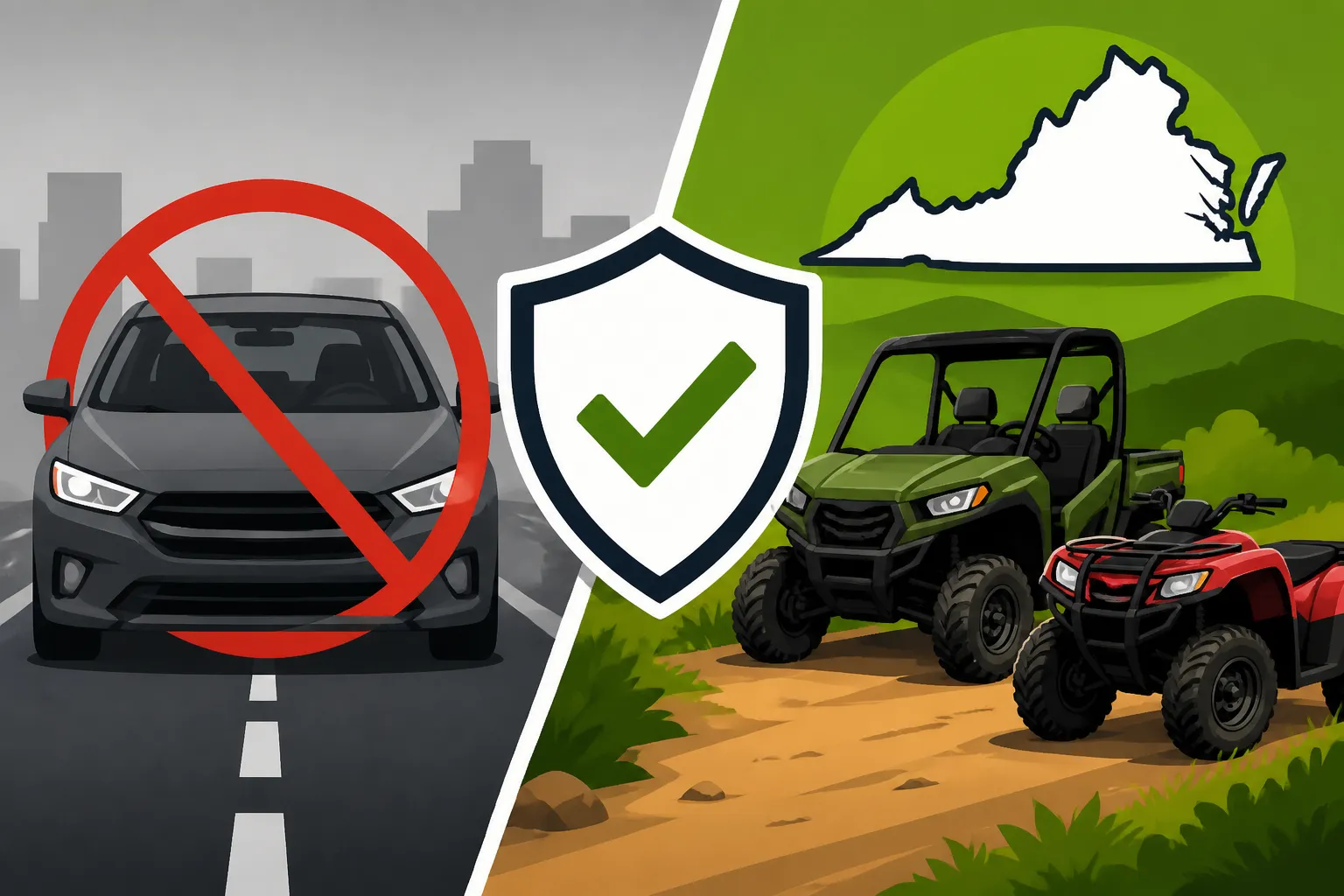
This is often the most heartbreaking truth for UTV enthusiasts: despite their car-like appearance and increasing capabilities, Virginia largely prohibits UTVs from public roads and highways. Many owners, especially those new to off-roading or moving from states with different regulations, are dismayed to learn that their powerful side-by-side cannot be registered for street use. This restriction is central to why Virginia distinguishes UTVs from "motor vehicles."
Why Virginia UTVs Are Not Street Legal (Generally)
The fundamental reason UTVs are not generally street legal in Virginia goes back to those definitions: they are not manufactured for highway use and do not meet the safety and equipment standards required for highway vehicles. This isn't just about a lack of turn signals; it encompasses a whole host of federal and state regulations regarding everything from lighting and braking systems to emissions and crashworthiness. While some UTVs can be modified with aftermarket parts, these modifications do not automatically confer street legality or make them eligible for registration with the Virginia DMV.
The state's position is clear: unless explicitly exempted, these machines are for off-road environments, private property, or designated trails. There is no established pathway in Virginia law for converting a UTV into a street-legal vehicle and obtaining a standard license plate. This is a crucial distinction, separating UTVs from even dirt bikes, which can sometimes be converted for limited street use under specific circumstances (though it's a complex process). For a deeper dive into why this path is blocked, see [Virginia Has No Street-Legal UTV Path].
Exceptions to the Rule: Farm and Emergency Use
Now, there are very specific, narrow exceptions where a UTV might legally operate on a public road in Virginia. These exceptions are typically tied to the machine's primary purpose and the specific conditions of its use, not its general eligibility for registration. The most common exceptions include:
- Agricultural Use: A UTV may be operated on public highways for agricultural purposes, such as moving between fields, transporting tools, or tending to livestock, for limited distances. This is usually restricted to county roads and requires the operator to follow specific safety guidelines, like having a "slow-moving vehicle" sign. For specific rules, refer to [Virginia Rules for a Utility Vehicle on a Farm].
- Emergency Services: Law enforcement, fire departments, and emergency medical services are typically permitted to use UTVs on public roads while responding to emergencies or performing official duties. These vehicles are essential tools in rescue operations or accessing difficult terrain.
- Crossing a Highway: You may be permitted to cross a public highway by the most direct route, perpendicular to the flow of traffic, to get from one piece of private property to another. This is a very short-distance, situational exception, not an authorization to travel down the road.
- Designated Public Access Routes: In very rare cases, specific local ordinances in certain counties (like Buchanan and Tazewell, known for their coalfield trails) may designate short stretches of public road as legal connectors between off-road trail systems. These are always clearly marked, have strict speed limits (often 25 mph), and are exceptions, not the norm.
These exceptions are strictly interpreted and do not grant general road access. They are circumstantial permissions, not a change in the UTV's fundamental non-highway vehicle status.
What About Out-of-State Registration Schemes?
You might hear whispers or see advertisements for schemes that promise to make your Virginia-based UTV street legal by registering it in another state, such as Montana. The idea is that you form an LLC in a state known for lenient vehicle laws, register the UTV there, and then operate it in Virginia under those out-of-state plates.
It's crucial to understand that these schemes are highly risky and generally not advisable for Virginia residents. While a Virginia law enforcement officer might initially see an out-of-state plate, the legality hinges on where the vehicle is principally garaged or used. If your UTV is primarily kept and operated in Virginia, Virginia law enforcement will apply Virginia law. This means that if your UTV doesn't meet Virginia's street-legal requirements, an out-of-state registration will likely not protect you from citations, fines, or impoundment. These arrangements are often scrutinized, and the legal repercussions can far outweigh any perceived convenience. It's almost always best to comply with the laws of the state where your vehicle primarily resides.
Practical Implications for UTV Owners
Beyond the legal definitions and titling requirements, owning a UTV in Virginia comes with a set of practical considerations that differ significantly from owning a car or even a traditional ATV. These implications touch on everything from how you protect your investment to how you legally transfer ownership. Navigating these aspects successfully requires a realistic understanding of your UTV's legal status.
Insurance, Financing, and Proof of Ownership
Since UTVs are not registered like motor vehicles, Virginia law does not require you to carry liability insurance for their operation. However, this absolutely does not mean you should skip it! Operating a UTV without insurance is a huge gamble. Accidents happen, and if you're involved in one where someone is injured or property is damaged, you could be personally liable for massive costs. Many responsible owners choose to carry comprehensive off-road vehicle insurance to protect against theft, damage, and liability, even if the state doesn't mandate it. For more on this, look into [Virginia Requires No ATV Insurance].
When it comes to financing, most lenders will treat a UTV loan differently than a car loan. Because there's no traditional registration, they rely heavily on the title as proof of ownership and as a place to record their lien. If you're financing a used UTV, the lender will almost certainly insist that you title the machine in your name, even if state law makes it "optional." This protects their investment. Always ensure the lender clearly understands the machine is a UTV and not a standard road vehicle, so there are no surprises with paperwork.
Proof of ownership is critical. Even without mandatory titling for some used machines, always keep a detailed bill of sale and any previous title or MSO documents. These papers, perhaps combined with a legal affidavit generated through services like LawDepot, are your primary defense against theft and your key to demonstrating legal ownership.
Selling or Buying a UTV in Virginia
Selling or buying a UTV in Virginia, especially a used one, can be a bit different from a car transaction. For a machine that was required to be titled (new, over 50cc, post-2006), the seller must sign over the title to you, just like a car title. This is a clear, unambiguous transfer of ownership.
However, for machines where titling was optional (pre-2006, under 50cc, or any used machine), you might encounter a seller who never bothered to get a title. In such cases, a comprehensive bill of sale becomes paramount. It should include:
- The full names and addresses of both buyer and seller.
- The make, model, year, and vehicle identification number (VIN) of the UTV.
- The purchase price.
- The date of sale.
- Signatures of both parties.
- A statement that the seller attests to legal ownership and that the machine is free of liens.
Some buyers might also request a notarized bill of sale or an affidavit of ownership to strengthen the paper trail. Services like LawDepot can help create robust, legally sound bills of sale and affidavits, offering an extra layer of protection for both parties. Always verify the VIN on the machine matches any paperwork and check for any outstanding liens through a DMV record search if possible, even for an untitled machine. It's often recommended to title a used UTV, even if optional, to simplify future sales and prove ownership unequivocally. More on this process can be found in [Virginia Titles After a Private Sale].
Addressing Common Concerns and Questions
Many UTV owners worry about property taxes. In Virginia, UTVs are generally subject to local personal property taxes, just like cars and other vehicles. How they are assessed (value, rate) will depend on your specific county or city. Since they don't have a specific "vehicle" classification in the same way cars do for titling, they typically fall under the general personal property tax rules. Always check with your local Commissioner of the Revenue or Treasurer's office for the exact rules in your area.
Another frequent question is about modifications. While you can customize your UTV to your heart's content for off-road performance or comfort, remember that these modifications do not change its legal status regarding public road use. Adding turn signals, a horn, or a windshield might make it safer for trail riding, but it won't magically make it street legal in Virginia. The state's stance on UTVs is about their fundamental design and manufacturing intent, not aftermarket additions.
Navigating Paperwork and Legalities
Dealing with vehicle paperwork can be daunting, and UTVs, with their unique legal status, often add another layer of complexity. Having the right documents and understanding their purpose is crucial, whether you're buying, selling, insuring, or just enjoying your machine. Knowing when and where to seek clarification can save you from costly mistakes.
Essential Documents for UTV Ownership
To ensure smooth ownership and avoid potential legal snags, every UTV owner in Virginia should keep a meticulous record of several key documents:
- Manufacturer's Statement of Origin (MSO) / Certificate of Origin (MCO): For new machines, this is the original proof that the vehicle was manufactured and is critical for initial titling. Keep this secure, as it's irreplaceable in its original form.
- Virginia Certificate of Title: If your UTV is titled, this document is your definitive proof of legal ownership. Guard it carefully. If lost, you'll need to apply for a duplicate at the DMV.
- Bill of Sale: For both new and used purchases, a detailed bill of sale is essential. It formalizes the transaction, records the purchase price, and provides critical details like the VIN. This is especially vital for used UTVs that may not have been titled. Consider using templates from a reliable source like LawDepot to ensure all necessary legal clauses are included.
- Insurance Policy Documents: Even if not required, having proof of insurance is smart. Keep a copy in your UTV (perhaps in a waterproof bag) and another in a safe place at home.
- Maintenance Records: While not legally required, good maintenance records can prove the vehicle was well-cared for, which helps with resale value and troubleshooting.
- Owner's Manual: Contains important operational, safety, and maintenance information specific to your UTV model.
Having these documents organized and readily accessible will make life much easier if you ever need to prove ownership, file an insurance claim, or sell your UTV.
Seeking Legal Clarity for Complex Situations
Sometimes, your situation might be unique, or the existing laws seem ambiguous. Perhaps you have a custom-built UTV, or you operate a business that uses UTVs for very specific, non-agricultural tasks on private land with occasional road crossings. In such cases, relying on general advice might not be enough.
For truly complex situations, especially those involving commercial use, property disputes, or intricate legal interpretations, it's always best to consult with a legal professional specializing in property or vehicle law in Virginia. They can provide advice tailored to your specific circumstances, ensuring you remain compliant and protected. You might also find answers to specific titling questions by directly contacting the Virginia DMV, although sometimes the answers can be generic. For common questions the DMV fields, you might find [Virginia Title Questions the DMV Hears] a useful starting point, but always verify details for your unique scenario.
What Virginia Law Doesn't Say (But Riders Wish It Did)
The current legal framework for UTVs in Virginia is clear, but it often leaves many owners wishing for more flexibility. The frustration of owning a capable machine that is essentially "landlocked" to private property or designated trails is a common sentiment among the UTV community. Understanding this gap between current law and rider aspirations helps frame the ongoing discussion and potential future developments.
The Ongoing Debate for Broader UTV Road Access
Across the country, there's a growing movement to allow UTVs more access to public roads, especially in rural areas where they serve as practical transportation and contribute to local economies, particularly tourism centered around trail systems. Many riders point to the safety features of modern UTVs—roll cages, seatbelts, even doors—arguing they are often safer than motorcycles or even some older cars. They also highlight the utility aspect, noting that for many, a UTV is a legitimate workhorse that could reduce wear and tear on their primary road vehicle if limited road use were permitted.
However, legislative efforts in Virginia to expand UTV road access beyond the very narrow current exceptions have generally faced an uphill battle. Concerns often revolve around differing vehicle safety standards, potential conflicts with traditional highway traffic, and the sheer diversity of UTV types, making it difficult to create a "one-size-fits-all" regulatory framework. While some states have adopted "street legal" conversion kits and registration for UTVs, Virginia has largely resisted this trend, preferring to maintain the clear distinction between highway-manufactured vehicles and off-road machines.
Looking Ahead: Potential Changes and Advocacy
While there's no immediate indication of a significant shift in Virginia's UTV road access laws, the landscape is not entirely static. As UTV technology advances, and as more people discover the utility and recreational appeal of these machines, the pressure for legislative review may increase. Advocacy groups, often composed of UTV clubs and enthusiast organizations, continue to engage with lawmakers, presenting data and arguments for responsible expansion of UTV use.
For UTV owners who wish to see changes, getting involved with local or state-level off-road vehicle associations is often the most effective way to make your voice heard. These groups track proposed legislation, organize public outreach, and directly communicate with policymakers. While the process of legislative change is slow, understanding why Virginia currently says a utility vehicle is not a motor vehicle is the first step in advocating for a future that might offer more flexibility while maintaining safety and order on public roads.
| Feature / Category | Virginia "Motor Vehicle" (e.g., Car, Truck) | Virginia "Utility Vehicle" (e.g., Side-by-Side) |
|---|---|---|
| Primary Design | Manufactured for public highway use | Manufactured for off-road, agricultural, or industrial use |
| Typical Seating | Tandem or multiple seats in rows | Side-by-side seating for 2+ passengers |
| Steering Control | Steering wheel | Steering wheel |
| Registration | Required for highway use (license plate) | Not eligible for standard highway registration |
| Titling | Required if over 50cc and new post-2006 (for ownership) | Required if over 50cc and new post-2006 (for ownership) |
| Odometer Reading | Required on title and for sales | Not recorded on title, not required for sales |
| Street Legality | Generally street legal | Generally NOT street legal |
| Insurance Req. | Mandatory for liability | Optional (though highly recommended) |
| Exceptions | N/A | Specific agricultural, emergency, or crossing use |
Disclaimer
This article is for general informational purposes only and does not constitute professional advice. Laws, prices and regulations vary by location and change over time. Consult a qualified professional for guidance on your specific situation.