Virginia Titles for an Inherited Machine
Inheriting an ATV or UTV in Virginia can be a bittersweet experience. While it might be a cherished memory of a loved one, the paperwork side of things can quickly turn a sentimental moment into a bureaucratic headache. You're likely grieving, or at least dealing with the emotional aftermath, and the last thing you want is to navigate complex DMV forms and legal requirements just to get that machine into your name. This guide is here to walk you through every step of titling an inherited ATV or UTV in Virginia, making a daunting process as clear and manageable as possible.
Understanding Virginia's ATV Titling Basics for Inherited Machines
Before you even think about visiting the Department of Motor Vehicles (DMV), it’s crucial to understand the foundational rules Virginia has for titling ATVs and UTVs. These rules don't change just because the machine is inherited; they are the bedrock for all ATV titling in the Commonwealth. Knowing them upfront can save you a lot of time and frustration, especially if, by some chance, the machine doesn't even need a title.
When a Title is Even Required in Virginia
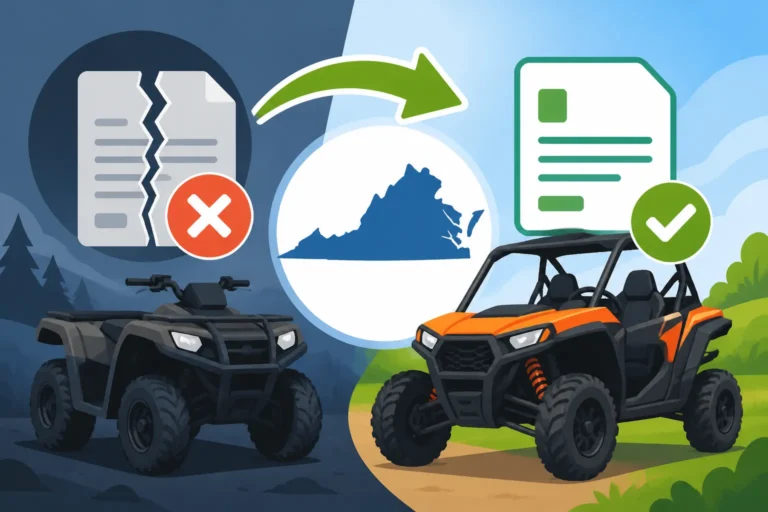
Here’s a fact many people don't realize: not every ATV or UTV in Virginia is legally required to have a title. The rules are pretty specific, and they depend on two main factors: engine size and when the machine was first purchased new. It might seem like an odd distinction, but it’s a critical one that could significantly impact your process.
First, Virginia law generally requires a title for any ATV with an engine displacement of 50 cubic centimeters (cc) or more. If the inherited machine is a smaller, youth-sized quad with an engine under 50cc, you might be off the hook for titling it altogether. These smaller machines are typically exempt from the titling requirement, simplifying things considerably. However, most adult-sized ATVs and utility vehicles easily exceed this 50cc threshold, so it's a good bet the machine you've inherited will likely fall into the "needs a title" category based on engine size alone. Keep in mind that even if it's not required, having a title is almost always a good idea for proving ownership and facilitating future sales, but we'll get into that later. [Virginia Titles Required on Machines Over 50cc]
The second key factor is the original purchase date. Virginia introduced ATV titling requirements relatively recently, with a specific cutoff date. Any ATV bought new after July 1, 2006, that also meets the 50cc-and-over requirement, is mandated to have a title. If the machine was purchased new before this date, even if it's well over 50cc, titling it remains optional in Virginia. This means if you've inherited an older quad that's been in the family for years, purchased say, in 2005, you might not be legally obligated to get a new title, though again, it's often advisable. These historical distinctions can certainly add a layer of complexity to an already emotional process, so it’s essential to confirm the machine’s age and engine size early on. [Virginia's July 2006 Titling Cutoff]
The Virginia DMV's Role in Estate Transfers
The Virginia DMV plays a crucial role in issuing titles, but it's important to understand that their authority begins after the estate has gone through its initial legal steps. The DMV isn't involved in determining who legally inherits the ATV or UTV; that falls to the probate court or the executor of the estate. Their job is to accept the appropriate legal documentation from the estate, verify it, and then issue a new title in the name of the rightful heir. They are essentially the final step in recognizing the new owner, not the first.
This means that while you'll ultimately interact with the DMV, the critical preliminary steps involve the legal process of settling the deceased's estate. The DMV will need proof that you are the legal successor to the ATV, whether that's through a will, a court order, or a small estate affidavit. Without this proper documentation establishing your right to the machine, the DMV won't be able to proceed with the title transfer. They are looking for clear, unambiguous evidence that the asset has been legally transferred from the deceased's estate to you.
The DMV's forms and procedures are designed to handle transfers of ownership, and an inherited machine is just one specific type of transfer. You'll still fill out forms similar to those used for a private sale, but instead of a bill of sale, you'll provide the estate documents. This interconnectedness between probate law and DMV regulations can feel overwhelming, but breaking it down into steps, starting with the estate, will make the whole process much clearer.
Navigating the Estate Process Before Titling
Before you can even think about filling out DMV forms, you absolutely must sort out the legal transfer of the ATV or UTV through the deceased's estate. This is often the most confusing part, as it involves wills, courts, and sometimes, navigating family dynamics. The type of documentation you’ll need for the DMV will depend entirely on how the estate is handled.
With a Will: Executor's Responsibilities
If the deceased left behind a valid will, this typically simplifies the process considerably, as the will designates an executor responsible for carrying out the deceased's wishes. The executor's primary role is to inventory all assets, including the ATV or UTV, pay any outstanding debts, and then distribute the remaining assets to the beneficiaries as specified in the will. In this scenario, the ATV is essentially a gift from the estate to the named beneficiary.
The executor will need to formally qualify with the circuit court, a process that typically results in the issuance of "Letters Testamentary." These letters are official court documents proving the executor's authority to act on behalf of the estate. When you go to title the ATV, you (or the executor, if they're titling it in your name) will need to present these Letters Testamentary, along with the deceased's death certificate, as proof that the transfer is legitimate and authorized by the estate. Without these official court documents, the DMV won't have the necessary legal reassurance to proceed with the title transfer, as they need to ensure the person requesting the transfer has the legal right to do so.
It's also worth noting that if the will specifically names you as the recipient of the ATV, that explicit mention provides strong support for your claim. If the ATV is simply part of the "residue" of the estate (meaning everything left after specific bequests), the executor will still distribute it according to the will's general instructions. The key is that the executor, empowered by the court, is the one who ultimately authorizes the transfer of ownership from the estate to you, enabling the subsequent DMV process.
Without a Will: Intestate Succession and Administration
When someone passes away without a will, the situation becomes a bit more complex. This is known as dying "intestate," and Virginia law dictates how assets are distributed based on a predetermined order of kinship. This usually means the spouse and children are primary heirs, followed by parents, siblings, and so on. In these cases, there isn't a named executor; instead, someone, usually a family member, will need to petition the court to be appointed as the "Administrator" of the estate.
The process of becoming an Administrator involves filing a petition with the circuit court, demonstrating your relationship to the deceased, and often, securing a bond. Once appointed, the court will issue "Letters of Administration," which serve the same purpose as Letters Testamentary—they grant official authority to manage the estate's assets. The Administrator then takes on responsibilities similar to an executor, distributing assets according to Virginia's laws of intestate succession. This court involvement ensures that the distribution is fair and follows legal guidelines, but it does add extra time and legal steps before you can even approach the DMV for the ATV title.
The challenge here is that if there are multiple heirs (e.g., several children inheriting from a parent without a will), they might all have a legal claim to the ATV. The Administrator would then have to decide how to distribute it, which could involve one heir taking the ATV and compensating the others, or even selling the ATV and distributing the proceeds. All of these scenarios require proper legal documentation from the court, proving who the Administrator is and how the asset is being lawfully transferred. The DMV will rely heavily on these court-issued Letters of Administration, along with the death certificate, to validate the new ownership.
Small Estate Affidavits When Applicable
Virginia does offer a simplified process for certain small estates, which can be a huge relief if the overall value of the deceased's assets is below a certain threshold. This is often referred to as a "Small Estate Act Affidavit" or similar document, designed to help families avoid the full, formal probate process when an estate is relatively modest. For an inherited ATV or UTV, this could be a game-changer, potentially allowing you to bypass the need for a court-appointed executor or administrator.
Currently, Virginia law allows for a simplified affidavit process if the total value of the deceased's personal estate (excluding real estate) is under a specific dollar amount. If the ATV/UTV, along with all other personal property, falls within this limit, an heir may be able to present a notarized affidavit directly to the DMV. This affidavit would essentially swear that you are the rightful heir, that the estate qualifies as a small estate, and that all legal requirements have been met. It removes the need for Letters Testamentary or Letters of Administration, streamlining the transfer.
However, it's absolutely vital to confirm the exact current dollar limit for small estates in Virginia and ensure the inherited ATV/UTV (and all other personal property) genuinely falls within that range. If the estate exceeds the limit, even slightly, you'll need to go through the more formal probate process. For help creating these types of legal documents, resources like LawDepot can offer templates and guidance for drafting affidavits of heirship or small estate affidavits, ensuring they meet the necessary legal format for Virginia. Always make sure the affidavit is properly notarized, as the DMV will require this for any such document submitted in lieu of a court order. [Transferring an ATV Left Behind in an Estate]
Required Documentation for Titling an Inherited ATV/UTV
Once you’ve navigated the estate process and have the legal authority to transfer the ATV or UTV, the next hurdle is compiling all the specific documents the Virginia DMV will require. This is where attention to detail really pays off, as missing even one piece of paper can lead to frustrating delays and multiple trips to the DMV.
Proof of Ownership from the Estate
This is arguably the most critical set of documents you’ll present to the DMV. It's the official evidence that the ATV or UTV has legally passed from the deceased's estate into your possession. Without proper proof of this transfer, the DMV cannot, and will not, issue a new title in your name. They need a clear paper trail demonstrating your legal right to the machine.
The specific documents you'll need will depend on how the estate was handled. If there was a will and a formal probate process, you'll need the deceased's official death certificate (a certified copy, not a photocopy) along with the "Letters Testamentary" issued by the court. These letters explicitly grant the executor the authority to distribute assets like the ATV. If there was no will, and an administrator was appointed, you'll present the death certificate and the "Letters of Administration" from the court. In simpler cases where a small estate affidavit was used, you'll provide the death certificate and the properly notarized affidavit of heirship or small estate affidavit. Remember, these documents are the DMV's way of verifying that you are the legitimate inheritor and that the estate has been properly administered, at least as far as this particular asset is concerned. Virginia Titles for an Inherited Machine
The Existing Title or Affidavit in Lieu of Title
Beyond proving the estate transfer, you'll also need documentation showing the original ownership of the ATV or UTV. Ideally, the deceased would have had a valid Virginia title in their name. If you have this original title, it simplifies things immensely. The executor or administrator (or you, if you are the sole heir and acting under a small estate affidavit) would then sign the "Assignment of Title" section on the back of the title, effectively transferring it to you. This is very similar to how a vehicle title is signed over during a private sale, just with the estate's representative doing the signing.
However, it's not uncommon for an older ATV to be untitled, especially if it was purchased before Virginia's 2006 titling requirement, or if the original owner simply never got around to it. It's also possible the title was lost or misplaced over the years. In these situations, you can't just throw up your hands. Virginia has a process for replacing a missing title, or for establishing ownership when a title never existed. You will likely need to complete a [Virginia Form VSA 12M Affidavit] for a Lost, Stolen, or Mutilated Title. This form requires detailed information about the ATV, the circumstances of the missing title, and usually requires notarization. If there truly never was a title (e.g., an older machine where titling was optional), you might need a different affidavit, often a general affidavit of ownership, perhaps supplemented with a bill of sale if one can be found, to establish the deceased's ownership before it can be transferred to you. The key is to demonstrate a clear chain of ownership, even if the original link is an affidavit rather than a formal title document. [The Notarized Affidavit That Replaces a Missing ATV Title]
Personal Identification and Virginia Residency Proof
When you finally go to the DMV to apply for the new title in your name, you'll need to prove who you are. This means bringing valid, government-issued photo identification, such as a Virginia driver's license or a state-issued ID card. This is standard procedure for any DMV transaction and ensures that the title is being issued to the correct individual.
In addition to your photo ID, you’ll also need to provide proof of your current Virginia address. This is important because the DMV needs to know where to mail your new title and to verify your residency for tax and record-keeping purposes. Acceptable proofs of address usually include things like a utility bill (electric, water, gas), a mortgage statement, a rental lease agreement, or a bank statement, all dated within the last couple of months. Ensure the name on your proof of address matches the name on your ID and the name you want on the new title. While it might seem like a minor detail amidst all the estate paperwork, overlooking this can cause unnecessary delays at the DMV counter, forcing you to make another trip home to gather the right documents. [Virginia Proof of Address at Titling]
Step-by-Step Titling Process at the Virginia DMV
After the emotional and legal heavy lifting of the estate, you’re finally ready for the practical steps of getting that ATV or UTV titled in your name. The Virginia DMV process, while seemingly intricate, is manageable if you approach it systematically with all your ducks in a row.
Gathering All Your Paperwork
Before you even think about setting foot in a DMV customer service center, create a comprehensive checklist of every single document you need. This might sound overly cautious, but it’s the best way to avoid multiple, frustrating trips. You'll need:
- The deceased's death certificate (a certified copy).
- Proof of your legal right to the ATV from the estate:
- Letters Testamentary (if there was a will and an executor).
- Letters of Administration (if there was no will and an administrator was appointed).
- A properly completed and notarized Small Estate Act Affidavit or Affidavit of Heirship (if the estate qualifies as small).
- The original Virginia title for the ATV, properly signed over by the executor/administrator/heir.
- OR, if no title or lost title: A completed and notarized [Virginia Form VSA 12M Affidavit] (Application for Replacement Title, or Affidavit in Lieu of Title for certain scenarios) along with any supporting documentation like old registrations or bills of sale to establish prior ownership.
- Your valid government-issued photo ID (e.g., Virginia driver's license).
- Proof of your Virginia residency (e.g., current utility bill).
- Payment for fees (check or credit/debit card are usually accepted).
Double-check every form for accuracy, especially names, addresses, and serial numbers. Any discrepancies can cause the DMV to reject your application. It can be helpful to make photocopies of everything for your records before you go, just in case.
Visiting Your Local Virginia DMV Office
Once your paperwork is meticulously organized, it's time to visit your local Virginia DMV customer service center. While some DMV services can be done online or by mail, titling an inherited machine, especially one that might involve affidavits or complex estate documents, is almost always best handled in person. This allows a DMV representative to review all your unique documents and provide immediate feedback if something is missing or incorrect.
Upon arrival, you'll typically take a number or check in, then wait to be called to a counter. When it's your turn, clearly explain to the clerk that you are there to title an ATV/UTV you inherited. Present all your prepared documents. The main form you will likely complete or have completed is the [Virginia Form VSA 17A Explained], which is the Application for Certificate of Title and Registration. Even though ATVs don't get traditional "registration" in the sense of plates or yearly renewals, this form is still used to process the title. The clerk will meticulously review your death certificate, the estate documents, the existing title (or affidavits), your ID, and your proof of address. Be prepared to answer questions about the machine and the estate. This direct interaction is invaluable for ensuring everything is processed correctly the first time. [Titling an ATV in Person at a DMV Office]
Potential Scenarios and Troubleshooting
Even with all the preparation, unique situations can arise when titling an inherited ATV. What if the deceased had a lien on the machine? What if there are multiple heirs? These aren't insurmountable problems, but they do require specific approaches.
If the inherited ATV has an active lien recorded against it (meaning the deceased still owed money on a loan for the machine), the titling process will be more complicated. The lienholder (usually a bank or credit union) has a legal claim to the machine. You'll either need to pay off the remaining balance on the loan, or the lienholder will need to formally release the lien before a clean title can be issued in your name. In some cases, if you assume the loan, the lienholder might work with the DMV to transfer the lien to your name along with the title. This is a scenario where you absolutely need to communicate with the lienholder early in the process. [Virginia Title and Lien Records]
Another common scenario involves multiple heirs. If the will or intestate succession laws dictate that the ATV is to be shared by several individuals (e.g., siblings), you'll need to decide how the title will be held. Virginia allows for multiple owners on a title, typically with "AND" or "OR" designations. "AND" means all listed owners must sign to sell or transfer the machine, providing more protection for each individual. "OR" means any one of the listed owners can act on the title independently. You'll need to make this decision together and ensure all names are accurately listed on the VSA 17A form. If one heir wants the ATV and intends to buy out the others, that agreement will typically be handled outside the DMV process, with the executor facilitating the financial transaction before the title is assigned to the single purchasing heir. The DMV’s role is simply to record the legal ownership as presented to them.
Here's a quick comparison of the types of documents you might bring:
| Document Type | Purpose | When Required |
|---|---|---|
| Death Certificate | Proof of the owner's passing | Always required for inherited machine titling |
| Letters Testamentary | Proves executor's authority to act on estate with a Will | When there is a will and an executor is appointed |
| Letters of Administration | Proves administrator's authority to act on estate without a Will | When there is no will and an administrator is appointed |
| Small Estate Affidavit | Simplified statement of heirship for low-value estates | When the total estate value meets Virginia's small estate thresholds |
| Original Virginia Title | Evidence of prior legal ownership, signed over by estate representative | Preferred when available, shows chain of ownership |
| VSA 12M Affidavit | Replaces a lost title or establishes ownership when title never existed | When original title is lost, stolen, or never issued (for optional titling machines) |
| VSA 17A Application | Your application for a new title | Always required at the DMV for titling |
| Photo ID | Verification of your identity | Always required for any DMV transaction by the new owner |
| Proof of Address | Verification of your Virginia residency | Always required for any DMV transaction by the new owner |
Costs and Important Considerations
As you navigate the process of titling an inherited ATV or UTV, it’s only natural to think about the financial aspects. While the initial emotional cost is priceless, there are practical fees and considerations that come with taking ownership of the machine.
Virginia Titling Fees and Sales Tax
One of the good pieces of news is that the actual fee for an ATV title in Virginia is quite modest. Currently, the standard fee for issuing a new ATV Certificate of Title is a flat $15. This fee is non-negotiable and covers the administrative cost of processing your application and printing the new title document. You'll pay this directly to the DMV when you submit your paperwork. It's a small but necessary expense to formally establish your ownership. [Virginia Title Fee of $15]
When it comes to sales tax, things get a little more nuanced, but generally, inheriting an ATV or UTV typically exempts you from paying Virginia sales tax. Sales tax is usually applied to the purchase price of an item when there's a transaction involving payment. Since you are inheriting the machine, there's no "sale" in the traditional sense, and therefore, no sales tax is typically levied. However, if there was any kind of monetary exchange involved, for instance, if you paid other heirs for their share of the ATV, or if it was part of a "bargain sale" from the estate, some tax implications could arise depending on the specifics. For most straightforward inheritances, though, you won't owe sales tax. The DMV clerk will confirm this during your visit, so be prepared to clearly explain that the transfer is due to inheritance. [Virginia Sales Tax at Titling]
Insurance, Registration, and Road Rules
Inheriting an ATV in Virginia also brings up important questions about insurance, registration, and where you can legally ride. One common misconception is that all titled vehicles must also be registered and have license plates. This is not the case for ATVs and UTVs in Virginia. The Commonwealth titles ATVs as proof of ownership, but it explicitly does not register them for highway use or issue license plates or decals. This means you won't have yearly registration fees to worry about, nor will you need to display a plate on your machine. [Virginia Issues No Plates for ATVs] [Virginia Issues No Decals for ATVs]
As for insurance, Virginia law does not require ATVs or UTVs to carry liability insurance. Unlike cars and trucks, there's no state mandate to insure your off-road machine. However, just because it's not legally required doesn't mean it's not a good idea. Comprehensive ATV insurance can protect you financially in case of an accident, theft, or damage to your machine. If you plan to ride on organized trails, like those in the Spearhead Trails system, they might require proof of liability insurance as part of their rules, even if the state doesn't. Many riders choose to carry insurance for peace of mind, especially given the potential for expensive repairs or liability if someone else is injured while riding your machine. It's a personal decision, but one worth considering seriously after you've completed the titling process. [Virginia Requires No ATV Insurance]
Finally, remember Virginia's strict rules about riding ATVs and UTVs on public roads and highways. In most instances, it's illegal. While there are a few very specific exceptions, such as designated coalfield routes in Buchanan and Tazewell counties, or for agricultural purposes, these are rare. Inheriting a machine doesn't grant you special privileges to ride it on public streets. Always transport your ATV/UTV to designated off-road trails or private property where you have permission to ride.
Planning for Future Sale or Use
Once you have that ATV or UTV title in your name, you've not only completed a crucial administrative task but also set yourself up for future ease. Having a clean title in your name is absolutely essential if you ever decide to sell the machine down the line. Trying to sell an ATV without a proper title, or with a title still in a deceased person's name, can be a huge hurdle. Buyers are (rightfully) wary of purchasing untitled machines, as it makes proving ownership and preventing fraud much more difficult. Many potential buyers will simply walk away if you don't have a clear, current title.
Beyond selling, having the title in your name provides undeniable proof of ownership for other purposes. This could be important for insurance claims, if you need to report the machine stolen, or even just for your own peace of mind. It solidifies your legal claim to the ATV/UTV, making it truly yours. So, even if the process felt like a lot of hoops to jump through, know that securing that Virginia title is an investment in both legal clarity and future flexibility for your inherited off-road machine. [Selling a Machine Without a Title in Virginia]
Disclaimer
This article is for general informational purposes only and does not constitute professional advice. Laws, prices and regulations vary by location and change over time. Consult a qualified professional for guidance on your specific situation.