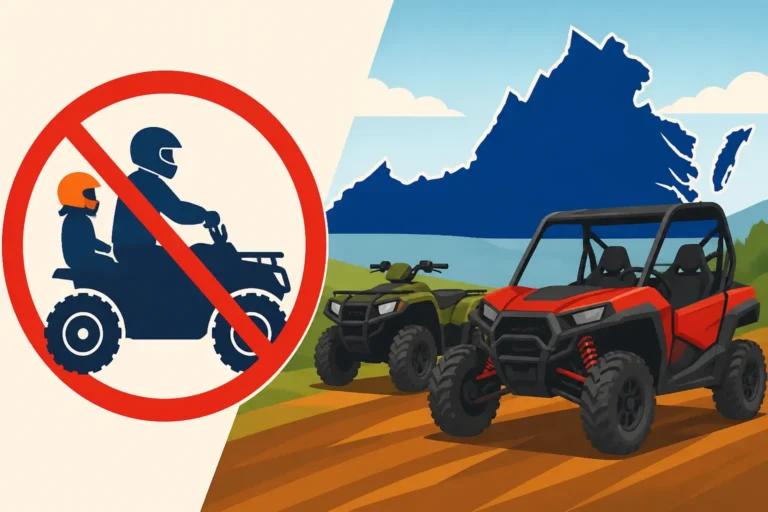
Virginia Has No Street-Legal UTV Path
It's a common dream for many UTV owners in Virginia: being able to hop on your side-by-side and cruise down the road to the local store, or connect between trails without the hassle of trailering. Unfortunately, Virginia law currently throws a pretty big wrench in that dream, creating a confusing and often disappointing situation for those hoping to make their utility vehicle street legal. This guide will meticulously break down why UTVs face such roadblocks and clarify the actual rules for riding in the Commonwealth.
The Heart of the Matter: Virginia's Vehicle Definitions
Understanding why your UTV can't just cruise down Main Street in Virginia starts with how the Commonwealth defines different types of vehicles. The legal classifications are very specific, and UTVs (or side-by-sides, as many call them) simply don't fit into any category that allows for general street use. This isn't just a technicality; it’s the fundamental reason for the restrictions.
How Virginia Defines a Utility Vehicle
In Virginia, a "utility vehicle" is defined very clearly in the Code. It's an off-road machine, not primarily manufactured for use on public highways, and it's designed to carry passengers or cargo. This definition is crucial because it immediately places UTVs outside the realm of vehicles intended for road use. Unlike a car or truck, which is designed and manufactured with highway safety standards in mind from the ground up, a UTV is purpose-built for rugged terrain, farm work, or trail riding.
This distinction means that even if your UTV has headlights, taillights, and even turn signals, it's still legally classified as an off-road vehicle. The Commonwealth looks at the primary design and intent of the manufacturer, not just the accessories you might add later. It's a source of frustration for many owners, especially those who have invested significantly in making their machine as safe and visible as possible, only to be told it still can't be driven on public roads.
The Contrast with "Motor Vehicles"
When Virginia law refers to "motor vehicles" that are permitted on public highways, it's talking about a completely different class of machine. These are vehicles manufactured to comply with federal motor vehicle safety standards (FMVSS) for highway use. Think about cars, trucks, and even motorcycles. These vehicles go through rigorous testing and design specifications to ensure they are safe for the speeds, traffic, and conditions found on public roads.
A UTV, by its very nature and design, doesn't meet these stringent highway safety standards. Its suspension, steering, braking, and structural components are optimized for off-road performance, not high-speed highway travel or crash protection in a collision with a 3,000-pound sedan. This fundamental difference in engineering and legal classification is why [Virginia Has No Street-Legal UTV Path] and why simply adding a horn or turn signals won't change its status. It's a bitter pill to swallow for many who wish for more flexibility with their expensive machines.
Why UTV Modifications Don't Create Road Legality
Many UTV owners, understandably, look for ways around the restrictions. They see aftermarket kits for turn signals, windshields, and mirrors and think, "If I add all this, surely it'll be legal, right?" Unfortunately, this is one of the biggest misconceptions. While these modifications might make your UTV safer and more visible for off-road or limited road crossings, they don't magically transform it into a street-legal vehicle in Virginia.
The Illusion of "Street Legal Kits"
You can find all sorts of "street legal kits" online or through aftermarket retailers like SuperATV. These kits often include things like DOT-approved windshields, turn signal kits, horns, brake lights, and side mirrors. On the surface, it seems logical: if a vehicle has all the components a regular car has, it should be able to drive on the road. However, Virginia law doesn't work that way for UTVs. The problem isn't just about having the equipment; it's about the vehicle's fundamental classification and certification.
Even with a full suite of aftermarket additions, your UTV remains a "utility vehicle" in the eyes of Virginia law. These kits are often designed for states with different, more permissive laws regarding UTV road use, or for limited off-road park requirements. While adding them might improve safety and visibility on a trail, they offer no legal pathway to operating your UTV on public streets in the Commonwealth for general transportation. It’s a classic case of what’s available for sale not always aligning with local regulations.
Virginia's Stance on Aftermarket Changes
Virginia's legal framework prioritizes the original manufacturer's designation and the vehicle's compliance with federal standards for highway use. Adding components, no matter how comprehensive, doesn't alter the vehicle's manufacturing certificate or its intrinsic classification. This means that a UTV, even one equipped with a [Virginia Dirt Bike Conversion Rules]-style setup (which dirt bikes can sometimes achieve, but UTVs cannot), will still be considered an off-road vehicle.
The issue isn't a lack of effort or ingenuity on the part of UTV owners or aftermarket companies. It's simply that the foundational legal definitions and safety standards for highway vehicles are distinct from those for off-road machines. Attempting to make a UTV street legal through aftermarket modifications in Virginia is akin to trying to make a golf cart into a fully certified highway vehicle – the core design and legal basis are simply too different. You might make it look more road-ready, but the law won't see it that way.
Understanding Permitted UTV Road Use in Virginia
Despite UTVs not being street legal, there are very specific and limited circumstances where they might legally touch a public road in Virginia. These are narrow exceptions, not general permissions, and they come with strict conditions. It's vital for UTV owners to understand these limitations to avoid potential fines, penalties, or even impoundment of their machine. [Virginia Bans ATVs on Public Highways] generally, and this applies equally to UTVs.
Direct Road Crossings
One of the most common and widely misunderstood exceptions allows for direct crossings of public highways. The law states that an ATV or UTV may cross a public highway by the most direct route, provided the crossing is made safely. This isn't an invitation to drive down the road for a mile to get to the next trail; it's strictly for traversing from one parcel of private land or an authorized trail to another, where the road is an unavoidable obstacle.
When making such a crossing, safety is paramount. You must yield to all oncoming traffic, and the crossing should be perpendicular to the road, not at an angle that prolongs your presence on the pavement. Think of it as quickly getting from point A to point B across a barrier, not using the barrier as part of your route. Violating these conditions, even on a crossing, can lead to serious legal consequences, including significant [Virginia Penalties for Illegal Riding].
Specific County and Municipal Ordinances
While statewide law generally prohibits UTVs on public roads, Virginia does grant limited authority to local governments, specifically county boards of supervisors, to open certain designated roads for ATVs and UTVs. Currently, only two counties, Buchanan and Tazewell, have taken advantage of this provision. These areas are usually in the heart of Virginia's coalfields, where off-road culture is deeply ingrained and serves specific economic or recreational purposes, such as connecting to trail systems.
Even in Buchanan and Tazewell counties, the permission is not blanket. It applies only to specifically designated routes, often unpaved secondary roads, and comes with its own set of rules regarding speed limits (often 25 mph), daylight hours, and the requirement for proper signage. For example, [Virginia Buchanan and Tazewell County Road Access] is carefully delineated. Riders in other parts of Virginia should absolutely not assume similar permissions exist. Always check local ordinances in the specific town or county you plan to ride in, as [Virginia Town Ordinances in Coal Country] can be very particular.
Agricultural and Emergency Responder Exceptions
There are also specific exemptions for agricultural purposes and emergency responders. Farmers, for instance, may use UTVs on public roads for agricultural purposes if they are operating between fields or for other farm-related tasks. This is not for personal transportation, but strictly for the direct needs of the farm operation. These machines are often equipped with slow-moving vehicle signs and used with extreme caution.
Similarly, law enforcement, fire departments, and rescue squads may use ATVs and UTVs on public roads when responding to emergencies or conducting official duties. These vehicles are vital for accessing remote areas or navigating difficult terrain during critical incidents. These exceptions are carved out of necessity for public safety and essential work, reflecting the utility aspect of these machines in specific, controlled contexts, rather than a general allowance for public enjoyment.
Comparing UTVs to Other Off-Road Vehicles in Virginia
It's natural to wonder why UTVs are so restricted when other vehicles that seem similar might have different rules. Understanding these distinctions helps clarify Virginia's approach to off-road machines and why the "street legal" question is handled differently for each. It’s not just about engine size, but about fundamental classifications.
ATVs vs. UTVs: Similar But Legally Distinct
While often grouped together by enthusiasts, Virginia law does make a distinction between "all-terrain vehicles" (ATVs) and "utility vehicles" (UTVs or side-by-sides), though their road use restrictions are largely similar. Both are defined as off-road vehicles. ATVs are generally single-rider or two-rider machines where the operator straddles the seat, while UTVs typically feature side-by-side seating, a steering wheel, and often a roll cage.
From a street-legal perspective, the outcome is the same: neither ATVs nor UTVs are generally permitted on public highways in Virginia, outside of the very specific exceptions we’ve discussed. The core reason remains their classification as off-road machines not meeting federal highway safety standards. You might find a [Virginia ATV and Utility Vehicle Definitions] guide that breaks down the subtle differences, but for road legality, they share the same fate.
Dirt Bikes and the Conversion Path
This is where it gets interesting, and often confusing for UTV owners. Unlike ATVs and UTVs, certain dirt bikes can be converted to be street legal in Virginia. This involves ensuring the motorcycle meets specific equipment requirements (headlights, taillights, turn signals, mirrors, horn, DOT tires, etc.) and then undergoing an inspection and titling process. This path is outlined in statutes like [Virginia Off-Road Motorcycle Conversion Titles].
The key difference lies in the base vehicle's classification. A dirt bike is fundamentally a motorcycle, albeit one optimized for off-road use. Motorcycles, as a category, have a legal pathway to street legality. UTVs, however, fall under a different, more restrictive "utility vehicle" or "ATV" category that simply doesn't have such a conversion clause in Virginia law. This is why [Why a Virginia DMV Branch Cannot Title a Conversion] for a UTV, even if it could for a dirt bike.
Mopeds and Their Limited Road Access
Another point of comparison is the moped. Mopeds have limited road access in Virginia, but they do have it. They are defined as vehicles with an engine size typically 50cc or less, no manual clutch, and a top speed limit. They can be ridden on public roads, often without a driver's license (though there are age restrictions and helmet laws). This is a completely different classification from UTVs.
The distinction again comes down to design and legal intent. Mopeds are designed for low-speed street travel, albeit with limitations. UTVs are not. [Virginia Moped Rules Compared] to ATVs and UTVs highlight that mopeds are built for a specific, if limited, kind of on-road use, whereas off-road vehicles are, by their very definition, excluded from general public highway access.
Hopes for the Future and Advocacy Efforts
The desire for UTV street legality isn't unique to Virginia. Many states have grappled with this issue, and some have adopted more permissive laws. For Virginia UTV owners, the current restrictions can feel isolating, especially when neighboring states might offer more flexibility. However, there's always the potential for change through legislative action and advocacy.
What Other States Are Doing
Across the country, there's a patchwork of laws regarding UTV street legality. Some states have created distinct "slow-moving vehicle" classifications or allowed counties to designate specific roads for UTV use, similar to Virginia's coalfield exceptions but often broader. Others have enacted comprehensive "neighborhood electric vehicle" or "low-speed vehicle" statutes that UTVs sometimes can fit into with specific modifications and inspections. These vary widely and reflect different state-level priorities regarding tourism, recreation, and public safety.
Virginia legislators keep an eye on these developments, but changes are slow and deliberate. The primary concerns often revolve around public safety, the potential for increased accidents on public roads, and the inherent differences in crashworthiness between UTVs and traditional highway-legal vehicles. This means that any proposed changes would need to carefully balance the desires of UTV owners with broader public safety considerations.
How Change Happens in Virginia
For UTVs to gain broader street-legal status in Virginia, it would require legislative action. This typically starts with proposals from individual lawmakers, often influenced by their constituents or advocacy groups. These proposals would then go through a committee process, debate, and votes in both the House of Delegates and the Senate, eventually needing the Governor's signature to become law. This is a lengthy process, and success is far from guaranteed.
Advocacy groups, such as local ATV/UTV clubs and statewide off-road organizations, play a crucial role in pushing for such changes. By organizing, educating legislators about the economic and recreational benefits of UTV use, and proposing well-reasoned solutions that address safety concerns, they can build momentum. It's a long game, requiring persistent effort and a willingness to engage in the political process, but it is the only real path forward for those hoping for more widespread road access.
The Role of Advocacy and Rider Responsibility
If you're passionate about seeing UTVs gain more road access in Virginia, getting involved with advocacy efforts is key. This could mean joining a local club, reaching out to your state legislators, or supporting organizations that are working on this issue. Providing thoughtful, constructive input to lawmakers, especially regarding how safety concerns can be addressed, is far more effective than simply wishing for change.
In the meantime, responsible riding is paramount. Adhering to the existing laws, even if they feel restrictive, helps demonstrate that the off-road community is serious about safety and compliance. Illegal riding on public roads only creates negative perceptions and makes it harder to advocate for future legislative changes. Showing respect for the law, even while working to change it, is the most powerful tool riders have.
| Vehicle Type | General Street Legal Status (Virginia) | Key Differentiating Factor | Common Road Uses |
|---|---|---|---|
| UTV (Side-by-Side) | No (except specific county routes, ag, emergency) | Not designed/certified for highway safety; Off-Road Vehicle | Trail connections in specific counties, farm work |
| ATV | No (except specific county routes, ag, emergency) | Not designed/certified for highway safety; Off-Road Vehicle | Trail connections in specific counties, farm work |
| Dirt Bike | No (but can be converted with specific mods/inspection) | Motorcycle base, potential for street conversion | On-road after conversion, otherwise off-road |
| Moped | Yes (with restrictions: speed, engine size) | Designed for low-speed street use; unique classification | Local errands, short commutes |
| Automobile/Truck | Yes (designed/certified for highway safety) | Primary design for public highway use; FMVSS compliant | General transportation, commuting, travel |
Disclaimer
This article is for general informational purposes only and does not constitute professional advice. Laws, prices and regulations vary by location and change over time. Consult a qualified professional for guidance on your specific situation.