Virginia Crossings by the Most Direct Route
It’s a scenario every ATV and UTV rider in Virginia has faced: you're out enjoying the trails, or simply moving between sections of your private property, and suddenly, a public road cuts right across your path. The question immediately pops into your head – can I just cross this road? It seems simple enough, but Virginia's laws around "crossings by the most direct route" are specific, often misunderstood, and crucial to navigate correctly to avoid fines or legal trouble. This comprehensive guide will meticulously break down what this rule means, how to comply, and how to stay safe and legal while on your machine.
The Legal Foundation: What Virginia Code Says About ATV/UTV Crossings
The temptation to just zip across a road to get to the other side is strong, especially when you're just trying to connect two pieces of land or different trail segments. However, Virginia law is quite particular about how and when you can do this. It's not a free-for-all, and understanding the nuances is your first line of defense against a potential citation.
Decoding "Cross by the Most Direct Route"
Virginia Code § 46.2-915.1 lays out the specific conditions under which off-road machines, including ATVs and UTVs, can interact with public roads. The critical phrase is that such machines "may cross a public highway, road, street, or sidewalk by the most direct route." This isn't just a suggestion; it's a very precise instruction from the state legislature.
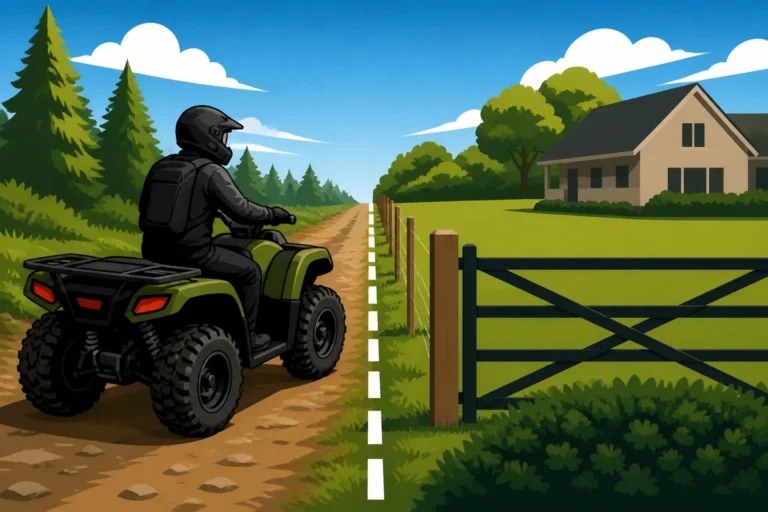
What "most direct route" implies, in practice, is a path that minimizes your time and distance on the public way. Think of it as a straight, perpendicular line from one side of the public road to the other. It means no diagonal travel, no meandering, and absolutely no riding parallel to the road for any length of time. The intent is to get you across and off the public thoroughfare as quickly and safely as possible. It's a point-to-point maneuver, not a segment of travel. This is a fundamental distinction, as [Virginia Bans ATVs on Public Highways] for sustained use, making the crossing exception a critical, yet limited, allowance.
This specific phrasing exists to provide a necessary convenience for landowners and trail riders, recognizing that public infrastructure often bisects private property or designated trail systems. Without this allowance, many parcels of land would be effectively cut off from each other for ATV access, and many trail networks would be impossible to connect. It’s a pragmatic solution, but one tethered firmly to the principle of minimizing public road exposure for off-road vehicles.
The Specific Roads You Can and Cannot Cross
The law broadly states "a public highway, road, street, or sidewalk." This covers pretty much any public thoroughfare you might encounter in Virginia, from bustling numbered state routes to quiet county gravel roads. It also explicitly includes sidewalks, though crossing a sidewalk with an ATV or UTV carries its own set of safety considerations due to potential pedestrian traffic.
Are there any exceptions to what kinds of roads you can cross? Not really, under this specific "most direct route" provision. The law is inclusive regarding the type of public way. However, it’s crucial to reiterate that this only applies to the act of crossing. You cannot, for example, use this rule as an excuse to travel along a major highway, even if you argue that your destination is "just down the road." The crossing must be swift and perpendicular.
The most common context for these crossings is often agricultural or recreational. For farmers, it might mean moving between fields separated by a secondary road. For trail riders, it's about linking legal segments of a trail system where a county road briefly intervenes. While [Virginia Rules for Riding Private Land] generally govern your activities, these crossings become necessary when private property abuts or is bisected by a public way. Always assume any public road or street is subject to these strict crossing rules unless explicitly designated otherwise by specific local ordinances or state law.
Mandatory Conditions for a Legal Crossing in Virginia
Just because you're allowed to cross a public road doesn't mean you can throw caution to the wind or ignore other crucial safety and legal requirements. Virginia law doesn't suspend its general rules for off-road vehicles just for a moment of crossing. You still have responsibilities as a rider, and neglecting them can lead to serious consequences.
Rider Requirements: Who Can Cross and How
First and foremost, the universal helmet law in Virginia applies. There’s no exception for a quick hop across the road. [Virginia Helmet Law Applies to Every Rider], whether you’re on the trail, on private land, or making that brief public road crossing. Think about it: a road crossing, however brief, is often the most dangerous part of your ride due to potential interactions with fast-moving traffic. Wearing a helmet is non-negotiable for your safety and legal compliance.
Secondly, age and supervision rules remain firmly in place. If you have a younger rider in your group, or you yourself are under a certain age and subject to engine size restrictions, those rules don't disappear when you approach a paved surface. For instance, [Virginia Rules for a 16-Year-Old Rider] still apply, meaning if they're on a machine over 90cc, they must be 16 or older. Always ensure that the rider is legally permitted to operate the specific machine they are on, even if it's just for a brief crossing.
Lastly, carrying passengers is only permitted if your machine is specifically designed by the manufacturer for multiple riders, and, of course, they too must be wearing helmets. [Virginia Passenger Rules on an ATV] are explicit. Don’t try to squeeze an extra person on for a quick crossing if your ATV is a single-rider model; it’s unsafe and illegal. Adhering to these rider-specific requirements ensures that even the shortest interaction with a public road is as safe and lawful as possible.
Machine and Environmental Constraints
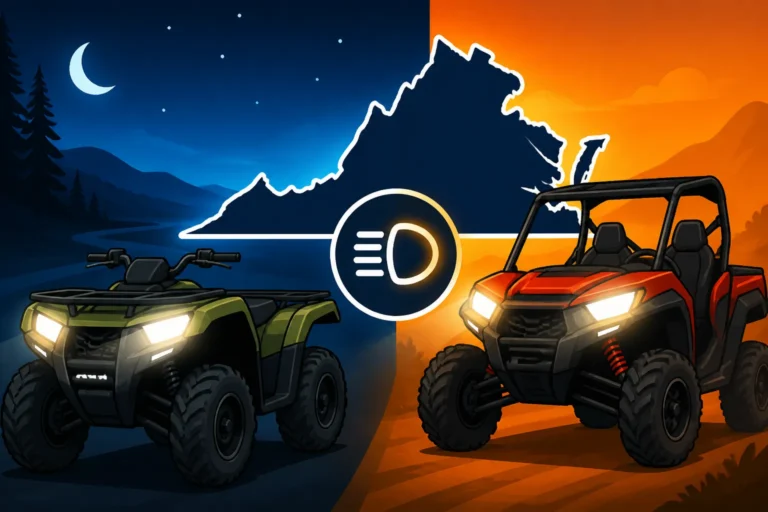
Beyond the rider, the machine itself and the timing of your crossing are also subject to specific rules. The law explicitly limits crossings to "Daylight Hours." This is a critical detail. [Virginia Daylight Hours on a Road Trail] means riding at dusk, dawn, or after dark, even for a crossing, is generally not permitted under this specific allowance. Visibility is naturally lower during these times, increasing the risk of an accident with other vehicles. Plan your rides so that any necessary road crossings are completed well before sunset.
While the law doesn't mandate specific additional lighting for a crossing, visibility is absolutely paramount. Your machine should have its factory lights operational, and it's always a good idea to wear bright, contrasting clothing. Many riders also add safety flags to their machines, especially those from companies like SuperATV, which can greatly increase your profile to approaching motorists. Reflective tape on your machine or helmet can also provide an extra layer of conspicuity, especially when dealing with varied light conditions in wooded areas adjacent to roads.
Finally, your ATV or UTV must be in safe operating condition. This means working brakes, a functional muffler (to avoid excessive noise that could distract or annoy drivers), and overall good repair. An officer performing [Virginia Equipment Checks by Officers] could still cite you for an unsafe vehicle if, for example, your brakes are faulty, even if your crossing maneuver itself was otherwise legal. Maintain your machine well, and ensure it meets basic safety standards before you ever consider approaching a public road.
The Crucial Difference: Crossing Versus Traveling
This is where many riders get into trouble. The line between a legal "crossing by the most direct route" and illegal "traveling on a public highway" can feel blurry in the moment, but legally, it's a bright, unmistakable line. Understanding this distinction is the most important lesson for any Virginia ATV or UTV operator.
Why Even a Short Distance on the Road is Illegal (Generally)
Let's be absolutely clear: Virginia's "most direct route" allowance for crossings is not an open invitation to travel along a public road for any distance, no matter how short. This is the single most common misinterpretation that leads to fines and impoundments. If you use the road to go "just to the next driveway," or "only a few hundred feet to that trail entrance," you have crossed the line from a legal crossing to illegal road use.
Any sustained travel along the pavement instantly transforms a legal, momentary crossing into an illegal operation. The duration and direction of travel are key. A true crossing is a swift, perpendicular maneuver. Traveling, even for a short distance, means you are now operating an off-road vehicle on a public highway, which is generally prohibited. This carries significantly higher risks for everyone involved and can lead to severe penalties. [Virginia Penalties for Illegal Riding] can be steep, and a simple misjudgment here can make your day on the trails very expensive.
Riders sometimes try to justify short stretches of road travel by saying it's "the only way to connect" or "my driveway is just down the road." Unfortunately, these justifications won't hold up in the eyes of the law. The intent of the statute is to allow a brief, direct transition across traffic lanes, not to facilitate short-distance commuting or bypassing difficult off-road terrain. If your destination requires traveling along the road, even for a short distance, then that destination is effectively inaccessible by ATV/UTV unless a specific local ordinance or designated "road trail" exception applies.
Special Road Access in Buchanan and Tazewell Counties (A Brief Contrast)
It's important to acknowledge that Virginia does have very specific, limited exceptions for ATV and UTV travel on public roads, but these are highly localized and not to be confused with the statewide crossing rule. Specifically, Buchanan and Tazewell counties have carved out special allowances for designated "road trails" to connect segments of the Spearhead Trails system. [Virginia Buchanan and Tazewell County Road Access] details these unique provisions.
However, these are explicit exceptions to the general ban on public road use and come with their own strict conditions, such as speed limits (often 25 mph), daylight-only operation, and specific route designations. These "road trails" are clearly marked and are the result of deliberate action by local boards of supervisors. They are not the "most direct route" crossing rule.
It cannot be stressed enough that outside of these very specific, designated road sections in Buchanan and Tazewell counties, the "crossing by the most direct route" rule is your only allowance for public road interaction with an ATV or UTV. Do not assume that because some counties have road access, you can interpret the crossing rule more broadly elsewhere. The rules are distinct, and adhering to this distinction is crucial for legal riding throughout the Commonwealth.
Navigating Crossings Safely and Avoiding Costly Mistakes
Making a road crossing with an ATV or UTV is inherently more dangerous than riding on a dedicated trail or private property. You're entering an environment with faster-moving, heavier vehicles, and the consequences of a mistake can be severe. Beyond legal compliance, adopting best practices for safety is paramount for both you and other road users.
Best Practices for a Safe and Legal Crossing
First, treat every road crossing with the utmost respect and caution. Imagine you're merging onto a busy highway in a car: you need to stop, look both ways multiple times, listen carefully for approaching vehicles, and only proceed when you are absolutely certain the path is clear. Do not assume drivers will see you or yield. Their focus is often on other cars, not off-road vehicles appearing from the side.
If you are riding in a group, consider designating a spotter, especially on roads with blind corners or heavy traffic. This person can ensure both directions are clear before giving the signal for the group to cross. Communication is key; make sure everyone understands the plan and waits for the all-clear before entering the roadway.
Finally, enhance your visibility as much as possible. Wear bright, high-contrast clothing that stands out against the natural background. A safety flag mounted on your machine, especially one that extends well above your head, can significantly increase your profile to approaching motorists. Some riders even add small, bright auxiliary lights to their machine during the day for increased conspicuity, even when not legally required. Brands like SuperATV offer a range of lighting solutions that can make your machine more visible in all conditions, providing an extra layer of safety during those critical crossing moments.
Penalties for Violating Crossing Rules
Misinterpreting or ignoring Virginia’s ATV/UTV road use statutes, including illegal crossings, is not a minor infraction. Violations are classified as civil offenses and can carry a penalty of up to $500. [Riding Illegally Costs Up to $500 in Virginia], a sum that can quickly turn an enjoyable ride into a very expensive regret. It's a significant financial hit that far outweighs the perceived convenience of an illegal shortcut.
Beyond the monetary fine, there's the very real risk of your machine being impounded by local authorities, especially if you're riding illegally within city or town limits. [Virginia City Impoundment Powers] means that local law enforcement has the authority to seize your ATV or UTV. Getting an impounded machine back can be an incredibly frustrating, expensive, and time-consuming process involving storage fees, administrative hurdles, and potentially court appearances.
Officers often conduct patrols near popular trailheads or known crossing points specifically to check for compliance. If you are stopped, always be prepared to explain your actions calmly and respectfully. Have your identification ready, and if applicable, any proof of land ownership or permission. [What an Officer Can Ask For at a Trailhead] and [Carrying Papers on a Coalfield Trail] are good resources to understand what you might need to provide. Knowing the law and being prepared can make a big difference in how such an encounter proceeds.
Practical Considerations and Hypothetical Scenarios
Understanding the letter of the law is one thing, but applying it to real-world situations can sometimes be tricky. Let's look at some common scenarios to solidify the distinction between a legal crossing and an illegal ride, and how to stay on the right side of Virginia law.
When a Crossing is Absolutely Necessary
One of the most common and legitimate uses of the "most direct route" crossing rule is for agricultural purposes. Imagine a farmer whose property is split by a state road. To move farm equipment, livestock, or even just to access different fields, they might need to drive their utility vehicle across that road. This is a classic example where the direct crossing rule is invaluable. While [Virginia Farming and Household Exceptions] applies to the use of machines in an agricultural context, the crossing allowance provides the literal path.
Another scenario involves connecting two legal segments of a private or permitted trail system. Many multi-mile trail networks are pieced together, and occasionally, a minor county road might briefly interrupt the continuity. In such cases, a brief, perpendicular crossing to pick up the trail on the other side would fall under the "most direct route" provision. This is about necessity – enabling continuous trail use – rather than convenience.
It’s crucial to understand that these scenarios are rooted in necessity, not just convenience or a desire to avoid a difficult trail section. The intent must be a direct, unavoidable transition, minimizing time on the public road. If there's an alternative, even if it's a longer trail route, using the public road for anything more than a direct crossing becomes legally dubious.
When a "Crossing" Becomes an Illegal Ride
Now, let's look at what doesn't qualify as a legal crossing. A very common mistake is attempting to use the "crossing" rule as an excuse to get to a store, a friend's house, or a gas station that's "just a quarter-mile down the highway." This is unequivocally not a legal crossing; it is illegal road travel, and you will likely face a citation. The law does not permit you to travel along a public road, even for a short distance, to reach a destination.
Similarly, trying to bypass a challenging or muddy section of a trail by briefly using a paved road is another example of illegal road use. Your intention here isn't a direct crossing to connect legal segments; it's to travel along the road to avoid an obstacle. Again, the intent and duration of your travel are critical. If you are traveling in parallel to the road, you are violating the law.
Even using a sidewalk can lead to issues. While sidewalks are included in the "public highway, road, street, or sidewalk" definition for crossing purposes, using a sidewalk to travel to a crossing point, unless it's the absolute shortest, most perpendicular path, can also be problematic. Remember, [Riding an ATV on a City Sidewalk] for any sustained distance is generally prohibited and can lead to impoundment by city authorities. The "most direct route" is about getting across, not getting to a better crossing point by using the public way as a travel lane.
Understanding these distinctions is paramount. When in doubt, err on the side of caution. If your route requires anything more than a swift, perpendicular crossing, assume it's illegal, and seek an alternative, off-road path.
| Feature | Legal Crossing (Most Direct Route) | Illegal Road Travel |
|---|---|---|
| Purpose | Connects two sections of private land or legal trail. Minimize time on public way. | Reaching a destination (store, friend's house, different trail entrance). |
| Direction | Perpendicular to the road. Straight across. | Parallel to the road. Any sustained travel along. |
| Duration | As brief as physically possible. | Any distance or time beyond immediate crossing. |
| Legality | Permitted under VA Code § 46.2-915.1, under strict conditions. | Generally prohibited statewide. |
| Penalties | None, if compliant. | Up to $500 civil penalty, possible impoundment. |
| Applicable Time | Daylight hours only. | Applies if designated road trail (rare exception). |
Enhancing Safety During Road Crossings
While adhering to the letter of the law is critical, your personal safety, and the safety of others, should always be the top priority when making a road crossing. Even a legal crossing carries inherent risks, and taking extra precautions can significantly reduce the chances of an accident.
Visibility and Rider Awareness
When you're preparing to cross a public road, make yourself as visible as possible. This goes beyond just wearing a helmet. Opt for bright, high-visibility clothing – neon colors, reflective vests, or gear designed for motorcycling often work well. This makes you stand out against the landscape and increases the chances that drivers will spot you.
Consider adding aftermarket accessories that enhance visibility. A tall safety flag on your ATV or UTV is an excellent investment, especially if you're emerging from a wooded area where visibility is limited. SuperATV, for instance, offers various flags and mounts that can be easily installed. Reflective tape on your machine's fenders, roll cage, or helmet can also provide crucial visibility, particularly in transitional lighting conditions like dusk or dawn, even if you're trying to cross during daylight hours.
Your awareness is also key. Before you even approach the edge of the road, slow down and scan your surroundings. Listen for traffic that you might not yet see, especially on blind curves or hills. Once at the road's edge, stop completely. Look left, then right, then left again. Make eye contact with any approaching drivers if possible, to confirm they see you. Remember, drivers often aren't expecting an ATV or UTV to appear, so a proactive approach to visibility and awareness is essential.
Planning and Communication
Good planning can prevent last-minute, risky decisions at the edge of a highway. Before you head out, review your route. Are there any known road crossings? If so, identify them on a map and mentally prepare for them. Look for areas with good sight lines for both you and approaching traffic. Avoid crossing at blind curves, hills, or complex intersections if at all possible. Sometimes, adjusting your route slightly to use a safer, more visible crossing point is a wise decision.
If you're riding with a group, communication before a crossing is vital. Establish a clear signal for "stop," "clear to cross," and "danger." Designate a lead rider and a spotter who can help verify traffic conditions. Ensure everyone understands the plan: cross one at a time, or in a tight, pre-determined formation if local conditions allow for a swift, unified crossing. Never assume the rider in front of you saw a car that you didn't.
Finally, always be prepared for the unexpected. A car might suddenly appear, or your machine might stall. Knowing how to react calmly and safely in such situations can make all the difference. While Virginia does not explicitly require an ATV safety course, considering one can significantly improve your riding skills and situational awareness, especially when dealing with public road interactions.
Disclaimer
This article is for general informational purposes only and does not constitute professional advice. Laws, prices and regulations vary by location and change over time. Consult a qualified professional for guidance on your specific situation.