Virginia Accepts an Out-of-State Title
It's incredibly frustrating to bring an ATV or UTV you love into a new state, or to buy one from a private seller across state lines, only to discover that the paperwork rules feel like a riddle wrapped in an enigma. You just want to ride, but the Virginia DMV has its own way of doing things. This guide will help you untangle the complexities of how Virginia handles ATVs and UTVs that come from other states, clarifying whether your out-of-state title will be accepted, what documents you'll need, and what to do if your machine was never titled to begin with.
Virginia's Unique Approach to ATV Titling
Virginia has a distinct perspective on titling off-road vehicles like ATVs and UTVs, which often surprises new residents or those buying machines from neighboring states. Unlike passenger cars or trucks, these machines aren't typically considered "motor vehicles" in the same way, leading to different requirements.
Why Virginia Titles Differ from Cars
One of the biggest sources of confusion for many riders is that Virginia titles ATVs and UTVs but does not register them in the traditional sense. This means you get a certificate of title that proves ownership, but you won't receive license plates or registration stickers like you would for a street-legal vehicle. This distinction is crucial because it frames how the DMV views your off-road machine from another state. The state primarily uses the title to establish legal ownership and to collect sales tax if applicable.
When you bring an ATV or UTV from, say, North Carolina or West Virginia, the Virginia DMV isn't looking for proof of registration; it's looking for clear evidence of ownership. The rules are designed to protect buyers and sellers within Virginia's framework, even if that framework feels a little unconventional compared to how other states operate or how Virginia titles its own street vehicles. You can read more about this in [Virginia Titles ATVs but Never Registers Them].
The July 2006 Cutoff and Its Impact
A significant date in Virginia ATV titling history is July 1, 2006. For any new ATV with an engine size over 50cc that was purchased on or after this date, Virginia law requires that it be titled. This rule was implemented to create a consistent paper trail for newer machines. If you bought a brand-new quad in, say, Maryland in 2007, and that state titled it, Virginia expects to see that title or its equivalent (like a Manufacturer's Statement of Origin, or MSO) when you move here.
However, if your machine was purchased new before this July 2006 cutoff, or if it has an engine under 50cc, it generally doesn't fall under this mandatory titling requirement. This means some older or smaller machines might legitimately arrive in Virginia without ever having been titled in their original state, which isn't necessarily a problem, but it does mean you'll need a different set of documents to prove ownership. This rule is a major point of confusion, and understanding it is key to a smooth process. You can dive deeper into this specific date in [Virginia's July 2006 Titling Cutoff].
Optional Titling for Used Machines
Here's where Virginia really deviates from many other states: for used ATVs and UTVs, titling is often optional. If you buy a used machine from a private seller, whether in Virginia or another state, and it doesn't already have a title from a state that mandated one, you are not legally required to obtain one in Virginia for personal use. This can be a relief for some, but it also creates a unique challenge in proving ownership, especially if you ever need to sell the machine or involve an insurance company.
While titling is optional for used machines, it's often a smart move to go ahead and get a Virginia title. It provides clear proof of ownership, makes future sales much smoother, and can be a requirement if you're financing the purchase through a bank or credit union. Many financial institutions will insist on a title to secure their loan, even if the state itself doesn't demand it for a private owner. This is an important consideration for anyone purchasing a used quad. For more details on this, see [Virginia Titles Are Optional on Used Machines].
Bringing an Out-of-State Titled ATV or UTV to Virginia
So, you're moving to Virginia, or you just bought an ATV from a dealer in a state that titles these machines. What happens next? Virginia is generally quite accommodating when it comes to recognizing valid ownership documents from other jurisdictions.
Machines with a Valid Out-of-State Title
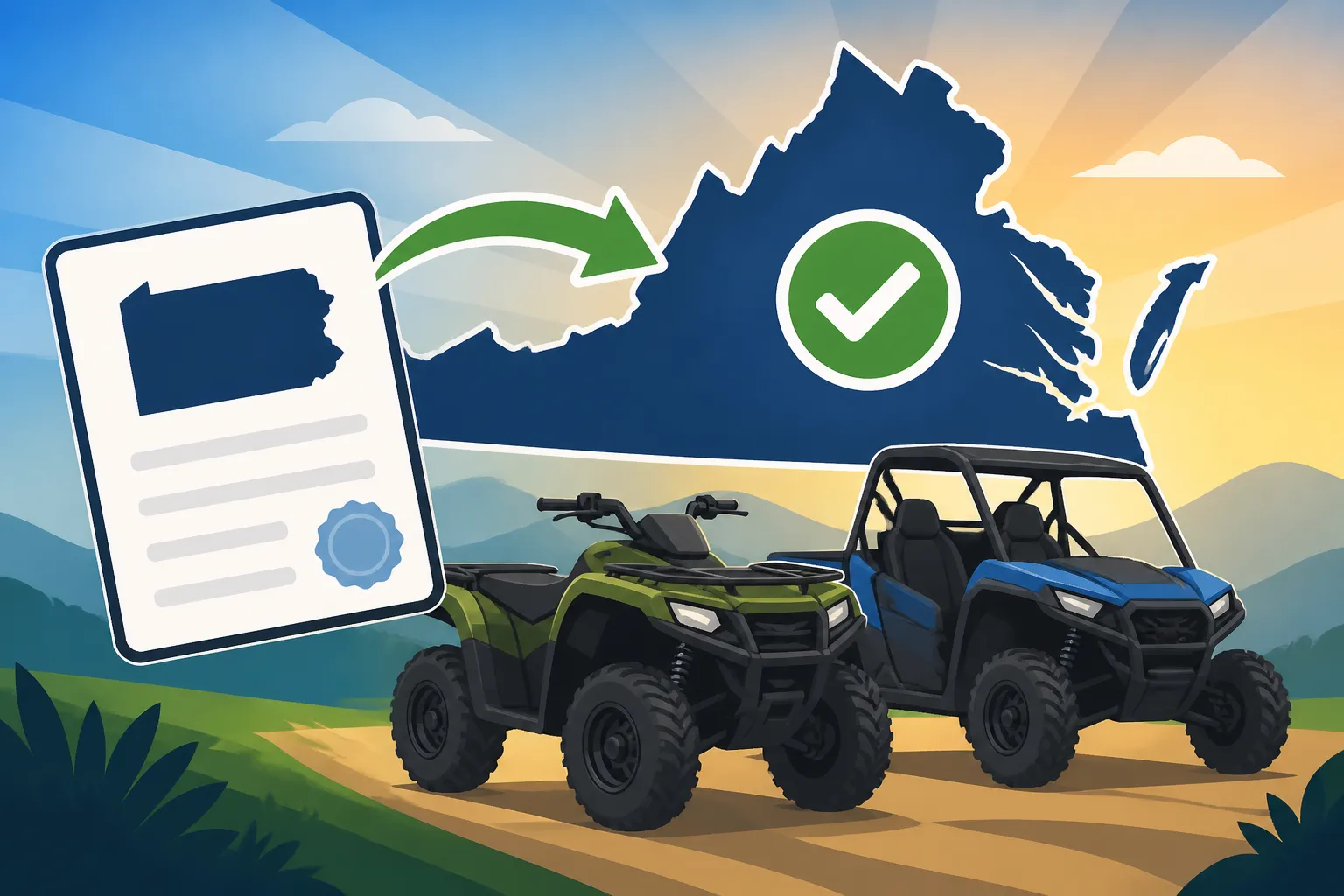
If your ATV or UTV already has a valid title issued by another state, Virginia will accept it as proof of ownership for the purpose of issuing a new Virginia title. The process is relatively straightforward, much like transferring a car title. You'll need to present the out-of-state title, along with a completed Virginia Application for Certificate of Title and Registration (Form VSA 17A), proof of identity, and proof of your Virginia address.
The key is that the out-of-state title must be properly assigned to you by the seller. This means the seller's signature must be present on the title, and it should accurately reflect the sale to you. If you purchased the machine from a dealer, they should have handled the assignment part, but always double-check. When you go to the DMV, they'll review your out-of-state title, verify its authenticity, and then process your application for a new Virginia title. This path is often the easiest, as the paper trail is already established. For specific form details, check out [Virginia Form VSA 17A Explained].
The Virginia DMV's Approach to Out-of-State Titles
When you present an out-of-state title, the Virginia DMV clerk will primarily be looking for a few things: clear identification of the vehicle (VIN/serial number), proper assignment of ownership to you, and confirmation that the title itself is legitimate. They are not generally concerned with the prior registration status in the other state, as Virginia does not register ATVs anyway. Their focus is on the chain of ownership.
One thing to be aware of is that some states might include an odometer reading on their ATV titles, even though Virginia specifically [Virginia Skips the Odometer Rule for ATVs]. This discrepancy won't be an issue; the Virginia title simply won't have an odometer reading section. The DMV clerks are accustomed to seeing various formats of out-of-state titles and generally know what to look for. As long as your out-of-state title clearly indicates you as the new owner and the machine's identifying details are legible, you should be in good shape.
When an Out-of-State Title Isn't Enough
While Virginia generally accepts out-of-state titles, there can be situations where additional documentation is needed, or the title itself presents a challenge. For example, if the out-of-state title is defaced, heavily altered, or has incomplete information, the DMV might ask for supporting documents. This could include a bill of sale, original purchase invoice, or a notarized affidavit from the seller clarifying any discrepancies.
Another common issue arises if the out-of-state title has a lien recorded on it that hasn't been properly released. You'll need proof that any previous loan has been paid off and the lien satisfied before Virginia will issue a clean title in your name. Always ensure all liens are cleared before you complete the purchase of any used machine, whether in-state or out-of-state. If you're coming from a state that doesn't issue titles, or your machine was legitimately untitled there, then an actual out-of-state title isn't even part of the equation, and you'll proceed as if the machine was never titled.
What if Your Out-of-State ATV/UTV Was Never Titled?
This scenario is far more common than many people realize, especially if you're buying an older machine or one from a state with lax titling laws for ATVs. Don't despair; Virginia has a process for this, though it requires meticulous attention to detail.
New Machines Without a Title from States That Don't Require Them
Some states, historically or even currently, do not require titles for new ATVs. If you purchased a new machine in such a state, and it's over 50cc and purchased after July 1, 2006, Virginia will still require it to be titled once it comes here. In this situation, the crucial document you'll need is the Manufacturer's Statement of Origin (MSO) – sometimes called a Manufacturer's Certificate of Origin (MCO). This is the original document issued by the factory that essentially acts as the vehicle's birth certificate.
The MSO proves that the machine is new and identifies its initial owner (which could be the dealership or, if it was directly sold to you, you). Without an MSO, titling a new machine that was never titled in its original state can become very difficult. Always ensure you receive the MSO when purchasing a new off-road vehicle, even if the selling state doesn't require a title for it. This is extensively covered in [Virginia Requires an MSO for a New Machine].
Used Machines Without a Title
This is perhaps the most frequent challenge: you bought a used quad from a private seller in another state, and they simply handed you a bill of sale, because the machine was never titled, or the title was lost years ago, and that state didn't care. For used ATVs and UTVs (regardless of engine size or purchase date) that have never been titled, or for which the original title is missing, Virginia will accept alternative forms of proof of ownership. The most critical documents here are a clear and comprehensive bill of sale, especially if it's notarized, and potentially a [Virginia Form VSA 12M Affidavit] if further clarification or a statement of facts is needed.
The bill of sale should clearly identify the ATV or UTV by its VIN/serial number, make, model, and year, along with the names and signatures of both the buyer and seller, the date of sale, and the purchase price. Including contact information for the seller is also highly advisable. If you have any old registration documents from the previous state (even if not a title), those can also help strengthen your case. When crafting these documents, tools like LawDepot can be invaluable for creating a legally sound bill of sale or a notarized affidavit. They offer templates that ensure all necessary fields are included, minimizing issues at the DMV.
Proving Ownership Without a Title
When you lack a formal title, your goal is to build an undeniable paper trail that demonstrates continuous ownership back to a legitimate source. This might involve:
- A Detailed Bill of Sale: As mentioned, this is paramount. It's your primary evidence of the transaction.
- Previous Registration or Insurance Cards: Even if not a title, these documents from another state can link the machine to its previous owner, which helps the DMV verify its history.
- Notarized Affidavits: If there are gaps in the ownership chain or the bill of sale isn't robust enough, a sworn statement from the seller (or even yourself, detailing how you acquired it) can provide the necessary legal declaration.
- Original Purchase Invoice/Receipts: If you are the original owner and it was never titled, the dealer invoice can serve as proof of first acquisition.
- Photos of the machine and VIN: While not a primary document, having clear photos can help if there's ever a question about the machine's identity.
The more evidence you can gather, the smoother the process will be. The DMV wants to ensure they aren't titling a stolen vehicle, so they need solid proof that you rightfully own the machine.
The Titling Process for Out-of-State Machines in Virginia
Regardless of whether your machine has an out-of-state title or not, the final steps to get a Virginia title will funnel through the DMV. Being prepared with all your paperwork is key to avoiding multiple trips.
Gathering Your Documents
Before you even think about heading to the DMV, take the time to organize everything you need. Here’s a checklist of common documents for titling an out-of-state ATV or UTV in Virginia:
- Current, valid out-of-state title (if applicable): Properly signed over to you.
- Manufacturer’s Statement of Origin (MSO) (if applicable): For new machines never titled elsewhere.
- A comprehensive Bill of Sale: Especially crucial if no title or MSO is available. Ensure it includes VIN, make, model, year, purchase price, and seller/buyer info. Consider having it notarized.
- Virginia Application for Certificate of Title and Registration (Form VSA 17A): This form can be found on the DMV website.
- Proof of Identity: A valid driver's license or state ID.
- Proof of Virginia Residency: A utility bill, lease agreement, or another official document showing your current Virginia address.
- Payment for fees and taxes.
Having all these items neatly organized will significantly expedite your visit. For a more generic checklist that applies to any machine, check out [What to Bring to the DMV to Title a Quad].
Completing Virginia Form VSA 17A
Form VSA 17A is the cornerstone of your Virginia title application. It requires detailed information about you (the applicant), the ATV/UTV itself, and how you acquired it. You'll need to accurately fill in sections like:
- Vehicle Description: Make, model, year, body type (ATV/UTV), fuel, and crucially, the Vehicle Identification Number (VIN) or serial number. Double-check this number against your machine and any supporting documents.
- Owner Information: Your full legal name, address, and social security number (or federal ID number for a business).
- Purchase Information: Date of purchase, purchase price, and seller's information. This is where you'll indicate if you bought it from a dealer or a private party.
- Lienholder Information (if applicable): If you financed the purchase, your lender will need to be listed here.
Be sure to sign the form in the designated areas. If you're unsure about any section, it's better to leave it blank and ask the DMV clerk for guidance rather than making a mistake that could delay the process. Understanding this form is so critical, we have a whole article on [Virginia Form VSA 17A Explained].
Fees and Sales Tax Considerations
When you title your out-of-state ATV or UTV in Virginia, you'll generally encounter two main financial components: the titling fee and sales tax.
- Titling Fee: Virginia charges a flat fee for issuing an ATV title. This fee is relatively modest, designed to cover the administrative costs of processing the paperwork and producing the title document. You can learn more about this in [Virginia Title Fee of $15].
- Sales Tax: This is where things can get a little more complex for out-of-state purchases. Virginia has a retail sales and use tax. If you purchased your ATV or UTV from a private seller out of state and did not pay sales tax at the time of purchase (or paid a lower rate than Virginia's), you will likely be assessed Virginia sales tax on the purchase price when you title it here. The DMV uses the declared purchase price on your bill of sale or, in some cases, a fair market value if the price seems unusually low or it was a gift. If you paid sales tax in another state, you might get a credit, but you'll need proof of payment. This is an important consideration for your budget. For a full breakdown, refer to [Virginia Sales Tax at Titling] and [Virginia Tax on an Out-of-State Purchase].
| Scenario | Required Documents | Virginia Title Fee | Virginia Sales Tax Considerations |
|---|---|---|---|
| New Machine (Out-of-State, No Title) | MSO, Bill of Sale, VSA 17A, ID, Proof of Address | Yes | Likely due on purchase price (if not paid in state of purchase) |
| Used Machine (Valid Out-of-State Title) | Out-of-State Title (signed over), Bill of Sale, VSA 17A, ID, Proof of Address | Yes | Due on purchase price (if not paid in state of purchase, or if Virginia's rate is higher, you may owe the difference). |
| Used Machine (Out-of-State, No Title) | Detailed Bill of Sale (preferably notarized), VSA 17A, ID, Proof of Address, (Optional: VSA 12M Affidavit) | Yes | Due on purchase price (if not paid in state of purchase). DMV may use fair market value if purchase price is deemed too low or if it was a gift. Building a strong paper trail is key. |
| Inherited Machine (Out-of-State) | Death Certificate, Will/Probate Docs, VSA 17A, ID, Proof of Address | Yes | No sales tax due if truly inherited. |
| Gifted Machine (Out-of-State) | Gift Affidavit (from LawDepot for example), VSA 17A, ID, Proof of Address | Yes | No sales tax due if truly a bona fide gift, but DMV may scrutinize, especially for high-value items, to prevent tax evasion. An affidavit from LawDepot could clearly articulate the gift. |
Common Challenges and Solutions
Even with all your ducks in a row, sometimes unique situations pop up. It's helpful to anticipate potential snags and know how to address them.
Serial Number Issues
The VIN or serial number is the unique identifier for your ATV or UTV, and it's absolutely critical for titling. If the serial number is missing, defaced, or unreadable, you're going to face significant hurdles at the DMV. They cannot title a machine without a verifiable VIN. In such cases, you might need to contact the manufacturer to see if they can provide a replacement VIN plate or documentation, or you might need to go through a special inspection process to verify the vehicle's identity. This can be a lengthy and frustrating process, emphasizing why verifying the VIN is one of the first things you should do when purchasing any off-road vehicle. For machines with a missing VIN, read [Virginia Title When the Serial Is Gone].
Seller Not Available or Lost Paperwork
Buying from a private seller can come with risks. If you buy an out-of-state machine and the seller later becomes unreachable, or if they promised to send you documents they never did, you'll be in a tough spot. This is why it's paramount to get all necessary paperwork and signatures at the time of sale. If you're dealing with a missing title or other essential documents, and the seller isn't cooperating, you might have to rely heavily on a well-documented bill of sale and perhaps a notarized affidavit (like those you can create through LawDepot) to present your case to the DMV. In some extreme situations, if you cannot definitively prove ownership, you might find yourself unable to title the machine, severely limiting its usability and resale value.
What About Side-by-Sides and Utility Vehicles?
Virginia's titling rules for side-by-sides (SxS or UTVs) generally fall under the same category as ATVs. Most UTVs are classified as ATVs in Virginia law if they meet certain criteria (designed for off-road use, certain width/weight limits, etc.). This means the same 50cc engine size rule, the July 2006 cutoff, and the optional titling for used machines typically apply.
However, there can sometimes be confusion, especially with larger, multi-purpose utility vehicles that might blur the lines with golf carts or even small off-road trucks. For the most part, if it looks like a recreational side-by-side or a work-focused utility vehicle designed for off-highway use, assume the ATV titling rules apply. Always confirm the specific classification if you're uncertain, as this dictates the paperwork process. You can find more clarity in [Titling a Side-by-Side in Virginia] and [Why Your Side-by-Side Counts as an ATV].
Why Title Your Out-of-State ATV/UTV in Virginia?
Even with the optional titling for used machines, there are compelling reasons to go through the process of getting a Virginia title for your out-of-state ATV or UTV.
Proving Ownership and Preventing Theft
A Virginia title is the strongest legal proof that you are the rightful owner of your ATV or UTV. In the unfortunate event of theft, having a title on record with the state police and the DMV makes it significantly easier to recover your machine and prove it belongs to you. Without a title, proving ownership can be a nightmare, leaving you with little recourse if your machine disappears. It's a layer of protection that's well worth the effort and minimal cost.
Resale Value and Legality
When it comes time to sell your ATV or UTV, having a clear, Virginia-issued title makes the transaction much smoother and increases its resale value. Buyers are naturally wary of machines without titles, as it can indicate potential legal issues, theft, or simply a lack of proper documentation. A clean title demonstrates that the machine has a legitimate history and that you, as the seller, have nothing to hide. It removes doubt and instills confidence in potential buyers. Furthermore, if the machine falls under the mandatory titling rules (e.g., new over 50cc bought after 2006), having the title ensures you are in compliance with state law.
Lending and Insurance Requirements
While Virginia might not mandate titling for all personally owned used ATVs, many financial institutions absolutely will. If you finance your ATV or UTV purchase, your bank or credit union will almost certainly require a title to be issued in your name, with their lien recorded on it. This protects their investment. Without a title, securing a loan for an ATV can be difficult, if not impossible. Similarly, while ATV insurance is optional in Virginia, if you choose to get comprehensive or collision coverage to protect your investment, your insurer will typically want a title on file to verify ownership, especially if you ever need to make a claim. For more on this, check [Why a Lender Wants a Virginia ATV Titled] and [What an Insurer Asks for on an Untitled Virginia Quad]. Having a title simplifies these vital financial and protective aspects of ATV ownership.
Disclaimer
This article is for general informational purposes only and does not constitute professional advice. Laws, prices and regulations vary by location and change over time. Consult a qualified professional for guidance on your specific situation.