The Five ATV Bans Written Into Virginia Law
It's incredibly frustrating when you just want to enjoy your ATV or UTV, but you're constantly worried about whether you're breaking the law. Virginia's rules for off-road vehicles can feel like a minefield, with different regulations for trails, private land, and especially public roads. This guide is here to untangle the confusion by clearly outlining the five core ATV bans written into Virginia law, so you can ride with confidence and keep yourself, and your machine, out of trouble.
The Blanket Ban on Public Highways and Streets
Let's cut right to the chase with one of the most fundamental rules in Virginia: you absolutely cannot, under almost any circumstance, ride your ATV on a public highway or street. This isn't just a suggestion; it's a solid, undeniable ban written directly into Virginia Code. For many new riders, or even experienced ones moving from states with more lenient road-use laws, this can come as a real shock. They might see a dirt road they've always used to get to a fishing spot and think, "What's the harm?" The harm, unfortunately, is a clear violation of state law.
Understanding "Public Highway" in Virginia
When the law talks about a "public highway," it's not just referring to multi-lane interstates or busy state routes. In Virginia, the definition is broad and includes pretty much any road, street, or public way that is open to the use of the public for purposes of vehicular travel. This means everything from a bustling main street in Roanoke to a quiet, gravel-covered county road out in rural Giles County that's maintained by the Virginia Department of Transportation (VDOT). If a four-wheeled passenger vehicle can legally drive on it, chances are your ATV cannot, unless a specific, rare exception applies. This often surprises people who assume a remote dirt road is fair game, but if VDOT maintains it, even intermittently, it falls under this ban.
The rationale behind this widespread prohibition is rooted deeply in safety. ATVs and UTVs are designed for off-road conditions, not for sharing asphalt with cars, trucks, and motorcycles. They lack many of the safety features common on street-legal vehicles, such as turn signals, rearview mirrors, specific lighting requirements, and even basic crash-worthiness for high-speed impacts. Their suspension systems and tire designs are optimized for uneven terrain, not for the grip and stability needed on hard, paved surfaces, especially at higher speeds. This fundamental design difference creates an unacceptable risk, which is why Virginia lawmakers put this ban in place. Imagine trying to stop a nimble ATV quickly in traffic or navigating a busy intersection where other drivers aren't expecting an off-road machine; the potential for serious accidents is just too high. For more details on this, you can check out [Virginia Bans ATVs on Public Highways].
The Dangers and Legal Consequences
Riding an ATV on a public highway isn't just unsafe; it carries tangible legal repercussions that can quickly turn a fun day into a costly nightmare. The immediate danger is, of course, the risk of a collision. An ATV, even a larger UTV, is significantly smaller and less visible than a car or truck. Other drivers simply aren't looking for them on the road, especially around blind curves or over hillcrests. A momentary lapse in attention from another driver, or a misjudgment by the ATV operator, can lead to devastating injuries or even fatalities, not to mention extensive damage to your machine. Beyond the immediate physical risks, the legal fallout is severe.
If you're caught operating an ATV on a public highway in Virginia, you're looking at a civil penalty. While it's not a criminal charge, a civil penalty can be steep, sometimes up to $500, plus court costs. This can quickly drain your wallet for what might have seemed like a harmless shortcut. Furthermore, an officer has the discretion to impound your ATV, leaving you with towing and storage fees on top of the penalty. Imagine being pulled over by a Virginia State Trooper in Botetourt County while trying to get from one private field to another via a short stretch of public road. That convenience quickly disappears when you're facing hundreds of dollars in fines and the hassle of getting your machine back. It's simply not worth the risk. For a deeper dive into the financial hit, explore [Virginia Civil Penalty for Illegal Riding].
Off-Limits: Other Public Property
Beyond public highways, Virginia law extends its prohibition to "other public property." This might seem vague, but it essentially covers any land or area owned or maintained by a government entity – state, county, or municipal – that isn't specifically designated for off-road vehicle use. This ban exists to protect public spaces, ensure pedestrian safety, and prevent environmental damage, recognizing that ATVs and UTVs can be noisy, disruptive, and destructive if used improperly in sensitive areas.
Sidewalks, Parks, and Easements
The term "other public property" casts a wide net, encompassing a variety of areas you might not immediately consider off-limits. This includes public sidewalks, which are strictly for pedestrian traffic, and public parks, whether they're small neighborhood greenspaces or larger state parks like Douthat State Park. It also extends to utility easements, which, while sometimes appearing like open trails, are typically public or semi-public property maintained for infrastructure and not for recreational ATV use. The key is that if the property is publicly owned or controlled, and not explicitly signed as an ATV trail, it's generally off-limits.
The reasons for these bans are multifaceted. Sidewalks are designed for walkers and are often close to homes and businesses, making ATV operation a significant safety hazard for pedestrians and a major nuisance due to noise. Public parks are meant for diverse recreational activities, and uncontrolled ATV use can damage turf, create erosion, disturb wildlife, and interfere with other park users' enjoyment. Even utility easements, while seemingly rugged, are often ecologically sensitive or have specific access requirements for maintenance crews, not for joyriding. A perfect example is someone riding their UTV through a public park in Fairfax County to get to a wooded area beyond, only to discover they've trampled flowerbeds and disturbed a family picnic. This kind of action is precisely what the law aims to prevent, leading to potential fines and impoundment.
City and County Ordinances
While state law sets a baseline for these bans, local city and county governments in Virginia have the power to enact their own ordinances that further restrict ATV use on public property within their jurisdictions. These local rules can be even more specific and sometimes more stringent than state law, reflecting the particular concerns of a community. For instance, a city council might pass an ordinance specifically banning ATVs from all municipal greenways, even if those aren't explicitly called out in state code. It's crucial for riders to be aware of these local variations, as ignorance of an ordinance is no defense.
One of the most severe consequences of violating these local ordinances, particularly in urban or suburban areas, is the potential for impoundment. Many cities have specific provisions allowing law enforcement to seize an ATV caught operating illegally on public property like sidewalks or city streets. This means not only facing a hefty fine, but also incurring towing fees, daily storage charges, and the significant inconvenience of having to retrieve your machine from an impound lot. Imagine riding your ATV down a sidewalk in Richmond, thinking it's just a quick way around traffic, only to have it seized by city police. The cost and hassle of getting it back will far outweigh any perceived time-saving. For information on local enforcement, you can review [Virginia City Impoundment Powers].
The Strict Rule on Private Land Access
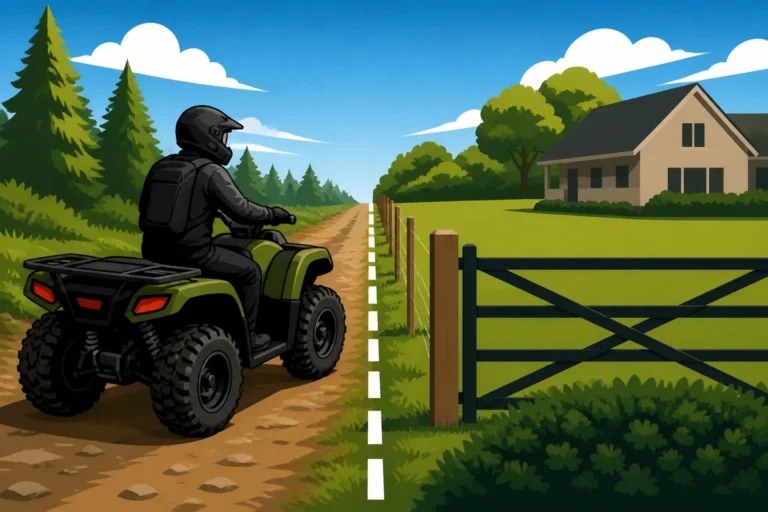
Here's a ban that often catches people off guard: even if you own an ATV, you cannot just ride it on any private land. Virginia law is very clear that operating an ATV on private property is strictly prohibited unless you have the explicit, written consent of the landowner. This isn't just good manners; it's a legal requirement designed to protect property rights and prevent trespassing. Thinking you have "permission" because a friend said it was okay, or because you've ridden there before without issue, won't cut it if you're stopped by law enforcement.
The "Written Consent" Mandate
Virginia Code doesn't mess around with ambiguity when it comes to private land. It explicitly states that no person shall operate an all-terrain vehicle on any private land unless he has the written consent of the owner of the land or his agent. "Written" is the operative word here. A verbal "yeah, sure, go ahead" from the property owner, while perhaps well-intentioned, provides absolutely no legal protection if an officer or the landowner himself decides to enforce the statute. This rule is in place to prevent misunderstandings, unauthorized access, and potential disputes that often arise from verbal agreements or assumed permissions.
To be truly safe and compliant, that written consent should ideally be robust. It should specify the dates or duration for which permission is granted, clearly identify the specific areas of the property where riding is allowed, and include the landowner's signature and contact information. A simple, dated note, "I, [Landowner's Name], grant [Rider's Name] permission to ride their ATV on my property located at [Address] from [Start Date] to [End Date]," is a good start. Without it, you are effectively trespassing in the eyes of the law, even if you genuinely believed you had permission. Imagine being stopped on a remote timber tract in Bath County, only to realize the verbal OK you got from a distant cousin doesn't satisfy the legal requirement for written consent. For guidance on securing proper permission, refer to [Virginia Written Consent on Private Land].
Trespassing Penalties and Landowner Rights
The consequences of operating an ATV on private land without the requisite written consent can range from a civil penalty to more severe legal action, depending on the circumstances and the landowner's wishes. Just like riding on a public highway, violating this rule can lead to a civil penalty of up to $500, plus court costs. But beyond that, you're also exposing yourself to potential charges for trespassing, which can be a criminal offense if the property is posted with "No Trespassing" signs or if the landowner has previously warned you to stay off.
This ban powerfully underscores landowner rights in Virginia. Property owners have the right to control who accesses their land and how it's used. Unauthorized ATV riding can cause significant damage to crops, fences, sensitive ecosystems, and private trails, leading to expensive repairs and long-term erosion issues. It also creates liability concerns for landowners. If someone is injured on their property without permission, even if they were trespassing, it can still lead to legal entanglements. Picture a scenario where a farmer in the Shenandoah Valley finds an ATV tearing through his freshly planted cornfield, causing hundreds of dollars in damage. That farmer has every right to call law enforcement, and without written consent, the rider will face serious repercussions, including potential impoundment of their machine and a demand for restitution for the damages.
Passenger Restrictions: One Seat, One Rider (Usually)
This ban is focused not on where you ride, but how you ride and who you carry. Virginia law is quite explicit about passenger capacity on ATVs, stemming from crucial safety considerations. The general rule is simple: if your ATV isn't specifically designed by the manufacturer to carry a passenger, then you absolutely cannot have one on board. This is a ban on a specific mode of operation that dramatically increases the risk of accidents and injury.
Single vs. Multi-Passenger Design
The core of Virginia's passenger ban revolves around the original design of the ATV. Single-rider ATVs are engineered for one person – one seat, one set of footrests, and weight distribution balanced for a solo operator. Attempting to squeeze a second person, especially an adult, onto a single-rider ATV fundamentally alters its balance, handling, and control characteristics. It makes steering more difficult, braking distances longer, and the machine far more prone to rollovers or losing stability, particularly on uneven terrain or during turns.
Conversely, manufacturers design multi-passenger ATVs, often referred to as "two-up" quads or side-by-sides (UTVs), with specific features to accommodate additional riders safely. These machines have longer, often contoured seats, dedicated handholds for passengers, separate footrests that allow passengers to maintain their balance, and a chassis designed to handle the increased weight and different center of gravity. For side-by-sides, this means full bucket seats, seatbelts, and a roll cage. It's imperative to distinguish between these designs. If you're on a traditional single-seat quad, like a sport ATV, don't even think about carrying a passenger, even for a short hop. It's a clear violation of [Virginia Passenger Rules on an ATV]. For those seeking to enhance their utility machines, SuperATV offers a wide array of accessories designed to improve cargo capacity and protection, but it's important to remember these do not change the vehicle's legal passenger capacity.
Safety Concerns and Aftermarket Modifications
The primary concern behind this ban is rider safety. Carrying an unauthorized passenger introduces a host of risks. The additional weight shifts the center of gravity, making the ATV unstable, especially during aggressive maneuvers, climbing hills, or traversing side slopes. The passenger themselves might interfere with the operator's ability to steer, shift their weight properly, or react quickly to changing trail conditions. In an emergency braking situation, a passenger can be easily ejected or cause the operator to lose control entirely. Even seemingly innocent actions, like a passenger shifting their weight unexpectedly, can throw a single-rider ATV off balance.
Furthermore, it's critical to understand that aftermarket additions designed to create a passenger seat on a single-rider ATV do not magically make it legal to carry a passenger. While products like bolt-on "rumble seats" might seem like a convenient solution, they do not change the fact that the original manufacturer designed the machine for one person. Such modifications do not add the necessary structural integrity, suspension adjustments, or safety features of a factory-designed multi-passenger vehicle. If you're involved in an accident while carrying an unauthorized passenger, these modifications could be used as evidence of negligence, void your insurance coverage, and lead to more severe penalties. It's always best to stick to machines purpose-built for the number of riders you intend to carry, ensuring everyone's safety on the trails.
Age and Engine Size Bans for Youth Riders
Virginia law takes the safety of young riders very seriously, implementing strict bans on specific age and engine size combinations for ATVs. These are not merely guidelines; they are clear prohibitions designed to prevent children from operating machines that are too powerful or too large for their physical capabilities, judgment, and experience levels. This ban helps ensure that kids develop riding skills on appropriate equipment, minimizing the risk of serious accidents.
The 12-Year-Old/70cc Rule
The first crucial ban targeting youth riders states that no person under the age of twelve years shall operate an all-terrain vehicle having an engine size of 70 cubic centimeters or greater. This means if you have a child who is, say, ten years old, they absolutely cannot ride an ATV that has an engine displacement of 70cc or more. This includes many entry-level youth models that might still exceed this limit, as well as, of course, any full-size adult ATV. This rule is rooted in developmental understanding. Children under twelve typically lack the physical strength, coordination, and cognitive judgment required to safely control a machine of that size and power. Their reaction times might be slower, and their ability to anticipate hazards or recover from a loss of control is still developing.
The rationale is straightforward: putting a smaller child on a powerful machine is a recipe for disaster. The weight of a 70cc+ ATV can be difficult for a young child to manage, especially in challenging terrain. They might struggle to turn the handlebars, operate the brakes effectively, or shift their body weight to maintain balance. This ban aims to prevent scenarios where an excited child, perhaps eager to keep up with older siblings or parents, attempts to control an ATV beyond their capability, leading to injuries. Parents looking for machines for younger kids need to be vigilant about engine size. It's not just about the child's height or perceived maturity; the law has specific, hard limits. You can find detailed age restrictions in [Virginia Age Limits by Engine Size].
The 16-Year-Old/90cc Rule
Building on the previous restriction, Virginia law also dictates that no person under the age of sixteen years shall operate an all-terrain vehicle having an engine size of 90 cubic centimeters or greater. This means that teenagers, from twelve up to sixteen, are limited in the size of the ATV they can legally operate. While they can ride machines larger than those for under-12s, they still cannot jump onto a 90cc or larger ATV until they turn sixteen. This rule acknowledges that while teenagers are more developed than younger children, they are still gaining experience and refining their decision-making skills. The step up in power and weight from a sub-90cc machine to a larger model requires a greater degree of strength, control, and judgment.
This ban ensures a graduated learning process, encouraging riders to progress to more powerful machines only when they are legally and physically ready. A 14-year-old, for example, might feel perfectly capable of handling a 250cc sport quad, but the law states otherwise. The risks associated with a larger, faster, and heavier ATV are amplified for a still-developing teenager who might be prone to taking greater risks or underestimating challenging terrain. Enforcement of these rules is vital for preventing accidents among youth. Parents who allow their children to violate these age/engine size bans not only put their kids at risk but can also face legal penalties themselves, as they are often responsible for supervising their minor children's activities. Ensuring your child is on the right-sized machine is as important as making sure they wear a helmet.
Navigating the Bans: Exceptions and Safe Riding
While the five bans discussed are strict and generally applicable, Virginia law does provide certain, highly specific exceptions to some of these rules. Understanding these narrow allowances is just as important as knowing the prohibitions, as they dictate the very limited circumstances where an ATV might legally operate outside typical off-road environments. Furthermore, knowing where you can legally ride is crucial for responsible and enjoyable ATV ownership.
Legal Exceptions to the Road Ban
The general ban on ATVs on public highways and public property does come with a few very specific, narrowly defined exceptions, primarily for essential activities. These exceptions are not loopholes for recreational riding; they are for genuine functional purposes. For example, Virginia law allows ATVs to be operated on public highways for agricultural purposes, such as checking fences or moving between fields, provided the crossing is made by the most direct route and safety precautions are taken. Similarly, utility workers and emergency responders (like fire or rescue squads) are permitted to use ATVs on public roads when performing their official duties. These vehicles are vital tools for accessing remote areas during emergencies or for maintaining critical infrastructure.
Perhaps the most talked-about exception involves a few specific coalfield counties: Buchanan and Tazewell. In these counties, boards of supervisors have the authority to designate certain secondary highways (county roads) for ATV use, under very strict conditions. These designated routes are typically short connectors between official trail systems, subject to speed limits (often 25 mph), daylight-only operation, and proper signage. These are carefully planned routes, often supported by ATV clubs, and are far from an open invitation to ride anywhere. If you're riding in these areas, always confirm the specific designated routes and conditions, as violating them can lead to the same penalties as riding on any other public highway. Understanding these precise rules can save you from a citation; see [Virginia Rules for Crossing a Highway] for more information.
Finding Legal Places to Ride
Given these bans, you might be asking, "So where can I ride my ATV in Virginia?" The answer lies in designated off-road trail systems and private land where you have explicit, written permission. Virginia boasts fantastic opportunities for legal, responsible ATV and UTV riding. The Spearhead Trails system in Southwest Virginia, for example, offers hundreds of miles of managed trails across multiple counties, accessible with a permit. Systems like Coal Canyon, Mountain View, and Jawbone are prime examples of extensive networks where riders can explore without worry. These trails are specifically designed, maintained, and permitted for off-road vehicles.
Beyond public-access trail systems, several private off-road parks across Virginia welcome ATVs and UTVs, often providing amenities like camping, wash stations, and various difficulty levels. These parks require waivers and typically charge a fee, but they offer a controlled and legal environment for riding. Always research and confirm access rules, permit requirements, and safety regulations before you haul your machine to any riding area. Many riders find that gearing up their machines for these dedicated trails, perhaps with aftermarket parts from SuperATV, significantly enhances their experience.
The Importance of Education and Safety Gear
Ultimately, understanding the five ATV bans written into Virginia law is just one piece of the puzzle for responsible riding. Education, coupled with appropriate safety gear, forms the foundation of a safe off-road experience. Taking an ATV safety course, even if not legally required for adults in Virginia, can provide invaluable skills and knowledge that can prevent accidents. These courses cover everything from proper riding techniques and hazard identification to emergency maneuvers and environmental stewardship.
Equally critical is the consistent use of proper safety gear. A DOT-compliant helmet is not just recommended; it's legally required for all ATV riders in Virginia, regardless of age or where they are riding – even on private land. This is outlined in [Virginia Helmet Law Applies to Every Rider]. Beyond a helmet, sturdy eye protection (goggles or a face shield), over-the-ankle boots, long pants, long-sleeved shirts, and gloves are essential. This gear provides vital protection against impacts, abrasions, and debris, significantly reducing the severity of injuries if an accident does occur. By respecting the law, understanding the risks, and investing in safety, you can ensure that your time on your ATV or UTV is both thrilling and safe.
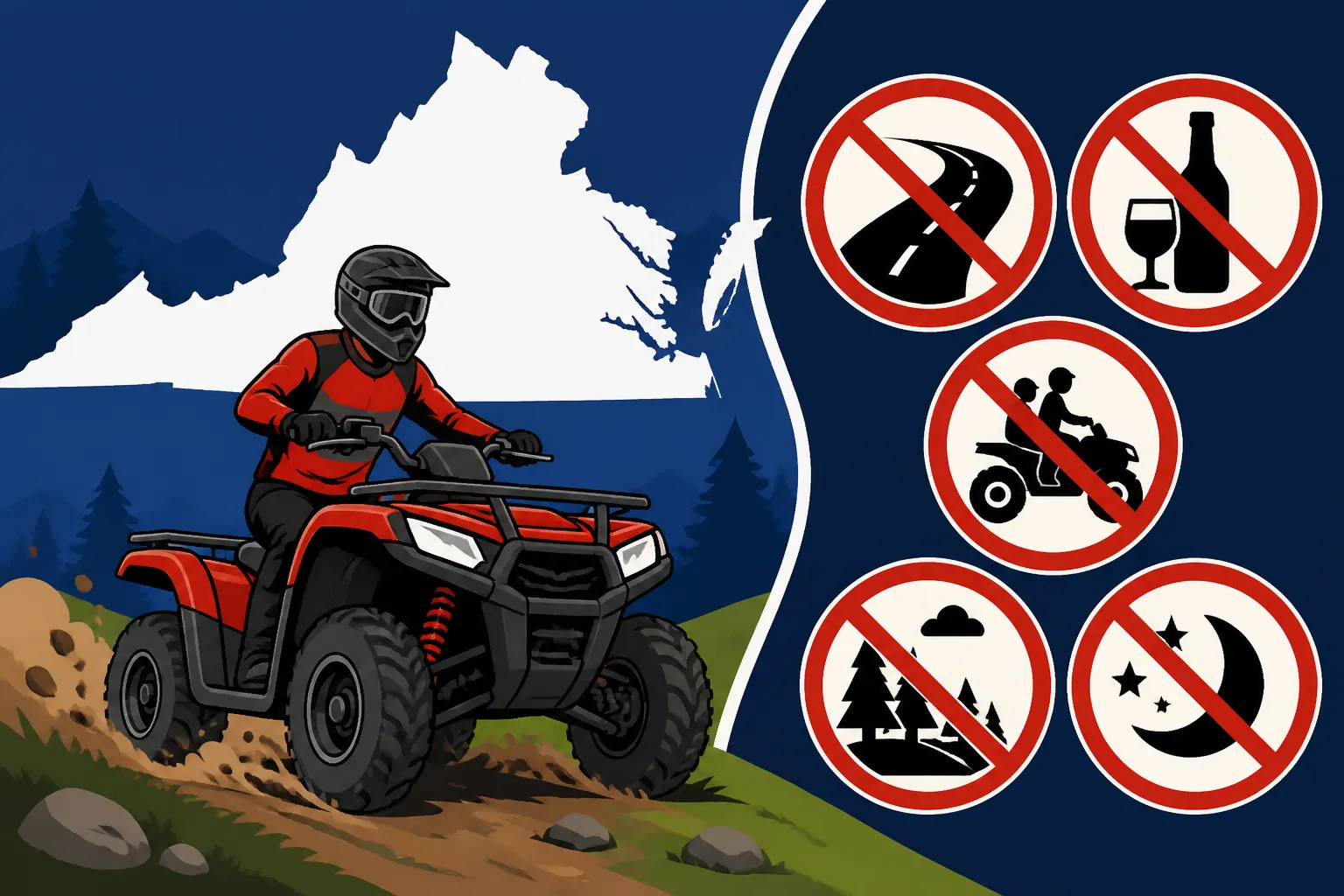
| Ban Category | What It Prohibits | Why It's Banned | Potential Consequences |
|---|---|---|---|
| Public Highways/Streets | Operating ATVs on any road, street, or public way open to vehicular travel (VDOT maintained). | Safety (ATVs not designed for road speeds/traffic, lack safety features). | Civil penalty up to $500, court costs, machine impoundment. |
| Other Public Property | Riding on public sidewalks, parks, greenways, and public easements not designated for ATVs. | Pedestrian safety, environmental damage, noise, interference with other public use. | Civil penalty up to $500, court costs, machine impoundment, local ordinance violations. |
| Private Land Without Consent | Operating ATVs on any private land without the specific, written permission of the owner. | Property rights infringement, prevention of trespassing, landowner liability. | Civil penalty up to $500, court costs, criminal trespassing charges (if property posted/previous warning), impoundment. |
| Unauthorized Passengers | Carrying a passenger on an ATV not specifically designed by the manufacturer for multiple riders. | Vehicle instability, increased risk of rollover, operator control interference, passenger ejection. | Civil penalty up to $500, court costs, potential negligence in accident claims. |
| Underage/Oversized Machine | Under 12 riding 70cc+; Under 16 riding 90cc+. | Child safety (lack physical ability, judgment for larger, more powerful machines). | Civil penalty up to $500, court costs for supervising adult, increased accident risk for minors. |
Disclaimer
This article is for general informational purposes only and does not constitute professional advice. Laws, prices and regulations vary by location and change over time. Consult a qualified professional for guidance on your specific situation.