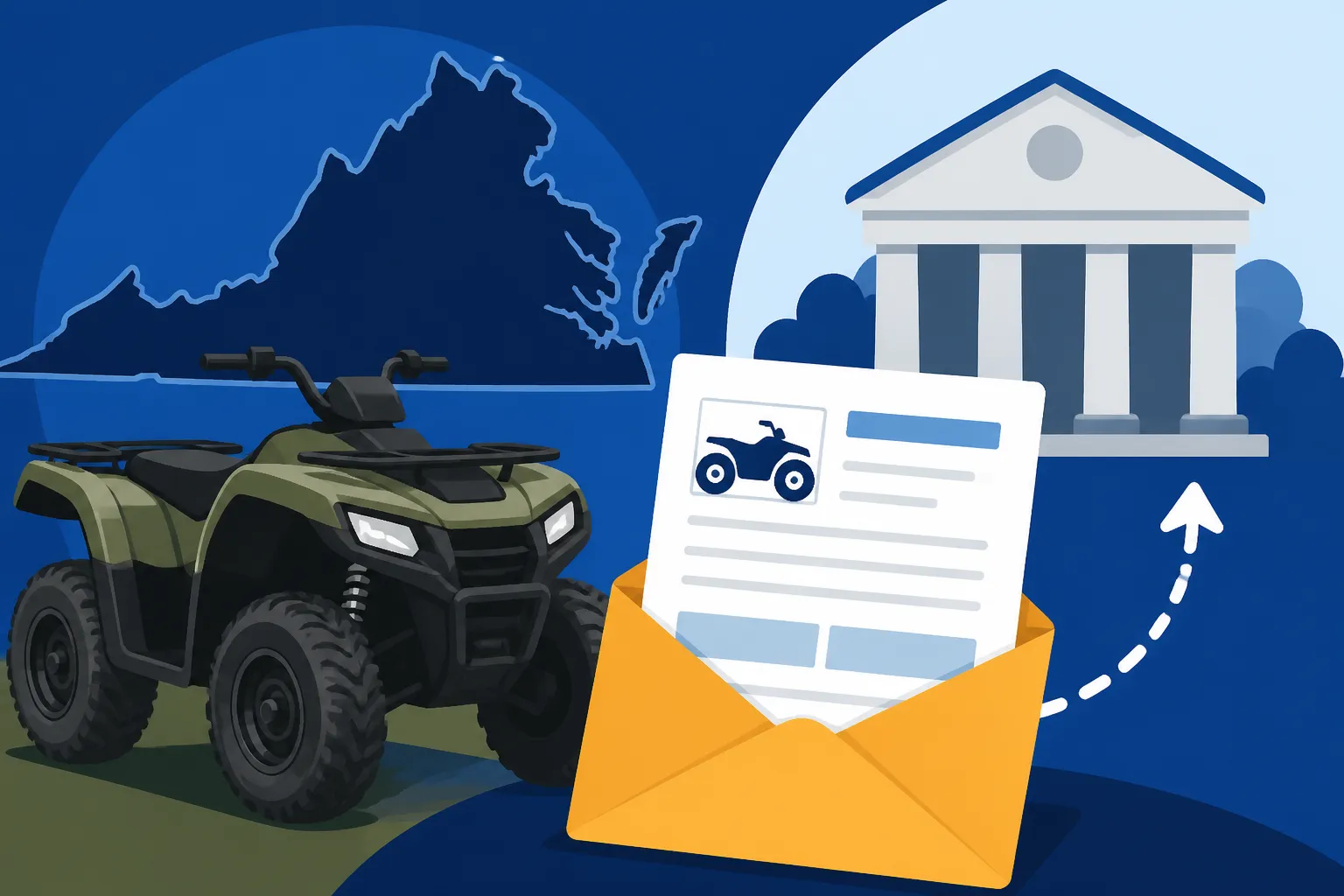
Mailing an ATV Title Application to the DMV
Dealing with the Virginia Department of Motor Vehicles (DMV) can often feel like a day-long quest, especially when all you want to do is get your shiny new (or new-to-you) ATV or UTV legally titled so you can hit the trails. The good news is that you don't always have to brave the lines and the waiting rooms. For many Virginians, mailing in their ATV title application is a perfectly viable and much less stressful option. This guide will walk you through everything you need to know to successfully title your off-road machine from the comfort of your home, ensuring your application gets processed smoothly without a hitch.
Why Mailing Your ATV Title Application Might Be Your Best Bet
Let's be real, who actually enjoys spending a significant chunk of their day at the DMV? Whether you live in a bustling urban center like Richmond or a more rural area where the nearest branch is a good drive away, the time commitment can be a major deterrent. That's where the option of mailing your ATV title application comes in as a genuine lifesaver. It offers a level of convenience that's hard to beat, allowing you to gather all your paperwork at your own pace and send it off when you're ready.
Imagine this: instead of rearranging your work schedule or sacrificing a precious weekend morning, you can compile your documents in the evenings, double-check everything, and drop it in the mail. For folks out in the coalfields or the Blue Ridge, where a trip to the nearest DMV customer service center might involve significant travel time and gas money, mailing can be a far more practical solution. It also gives you the chance to ensure every single detail is perfect before it reaches a clerk's desk, reducing the likelihood of a rejected application due to a minor oversight that you might rush past in a busy office setting.
However, it's not without its trade-offs. The primary downside is the processing time. When you walk into a DMV office, your application is typically processed on the spot, and you leave with your new title in hand (or at least proof it's being issued). Mailing, on the other hand, means you'll be waiting a bit longer. There's the mail transit time, plus the internal processing queue at the DMV's central office. This isn't ideal if you're in a huge hurry to get your machine titled, perhaps because you just bought it and want to get riding immediately on one of the [Virginia ATV Trails: Spearhead and the Forest]. But if you're not facing an urgent deadline, the convenience often outweighs the wait.
Comparing Mailing to In-Person Titling
Let's break down the main differences so you can decide which path makes the most sense for your situation. It's about weighing your priorities: time, convenience, and immediacy.
| Feature | Mailing Application to DMV | In-Person Application at DMV |
|---|---|---|
| Convenience | High. Prepare documents at home, mail anytime. No travel, no waiting in line. | Low to Moderate. Requires travel to a DMV customer service center, potentially long wait times, and fitting into their operating hours. |
| Processing Speed | Slower. Includes mail transit time plus DMV processing queue. Expect several weeks for title arrival. | Faster. Often processed on the spot, though titles might be mailed later. You get immediate proof of application. |
| Document Review | Self-review. You're responsible for ensuring all documents are correct and complete before mailing. | Clerk review. A DMV clerk will review your documents on the spot and can point out any missing information or errors, allowing for immediate correction if possible. |
| Payment Method | Limited. Typically check or money order. Some forms may allow credit card info directly on the application, but this varies. | Broader. Cash, check, money order, credit/debit cards. |
| Questions/Support | Requires calling the DMV or checking their website if you have questions during preparation. | Direct interaction with a clerk who can answer questions and provide guidance immediately. |
| Receipt/Proof | Mail tracking provides proof of delivery. Your canceled check or money order stub serves as payment proof. No immediate DMV receipt. | Immediate receipt provided by the DMV upon successful application. |
| Risk of Error | Higher if you're unsure about requirements. A single missing document or incorrect detail can delay processing significantly. | Lower due to immediate feedback from a clerk. However, errors can still occur if not caught by the clerk or if information is unclear. |
| Best For | Those with non-urgent titling needs, living far from a DMV, or preferring to avoid public offices. People with a clear understanding of the requirements. | Those needing a title quickly, requiring direct assistance, or preferring to handle transactions in person. If you're unsure about the paperwork, this is often the less stressful option. |
For many of us, especially those juggling busy lives or living a fair distance from a DMV office, the thought of saving hours of travel and waiting is incredibly appealing. If you've got all your ducks in a row and a little patience, mailing your application can be a surprisingly smooth process.
What You Need to Include in Your Mailed Application
This is where the rubber meets the road. Sending in an incomplete application is a surefire way to delay the process, sending you right back to square one. You need to be meticulous. The Virginia DMV requires specific documentation to prove ownership, verify your identity, and assess any applicable taxes and fees. Think of it like a carefully assembled puzzle; every piece must be present and correctly fitted for the picture to be complete.
First and foremost, you'll need the correct application form. For titling an ATV or UTV in Virginia, you'll typically be using Form VSA 17A, the "Application for Certificate of Title and Registration." Even though [Virginia Titles ATVs but Never Registers Them] for highway use, this is the standard form used by the DMV for titling these off-road machines. Make sure you fill out every applicable section clearly and accurately. Don't leave blanks unless specifically instructed to do so. Inconsistent or missing information is a common reason for applications being returned.
Beyond the main form, the supporting documents will vary slightly depending on whether your machine is brand new or used.
Documents for a Brand New ATV or UTV
When you purchase a new ATV or UTV from a dealership, the process is usually a bit more straightforward because the dealer should provide you with most of the necessary paperwork.
- Manufacturer's Certificate of Origin (MCO): This is arguably the most critical document for a new machine. It's essentially the birth certificate of your ATV or UTV, showing it's never been titled before. The dealer provides this to you. Make absolutely certain it's signed over to you correctly by the dealership. This MCO is vital because [The MSO You Need to Title a New Quad] is proof of its origin and initial transfer of ownership.
- Bill of Sale or Buyer's Order: This document from the dealer confirms your purchase price and details. It's important for calculating [Virginia Sales Tax at Titling]. Even if you just moved to the state, the DMV will need this.
- Form VSA 17A: As mentioned, this is your application for title. Fill it out completely.
- Proof of Virginia Residency: You'll need to demonstrate that you are a Virginia resident. This could be a copy of your Virginia driver's license or state ID, or other accepted documents that show your current Virginia address. The DMV wants to know where the machine will be "garaged" so they can accurately apply sales tax rates based on your region, like the higher rate in Northern Virginia or the Hampton Roads area. For example, [Virginia Proof of Address at Titling] is a standard requirement for any vehicle.
Documents for a Used ATV or UTV
Titling a used ATV or UTV can sometimes be a bit trickier, especially if previous owners haven't kept meticulous records. Virginia law is quite clear that [Virginia Titles Are Optional on Used Machines] for private sales, but if you're mailing in, you clearly want a title.
- Previous Virginia Title, Signed Over to You: If the machine was previously titled in Virginia, the seller should provide you with the physical title. They must sign it over to you in the designated "Assignment of Title" section. This is crucial for verifying ownership transfer. Make sure their signature is legible and matches the name on the title.
- Out-of-State Title, Signed Over to You: If you bought the ATV from a seller in a neighboring state like West Virginia or North Carolina, you'll need the out-of-state title. [Virginia Accepts an Out-of-State Title], but it must be properly assigned to you by the previous owner.
- Bill of Sale: Even if the machine had a Virginia title, a bill of sale detailing the purchase price is essential for sales tax purposes. If the seller didn't provide one, or if it was just a handshake deal, you might need to create one yourself. Services like LawDepot can offer templates for a general bill of sale to ensure you cover all the legal bases and clearly state the purchase price. This helps the DMV calculate [Virginia Sales Tax at Titling].
- Form VSA 17A: Again, complete this application thoroughly.
- Affidavit in Lieu of Title (VSA 12M): This is where things get interesting if the used ATV or UTV you're buying doesn't have a title, or the seller has lost it. Virginia offers a pathway for titling machines without a physical title through an affidavit. [Virginia Form VSA 12M Affidavit] is the form you'll need. This usually requires notarization. If you're drafting this affidavit or need templates for proving ownership in lieu of a title, sometimes resources like LawDepot can be helpful in structuring the information, though the notarization part must be done by a qualified notary. This scenario is most common for older machines or those from states where titling wasn't required.
- Proof of Virginia Residency: Just like with a new machine, include a copy of your Virginia ID or other proof of address.
A quick note on sales tax: The DMV will calculate sales tax based on the purchase price listed on your bill of sale. Be prepared for this fee, as it's typically paid at the time of titling. If you claim a very low sale price, the DMV may sometimes refer to an online valuation guide to ensure the declared price is reasonable. The standard [Virginia ATV Sales Tax Rate] applies.
Payment for Fees and Taxes
You'll need to include payment for the title fee and any applicable sales tax. The [Virginia ATV Title Cost] is a standard $15. For mailed applications, the DMV typically accepts checks or money orders made payable to "Department of Motor Vehicles." Do not send cash through the mail. Carefully calculate the total amount due – the $15 title fee plus your sales tax – and double-check it. An incorrect payment amount will almost certainly lead to delays. Remember, you might also have to pay a [Virginia Title Fee of $15] per machine.
Step-by-Step: Preparing Your Packet for the Mailbox
Once you've gathered all your documents and filled out Form VSA 17A, it's time to assemble your mailing packet. This isn't just about stuffing everything into an envelope; a little care here can prevent headaches down the road. Think of yourself as a meticulous organizer, ensuring everything is clear, secure, and ready for review.
Checklist and Copies
Before you even think about an envelope, create a checklist of all the documents you need based on the previous section. Go through it piece by piece, confirming you have everything. Then, make photocopies of every single document you plan to send. This includes the MCO, any existing titles, bills of sale, your ID, and the completed VSA 17A. These copies are your safety net. In the unlikely event your packet gets lost in the mail, or if there's a dispute, you'll have a record of exactly what you sent. Never send the only original you have without making a copy first, especially for something as critical as an MCO or existing title.
It's a good practice to write down the Vehicle Identification Number (VIN) of your ATV or UTV on your checklist, too. This is the unique identifier for your machine, and having it handy makes any follow-up inquiries much easier.
Assembling the Packet
Organize your documents in a logical order. A common sense approach is to put the VSA 17A on top, followed by the MCO or previous title, then the bill of sale, and finally your proof of residency. If you're including a [Virginia Form VSA 12M Affidavit], place that prominently as well. Secure the documents with a paper clip or a binder clip; avoid staples, as they can sometimes damage documents or get caught in processing machines.
Place your check or money order on top of the VSA 17A, perhaps clipped to it, so it's easily found by the processing clerk. Make sure the payment amount is clearly written and accurate.
Addressing the Envelope
Use a sturdy envelope, ideally a large one (like a 9×12 inch) to avoid folding critical documents too many times. Clearly print or type the mailing address for the Virginia DMV Titling Work Center. You can typically find this address on the VSA 17A form itself or on the Virginia DMV website. Ensure your return address is clearly visible on the envelope as well.
It's strongly recommended to use a mailing service that provides tracking and delivery confirmation. While standard mail works, having that peace of mind knowing exactly when your important documents reached the DMV is invaluable. Services like USPS Certified Mail with a return receipt, FedEx, or UPS Ground can give you that tracking ability. This is particularly important because [Virginia Title Processing Time] can take a few weeks, and you'll want to be able to confirm they received your application before you start worrying.
What Happens After You Mail It: Waiting and What to Expect
The hardest part about mailing your application is often the waiting game. Once your carefully prepared packet is in the mail, it leaves your hands and enters the DMV's system. Knowing what to expect can help ease any anxiety during this period.
Processing Time and Confirmation
First, factor in mail delivery time. Depending on where you are in Virginia, this could be a couple of days to a week. After that, your application enters the DMV's internal processing queue. While they don't provide real-time updates for mailed applications, typically you can expect your new title to arrive in the mail within several weeks. If you're concerned about [Virginia Title Processing Time], remember that peaks in volume, like during spring riding season, can sometimes extend these timelines.
You won't get a confirmation email or phone call when your application is received. Your first notification will usually be the actual title certificate arriving in your mailbox. However, if you used a tracked mailing service, you'll know when it was delivered to the DMV. Keep that tracking number! If you need to call the DMV about the status of your application, having the date it was delivered is crucial information they'll ask for.
Potential Delays and How to Handle Them
Sometimes, despite your best efforts, something might be missing or incorrect, leading to a delay.
- Missing Information/Documents: The most common reason for a delay or rejection is an incomplete application. If the DMV identifies a missing document or requires clarification, they will typically mail you a letter explaining what's needed. This is why having your copies and being reachable at your mailing address is important. You'll then need to provide the requested information and send it back, which adds more time to the process.
- Incorrect Payment: If your check bounces or the payment amount is wrong, the DMV will notify you. Double-check your calculations before mailing.
- Signatures: Ensure all required signatures are present and correctly placed on the VSA 17A, MCO, or previous title. A forgotten signature is another common pitfall.
If you haven't received your title within the expected timeframe (e.g., four to six weeks) and you've confirmed delivery via tracking, it's a good idea to call the Virginia DMV's customer service line. Have your VIN and the date your application was delivered ready. They can often look up the status and tell you if it's still processing or if there's an issue. Don't be shy about calling if you're concerned; a polite inquiry can often clear things up.
Finally, once that shiny new [What You Get for the $15 ATV Title Fee] arrives in your mailbox, examine it carefully. Make sure all the information – your name, address, the VIN, and the machine's details – is correct. If you find any errors, no matter how small, contact the DMV immediately to get them corrected. It's much easier to fix an error shortly after issuance than months or years down the road when you go to sell the machine. Congratulations, your ATV or UTV is now officially titled in Virginia, ready for all your off-road adventures!
Disclaimer
This article is for general informational purposes only and does not constitute professional advice. Laws, prices and regulations vary by location and change over time. Consult a qualified professional for guidance on your specific situation.