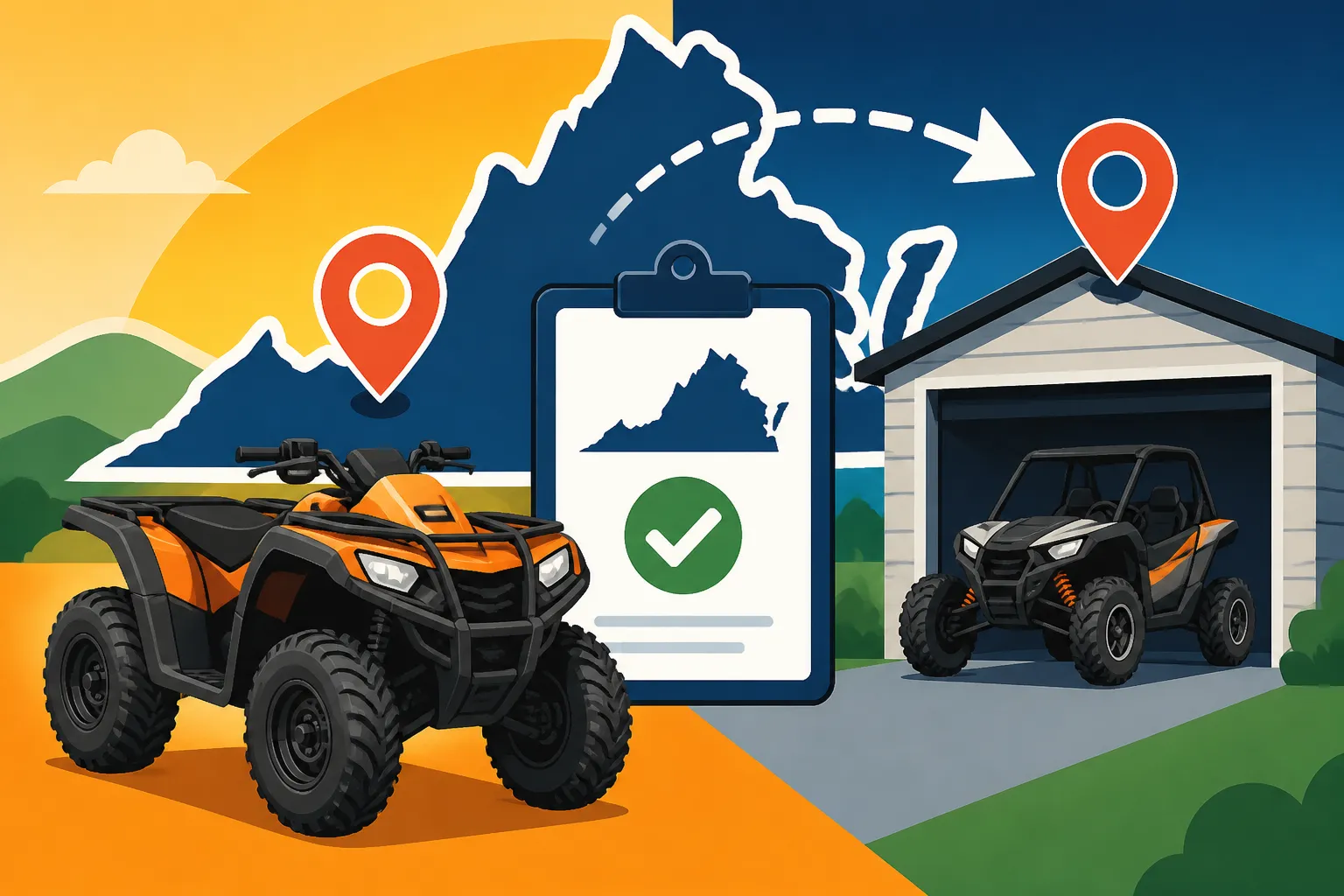
Titling in Virginia When the Quad Is Garaged Elsewhere
It can feel like you're trying to solve a complicated riddle when you own an ATV in Virginia but find yourself garaging it across state lines. This common situation often leads to confusion about where your machine should be titled and what documents you actually need. This guide is here to walk you through the ins and outs of titling your quad in Virginia, even if it calls another state home for most of the year, cutting through the red tape so you can ride with peace of mind.
Understanding Virginia's ATV Titling Basics for Residents
Before we dive into the complexities of out-of-state garaging, let's nail down the core principles of ATV titling here in the Old Dominion. Virginia has a unique approach to ATVs compared to standard motor vehicles, and understanding these fundamentals is key to navigating any unusual circumstances. It's not always as straightforward as titling your car, and many riders find themselves scratching their heads, especially when their situation isn't perfectly conventional.
Why Virginia Titles ATVs but Doesn't Register Them
One of the biggest head-scratchers for new ATV owners, or those moving into the state, is the fact that Virginia requires titles for many ATVs but doesn't actually register them in the traditional sense with yearly fees and license plates. You'll get a title, much like you would for a car, but don't expect a set of tags for your quad. This distinction is crucial because it highlights that the state's interest is primarily in establishing ownership and creating a paper trail for sales and transfers, rather than regulating road use or collecting annual registration revenue. It’s all about proving who owns what, which becomes even more important when you consider potential future sales or if your machine ever gets lost or stolen.
Think of it this way: the title acts as a certificate of ownership. It proves the ATV belongs to you, much like a deed proves you own a house. However, unlike a car, which also gets a title, an ATV doesn't go through the annual registration process because it's generally not considered street-legal for public roads in Virginia. This means no renewal stickers, no yearly fees beyond the initial titling cost, and no license plate to display. This can be a relief for some, but it's often a source of confusion for those expecting the same process they're used to with their cars or trucks. For more on this, check out [Virginia Titles ATVs but Does Not Register Them].
General Rules for Virginia ATV Titling
Virginia's titling rules for ATVs are fairly specific and depend heavily on when the machine was purchased new and its engine size. Generally, if you bought an ATV new in Virginia after July 1, 2006, and its engine is over 50cc, you're required to title it. This is a crucial date and engine size benchmark that dictates whether titling is mandatory or optional. Many people overlook these details, leading to surprises down the road, especially when they go to sell their machine or try to prove ownership.
If you bought your ATV new before that July 2006 cutoff, or if it has an engine 50cc or smaller, titling is generally optional. For used machines, titling is almost always optional, but highly recommended, especially if you plan to finance it or want a clear record of ownership. Lenders, in particular, will almost always require a title to secure their interest in the machine. While the DMV might not chase you down for a title on an older used quad, having one can save you a world of hurt later on. Knowing these basic requirements is the first step toward figuring out your specific situation, especially before adding the wrinkle of out-of-state garaging. You can learn more about these requirements in [Virginia Titles Required on Machines Over 50cc] and [Virginia's July 2006 Titling Cutoff].
The Out-of-State Garaging Conundrum
So, you're a proud Virginia resident, you own an ATV, but for whatever reason, that quad spends most of its time sitting in a shed or barn just across the state line. Maybe you have family land in West Virginia, or a hunting lease in North Carolina, and it's just easier to keep the machine there. This scenario introduces a layer of complexity to the titling process that can leave many riders feeling frustrated and unsure of how to proceed. It's a legitimate question: does it matter where the ATV actually is if you, the owner, are a Virginia resident?
Why Location Matters for Taxes, Not Always for Titles
The primary reason where your ATV is garaged can matter is often related to sales or use tax, and sometimes local personal property taxes, rather than the initial titling itself. Virginia's DMV primarily cares about the owner's residency when it comes to issuing a title. If you live in Virginia, and the ATV is yours, Virginia is generally where you'll title it, regardless of whether it's kept in a barn in Pocahontas County, West Virginia, or a shed in Danville, Virginia. However, if you purchase a machine in another state and immediately garage it there, and never bring it into Virginia, you might find yourself exempt from Virginia sales and use tax, but the titling itself would still technically fall under Virginia jurisdiction if you are a resident. This is a subtle but important distinction.
The complications usually arise when you're trying to prove where the machine is primarily kept for tax purposes or if there's any ambiguity about your residency. For instance, if you bought the ATV in West Virginia, paid their sales tax, and then brought it to your Virginia residence, Virginia might assess a use tax. But if you bought it in West Virginia and kept it in West Virginia on a permanent basis, and only occasionally brought it over the line, the waters get a bit muddier. The DMV is generally focused on your Virginia address when issuing the title.
Scenarios: Virginia Resident, Out-of-State Quad
Let's break down a few common scenarios where a Virginia resident owns an ATV garaged elsewhere. These situations often cause the most headaches and require careful attention to detail during the titling process.
Scenario 1: You live in Virginia, bought the ATV new here, but keep it at a cabin in North Carolina.
In this case, the process is usually straightforward for titling. Since you're a Virginia resident and bought the machine here, you'd follow the standard Virginia titling procedure. The fact that the ATV is then transported to a secondary location out of state usually doesn't impact the issuance of the Virginia title itself. You'll apply for the title at a Virginia DMV customer service center, using your Virginia residential address. The DMV's system is designed to handle resident transactions, and the physical location of the quad post-purchase isn't usually a data point they track for titling purposes, as long as it's not a fraudulent attempt to avoid taxes or regulations. The paperwork for titling a new machine, like an MSO, will list your Virginia address. See [Virginia Title Requirements for a New Machine] for more.
Scenario 2: You live in Virginia, bought a used ATV from an out-of-state seller (e.g., Tennessee), and then garage it in Tennessee.
This scenario can be a bit trickier. Even though the ATV is garaged in Tennessee, if you are a Virginia resident, you'll still apply for a Virginia title. When purchasing a used machine from an out-of-state seller, you'll need the original title, properly signed over to you, or a bill of sale, and possibly a [Virginia Form VSA 12M Affidavit] if the title is missing. The challenge here might be proving to the Virginia DMV that you paid sales tax (or are exempt) in the other state, or that Virginia's use tax applies.
If you never physically bring the machine into Virginia, you might argue that Virginia's use tax doesn't apply, but this can be a gray area and is best discussed directly with the DMV or a tax professional. However, for the title itself, your Virginia residency dictates that the title should be issued by Virginia. The address on your title application would be your Virginia residence. The DMV isn't typically going to ask for a photo of where your ATV sleeps at night. When you buy from a private seller, you might use a generic bill of sale, or even a specific template from a resource like LawDepot, to ensure all details are captured correctly, even if the machine stays out of state. For more on out-of-state purchases, refer to [Virginia Tax on an Out-of-State Purchase].
Scenario 3: You live in another state (e.g., Maryland), own an ATV, but garage it exclusively in Virginia on family land.
This is the inverse. If you're a Maryland resident, your ATV would typically be titled in Maryland, even if it permanently resides in Virginia. Virginia's titling process is primarily for Virginia residents. If you're a new resident moving to Virginia with an ATV, then you would need to title it here, regardless of where it was previously kept. But if you're merely garaging it here as an out-of-state resident, your home state's rules apply for titling. Virginia wouldn't issue a title to a non-resident for a machine garaged here.
Navigating the Titling Process
So, you're a Virginia resident and your ATV is parked out of state. What exactly do you need to do to get that Virginia title in your hands? The steps largely mirror the standard Virginia titling process, but with extra attention to your proof of residency and perhaps how you handle the sales tax component.
Required Documentation for Virginia Residents
Regardless of where your ATV is garaged, if you're a Virginia resident applying for a Virginia title, you'll need to gather the standard documentation. This typically includes:
- Application for Certificate of Title and Registration (Form VSA 17A): This is the main form where you'll provide all your personal information and details about the ATV. You'll use your Virginia residential address here.
- Proof of Ownership:
- New ATV: Manufacturer's Statement of Origin (MSO), also sometimes called a Manufacturer's Certificate of Origin (MCO). This document is crucial for new machines and verifies it hasn't been titled before. See [The MSO You Need to Title a New Quad].
- Used ATV: The previous owner's properly assigned title. Make sure all signatures are in the correct places. If the title is missing, you might need a [Virginia Form VSA 12M Affidavit] along with other supporting documents like a bill of sale.
- Bill of Sale: While not always strictly required if you have a properly assigned title, a bill of sale is highly recommended for all private transactions. It documents the purchase price, date, and seller/buyer information. You can find reliable templates for a bill of sale on sites like LawDepot to ensure all legal bases are covered, even for out-of-state purchases. This helps establish the sales price for tax purposes.
- Proof of Virginia Residency: A valid Virginia driver's license or ID card will usually suffice.
- Payment for Fees and Taxes: This includes the titling fee (which is a set amount, not a variable one), and Virginia sales and use tax, if applicable. Remember, Virginia has specific sales tax rates for ATVs, which are different from standard motor vehicles.
It's absolutely critical to have all these documents in order before you head to the DMV. Missing even one signature or a piece of paperwork can send you home frustrated, forcing you to make another trip.
Where to File Your Application
As a Virginia resident, you'll file your title application at any Virginia Department of Motor Vehicles (DMV) customer service center. You can also mail in your application, but for complex situations, or if you anticipate questions about your out-of-state garaging, going in person is usually the best approach. It allows you to speak directly with a clerk, clarify any ambiguities, and get immediate feedback on your paperwork.
When you're at the DMV, ensure you present all your documents clearly. While clerks are unlikely to question why your ATV is garaged out of state, they will verify your Virginia residency and the validity of your ownership documents. The most important thing is that the address you provide on the VSA 17A is your current, valid Virginia residential address.
Addressing Sales Tax and Use Tax
This is where the out-of-state garaging situation can get a bit more intricate. Sales tax and use tax are often the primary concerns when an ATV is purchased in one state but primarily used or garaged in another by a Virginia resident.
Virginia Sales and Use Tax Rules
Virginia generally assesses a sales and use tax on ATVs purchased by its residents. This tax is typically paid at the time of titling. The tax rate for ATVs is the general sales tax rate, which differs from the specific vehicle sales and use tax rate applied to cars and trucks. It's important to understand this distinction because it often catches people off guard.
If you bought your ATV in Virginia, whether new from a dealer or used from a private seller, you'll pay Virginia sales tax based on the purchase price (or a set minimum if the price is extremely low). This is straightforward. The complexity arises when you purchase the ATV in another state.
Out-of-State Purchases and Tax Implications
When you, a Virginia resident, purchase an ATV in another state and intend to title it in Virginia, you'll generally be subject to Virginia's use tax. This tax is levied on goods purchased outside the state but consumed or used within Virginia. Even if your ATV is primarily garaged out of state, if you're a Virginia resident and plan to title it here, the DMV will expect to collect Virginia's use tax unless specific conditions are met.
Here’s the key: If you paid sales tax in the state where you purchased the ATV, Virginia may grant you a credit for the sales tax paid to the other state, up to Virginia's sales tax rate. This means you might only pay the difference if the other state's tax rate was lower than Virginia's, or no additional tax if it was higher or equal. You'll need proof of the sales tax paid in the other state, usually shown on the bill of sale from a dealer or a receipt. Without this proof, Virginia will likely charge you the full use tax.
However, if you purchase a used ATV from a private seller in another state where no sales tax was collected (as is common in many private sales), Virginia will then charge you the full use tax based on the purchase price you declare, or the machine's book value if the declared price is suspiciously low. Again, a comprehensive bill of sale, perhaps generated using a platform like LawDepot, can be invaluable here for documenting the transaction details and purchase price correctly. Always be prepared to discuss these details with the DMV clerk, especially if you think you're due a credit for taxes paid elsewhere. You can read more about this in [Virginia Tax on an Out-of-State Purchase].
Potential Pitfalls and Proactive Solutions
Even with a clear understanding of the rules, specific situations can throw a wrench into the works. Being aware of these potential pitfalls and having solutions ready can save you a lot of time and frustration.
Missing or Incomplete Paperwork
This is by far the most common problem. You show up at the DMV with what you think is everything, only to find a missing signature, an incorrectly filled-out form, or a document that simply isn't acceptable. This is especially true when dealing with out-of-state private sellers who might not be familiar with Virginia's specific requirements.
Solution: Before you even leave home, double-check every form. If you're buying from a private seller, especially out of state, use a comprehensive bill of sale that clearly identifies both parties, the machine's VIN, the purchase price, and the date. Sites like LawDepot offer templates that cover essential legalities, helping to prevent misunderstandings or omissions. Make photocopies of everything. If you're unsure about a form, check the Virginia DMV website or call them beforehand. When in doubt, it's better to over-prepare with documentation than to be sent home empty-handed.
Proving Residency When Life is Complicated
What if you have multiple residences, or your mail goes to one place but you physically spend more time in another? Virginia's DMV requires proof of Virginia residency for titling. If your driver's license doesn't reflect your current Virginia address, or you don't have utility bills or other official documents for that address, you could face delays.
Solution: Ensure your Virginia driver's license or state ID card is up to date with your primary residential address in Virginia. If you've recently moved, update it first. If you need additional proof, bring utility bills, a lease agreement, or bank statements showing your Virginia address. The DMV wants to establish a clear connection between you, the applicant, and your residency in the Commonwealth. [Virginia Proof of Address at Titling] delves into this further.
Communication Challenges with Out-of-State Sellers
Buying an ATV from a private party in another state, especially one you've never met, can present communication challenges. They might not understand Virginia's titling requirements, or they might be reluctant to provide certain information.
Solution: Be clear and upfront with the seller about the documents you'll need. Specifically ask for a clean title, properly signed over, and a detailed bill of sale. If they're hesitant or can't provide these, it might be a red flag. Consider using an escrow service for the payment if the purchase is large, and always verify the VIN on the machine matches the paperwork. A well-prepared bill of sale, perhaps drafted using a legal forms provider like LawDepot, can serve as a clear agreement between you and the seller, protecting both parties and ensuring you have the necessary information for your Virginia title application.
Long-Term Considerations for Out-of-State Garaged ATVs
Once your Virginia title is in hand, the immediate hurdle is cleared. However, there are still some long-term considerations when your ATV is garaged out of state that are worth keeping in mind. These mostly revolve around local regulations, insurance, and the practicalities of ownership.
Insurance Implications
Virginia does not require insurance for ATVs. This is a common point of confusion, as most people assume any titled vehicle needs insurance. However, just because it's not legally required doesn't mean it's not a good idea. If your ATV is garaged out of state, your homeowner's insurance policy might offer some limited coverage, but usually only for theft while it's on your property. For broader protection, especially against liability if you injure someone or damage property while riding, or for comprehensive and collision coverage, you'll want a dedicated ATV policy.
When purchasing insurance, be upfront with your insurer about where the ATV is primarily garaged. If it's kept in West Virginia, for example, but titled in Virginia, the insurer will need to know the physical location to accurately assess risk and determine coverage options. Some states have different insurance requirements or risk profiles, and honesty with your insurance provider ensures your policy is valid if you ever need to file a claim. You can read more about this in [Why Virginia Requires No ATV Insurance].
Local Regulations and Taxes in the Garaging State
While Virginia controls your ATV's title, the state where your ATV is garaged might have its own local personal property taxes or other regulations that could apply. For example, some counties or municipalities in neighboring states assess an annual personal property tax on vehicles, including ATVs, that are stored within their jurisdiction, regardless of where they are titled.
Check the local laws: It's a good idea to research the specific county or municipality where your ATV is garaged out of state. Understand if they have any local taxes, registration requirements for off-road use, or specific rules for non-resident owners. This is separate from Virginia's titling and tax process, but it's an important part of responsible ownership. Ignoring these local rules could lead to unexpected fees or penalties from the garaging state.
Transporting Your ATV Between States
If your ATV is garaged out of state but you frequently bring it back to Virginia for riding or maintenance, remember to adhere to all transport laws. This includes securing it properly on a trailer, ensuring your trailer is properly registered and inspected (your trailer does need a plate, unlike your ATV!), and having the necessary driver's license for your vehicle class. While your ATV doesn't need a license plate, your trailer certainly does.
When crossing state lines, you generally won't need to show your ATV title to a police officer unless there's a specific incident, like an accident or a suspicion of theft. However, having proof of ownership (your title, or a copy) readily accessible is always a good practice, especially if you're taking your machine to public riding areas that might require it.
Table: Titling Checklist for Virginia Residents with Out-of-State Garaged ATVs
| Item | New ATV Purchase | Used ATV Private Sale | Purpose |
|---|---|---|---|
| VSA 17A Form | Required | Required | Application for Virginia Title |
| MSO/MCO | Required | N/A (Previous Title) | Proof of first ownership for new machine |
| Previous Title | N/A (MSO/MCO) | Required (signed over) | Proof of ownership for used machine |
| Bill of Sale | Recommended (from dealer) | Highly Recommended (LawDepot) | Documents purchase price, date, seller/buyer |
| Proof of VA Residency | Required | Required | Establishes eligibility for VA title |
| Payment (Title Fee) | Required | Required | Virginia's fixed titling fee |
| Payment (Sales/Use Tax) | Required | Required (or proof of tax paid) | Virginia sales or use tax (with possible credit) |
| Photo ID | Required | Required | For identity verification at DMV |
| Notarized Affidavit | N/A | Required if title missing (VSA 12M) | Legal declaration of ownership (e.g., [The Notarized Affidavit That Replaces a Missing ATV Title]) |
This table provides a quick reference, but always remember to check the specific requirements with the Virginia DMV, especially if your situation is complex.
Navigating the nuances of titling an ATV in Virginia when it's garaged in another state can seem daunting at first. However, by understanding Virginia's core titling principles, being prepared with the correct documentation, addressing sales tax concerns proactively, and considering the long-term implications, you can ensure your ATV is legally owned and ready for adventure, no matter where it rests its wheels at night.
Disclaimer
This article is for general informational purposes only and does not constitute professional advice. Laws, prices and regulations vary by location and change over time. Consult a qualified professional for guidance on your specific situation.