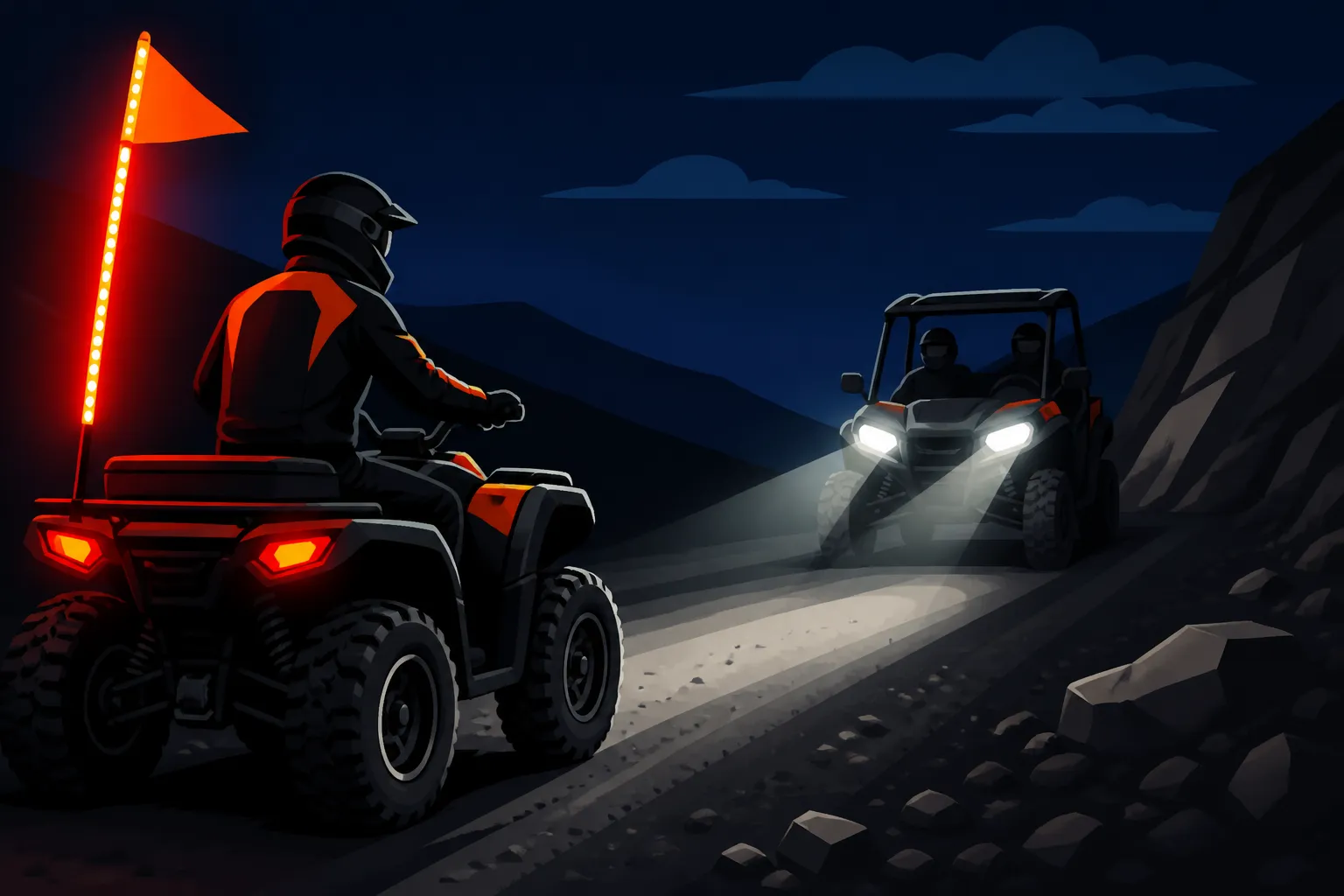
Being Seen at Night on a Coalfield Road
Riding an ATV or UTV on Virginia's coalfield roads, especially when the sun dips below the mountains, can be an exhilarating experience, but it comes with a serious, often underestimated challenge: being seen. The low light, winding gravel, and unexpected industrial traffic can make you feel invisible. This guide will walk you through practical strategies and essential gear to ensure you're highly visible, keeping you safer and more confident on those unique Appalachian routes.
The Unique Challenges of Night Riding on Virginia's Coalfield Roads
There's a raw beauty to Virginia's coalfields after dark, but that beauty often hides significant hazards for off-road enthusiasts. The conditions aren't just about darkness; they're about the type of darkness, the kind of roads you're on, and who else might be sharing them. It's a whole different ballgame compared to riding on a private trail during the day.
Low Light and Unpredictable Terrain
When you're out on the trails or designated road sections in places like Buchanan or Tazewell counties, the natural light is usually minimal once the sun sets. You're not dealing with streetlights or even much ambient glow from distant towns. Instead, it's pitch black, with shadows playing tricks on your eyes. The terrain itself, often gravel or packed dirt, can be uneven, rutted, or suddenly present obstacles like loose rocks or washouts that are hard to spot even with good lights. Without adequate visibility, both for seeing and being seen, a simple evening ride can quickly become a high-risk situation. You're relying entirely on your machine's lighting and any reflective elements to navigate safely.
Moreover, the nature of these roads means you can encounter unexpected dips, blind corners, and sudden changes in elevation. The narrowness of some routes, combined with thick tree cover, only intensifies the darkness. It's not just about seeing what's directly in front of you; it's about being aware of the edges of the road, potential drop-offs, and anything that might be coming your way. Even a simple deer or other wildlife can appear out of nowhere, especially at night, posing a significant risk if you can't react quickly. This unpredictable environment demands that riders take every precaution to maximize their presence visually to others.
Sharing the Road with Industrial Traffic
One of the most critical aspects of riding on coalfield roads, particularly at night, is the potential for encountering heavy industrial traffic. These aren't just recreational paths; they're often working roads used by logging trucks, coal haulers, and other large machinery that operates around the clock. These vehicles are enormous, sometimes moving slowly, but they have massive blind spots and their drivers might not expect a smaller ATV or UTV, especially one with inadequate lighting, to be on the road after dark. The sheer size difference alone means any collision would be catastrophic for the off-road rider.
The noise of your own machine can also make it difficult to hear approaching traffic, adding another layer of risk. Imagine rounding a bend to find a fully loaded coal truck heading your way, and neither of you has had sufficient warning of the other's presence. It's a terrifying thought, and it's why making yourself as visible as humanly possible is not just a suggestion, but an absolute necessity. These industrial roads, while sometimes open to recreational use, are fundamentally functional arteries for local industry, and coexisting safely requires proactive measures on the part of every rider.
Virginia's Specific Road Access Rules
It's crucial to remember that Virginia has very specific rules about where and when ATVs and UTVs can even be on public roads. Generally, ATVs are banned from public highways, but there are exceptions in certain counties like Buchanan and Tazewell, where local boards of supervisors have designated specific routes for off-road vehicles. Even on these designated routes, there are often limitations, such as a [Virginia's 25 mph Coalfield Road Limit] and requirements for riding during [Virginia Rules for Riding After Dark] only. Knowing these rules is your first line of defense, because riding where you shouldn't be only exacerbates the visibility problem.
For example, when these road sections are open, they often come with conditions, such as signage, speed limits, and even specific times of day or night when use is permitted. It's not a free-for-all. An officer conducting [Virginia Equipment Checks by Officers] will certainly be looking for compliance, and this includes proper lighting. If you're riding on one of these approved routes, you must ensure your machine meets the [Virginia Lighting Rules on a Road Trail] and other safety standards, not only for your own safety but also to avoid potential penalties. Understanding [Virginia Buchanan and Tazewell County Road Access] is paramount before you ever hit the trails, especially once the sun goes down.
Essential Lighting Upgrades for Night Visibility
Your machine's factory lighting is a good starting point, but let's be realistic: it's rarely enough for the intense darkness and unique hazards of Virginia's coalfield roads at night. To truly be seen and to see effectively, you'll need to think beyond the basics and invest in some serious upgrades. This isn't just about seeing the trail; it's about announcing your presence to everything and everyone else out there.
Headlights and Tail Lights: Beyond the Basics
While your ATV or UTV comes with headlights and tail lights from the factory, these are often designed more for minimal compliance than for optimal night riding in challenging conditions. The stock halogen bulbs might give off a yellowish glow, but they often lack the intensity and beam pattern needed to cut through the absolute darkness of mountain roads. Upgrading to LED headlights can make a dramatic difference. LEDs offer a brighter, whiter light that illuminates the trail much more effectively, improving your ability to spot obstacles like rocks, ruts, or fallen branches long before you're on top of them.
Beyond just brighter output, look for LED headlight assemblies or replacement bulbs that offer a superior beam pattern. You want a good spread of light to illuminate the shoulders of the road and upcoming turns, as well as a strong, focused beam for distance vision. For tail lights, consider brighter LED replacements too. A dim tail light might be legal, but it's not truly safe when a large vehicle could be approaching from behind on a dark road. Some aftermarket tail lights also incorporate brake light functionality that's more visible, or even additional running lights. SuperATV offers a variety of aftermarket lighting solutions, from replacement bulbs to full headlight assemblies, designed to withstand the rugged demands of off-road use while significantly boosting your visibility and sight lines.
Auxiliary Lighting: Light Bars and Pods
Once your primary headlights are sorted, auxiliary lighting is where you can truly transform your night riding experience and massively enhance your "being seen" factor. Light bars, whether mounted on the roof, bumper, or grill, throw out an incredible amount of light, turning night into a much more manageable twilight. These aren't just for seeing ahead; the sheer intensity of a good light bar makes your machine undeniable to anyone else on the road, even from a distance. Pod lights, smaller and more versatile, can be strategically placed to fill in dark spots, such as illuminating the sides of your machine for wider visibility or serving as dedicated reverse lights.
When choosing auxiliary lighting, consider both flood and spot beam patterns. A combination often works best: a flood pattern for broad illumination close to the machine, and a spot pattern for piercing distance vision. Installation is key here; make sure they are mounted securely to withstand vibrations and impacts common on coalfield roads. Proper wiring with relays and fuses is also essential for safety and to protect your electrical system. For riders navigating areas where [Virginia Rules for Riding a County Road] apply, the added illumination from these powerful lights can be the difference between a safe passage and a close call. Remember, while immensely helpful, these powerful lights should be used responsibly, especially when sharing roads with others, to avoid blinding oncoming traffic.
Accent and Rock Lights for Enhanced Awareness
While headlights and light bars focus on forward visibility, accent and rock lights play a different, but equally important, role in making you more visible, especially to traffic approaching from the sides or when you're maneuvering slowly. Rock lights, often small LED pods, are mounted low on the frame, under the fenders, or even in the wheel wells. Their primary purpose is to illuminate the terrain directly around your wheels when rock crawling or navigating tricky obstacles, but they also create an illuminated "glow" around your machine. This ground effect can be surprisingly effective at drawing attention to your ATV or UTV, especially in low-light conditions.
Accent lighting, like LED strips or small pods, can be installed in various places on your machine – along the frame, under the seats, or highlighting specific components. While often chosen for aesthetic reasons, the additional light sources from different angles make your machine appear larger and more distinct to other drivers. This 360-degree illumination helps prevent you from becoming a "ghost" in the dark. Combined with other lighting, these subtle additions fill in the gaps, creating a more comprehensive visual footprint. These lights are especially useful in situations where [Virginia Rules for a Side-by-Side Driver] might put you in a wider vehicle, increasing the area that needs to be illuminated from all angles.
Maximizing Your Visibility with Reflective Gear and Accessories
Beyond active lighting, there's a passive but highly effective strategy for boosting your visibility: reflectivity. Reflective materials don't generate their own light, but they bounce back any light that hits them, making you stand out to headlights and other light sources. This is a critical layer of defense, especially if your primary lights were to fail or if you're in a situation where direct light isn't hitting your machine.
Reflective Tape on Your Machine
One of the most cost-effective and powerful ways to enhance your ATV or UTV's visibility is by strategically applying high-quality reflective tape. This isn't just about a strip here or there; think about creating a visible outline of your machine from all angles. Apply tape along the edges of fenders, the front and rear bumpers, the sides of the roll cage on a UTV, and even on the wheels or suspension components. The goal is to make your machine "light up" when hit by headlights, regardless of whether your own lights are on. [Adding Reflective Tape to a Quad for Road Sections] can truly make a difference.
Choose bright, conspicuity-grade reflective tape, ideally in colors like white, yellow, or orange, as these tend to have the best retro-reflective properties. Don't be afraid to use a generous amount, particularly on areas that are most likely to be seen by other drivers approaching from the front, rear, and sides. Imagine a truck driver's headlights sweeping across a dark, winding road – you want your machine to immediately pop into view as a recognizable shape. This simple addition acts as a passive beacon, working tirelessly to keep you visible without consuming any power from your battery.
Rider-Worn Reflective Apparel
It's not just your machine that needs to be seen; you need to be seen too. Even with a brightly lit ATV or UTV, a rider in dark clothing can disappear against the background, especially if they become separated from the machine. Wearing reflective gear is an absolute must for night riding. This includes jackets, vests, or even helmets that incorporate reflective materials. Many reputable gear manufacturers, including those like SuperATV, offer apparel designed with high-visibility elements for enhanced safety. Look for gear with large swaths of reflective fabric or strategically placed reflective strips.
Consider wearing a high-visibility vest over your riding jacket. These are inexpensive, lightweight, and instantly make you more noticeable. Helmets are another critical area; while [Virginia Helmet Law Applies to Every Rider] for safety, a reflective helmet can also significantly increase your head's visibility, which is often the highest point of your silhouette. Think about reflective gloves or armbands as well, especially since your hands and arms are used for signaling. The more reflective surface area you present, the greater your chances of being seen, not just by other vehicles but also by your riding partners. This integrated approach ensures that both you and your machine are as visible as possible.
Signals and Indicators for Communication
Beyond simply being seen, effectively communicating your intentions is vital, especially on shared roads at night. While ATVs and UTVs might not come standard with turn signals, adding them is a smart upgrade if you plan to use designated road sections. Clear, bright turn signals eliminate guesswork for other drivers, letting them know when you're preparing to turn or change direction. This is especially crucial on winding roads where sudden movements can catch others off guard.
If adding full turn signals isn't feasible, consider using hand signals, but ensure your arms are also equipped with reflective bands or that you're wearing reflective gloves so these signals are clearly visible in the dark. For UTVs, additional brake lights or even a flashing amber beacon can provide an extra layer of warning, particularly if you're moving slowly or stopping. Anything that helps you communicate your actions visually significantly reduces the risk of misunderstanding and potential collisions. When riding on a designated route, knowing that [Virginia's Named Route in Buchanan County] or [Virginia's Named Route in Tazewell County] are shared paths means being a predictable and visible participant in traffic.
Safe Practices for Night Riding in Coal Country
Even with all the best lighting and reflective gear, safe night riding on Virginia's coalfield roads also hinges on your riding habits and preparedness. Technology can only do so much; the rest is up to you and your crew. These practices are about mitigating risk through smart decisions before and during your ride.
Reduced Speed and Increased Awareness
The first and most critical rule for night riding, especially on unfamiliar or challenging terrain like coalfield roads, is to significantly reduce your speed. What feels like a comfortable speed in daylight can become dangerously fast when your vision is limited to the beam of your lights. Even with powerful auxiliary lights, your reaction time to unexpected obstacles – a deep pothole, a fallen tree limb, or an animal darting across the road – is severely diminished at night. A slower speed gives you more time to see, process, and react, which is paramount for safety.
Coupled with reduced speed is an intensified focus on awareness. Your senses should be heightened. Listen for sounds that might indicate approaching vehicles or wildlife. Scan the edges of your light beam for movement. Be extra vigilant for road signs, trail markers, and any changes in the road surface that might indicate a hazard. Anticipate blind corners and crests, always assuming there might be something on the other side. This heightened state of awareness, combined with a conservative speed, is your best defense against the inherent unknowns of night riding in Appalachian coal country. Remember, designated routes in the coalfields often have a strict [Virginia's 25 mph Coalfield Road Limit], which is a good baseline to stick to.
Riding with a Buddy System
Never ride alone at night, especially in remote areas like the coalfields. A buddy system is more than just company; it's a critical safety net. If one rider encounters a problem – a breakdown, an injury, or simply gets lost – having another person there to assist, go for help, or call for assistance is invaluable. On dark roads, seeing another set of headlights or taillights from a riding partner can also provide a sense of perspective and depth, helping you gauge distances and turns more accurately than relying solely on your own lights.
When riding in a group at night, establish clear communication methods beforehand. This could involve two-way radios, hand signals (well-practiced and reflective!), or simply agreeing to maintain a visible distance from one another. Avoid riding too close, which can kick up dust and obscure vision, but also avoid getting so far apart that you lose sight of each other. A good staggered formation can maximize each rider's visibility from the front and rear of the group. Having a designated leader and sweep rider, both equipped with excellent lighting and reflective gear, can also add structure and safety to the group.
Pre-Ride Checks and Maintenance
Before you even think about heading out after dark, a thorough pre-ride check of your ATV or UTV is non-negotiable. This is where you ensure everything that contributes to your visibility and safety is in top working order. Start with your lighting: check all headlights, tail lights, brake lights, and any auxiliary lights to ensure they are functioning correctly and are aimed properly. Replace any dim or burnt-out bulbs. Check your battery voltage to ensure it can handle the increased electrical load of additional lighting.
Beyond lights, inspect your tires for proper inflation and tread depth, as traction is even more critical in low light. Check your brakes, steering, and suspension components. Ensure your fuel tank is full, and carry any essential tools, a first-aid kit, and an emergency communication device. It's also wise to pack a backup light source, like a powerful flashlight or headlamp, in case of a main light failure. Taking these few extra minutes before each night ride can prevent a minor issue from becoming a major incident when you're miles from anywhere in the dark. This proactive approach to maintenance and preparedness gives you confidence and minimizes unexpected hazards.
Disclaimer
This article is for general informational purposes only and does not constitute professional advice. Laws, prices and regulations vary by location and change over time. Consult a qualified professional for guidance on your specific situation.