Moped Fines Stop at $50 While ATV Penalties Reach $500
It’s a frustrating reality for many off-road enthusiasts in Virginia: the rules and penalties for ATVs often feel confusing, especially when compared to other small motorized vehicles like mopeds. You might think, "It's just another two or four-wheeled machine, how different can the fines be?" But Virginia law sees them through entirely different lenses, and getting caught riding your ATV where you shouldn't can lead to a surprisingly steep financial hit compared to a moped violation. This guide will cut through the confusion, explaining why ATV penalties are significantly higher, what those penalties entail, and how you can avoid them by understanding Virginia's specific regulations.
Understanding Virginia's Legal Classifications: ATVs vs. Mopeds
The primary reason for the vast difference in penalties boils down to how Virginia legally classifies an all-terrain vehicle (ATV) versus a moped. These aren't just semantic distinctions; they dictate everything from where you can ride to the type of safety gear required, and most critically, the severity of the consequences when you break the rules. It's not about how fast they go or how many wheels they have in a superficial sense, but rather their designed purpose and how the Commonwealth defines their legal operating environment.
The Core Difference in How Virginia Sees Them
Virginia's legal framework fundamentally segregates ATVs from mopeds. An ATV, as defined by state code, is a motor vehicle specifically designed for off-road use, usually having three or more wheels, high-flotation tires, and handlebars. It's built to tackle rough terrain, not cruise down Main Street. The entire premise of an ATV's existence in the eyes of Virginia law is that it belongs off public roads and highways. Because of this, when an ATV is operated on a public highway, sidewalk, or other prohibited public property, it's seen as a direct violation of its intended use and a significant safety hazard to other motorists and pedestrians.
Mopeds, on the other hand, are explicitly designed and classified as vehicles that can operate on public roads, albeit with certain restrictions. They often have pedals and an engine size that keeps them below a certain speed and power threshold. Virginia considers them a form of low-speed transportation, a kind of hybrid between a bicycle and a motorcycle. This inherent "road-worthiness" in their legal definition means that while mopeds have their own set of rules and potential fines, violations are typically related to registration, lighting, or operating within their designated lane, not the fundamental act of being on the road itself. This is a critical distinction, as the state views an ATV on the road as an out-of-place machine creating a hazard, whereas a moped is generally an in-place machine that might be violating a minor operational rule. You can find more specific details by looking at [Virginia ATV and Utility Vehicle Definitions] and [Virginia Moped Rules Compared].
Impact of Engine Size on Classification and Rules
While both ATVs and mopeds might come in various engine sizes, this factor plays out differently in their legal implications. For mopeds, engine size (typically 50cc or less) is often a defining characteristic that keeps them in the "moped" category, allowing them on roads without the need for a motorcycle endorsement on a driver's license. Exceed that engine size, and it likely becomes a motorcycle, subject to a whole new set of regulations, including titling, registration, and endorsement requirements.
For ATVs, engine size primarily impacts age restrictions for riders on private land or designated trails, but it does not alter its fundamental classification as an off-road vehicle. A 50cc youth ATV and a 1000cc utility side-by-side are both ATVs in Virginia, meaning neither is legally permitted on public highways. The larger the ATV, the more perceived danger it poses when operated unlawfully on roads, which could implicitly factor into enforcement's perception, though the base penalty remains the same. The rules are clear: if it's an ATV, it's generally off-limits for public road use, regardless of its power output. This distinction helps explain why the penalty structure is so different, targeting the core misuse of the vehicle rather than just an operational infraction.
The Steep Cost of Illegal ATV Riding in Virginia
If you’ve ever seen someone riding an ATV down a public road in Virginia, you might wonder about the consequences. The truth is, Virginia law comes down hard on illegal ATV operation, imposing civil penalties that can be significantly higher than many traffic infractions or moped violations. This isn't just a minor slap on the wrist; it's a clear signal from the state that ATVs belong off-road, and straying onto public ways carries a substantial price tag.
Common Scenarios Leading to the $500 Penalty
Virginia Code § 46.2-915.1 lays out the rules for ATVs, explicitly stating that they are not to be operated on any public highway or public property. This blanket prohibition is the foundation for the steep penalties. When you read [Virginia Bans ATVs on Public Highways], you understand the severity. So, what exactly triggers that hefty fine?
- Riding on Public Roads or Streets: This is the most straightforward violation. Whether it's a busy state highway, a quiet county road, or a city street, if it's a public way, your ATV shouldn't be on it. Even a short hop across the street or a brief ride to a friend's house can result in a citation. Law enforcement officers are vigilant about this, especially in areas where ATV use is common or where local residents complain. It's not just about main thoroughfares; it applies to all paved and unpaved public roads.
- Operating on Public Property: This extends beyond roads to include public parks, school grounds, sidewalks, and even unpaved public rights-of-way where ATVs are not explicitly permitted. The rule is broad: if the land is owned by the state, county, or municipality and isn't designated for ATV use, you're likely breaking the law. Some counties, like Buchanan and Tazewell, have specific exceptions for designated routes, but these are clearly marked and highly regulated. Any deviation from these specific, named routes can lead to a penalty.
- Trespassing on Private Property: While the $500 penalty specifically targets misuse of public ways, riding on private land without the owner's express written consent can also lead to significant legal trouble, including trespassing charges and property damage claims, which could escalate beyond the civil penalty. This is why [Virginia Written Landowner Consent] is so crucial. Even if you think a field looks abandoned, it belongs to someone, and riding there without permission is illegal.
In each of these scenarios, the person operating the ATV can be subject to a civil penalty of up to $500. This amount reflects the Commonwealth's serious view on the improper use of these powerful machines in areas not designed for them. It’s not a criminal charge, but a civil penalty, which still means a court appearance and a substantial financial hit if found in violation. You can explore this further by looking into [Virginia's Civil Penalty for Illegal Riding] and [Virginia Penalties for Illegal Riding].
Beyond the Fine: Other Potential Consequences
While the $500 civil penalty is the headline, it's important to understand that other repercussions can stack up, making an illegal ride far more costly. These aren't just theoretical; they are real-world problems that riders face when they ignore Virginia's ATV laws.
Firstly, if an officer observes an ATV being operated illegally, they have the authority to impound the machine. This means your ATV could be towed away and stored at an impound lot. Getting it back isn't cheap. You'll be responsible for towing fees, daily storage fees, and any administrative fees the impounding authority charges. These costs can quickly add up, often exceeding the initial $500 civil penalty. Imagine paying hundreds of dollars just to get your machine out of storage, on top of the fine itself. [Cities Can Impound an ATV Ridden on a Sidewalk] highlights this power.
Secondly, riding illegally often means you're without the proper safety gear, which is a separate violation. Virginia has a strict [Virginia Helmet Law Applies to Every Rider] on ATVs, regardless of age or property type. Not wearing an approved helmet can result in additional fines. While this won't be another $500 penalty, it adds to your total cost and indicates a disregard for safety regulations. Furthermore, if you're involved in an accident while riding illegally, your insurance might not cover damages, leaving you personally liable for repairs to your machine, other property, or even medical bills for injuries to yourself or others. This can turn a single moment of ill-advised riding into a financial catastrophe. Many riders choose not to get [Virginia Requires No ATV Insurance] since it's not mandated, but this can be a huge mistake if you face an accident.
Moped Fines: A Different Set of Rules and Dollar Amounts
When we talk about mopeds in Virginia, the legal landscape shifts considerably. While still regulated, the penalties associated with moped violations are generally far less severe than those for illegal ATV operation. This difference isn't arbitrary; it reflects the moped's legal status as a road-worthy vehicle, albeit one with specific limitations, as opposed to an ATV's classification as an off-road machine.
Typical Moped Violations and Their Fines
Mopeds are permitted on most public roads in Virginia, provided they adhere to specific operational and equipment requirements. Therefore, moped violations typically revolve around these operational aspects rather than the fundamental act of being on the road itself. Here are some common infractions and their associated fine structures, which are notably different from the ATV penalties:
- Failure to Register: While ATVs are titled but not registered in Virginia (you can learn more from [Virginia Titles ATVs but Never Registers Them]), mopeds often require registration through the DMV. Operating an unregistered moped can lead to a fine, but it's usually a standard traffic infraction fine, far less than the $500 civil penalty for an ATV.
- Operating Without a License (or Learner's Permit): While a special motorcycle endorsement isn't needed for a moped, you generally need at least a valid driver's license or learner's permit. Operating without one would result in a fine similar to other unlicensed driving offenses, again typically in the tens of dollars, not hundreds.
- Equipment Violations: Mopeds are subject to lighting requirements (headlight, taillight, brake light), mirrors, and often a horn. Faulty or missing equipment can lead to fines comparable to those for similar infractions on a car or motorcycle. For example, a non-working headlight might incur a modest fine.
- Passenger Restrictions: Many mopeds are designed for a single rider. Carrying an unauthorized passenger can also result in a fine, usually a standard traffic citation.
- Failure to Wear Proper Protective Gear: While mopeds don't always require a helmet for adults over 18, depending on the specific statute, there can be rules regarding eye protection or helmets for younger riders. Fines for these violations typically align with other minor safety infractions.
- Speed Limit or Lane Violations: Mopeds have specific speed limits (often not exceeding 35 mph) and may be restricted to certain lanes or required to ride as far right as practicable. Violating these rules would result in typical traffic fines, similar to what a cyclist or motorist might face for similar infractions.
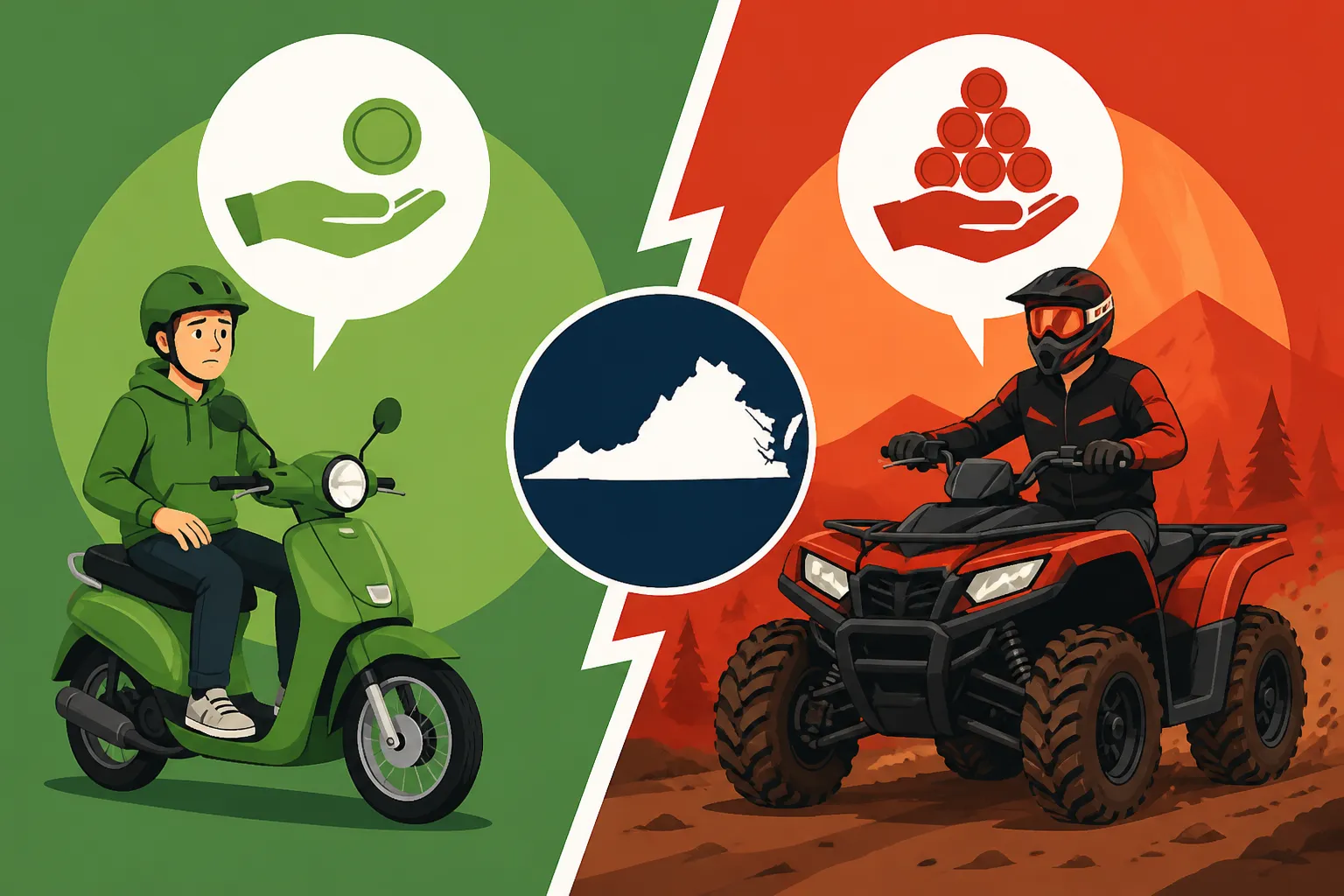
The key takeaway is that these fines are generally on par with other minor traffic offenses, often falling in the $25 to $50 range for initial violations, with potential increases for repeat offenses or more serious infractions. This is a stark contrast to the up to $500 civil penalty an ATV rider faces for merely being on a public road. This clear distinction is a vital piece of information for anyone owning either type of vehicle in Virginia, as the legal exposure is dramatically different. More details can be found under [Virginia Moped Statute Compared].
Why Mopeds Often Face Less Severe Penalties
The reason mopeds face less severe penalties than ATVs in Virginia is rooted in their fundamental legal classification and perceived risk. Mopeds are categorized as low-speed vehicles designed for street use. While they share some characteristics with motorcycles, their limited speed and power output generally make them less of a perceived hazard to other vehicles and pedestrians than a full-sized ATV. The state views moped violations more as operational oversights or minor traffic infractions that can be corrected, rather than a fundamental misuse of the vehicle's design.
An ATV, by definition, is an off-road vehicle. Its wide tires, high ground clearance, and open chassis are built for rugged terrain, not asphalt. When an ATV is operated on a public road, it is seen as inherently unstable and ill-equipped for road conditions, posing a significant risk to the rider and others. The legal system views this as a direct violation of safety and public order. This isn't just about a broken tail light; it's about a machine being in a place it fundamentally should not be, creating a dangerous situation. The higher penalty for ATVs reflects this greater perceived risk and the state's intent to deter any public road use by these machines. The legislature has deliberately carved out separate statutes for each vehicle type, making their regulatory frameworks distinct, and consequently, their penalties.
Avoiding Penalties: Riding Your ATV Legally in Virginia
No one wants to face a hefty $500 civil penalty, impoundment fees, or additional fines. The best way to avoid these headaches is to understand and strictly adhere to Virginia's ATV laws. It might feel restrictive, but knowing where and how you can legally ride your ATV is your best defense against unexpected legal trouble and financial strain.
Knowing Where You Can Ride Your ATV
The good news is that Virginia does have legal places for you to enjoy your ATV, even if public roads aren't one of them. The key is to seek out designated off-road areas.
- Designated Trail Systems: Virginia is home to some fantastic trail systems, notably the Spearhead Trails in the southwestern part of the state. Systems like Coal Canyon, Mountain View, and Original Pocahontas offer hundreds of miles of trails specifically designed and maintained for ATVs, UTVs, and dirt bikes. These systems require permits (you can get information on [Virginia Spearhead Trail Permits]), but they offer a legitimate, legal, and thrilling place to ride. Similarly, the George Washington and Jefferson National Forests have OHV trails like Peters Mill Run and Taskers Gap, which also require [Virginia National Forest OHV Permits]. These are the places your machine is meant to be.
- Private Land with Permission: If you own private land, you can generally ride your ATV on your own property. However, be mindful of noise ordinances and local regulations that might still apply. If you want to ride on someone else's private property, you must have their express [Virginia Written Landowner Consent]. A simple verbal "yes" isn't enough; getting it in writing protects both you and the landowner. Without it, you could face trespassing charges, which are separate from the ATV public highway penalty but still costly.
- Limited Road Access in Designated Coalfield Areas: There are very specific, highly regulated exceptions in Buchanan and Tazewell counties where a limited number of designated county roads are open to ATVs as part of the Spearhead Trails network, connecting trails or allowing access to trail towns. These routes are signed, have strict speed limits (25 mph), and are for transit, not joyriding. These are the only exceptions to [Can You Ride an ATV on the Road in Virginia?], and riders must pay close attention to the signage. Any deviation, or riding on an undesignated road in these counties, is still illegal.
When you're equipping your machine, consider performance parts and accessories from reputable brands like SuperATV. While SuperATV focuses on enhancing your off-road experience with performance parts and accessories, equipping your machine for rugged trail use with durable components can indirectly help you stay on legal paths. A well-maintained ATV is less likely to break down in the backcountry, removing any temptation to illegally use public roads for recovery, thus helping you steer clear of those steep fines. Quality components mean you're more reliably on the trails, which is where your ATV belongs.
Essential Paperwork and Preparations
Beyond knowing where to ride, understanding the necessary paperwork and making proper preparations can save you a lot of trouble.
- Titling Your ATV: In Virginia, ATVs over 50cc bought new since July 1, 2006, must be titled with the DMV. Even for older or used machines where titling is optional, having a title provides proof of ownership, which can be invaluable if your ATV is stolen or if there's any dispute about who owns it. The [Virginia Title Fee of $15] makes it an affordable safeguard. Keeping a copy of your title or proof of ownership with you on the trails can be helpful if asked by a trail ranger or law enforcement.
- Permits for Designated Trails: If you plan to ride on a system like Spearhead Trails or within the National Forests, you'll need the appropriate permit. Purchase these ahead of time and ensure they are valid for the specific system and duration you plan to ride. Trail rangers regularly check for these, and riding without a permit can result in fines and removal from the trail system.
- Safety Gear: Always wear an approved helmet, eye protection, and appropriate riding gear. This isn't just about avoiding fines for not wearing a helmet; it's about your safety. Accidents happen, and proper gear can literally be a lifesaver. This is a non-negotiable part of responsible ATV riding in Virginia.
- Know the Rules of Your Riding Area: Each trail system or private land area might have its own specific rules regarding speed limits, passenger restrictions, sound limits, or group sizes. Familiarize yourself with these before you hit the trail. For example, some National Forest trails have specific width limits, and all require a spark arrester.
By investing in understanding the regulations, preparing properly, and choosing legal riding destinations, you can enjoy your ATV experience without the looming threat of costly penalties. Focusing on the legal, designated riding areas, perhaps with a machine upgraded with durable parts from SuperATV for reliability, ensures you’re not only having fun but doing so responsibly and within the bounds of Virginia law.
Comparative Overview: Penalties for Illegal Moped vs. ATV Operation
To clearly illustrate the distinction discussed, here's a summary table comparing common violations and their typical penalty ranges for mopeds versus ATVs in Virginia. This highlights why understanding the precise legal classification of your machine is so critical.
| Violation Type | Typical Moped Penalty Range | Typical ATV Penalty Range (Public Road/Property) | Notes |
|---|---|---|---|
| Operating on Public Highway/Property | Standard traffic infraction (e.g., $25-$100) | Up to $500 civil penalty (plus impoundment) | Mopeds are designed for roads; ATVs are explicitly banned. This is the core difference. |
| No Registration/Permit | Standard traffic infraction (e.g., $25-$50) | N/A (ATVs are titled, not registered) | ATVs require titling for new machines >50cc, but do not have annual registration fees like mopeds. |
| No Helmet/Eye Protection | Minor traffic infraction (e.g., $25-$50) | Minor traffic infraction (e.g., $25-$50) | Both require helmets in many scenarios; fines are for the safety violation itself, additional to illegal operation for ATVs. |
| Equipment Violations (lights, etc.) | Standard traffic infraction (e.g., $25-$50) | N/A (ATVs don't have road-legal equipment requirements) | ATVs don't need road-legal equipment for trail use, but mopeds must meet specific road standards. A poorly equipped ATV on the road would fall under the "illegal operation" fine. |
| Trespassing (Private Land) | Depends on severity (e.g., $100-$250+) | Depends on severity (e.g., $100-$250+) | Penalties for trespassing apply to both, and are separate from vehicle-specific road use fines. Always get [Virginia Written Landowner Consent]. |
This table makes it starkly clear: while a moped rider might face a relatively minor fine for an operational mistake, an ATV rider found on a public road or unauthorized public property is looking at a significantly higher, dedicated civil penalty. The difference is not just a little more; it's a difference in legal philosophy regarding where these vehicles are allowed to operate at all.
Disclaimer
This article is for general informational purposes only and does not constitute professional advice. Laws, prices and regulations vary by location and change over time. Consult a qualified professional for guidance on your specific situation.