Why Virginia Adults Must Wear a Helmet, Not Just Kids
It's a common sight: families out enjoying the trails in Virginia, kids decked out head-to-toe in protective gear, helmets snugly fastened. Then you see an adult rider, perhaps on a powerful UTV, with no helmet in sight. The assumption often is that once you're an adult, or if you're on private land, helmets become optional, a mere suggestion. But here in Virginia, when it comes to riding ATVs and UTVs, the law is clear, and it applies to everyone, regardless of age or location. This guide is going to break down why Virginia's helmet law isn't just for the youngsters, but a mandatory requirement for every single rider, and what that truly means for you and your adventures.
The Persistent Myth: Helmets Are Just for Kids
Let's be honest, many of us grew up with the idea that helmets were mostly for children learning to ride bikes or for very young ATV riders. This perception is deeply ingrained for some, making the reality of Virginia's laws feel surprising or even unfair. The image of a rugged adult rider, wind in their hair, is compelling, but it's a dangerous fantasy when you consider the realities of off-road riding in our beautiful, yet challenging, Appalachian terrain.
Why Adults Often Overlook Helmet Use
There are a few reasons why adults might mistakenly believe they're exempt from helmet rules. First, there's a strong sense of personal freedom, especially on one's own land or what they perceive as private, uncontrolled property. The thought is, "This is my machine, my property, my risk." Second, some might feel that their experience level negates the need for a helmet; they've been riding for years, they know their machine, they know the trails. Third, comfort can be a factor. Helmets can be hot, cumbersome, and can limit peripheral vision for some, leading riders to forgo them for what feels like a more enjoyable, less restricted experience. This is a big one, especially on a warm summer day in the mountains, but it's a trade-off that can have devastating consequences.
The Dangers of Believing the Myth
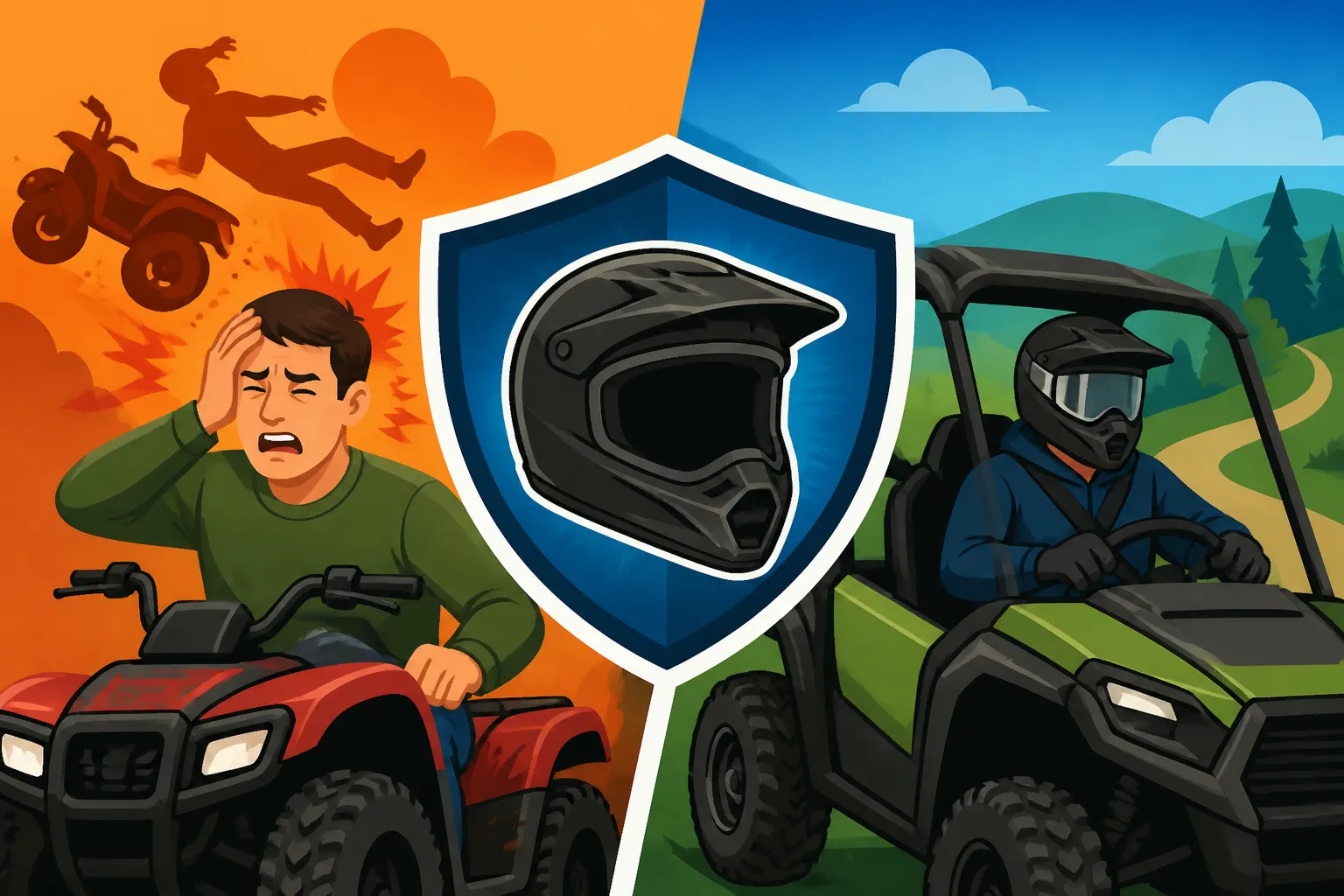
The danger in this pervasive myth is self-evident: serious head injury. While children's developing brains are certainly more vulnerable, an adult's skull and brain are by no means invincible. A fall from an ATV or UTV, even at low speeds, can result in severe trauma. Consider a sudden rollover on a steep incline in the Blue Ridge mountains, or an unexpected collision with a hidden tree stump in the George Washington National Forest. The forces involved are immense, and without a helmet, the outcome can be life-altering, leading to traumatic brain injuries, permanent disability, or worse. It’s not just about dramatic crashes either; even a minor tip-over can result in your head hitting a rock or hard ground, with critical results.
Virginia's Unwavering Stance: The Law Explained
Virginia's General Assembly has taken a very clear and unequivocal stance on ATV and UTV helmet use. Unlike some states that have age-based exemptions or rules that differentiate between public and private land, Virginia’s law is broad and inclusive, leaving little room for interpretation. It’s designed to protect all riders, recognizing the inherent risks of these powerful machines.
The Broad Scope of Virginia's Helmet Law
The specific statute, Virginia Code § 46.2-915.1, doesn't mince words. It mandates that any person operating or riding on an all-terrain vehicle (which includes most utility vehicles or side-by-sides under Virginia's broad definition) must wear a protective helmet. Crucially, the law specifies that this helmet must meet the standards established by the Superintendent of State Police. This isn't just a suggestion; it's a legal requirement that applies across the board. The law makes no distinction for age, meaning "Virginia Helmet Law Applies to Every Rider," from the youngest passenger to the most seasoned adult operator.
Furthermore, the law doesn't differentiate between private property and public trails. While many assume "my land, my rules," the Virginia Code casts a wider net. If you are operating an ATV or UTV, the helmet law applies. This is particularly important for those who own large tracts of land or ride on permitted private properties, as they are still subject to this statewide regulation. It's not just about staying safe on Spearhead Trails or Peters Mill Run; it's about staying safe, period.
Understanding Approved Helmet Standards
It's not enough to simply wear a helmet; it must be one that meets specific safety standards. These standards are typically set by organizations like the Department of Transportation (DOT), Snell Memorial Foundation (Snell), or the Economic Commission for Europe (ECE). When looking for a helmet, you'll often see a DOT certification sticker on the back. This indicates that the helmet has been tested and meets federal safety requirements, offering a baseline level of protection.
Higher-end helmets might also carry Snell or ECE certifications, which often involve more rigorous testing protocols. For riders, this means checking for these labels before purchase. Buying a cheap, uncertified helmet from an unknown source is not only a false economy but also doesn't satisfy the legal requirement for adequate protection. Virginia wants you to wear a helmet that can actually do its job in a crash, not just one that looks the part. When considering upgrades to your machine, perhaps a new windshield or cargo box from a company like SuperATV, remember that your personal safety gear needs to meet equally high standards.
Beyond the Law: Why Helmets Are Essential for Adults
While the legal mandate is a strong motivator, the practical reasons for adult helmet use far outweigh simply avoiding a ticket. The human head is incredibly complex and vulnerable, and the risks associated with off-road riding are diverse and significant. A helmet is not just a piece of equipment; it's an investment in your well-being and your future.
The Physics of a Crash and Head Protection
Imagine the forces at play in a typical ATV or UTV incident. A machine weighing hundreds of pounds, moving at speeds that could easily exceed 25 mph (even if the trail limit is exactly that), suddenly stops, flips, or collides. Your body continues to move forward or sideways due to inertia, and if your head strikes a solid object—the ground, a tree, another part of the machine—the impact can be catastrophic. A helmet is engineered to absorb and dissipate these forces. It does this through several layers: a hard outer shell that spreads the impact over a larger area, an energy-absorbing inner liner (often made of expanded polystyrene or EPS foam) that crushes to absorb kinetic energy, and a comfort padding layer.
Without this crucial protection, the impact directly transfers to your skull and brain, leading to concussions, skull fractures, brain hemorrhages, or diffuse axonal injury. These aren't minor injuries; they can result in long-term cognitive impairment, motor skill loss, or require extensive rehabilitation. [Virginia ATV Helmet Law Explained] goes into more detail about how the state's requirements aim to mitigate these severe outcomes.
Protecting Against More Than Just Direct Impact
It's not just the direct, blunt force impact that a helmet protects against. Think about flying debris on the trail—rocks kicked up by other riders, low-hanging branches in wooded areas, or even unexpected wildlife. A helmet with a face shield or goggles provides vital eye protection, preventing serious injury or temporary blindness that could lead to a crash. Many serious riders equip their machines with robust accessories, and brands like SuperATV are popular for their durable components. Just as those components protect your machine, a helmet protects you from the environment itself.
Moreover, a helmet can reduce the risk of secondary injuries like whiplash. By providing a stable, protective shell around the head and neck, it helps to minimize extreme head movements during a tumble, potentially reducing strain on the cervical spine. While a helmet can't prevent all injuries, it dramatically reduces the severity and likelihood of the most critical ones.
Common Scenarios and the Helmet Rule
Understanding the law in the abstract is one thing, but applying it to real-world riding situations helps clarify its comprehensive nature. Virginia's helmet law touches nearly every aspect of ATV and UTV operation within the state.
Riding on Private Property and Farmland
This is perhaps the biggest point of contention for many adult riders. "I'm just riding my quad on my own farm," or "We're on our hunting lease, miles from anyone." The temptation to skip the helmet is strong. However, Virginia's law does not make exceptions for private land or agricultural use. If you are operating an ATV or UTV, the helmet is required.
Consider a scenario in the rural stretches of Bath County. You're using your UTV to check fences on your sprawling property. It's a routine task, nothing fast or extreme. Suddenly, you hit a hidden rut, the UTV lurches, and you're thrown. If your head hits the ground, that routine task can turn into a life-threatening emergency, even though you were on your own land. The law understands that gravity and unforeseen obstacles don't care about property lines. [Virginia Rules for Riding Private Land] offers further insights into landowner responsibilities and rider conduct.
Public Trails and Designated Riding Areas
For those who frequent Virginia's fantastic public trail systems, like the Spearhead Trails or Peters Mill Run, the helmet requirement is often more readily accepted. These areas are usually managed with clear safety guidelines, and rangers or staff will enforce helmet use. On these trails, the risks are higher due to varied terrain, shared paths with other riders, and potential for higher speeds.
For instance, riding the scenic yet challenging trails of Coal Canyon near Grundy, you'll encounter steep climbs, rocky sections, and tight turns. These conditions demand maximum protection. Even a low-speed tip-over on an uneven rock section can lead to serious injury if you're not wearing proper head protection. In such environments, a helmet isn't just a legal obligation; it's common sense, part of the standard gear alongside your sturdy boots and protective eyewear.
Passenger Rules and Side-by-Sides
What about passengers? The law is equally clear: "any person operating or riding on an all-terrain vehicle" must wear a helmet. This includes passengers on an ATV designed for two, or anyone riding in a side-by-side (UTV). Just because a side-by-side often has a roll cage and seatbelts, that doesn't negate the helmet requirement. In fact, in a rollover, even with a roll cage, there's a significant risk of head trauma from striking the cage itself or the ground if the vehicle is badly deformed.
A family outing to the Mountain View trail system, with kids and adults enjoying a UTV ride, requires every occupant to wear a helmet. There's no age limit where passengers are exempt, nor is there a distinction for the "comfort" of a side-by-side. The potential for head injury remains, and the law applies to everyone inside the machine. For those wondering about the legal classification of their machine, "Virginia ATV and Utility Vehicle Definitions" provides helpful clarification.
What Happens If You Don't Wear a Helmet
Ignoring Virginia's helmet law comes with both legal consequences and, far more critically, severe personal risks. It's not just a slap on the wrist; the penalties are designed to be a deterrent, and for good reason.
Legal Penalties and Fines
If you're caught riding an ATV or UTV without a helmet where required by Virginia law, you can face a civil penalty. The specific amount for such a violation can be significant, often reaching up to several hundred dollars. This fine is not a criminal charge, but rather a civil infraction, much like a traffic ticket. However, it still means court costs and a mark on your record, potentially making your off-road adventures a lot more expensive than you anticipated. [Virginia Civil Penalty for Illegal Riding] details the financial impact of such violations.
Beyond the initial fine, remember that a citation for a helmet violation might be accompanied by other infractions if you're found riding illegally, such as trespassing or riding on restricted roads. Each of these can stack up, quickly turning a simple ride into a costly legal headache. An officer at a trailhead or even on a property boundary can certainly ask to see proper documentation and observe safety compliance. "What an Officer Can Ask For at a Trailhead" clarifies the authority of law enforcement in these situations.
Insurance Implications and Injury Costs
Perhaps even more impactful than a fine are the potential insurance implications. While Virginia does not require ATV or UTV insurance by law, many riders choose to carry it for liability and medical coverage. If you are involved in an accident while not wearing a legally required helmet, your insurance company could potentially deny certain claims related to head injuries, arguing that you contributed to the severity of your injuries by failing to comply with the law. This could leave you on the hook for massive medical bills.
Think about a severe head injury. The costs can quickly escalate into hundreds of thousands of dollars for emergency care, surgeries, extended hospital stays, and long-term rehabilitation. Without insurance coverage—or with a denied claim—this financial burden falls squarely on you and your family. A $100 helmet is a minuscule expense compared to the financial and emotional toll of a severe, preventable head injury. It's a stark reminder that sometimes the cheapest options have the highest hidden costs.
Choosing the Right Helmet for Virginia Trails
Given the non-negotiable nature of helmet use in Virginia, understanding how to select an appropriate and safe helmet is paramount. This isn't just about grabbing any helmet off the shelf; it's about making an informed decision that prioritizes your safety and comfort for those long days on the trails.
Types of Helmets for Off-Road Riding
For ATV and UTV riders, several helmet types offer excellent protection:
- Off-Road/Motocross Helmets: These are easily recognizable by their aggressive styling, prominent visor, and elongated chin bar. They offer excellent ventilation, which is a huge plus on hot Virginia summer days. The large eye port is designed to accommodate goggles, which are essential for dust and debris protection. These are often the go-to for serious trail riders.
- Dual-Sport Helmets: A hybrid of street and off-road helmets, dual-sport helmets feature an integrated visor, but often retain the chin bar and extended eye port of an off-road helmet. They can be a good choice for riders who might transition between very short road sections (where permitted) and trails, offering more wind protection than an open face while still allowing for goggles.
- Modular/Flip-Up Helmets (less common for pure off-road): While popular with street riders, modular helmets are less common for dedicated off-road use due to their increased weight and potential for mechanisms to clog with dust or mud. If considering one, ensure it has proper off-road certification and robust construction.
- Open-Face Helmets (generally not recommended): While some riders prefer the feeling of an open-face helmet, they offer very little protection to the chin and face, which are common impact points in an off-road crash. Given Virginia's comprehensive safety mandate, full-face protection is always the smarter choice.
No matter the style, the key is to ensure it meets the required safety standards, as discussed earlier. Look for the DOT certification, and ideally Snell or ECE approval for an even higher level of protection.
Sizing and Fit: Your Helmet's Most Important Feature
A helmet can only protect you if it fits correctly. A helmet that's too loose can shift during an impact, failing to absorb energy effectively and potentially even coming off. One that's too tight can be uncomfortable, distracting, and even cause headaches. Here's how to check for a proper fit:
- Measure Your Head: Use a cloth tape measure to find the circumference of your head, just above your eyebrows and ears. Compare this to the helmet manufacturer's sizing chart.
- Try It On: When you put the helmet on, it should feel snug, with even pressure all around your head. It shouldn't be painful, but it should feel like it's hugging your head.
- Check for Movement: With the chin strap fastened securely (but not uncomfortably tight), try to move the helmet from side to side and up and down. Your skin should move with the helmet, and there should be no significant independent movement of the helmet on your head.
- Field of Vision: Ensure the helmet doesn't restrict your peripheral vision excessively. You need to be able to see potential hazards all around you on the trail.
- Comfort Check: Wear the helmet for a few minutes. Check for pressure points. Remember, the padding will compress slightly over time, so a new helmet should feel quite snug.
Many riders, especially those with UTVs, might consider a communication system within their helmet. Ensure any such addition doesn't compromise the helmet's structural integrity or fit. For gear that stands up to the rigors of Virginia's backcountry, much like the heavy-duty components from SuperATV, investing in a properly fitted, high-quality helmet is a decision you won't regret.
Maintenance and Replacement
Helmets aren't designed to last forever. Over time, the materials can degrade from exposure to UV light, sweat, and general wear and tear. If your helmet has been involved in any impact, even if it looks fine on the outside, the internal energy-absorbing liner might be compromised. In such cases, the helmet must be replaced immediately. Many manufacturers also recommend replacing helmets every five years, regardless of crashes, due to material degradation. Regularly inspect your helmet for cracks, frayed straps, or signs of wear. Keeping your helmet in top condition is just as important as having one in the first place.
| Helmet Myth | Virginia Reality | Why It Matters for Adults |
|---|---|---|
| Helmets are only for kids. | Virginia law applies to all riders, regardless of age. | Adults face the same, if not greater, impact forces in a crash. |
| I don't need a helmet on my own land. | The law applies on private property as well as public land. | Accidents don't discriminate based on property lines; safety is universal. |
| My UTV has a roll cage, so I'm safe. | Roll cages reduce rollover risk but don't prevent head impacts inside the cage. | Head can still strike cage components or ground in a severe incident. |
| Helmets are uncomfortable and hot. | Modern helmets offer advanced ventilation and comfort features. | Prioritizing comfort over safety can lead to irreversible injury. |
| I'm an experienced rider, I won't crash. | Even experienced riders can encounter unforeseen obstacles or mechanical failures. | Experience reduces risk but doesn't eliminate it; safety is always paramount. |
| Any helmet will do. | Helmets must meet specific safety standards (e.g., DOT, Snell, ECE). | An uncertified helmet offers false security and inadequate protection. |
Final Thoughts on Adult Helmet Use in Virginia
The message from Virginia is loud and clear: if you're riding an ATV or UTV, you're wearing a helmet. This isn't just about ticking a box or avoiding a fine; it's about protecting yourself, your loved ones, and ensuring you can continue to enjoy the incredible off-road opportunities our state offers for years to come. From the rolling hills of the Shenandoah Valley to the rugged coalfields of Southwest Virginia, the trails offer adventure, but they also demand respect and preparation.
Before you head out, make sure every rider in your group, young or old, has a properly fitted, certified helmet. Check for damage, ensure straps are secure, and make it a non-negotiable part of your pre-ride routine. Understanding the law, accepting the risks, and making the smart choice to protect your most vital asset – your brain – will allow you to focus on what truly matters: the joy and freedom of off-road riding in Virginia. [Virginia Helmet Standards From the State Police] can provide further specifics on approved gear. Stay safe, and happy trails!
Disclaimer
This article is for general informational purposes only and does not constitute professional advice. Laws, prices and regulations vary by location and change over time. Consult a qualified professional for guidance on your specific situation.