Virginia Riders 16 and Over
You're 16 or older, you've got your ATV or UTV, and you're itching to ride. Maybe you're looking to hit some local trails, get some work done on your property, or just understand what's legal and what's not in the Old Dominion. The rules around off-road vehicles in Virginia can be incredibly confusing, often leaving adult riders scratching their heads about where they can actually take their machine without breaking the law. This guide is here to cut through the noise, providing a comprehensive look at the specific regulations that apply to riders aged 16 and over in Virginia, so you can ride with confidence and stay on the right side of the law.
Understanding Virginia's Core ATV Road Rules for Adults
It's a common misconception that once you're an adult, the rules for ATVs and UTVs magically loosen up, especially concerning road use. Unfortunately, Virginia's stance on off-road vehicles on public roads is quite strict, and your age doesn't change the fundamental prohibitions. The state prioritizes safety and the distinct nature of these machines, which are simply not designed for the same conditions as street-legal vehicles. For many adult riders, this can be a real point of frustration, especially if you're just trying to get from one section of your property to another or access a nearby trail.
The Blanket Ban on Public Highways
Let's get this straight right off the bat: Virginia law (specifically Code of Virginia § 46.2-915.1) imposes a near-total ban on operating ATVs and UTVs on public highways. This isn't just about interstates or busy thoroughfares; it includes most state-maintained roads, streets, and even many unpaved county roads. The thinking behind this is that these machines lack the safety features, signaling, and protection designed for mixing with conventional traffic. They don't have turn signals, proper headlights and taillights for road use, or the stability at higher speeds required for paved roads. This means that for the vast majority of your riding, if you're 16 or over, you'll need to transport your ATV or UTV to the riding area, rather than driving it there. This often means loading it onto a trailer, which adds an extra step to every outing. It can feel restrictive, especially if you have a short distance to cover, but it's a rule that's strictly enforced for the safety of everyone on the road. Remember, even if you feel perfectly capable of handling your machine on the asphalt, the law sees it differently.
Limited Exceptions: The Coalfield Corridors
Now, there are a few very specific, highly localized exceptions to the blanket ban on public roads, and these are often what adult riders hear about, leading to confusion. Virginia has carved out some unique allowances in certain coalfield counties: Buchanan and Tazewell. If you're riding in these particular areas, you might find designated sections of certain public highways that are open to ATVs and UTVs. However, these aren't free-for-all zones. These routes are specifically named in the law, typically for connecting sections of designated off-road trail systems like the [Spearhead Trails in Virginia Explained]. The conditions are stringent:
- You must be riding on a designated route.
- The machine must be equipped with certain lighting if riding during daylight hours, as well as a horn and mirror.
- There's a strict 25 mph speed limit.
- Riding is generally restricted to daylight hours.
- Signs indicating these designated routes must be posted, often funded by local ATV clubs. [Virginia Signs Paid For by a Club]
It's crucial to understand that these exceptions are geographically limited and don't apply statewide. So, if you're planning a trip to ride in the coalfields, make sure you know the exact routes open to off-road vehicles and adhere strictly to the conditions. Venturing off a designated route, even a short distance, could quickly put you in violation of the law. For the vast majority of Virginia, public roads remain off-limits, regardless of your age or riding experience.
Crossing a Highway: The Most Direct Route
Even with the general ban on riding ATVs and UTVs on public roads, there are times when you might need to cross one to get from one section of private property to another, or to access a legal trail. Virginia law does allow for these brief crossings, but under very specific conditions. As an adult rider, you are permitted to cross a public highway by the most direct route. This means you cannot ride parallel to the highway for any distance, nor can you turn onto it and drive down the shoulder. You must approach the highway, cross it as quickly and directly as possible, and then immediately exit onto the other side. This is not an invitation to use the highway as a shortcut, but rather a necessary allowance for practical land navigation.
During such a crossing, you are still expected to yield to all vehicular traffic on the highway. Think of it like crossing a busy street on foot; you wouldn't walk down the middle of the road, and you'd be extra cautious. The same applies here. It's about minimizing the time your off-road machine is exposed to highway traffic. If you're on a multi-lane highway, you still cross by the most direct route, not weaving through traffic. This limited permission ensures that critical access points aren't entirely blocked, while still upholding the overall safety intent of keeping ATVs off public roads. Always assume that officers will interpret "most direct route" very strictly, so plan your crossings carefully and make them as brief as possible.
Essential Safety Gear and Passenger Rules for Adult Riders
Riding an ATV or UTV, even as an experienced adult, comes with inherent risks. Virginia's laws reflect this, mandating certain safety measures and dictating how passengers can be carried. These rules are in place not to diminish your fun, but to help protect you and anyone riding with you from serious injury. It's easy to feel invincible when you've been riding for years, but accidents can happen to anyone, anywhere, and proper gear can make a world of difference.
The Virginia Helmet Law for Every Rider
Here's a rule that often surprises adult riders: Virginia's helmet law applies to everyone operating or riding as a passenger on an ATV or UTV, regardless of age. There's no exception for adults, or for riding on your own private land. If you're on a machine, your head needs to be protected. This isn't just a suggestion; it's a non-negotiable legal requirement under Virginia Code § 46.2-915.1. So, whether you're heading out for a full day on the [Mountain View Trail System in Virginia] or just puttering around your backyard, a properly fitted helmet that meets state police standards is mandatory. [Virginia Helmet Standards From the State Police]
Many riders question this, especially if they're riding slowly or on familiar terrain. However, the law is clear: a helmet is always required. This measure is a direct response to the potential for head injuries in ATV accidents, which can occur even at low speeds or during unexpected rollovers. It's a simple piece of gear that offers immense protection. So, make sure you and any adult passengers always don a helmet before starting your engines. For trail riding, you might also consider additional protective gear like goggles, gloves, and sturdy boots, which while not always legally mandated for adults, can significantly enhance your safety and comfort.
Carrying Passengers on an ATV or UTV
The question of carrying passengers on your ATV or UTV as an adult rider is another area ripe for misunderstanding. The rule is quite specific: an ATV is designed to carry only the operator and, if so designed, a passenger. This means if your ATV has a single, long seat designed only for one person, or no designated passenger footrests and handholds, you cannot legally carry a passenger on it. Period. Many standard, single-rider ATVs are not built to safely accommodate a second person, and attempting to do so can throw off the machine's balance and handling, making it much more prone to rollovers.
Utility Task Vehicles (UTVs) or side-by-sides, on the other hand, are typically designed with multiple seats, often with seatbelts and roll cages, specifically for carrying passengers. For these machines, carrying passengers up to the number of factory-installed seats is generally permissible, provided everyone uses the safety restraints. [Virginia Passenger Rules on an ATV] For example, a two-seat UTV from a brand like SuperATV, built with a second designated seat, is perfectly fine for two riders. Trying to squeeze three people into a two-seater, however, or adding an aftermarket seat to a single-rider ATV, would likely be a violation and pose a significant safety risk. Always check your machine's manufacturer specifications and ensure any passenger-carrying capacity is factory-designed and not an aftermarket modification that compromises safety or legality.
Why Virginia Skips ATV Insurance Requirements
One piece of good news for adult riders in Virginia is that, unlike street-legal vehicles, the state does not require ATVs or UTVs to carry liability insurance. This might sound like a relief to your wallet, and it's certainly true that you won't be fined by the DMV for not having a policy. However, this lack of a mandate does not mean you shouldn't consider insurance for your off-road machine. [Virginia Requires No ATV Insurance]
Think about the "what ifs." What if you're involved in an accident on a private trail, even if it's not your fault, and someone is injured or property is damaged? What if your expensive side-by-side, loaded with aftermarket accessories from SuperATV, is stolen from your garage or trailer? Without insurance, you'd be personally responsible for any medical bills, repair costs, or replacement value. Many riders, despite the lack of a legal requirement, opt for comprehensive coverage that protects against theft, damage, and liability. If you've financed your ATV or UTV, your lender will almost certainly require you to carry insurance to protect their investment. So while the state allows you to skip it, a wise adult rider will carefully weigh the risks and benefits of securing an appropriate off-road vehicle insurance policy. [Buying ATV Insurance When No Law Requires It]
Riding on Private Land and Public Trails in Virginia
For adult ATV and UTV riders in Virginia, the primary and safest avenues for enjoying your machine are on private property with permission or on designated public trail systems. Understanding the nuances of these options is key to a hassle-free and legal riding experience. It’s where you can truly unleash the power of your machine, whether it's for recreation or utility, without constant worry about citations.
The Importance of Written Landowner Consent
Riding on private land is often the most accessible option for many adult riders. Maybe you own a sprawling farm in the Shenandoah Valley, or you have a friend with a large wooded tract. While it might seem obvious that you can ride on your own land, or that verbal permission from a friend is enough, Virginia law strongly encourages, and often implicitly requires, written landowner consent when you’re not the owner. [Virginia Written Consent on Private Land] This isn't just about avoiding trespassing charges; it's also about protecting yourself from potential liability and clarifying the terms of your access.
If you're riding on someone else's property, even if they're a close family member or friend, having a signed document that explicitly states you have permission to ride your ATV or UTV, for what purpose, and during what times, can prevent a lot of headaches. Imagine an unforeseen accident or a dispute with a neighbor; a written consent form acts as a clear legal record. It helps everyone understand the boundaries and expectations. [What a Landowner's Written Permission Note Should Say] This practice is particularly vital if you're part of an ATV club that utilizes private land for group rides or events. Always err on the side of caution and secure that written permission – it’s a simple step that offers significant peace of mind.
Accessing Virginia's Designated Off-Road Trails
For many adult riders, the real joy of ATV and UTV ownership comes from exploring purpose-built trail systems. Virginia is home to some fantastic options, most notably the Spearhead Trails network and sections of the George Washington and Jefferson National Forests. These are designed specifically for off-road vehicles, offering varying levels of difficulty and stunning natural beauty. Spearhead Trails, for instance, spans several counties in Southwest Virginia and provides hundreds of miles of interconnected routes. [Virginia ATV Trails: Spearhead and the Forest]
To access these trails, you'll need the appropriate permits. Spearhead Trails requires a permit for every rider, including adults, and you'll typically need to show photo ID to match your permit. [Virginia Photo ID Matching a Permit] These can often be purchased online or at designated vendors in "trail towns." Similarly, if you plan to ride on National Forest OHV trails like Peters Mill Run, you'll need a Forest OHV permit, which might be a daily, three-day, or annual pass. [Virginia National Forest OHV Permits] These permits fund trail maintenance and operations, ensuring these resources remain available for future generations of riders. Always check the specific rules for the trail system you plan to visit, as they often have additional regulations regarding things like noise limits, width restrictions for UTVs, and spark arrestor requirements. It's also wise to check trail conditions before you haul your machine, especially after heavy rain, as closures can occur.
Rules for Farm Use and Household Tasks
Virginia law provides specific exemptions for ATVs and UTVs when they are used for agricultural purposes or for performing certain household tasks. This is a practical recognition of how these machines are often employed by adult landowners and farmers. If you're using your ATV or UTV strictly for farm use – hauling feed, checking fences, moving equipment, or tending to crops – it is generally exempt from the public highway ban when being operated directly on the farm property. This includes crossing public highways by the most direct route to get from one part of your farm to another, provided you stay within the confines of your agricultural operations. [Virginia Farming and Household Exceptions]
Similarly, if you're using your UTV to haul firewood from your back acreage to your house, or performing yard work on your property, these activities fall under the "household tasks" exemption. The key here is that the machine's use must be directly related to these specific activities and not for general recreational riding on public roads. These exemptions are a lifeline for many rural Virginians who rely on their ATVs and UTVs as essential tools. However, they are not a loophole for recreational street riding. An officer observing you cruising down a public road on your UTV, even if it has a utility bed, will likely assume recreational use unless it's clearly part of an ongoing farm or household operation and adheres to the direct crossing rule. [Virginia Paperwork for a Farm Utility Vehicle]
Navigating Legal Issues and Penalties
Even for experienced adult riders, navigating the legal landscape around ATVs and UTVs in Virginia can be tricky. Ignorance of the law is never an excuse, and violations can lead to significant financial penalties and even the loss of your machine. It's crucial for riders 16 and over to understand the potential repercussions of illegal riding and to avoid common pitfalls.
Virginia's Civil Penalty for Illegal Riding
Unlike some states where ATV violations might result in criminal charges, Virginia typically categorizes illegal ATV operation as a civil offense. However, "civil" does not mean "minor" or "insignificant." The civil penalty for operating an ATV in violation of state law can be up to $500. This fine is not a small sum, and it can quickly add up if you're cited multiple times. [Virginia's Civil Penalty for Illegal Riding] Imagine taking your side-by-side out for a spin down a county road you thought was "quiet," only to be pulled over and slapped with a $500 fine. That's a quick way to sour an afternoon ride.
Furthermore, a civil penalty might not carry the same stigma as a criminal conviction, but it still goes on your record and can be pursued through the civil court system. This penalty is a clear deterrent, signaling that Virginia takes its off-road vehicle laws seriously. It's important to remember that these fines are applied per offense, so if you're caught violating multiple rules (e.g., riding on a public highway without a helmet), you could face multiple citations and even higher costs. The best way to avoid this is to meticulously follow the rules regarding where you can ride, what gear you need, and any passenger restrictions.
Impoundment Powers of Localities
Beyond the hefty civil penalty, another serious consequence of illegal ATV or UTV operation in Virginia is the potential for your machine to be impounded. Many cities and counties across the state have ordinances that grant them the power to seize and impound off-road vehicles found operating illegally on public property, such as sidewalks, city streets, or public parks. [Virginia City Impoundment Powers] This can be a particularly devastating consequence for adult riders, as it means not only losing access to your expensive machine but also incurring significant impoundment fees.
Getting an impounded ATV or UTV back is often a costly and time-consuming process. You'll likely have to pay the initial towing fee, daily storage fees, and any associated administrative charges, in addition to the original civil penalty. If you don't retrieve your machine within a certain timeframe, the locality may even have the right to sell it to recover costs. This is a strong enforcement tool designed to curb illegal street riding, especially in urban or suburban areas where ATVs pose a greater risk to pedestrians and motorists. The threat of impoundment serves as a powerful reminder that while your ATV is a powerful and fun machine, it comes with responsibilities. Always check local ordinances in addition to state law, especially if you're riding in or near a municipality.
Street-Legal Conversions and Why They Don't Work for ATVs/UTVs
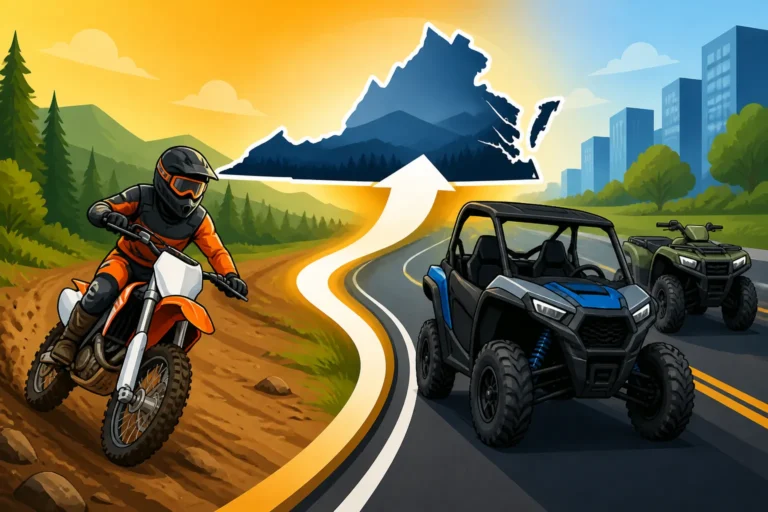
A common question among adult riders, especially those with powerful UTVs, is whether they can be made "street legal" in Virginia. The simple answer, which often frustrates enthusiasts, is generally no for ATVs and UTVs. While Virginia does have a process for converting certain off-road motorcycles (dirt bikes) into street-legal vehicles, this pathway is explicitly not available for ATVs or UTVs. [Can a Virginia ATV Be Made Street Legal at All?] The state's definitions and vehicle classifications are very clear: an ATV is an "all-terrain vehicle," and a UTV falls under similar categories that prevent it from being titled and registered as a conventional motor vehicle for highway use.
This distinction lies in fundamental design differences. Street-legal vehicles must meet stringent federal motor vehicle safety standards (FMVSS) for things like crashworthiness, emissions, lighting, and braking systems. ATVs and UTVs, by their very nature, are designed for off-road performance, not on-road safety. They lack features like crumple zones, advanced airbag systems, and specific lighting configurations required for highway travel. Even if you install aftermarket parts like turn signals, mirrors, and a horn – perhaps even top-notch accessories from SuperATV – your machine still won't meet the underlying structural and safety requirements to be granted street-legal status by the Virginia DMV. Efforts to bypass these rules, such as trying an out-of-state LLC registration scheme, are fraught with legal risk and generally not advisable for Virginia residents. [Why Out-of-State Plate Schemes Are Risky] For Virginia adult riders, the best approach is to accept that ATVs and UTVs are off-road machines and plan your riding activities accordingly.
| Feature / Rule | Standard ATV/UTV (16+ Riders) | Dirt Bike (with conversion) | Passenger Car / Truck |
|---|---|---|---|
| Public Road Use | Generally Banned | Possible (after conversion) | Permitted |
| Helmet Required (16+) | YES | YES (on road) | NO (unless motorcycle) |
| Insurance Required | NO (but recommended) | YES (after conversion) | YES |
| Street Legal Conversion | NO | YES (VSA 130 process) | N/A (already street legal) |
| Title Required | Optional (used), Mandatory (new 50cc+) | Mandatory | Mandatory |
| License Plate Issued | NO | YES (after conversion) | YES |
| Age Limit for Operator | 16+ for larger machines | 16+ for converted bike | 16+ (with license) |
Disclaimer
This article is for general informational purposes only and does not constitute professional advice. Laws, prices and regulations vary by location and change over time. Consult a qualified professional for guidance on your specific situation.