Where a Spearhead Permit Stops Being Valid
A Spearhead permit can cover more than one trail system, but it does not open every off-road route in Virginia or neighboring states. The key is knowing where Spearhead’s managed trail network ends, which other riding areas require separate permission, and what to check before unloading your machine.
Where a Spearhead permit is valid
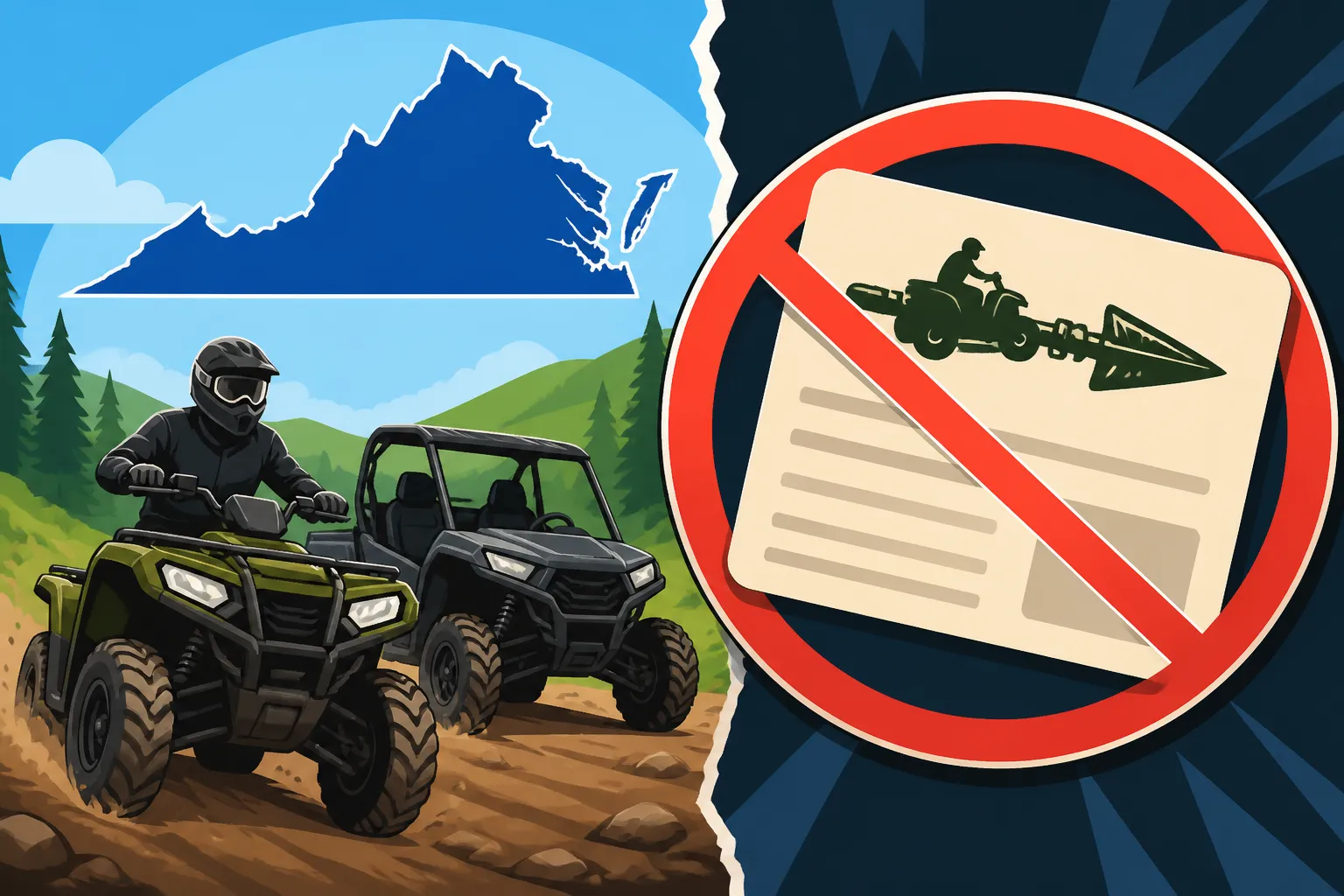
A Spearhead permit is for riding on the designated trails in the Spearhead trail network. It is not a statewide off-road permit, a road-use authorization, or permission to ride any land that happens to be near a Spearhead trailhead.
Spearhead’s systems include Coal Canyon, Mountain View, Original Pocahontas, Jawbone, Ridgeview, Stone Mountain, and Laurel Creek. The permit’s intended area is the open, signed trail network managed as part of Spearhead—not every nearby forest road, town street, private track, or piece of undeveloped land.
That distinction matters in Southwest Virginia, where trail routes may pass near communities, property boundaries, industrial roads, and other riding areas. A trailhead’s location does not make all roads leading away from it legal for ATVs or UTVs. Follow the marked route and the posted access rules. If a trail ends at a gate, sign, or property boundary, the permit does not give you permission to continue beyond it.
| Place or route | Does a Spearhead permit cover it? | What to check |
|---|---|---|
| Designated, open Spearhead trails | Yes, subject to the permit’s current conditions | Trail status, permitted vehicle type, age and safety rules |
| A different Spearhead system | Generally, the permit is for the Spearhead network | Confirm the system is part of Spearhead and open to your machine |
| Hatfield-McCoy Trails | No | Buy and meet the separate permit requirements |
| Virginia National Forest OHV routes | No | Check the specific forest route and its separate permit rules |
| Private riding parks | No | Follow that park’s access, waiver, and permit requirements |
| Public roads or streets | No | A trail permit does not make an ATV or UTV street legal |
| A closed trail or route outside the signed system | No | Closures and landowner restrictions apply regardless of permit |
The permit is therefore best understood as one part of access: it helps authorize eligible riding within the network, but it does not replace the trail rules, landowner permission, or legal requirements that apply to a particular route.
For a broader look at where the network sits and how its areas differ, see Spearhead Trails in Virginia Explained. If you are deciding between individual systems, Virginia ATV Trails: Spearhead and the Forest can help clarify the difference between Spearhead access and National Forest riding.
A permit does not mean every trail is open
Even inside the Spearhead network, access can depend on trail status and the rules for the machine you are riding. A trail may be temporarily closed, restricted to certain vehicle types, or unsuitable for a particular machine. A permit does not cancel those limits.
Before a trip, check current trail notices and the rules for the specific system. Do not assume that a route shown on an older map is still open, or that an open trail for one class of vehicle is open to every ATV, UTV, or registered four-wheel-drive vehicle. Rules can differ by system and route.
The same principle applies to weather and maintenance closures. If a route is closed, having a valid permit does not allow you to ride around the closure or use an unmarked bypass. Virginia Trail Closures and Seasons covers why checking conditions is part of planning, not just a last-minute precaution.
Where the permit stops applying
The most common mistake is treating a Spearhead permit as a general pass for off-road riding. It is not. Once you leave the authorized Spearhead route, the permit no longer provides access by itself.
That can happen even when the next road or trail looks connected. A route may lead toward another network, a public road, private property, or an industrial access road. Physical connection does not establish legal permission. A trail marker, posted rule, gate, or route map is a better guide than the fact that one path appears to continue into another.
Hatfield-McCoy is a separate network
A Spearhead permit does not substitute for a Hatfield-McCoy permit. The two networks are separate, and riders should not assume that buying access for one covers the other. If a planned ride includes both systems, confirm the entry requirements for each before leaving home.
This is especially important when a trip crosses state lines or uses a connector route. Even where trails or roads link nearby riding areas, the access rules belong to the network or land manager responsible for each segment. You need to know which system you are on and hold the permit or authorization it requires. For details, see Hatfield-McCoy and Spearhead Still Sell Separate Permits and Why One Permit Does Not Cover Both Networks.
Do not rely on a permit accepted at one trailhead as proof that you can continue into a neighboring network. Check the official rules for the destination system, not just the trail where you began.
National Forest routes need separate authorization
Spearhead access does not cover Virginia National Forest OHV routes. Forest routes have their own access, equipment, and permit conditions. A Spearhead permit is not a replacement for a National Forest OHV permit, and a forest permit does not automatically authorize riding at Spearhead.
The route itself matters, too. A road on public land is not necessarily open to motorized recreation, and a permitted route can have limits on vehicle dimensions, equipment, noise, or seasonal access. Check the rules for the specific trail or road rather than assuming a permit for one place applies to all nearby forest land. See Virginia National Forest OHV Permits for a separate overview.
Private parks, roads, and land outside the system
Private off-road parks set their own admission and operating rules. A Spearhead permit does not cover a private park, even if the park is in the same region or a rider uses it on the same trip. Contact the park about its own requirements.
Nor does a Spearhead permit authorize riding on public streets or ordinary roads. Virginia road access is a separate legal question, and an off-road permit does not turn an ATV or UTV into a street-legal vehicle. For the state-law distinction, see Can You Ride an ATV on the Road in Virginia?.
Private land has its own boundary as well. A Spearhead permit does not replace permission from a landowner when a route leaves the signed network. Get permission before entering private property, and do not treat an open-looking gate or an unmarked path as an invitation. Virginia Written Consent on Private Land explains why clear permission matters.
What a permit does not override
A valid permit is not a blanket exemption from safety requirements, machine restrictions, or trail conduct rules. You can have the right permit and still be in violation if you ride a closed route, use a machine that is not allowed there, ignore a posted speed limit, or fail to meet the system’s other conditions.
Think of the permit as authorization to use a defined network under defined terms. It does not grant every right a rider might want while traveling to or through that area.
It does not make an ineligible machine acceptable
Spearhead’s rules can limit which machines may use a route or system. Vehicle requirements may address the machine’s design, equipment, dimensions, or safety features. A permit should not be treated as proof that every machine is approved for every trail.
Before hauling, check the current requirements for the particular machine. That is especially important for side-by-sides, four-seat UTVs, modified machines, and vehicles that do not have standard factory safety equipment. If the system requires a factory cage or working seatbelts, a permit does not excuse a machine that does not meet those conditions. Spearhead Requires a Factory Cage and Working Seatbelts explains one of the key checks for UTV riders.
Likewise, an approved machine on one system may not be accepted on a different trail or network. Confirm both the permit coverage and the vehicle rules for every planned destination.
It does not replace age, supervision, or safety rules
Riders must still meet the age and supervision requirements that apply to the trail system and machine. A permit does not let a child ride a machine that is too large for the applicable rules, or allow an unaccompanied minor to ignore a supervision requirement.
Helmet and eye-protection requirements also remain in force where they apply. Other rules may cover speed, trail hours, passengers, seatbelts, and riding conduct. Check the current conditions before the trip, especially if your group includes minors or a mix of ATVs and UTVs.
If you are bringing a young rider, review Virginia Trail Rules for Riders Under 18 and Do Virginia Kids Need Their Own Permit?. These issues are separate from the question of where the permit is valid: a permit can cover the right network, but the rider and machine still need to meet the applicable conditions.
It does not excuse riding after a closure or beyond a boundary
Trail closures can change access even when your permit remains valid. Do not ride around a closed gate, past a closure sign, or onto a route that appears to bypass an official trail. A permit is not permission to cross a boundary for convenience.
A similar caution applies to roads used to reach a trail system. The fact that a route is necessary to get near a trail does not mean it is open to ATVs or UTVs. Confirm the legal route to the trailhead and use an appropriate trailer or other lawful transport where needed. For travel planning, Checking Rules Before a Long Mountain Drive offers a useful checklist.
How to check coverage before you ride
A few checks before departure can prevent a wasted trip or an accidental ride outside the permitted area. Make them for each system on your itinerary, not just for the first trailhead.
- Name every riding area on your route. Separate Spearhead systems from Hatfield-McCoy, National Forest routes, private parks, and public roads. If your plan includes more than one network, treat each as a separate destination.
- Confirm the route is part of Spearhead. Use current official maps and trail information. Do not infer coverage from a nearby trailhead, an old map, or a visible connection.
- Check the status of the specific trails. Look for closures, restricted sections, and any limits that apply to your machine. A permit does not make a closed trail available.
- Review permit conditions and rider details. Confirm the permit is current and that the required information matches the person or machine it covers. Do not assume another group member can use a permit issued for someone else.
- Check machine and rider rules. Verify vehicle eligibility, passenger rules, safety equipment, age limits, and supervision requirements for the route.
- Plan legal access to and from the trailhead. A Spearhead permit does not authorize riding on public roads or across private property. Arrange transport or obtain any separate permission you need.
- Keep proof available. Spearhead permits are digital, so make sure you can retrieve the permit details when needed. Do not depend on having mobile service at a remote trailhead. Save the confirmation in advance and carry identification if the permit rules require it.
For the purchase and verification process, see How to Buy a Virginia Trail Permit and Virginia Permit Verification Steps. If you are relying on a phone, Showing a Digital Permit With No Cell Signal discusses how to plan for limited reception.
A useful final check is to ask: “If we leave this marked trail, what authority lets us continue?” If the only answer is that your Spearhead permit is valid, stop and verify. You may be entering a different network, a closed area, a public road, or land that requires separate permission.
Common situations that cause confusion
“We bought the permit for a Spearhead trail. Can we ride at any Spearhead system?”
A Spearhead permit is intended for the Spearhead network, but confirm the current permit terms and the rules for the specific destination system. Network-wide permit coverage does not mean every trail is open to every machine or rider.
“The trail seems to connect to another trail system. Can we keep going?”
Not based on the connection alone. Identify where the Spearhead route ends and whether the next segment belongs to another network. A neighboring system can require a separate permit, and a road between trail areas may not be open to off-road vehicles.
“Can we ride a public road to reach a Spearhead trail?”
The permit does not authorize road use. Check Virginia’s road rules and any local route authorization separately. Do not assume a road is open just because it leads to a trailhead.
“Does my Spearhead permit cover a National Forest trail nearby?”
No. National Forest access is separate and may have its own permit, route, equipment, and seasonal rules. Check the specific forest route before riding.
“The trail is closed, but our permit is valid. Can we take a side route?”
No. The permit does not override closures or authorize an unmarked detour. Use only open, designated routes and follow closure signs.
Frequently Asked Questions
Does a Spearhead permit cover all of Virginia?
No. It applies to the Spearhead trail network under its current terms. Other trail systems, public roads, National Forest routes, and private parks have separate rules.
Does a Spearhead permit cover Hatfield-McCoy Trails?
No. Hatfield-McCoy is a separate network with separate permit requirements. A permit for one does not replace the permit for the other.
Can I use my permit on a closed Spearhead trail?
No. Permit validity does not reopen a closed route or allow a rider to go around a closure.
Does the permit make an ATV or UTV legal on public roads?
No. A trail permit is not road registration or street-legal status. Check Virginia road rules separately.
What should I do if I am unsure where Spearhead access ends?
Stop before continuing beyond the marked route. Check the current official map or trail information and ask the relevant trail office or land manager if the boundary is unclear.
Disclaimer
This article is for general informational purposes only and does not constitute professional advice. Laws, prices and regulations vary by location and change over time. Consult a qualified professional for guidance on your specific situation.