Virginia Hunting Season and Trail Access
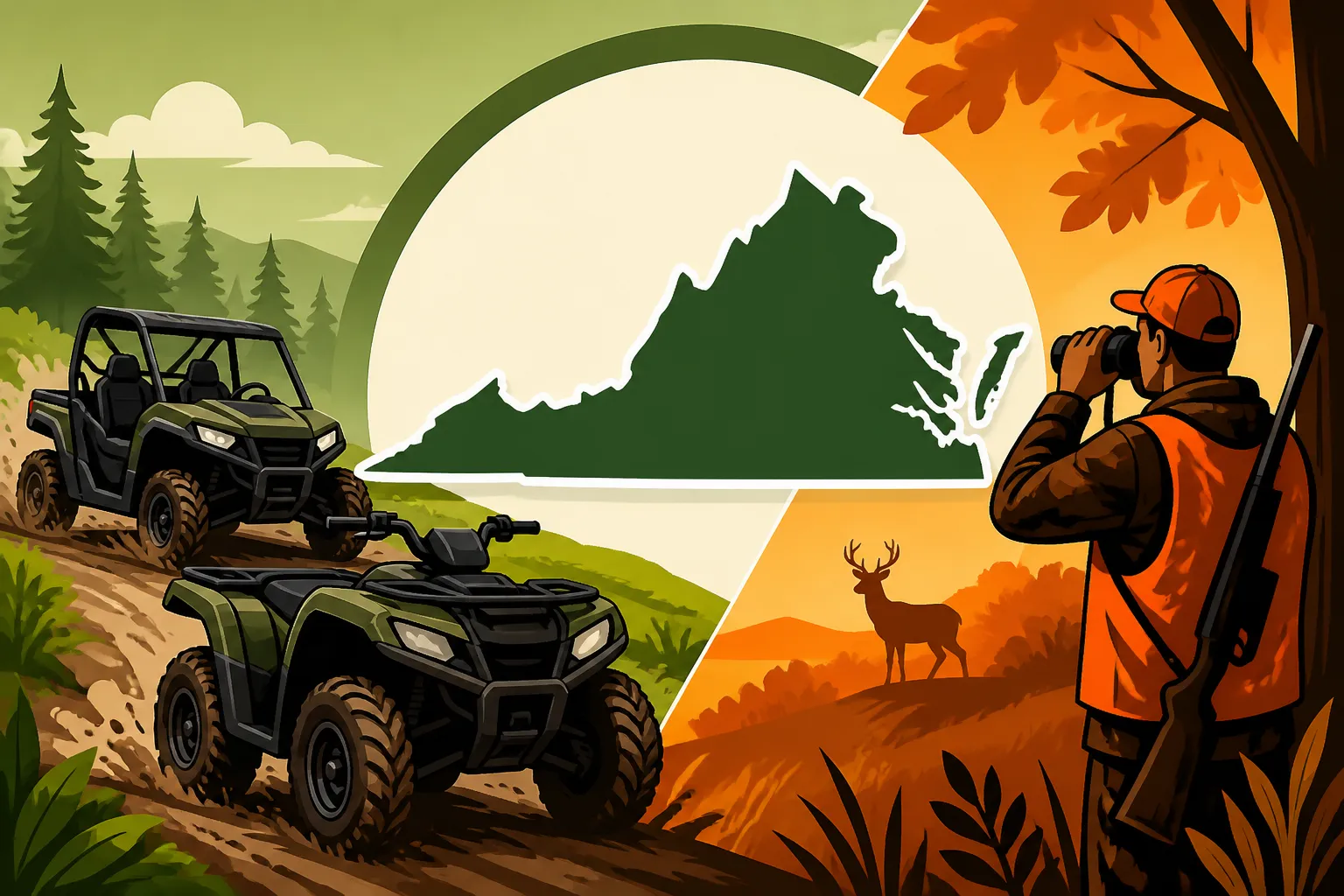
Virginia hunting season can make an ATV outing more complicated than checking whether a trail is open. A route may cross private timberland, a hunting lease, or public land with seasonal restrictions, and permission to hunt does not automatically include permission to ride. This guide explains how to check access, plan around hunters, and avoid arriving at a closed gate.
Why hunting season changes ATV trail access
A trail being mapped does not mean it is open
A line on a phone map can be useful for orientation, but it does not establish that a road or trail is legally open to ATVs. The route might cross private property, a closed forest road, or land where motorized access is limited to specific users or dates. Even a familiar route can have different rules on either side of a property boundary.
This matters especially in Virginia’s rural and mountainous areas, where trails, timber roads, hunting club roads, and public routes can run close together. A route you used in summer may pass through property being actively hunted in fall. A gate, temporary sign, or posted notice may also reflect a restriction that is not obvious on a general-purpose map.
Before riding, identify who manages the land and check the rules that apply to the particular route. For public land, look for current information from the agency responsible for it. For private land, get permission from the owner or authorized manager. A hunting license, trail permit, or past permission for one activity does not necessarily authorize ATV use.
Digital tools such as onX Offroad can help you study terrain and property boundaries while planning, but treat them as planning aids rather than proof of access. Confirm important details with the land manager, especially if the route crosses multiple parcels or reaches a hunting area. The related guide [Virginia Hunting Season Trail Rules] covers why seasonal access can depend on both the land and the activity.
Hunting permission and riding permission are different
A landowner might allow a person to hunt but not to drive an ATV across the property. Another owner might permit a machine for retrieving equipment or reaching a cabin but prohibit recreational riding. Permission may also be limited to certain roads, dates, riders, or machine types.
Ask directly whether ATV or UTV use is allowed, where you may ride, and whether the permission applies during the dates you plan to visit. If a hunting club, leaseholder, or timber company manages the property, find out whether that organization has authority to grant access. The owner and the day-to-day land manager are not always the same party.
For a hunting trip, clarify whether the machine is allowed only for access, or whether it may be used for scouting, hauling gear, or retrieving game. Do not assume that a vehicle allowed for one purpose can be used for every purpose. A short written note or message can help prevent misunderstandings about the boundaries and conditions of permission. See [Virginia Landowner Permission Forms] and [Virginia Hunting License and Land Access] for related access considerations.
Public land has its own rules
Public ownership does not mean every road or trail is open to motorized riding. National forest roads and trails may be designated for specific uses, and seasonal closures can apply. A road used by hunters on foot or in a street-legal vehicle is not automatically an ATV route. Likewise, a trail that appears on an older map may have changed status or may not allow the machine you are hauling.
Virginia state parks generally do not allow ATVs as ordinary recreational vehicles, so a park boundary should not be treated as an invitation to ride. Other public areas may have their own restrictions, hours, permit requirements, or vehicle rules. Check the manager’s current maps and notices before planning a route through public land. For related details, see [Virginia State Parks Ban ATVs] and [Virginia National Forest OHV Permits].
How to check a route before riding during hunting season
Start with the land manager, not just the app
Begin by writing down the route you intend to use, including access roads, trailheads, parking areas, and any connections between riding areas. Then identify the manager responsible for each segment. A route can cross several parcels, and each may have a different access policy.
Use a digital map to help spot likely boundaries and plan alternatives. onX Offroad may be useful for reviewing a proposed route before you leave, but verify access with the relevant land manager. Maps can be incomplete, boundaries can be difficult to interpret on the ground, and an app cannot grant permission on behalf of a landowner.
For an organized trail system, check the official system information for access rules and closures. For national forest riding, confirm which routes are open to your type of machine and whether a permit is needed. For private property, ask the person with authority over the land. If you cannot establish that a route is open, choose a route with clear authorization instead.
Check hunting activity and closures close to your ride date
Hunting seasons and access restrictions vary by species, location, and land manager. A broad “hunting season” label does not tell you whether a particular tract will be occupied, whether motorized travel is restricted, or whether a road is closed. Check the specific dates and area relevant to your plans rather than relying on a general statewide assumption.
Look for notices posted at trailheads and gates, and check with the agency or property manager shortly before travel. Conditions may change after storms, maintenance work, fire danger, or wildlife-management decisions. If you are visiting a managed trail network, its access status is more useful than a general map label. [Virginia Trail Closures and Seasons] offers additional context for planning around changing access.
Do not treat an absence of a closure notice online as confirmation that private land is open. If the property manager does not provide clear information, ask before entering. Save contact details and any permission message where you can find them offline, since cell service can be unreliable in mountain and forest areas.
Use a practical access checklist
Before you load the machine, make sure you can answer these questions for every part of your route:
- Who owns or manages the land?
- Is ATV or UTV travel allowed on this specific road or trail?
- Does permission apply during the planned hunting dates?
- Is access limited to a certain purpose, vehicle, or group?
- Are a permit, registration document, or other trail credential required?
- Is the route currently open, and is there a signed alternate if it is not?
- Where can you park or unload without blocking a gate, road, or hunter access?
This checklist is especially helpful when a route includes a hunting lease or private timber road. A trail may be open on one side of a boundary and closed on the other. Marking a turnaround point before you ride can prevent the uncomfortable moment of discovering a locked gate after you have already traveled miles into unfamiliar terrain.
| Access situation | What to verify before riding | Common mistake to avoid |
|---|---|---|
| Private land or hunting lease | Written or clearly documented permission for ATV use and the route allowed | Assuming hunting permission includes riding |
| National forest route | Designated vehicle access, current closures, and permit requirements | Treating every forest road as an ATV trail |
| Managed trail system | System rules, permit requirements, hours, and current status | Assuming a permit for one network covers another |
| State park or recreation area | Whether ATVs are allowed at all | Assuming public ownership means motorized access |
| Route crossing several properties | Access authorization for every segment | Checking only the trailhead or starting parcel |
Riding considerately around hunters and rural properties
Give hunters space and avoid creating pressure
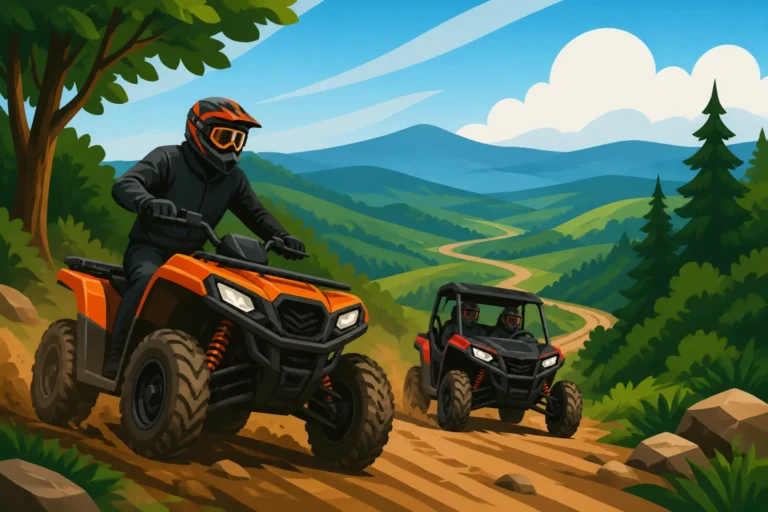
During hunting season, riders may encounter hunters walking in from a parking area, waiting near a road, or carrying equipment along a trail. Slow down well before reaching people, give them room, and follow any directions from the land manager. If a road is narrow, stop in a safe place and let people pass rather than crowding them or revving the engine.
Avoid riding close to active hunting locations, blinds, camps, or parked vehicles unless you have been specifically directed to use that route. Noise can disrupt a hunt even when riding is technically allowed. If you see a temporary sign, closed gate, or group preparing to hunt, do not assume it is safe to continue simply because the route appeared open on your map.
Some hunters use ATVs to reach a legal access point or transport equipment, but that does not make every nearby route open for recreational riding. Keep your group together, use the route you were authorized to use, and avoid cutting across fields or taking unmarked shortcuts. Local guidance on [Virginia Hunting Club Riding Rules] may help explain why a club’s access conditions can be more specific than a general trail map.
Make your group visible and predictable
In wooded terrain, bends, hills, and dense cover can make it hard for riders and hunters to see one another. Keep speeds controlled, use appropriate lights when required, and approach blind corners cautiously. Avoid stopping where a hunter or another rider would not expect to find a machine, such as in the middle of a narrow access road.
If you ride with a group, agree on a simple plan before starting: who leads, who rides last, where the group will stop, and what to do if someone sees a closure or hunting activity. A ride leader can make it easier to turn around promptly instead of having each rider make a different decision. Carry a paper map or save route information for offline use; cell service may disappear in remote areas.
A mapping app such as onX Offroad can help your group keep track of the planned route, but use it alongside official trail information and on-the-ground signs. Do not keep staring at a screen while moving, and do not let a mapped line override a closed gate or direct instruction from a land manager.
Keep access respectful after the ride
Close gates only if you are instructed to do so; some landowners want gates left open, while others require them to be closed. Do not park where you block a logging road, trailhead, farm entrance, or hunter’s access. Pack out litter and avoid leaving ruts or widening a route to get around mud.
If you encounter a closure or a property boundary you did not expect, turn around rather than trying to find a workaround across adjacent land. Report confusing signage or a damaged gate to the responsible manager when practical. A respectful response protects access for future riders and reduces the chance that a landowner will close a route to everyone.
For a planned trip, review [Virginia Trail Conditions Before You Haul] before loading up. If your route depends on a particular public-land permit or managed system, check that requirement separately; one permit should not be assumed to authorize travel on unrelated land.
A safer plan for hunting-season rides
Build a route with a clear fallback
Choose a primary route and an alternate that you already know is authorized. If your first choice is closed, occupied by hunting activity, or difficult to verify, use the alternate without trying to improvise a connection across private property. It is easier to make that decision at home than at a gate with a trailer behind you.
Share the plan with everyone riding, including where the group will park and which routes are off-limits. If riders are meeting from different towns, make sure everyone understands that the starting point is not permission to explore nearby roads. A turnoff that looks inviting may lead onto a lease or private access road.
Before departure, check the operating rules for the trail system you plan to use. Spearhead trails and national forest routes have distinct management and permit arrangements, so confirm the relevant one for your destination. The guides [Virginia Spearhead Trail Permits] and [Virginia National Forest OHV Permits] explain why it is important to match the permit to the riding area rather than treating all Virginia trails as one network.
Decide when to postpone
Postpone or change plans if the land manager cannot confirm access, a route is posted closed, permission is unclear, or hunting activity makes the ride feel intrusive or unsafe. A long drive and a loaded trailer make it tempting to press on, but uncertainty at a boundary is a good reason to stop and reassess.
The same applies when heavy rain, poor visibility, or a crowded trailhead makes it difficult to ride responsibly. Choose an open route with clear rules, or save the trip for another day. A disappointing change of plan is far better than trespassing, interfering with a hunt, or damaging a road that the community relies on.
When you return, make a note of what worked: which office or land manager gave useful guidance, where signs were posted, and whether the route was easy to follow. That record can make the next hunting-season ride much less stressful, especially when you are revisiting a remote area or coordinating a group.
Disclaimer
This article is for general informational purposes only and does not constitute professional advice. Laws, prices and regulations vary by location and change over time. Consult a qualified professional for guidance on your specific situation.