Virginia Crossings of Numbered State Routes
It’s a scenario every ATV or UTV rider in Virginia has likely faced: you’re on a fantastic trail, carving through the woods or climbing a ridge, and suddenly, you see a paved road ahead—a numbered state route, no less—that seems to cut right through your path. Your heart might sink a little, because you know Virginia’s rules about off-road vehicles on public roads are strict, and figuring out what’s allowed and what’s not can be a real headache. This guide is here to untangle the complexities of crossing Virginia's numbered state routes on your ATV or UTV, providing clarity on the law, what's permitted, and how to stay safe and legal.
Understanding Virginia's Stance on ATVs and Public Roads
Virginia’s Department of Motor Vehicles and state law are pretty clear: ATVs and UTVs are designed and intended for off-road use. This fundamental principle dictates most of the regulations you'll encounter when your machine comes anywhere near a public road. It’s not about making things difficult for riders; it’s rooted in safety and the inherent differences between an off-road vehicle and one designed for street travel.
Why Roads Are Generally Off-Limits
The primary reason ATVs and UTVs are generally banned from public highways in Virginia comes down to design and safety. Unlike cars, trucks, or motorcycles, these machines lack many features essential for safe road operation. They often don't have turn signals, rearview mirrors, proper lighting for night driving, or the suspension and tire design suitable for paved surfaces and high speeds. Their stability characteristics are different, too, making them more prone to rollovers on hard surfaces or when encountering uneven pavement or side slopes. Imagine trying to stop a nimble sport quad suddenly on a busy highway, or a utility UTV making a quick turn with a loaded bed. The risks are significantly higher than with a street-legal vehicle. This is why [Virginia Bans ATVs on Public Highways] is such a foundational rule. The law aims to prevent accidents and protect both ATV riders and other motorists who aren't expecting these types of vehicles on main thoroughfares.
What Qualifies as a "Numbered State Route"?
When the law talks about "numbered state routes," it's referring to the highways and roads maintained by the Virginia Department of Transportation (VDOT) that have route numbers assigned to them. Think of roads like Route 58, Route 19, Route 460, or even smaller state-maintained roads like Route 615. These are distinct from private roads, which are owned and maintained by individuals or entities, and from unnumbered county roads, which are typically maintained by local county governments and might have different (though still often restrictive) rules depending on the locality.
The distinction is crucial because the specific exceptions for ATV use, such as those permitting crossings, are often tied directly to whether the road is a state-maintained numbered route or not. The regulations are designed with the safety and traffic volume of these more major arteries in mind. While you might occasionally encounter an unnumbered dirt road maintained by a county that feels like a trail, the moment you hit a road with a VDOT sign and a number on it, you're entering a different legal landscape. Understanding this distinction is the first step in knowing how and where you can legally operate your off-road machine.
The Specifics of Permitted Crossings
While Virginia's default rule is "no ATVs on public roads," the law does recognize the practical necessity for riders to occasionally cross a numbered state route to get from one section of a trail to another, or to access different private properties. However, these crossings are not a free-for-all. They are highly restricted and come with very specific conditions designed to maximize safety for everyone involved.
The "Most Direct Route" Rule
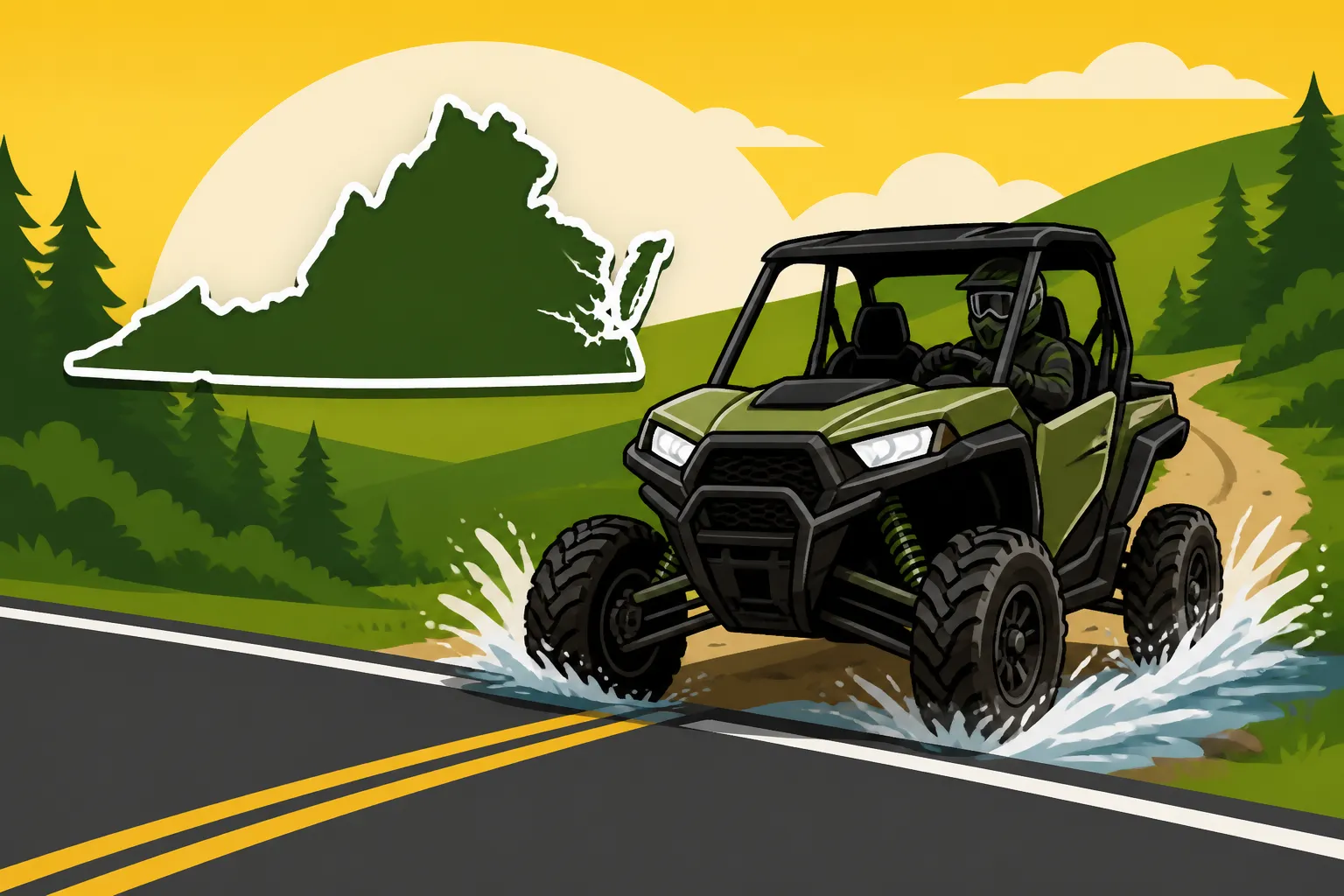
This is perhaps the most critical condition for any ATV or UTV crossing a numbered state route in Virginia. The law explicitly states that you must cross "by the most direct route." What does "most direct" really mean in practice? It means the shortest possible distance, usually a straight line, from one side of the road to the other. You cannot ride along the shoulder for a quarter-mile to find a better crossing point, nor can you make a sweeping turn. The intent is to minimize the time your off-road machine spends on the paved surface, thereby reducing the risk of a collision with oncoming traffic.
Imagine you're riding a trail in Southwest Virginia, and it ends abruptly at a two-lane state route, say, Route 72. On the other side, the trail picks up again. To legally cross, you must approach the road, stop, look both ways, and then proceed directly across to the other side at a 90-degree angle, or as close to it as road geometry allows. You wouldn't be permitted to turn right, ride 100 feet down the road, and then turn left to re-enter a trail, even if that seemed like an easier or safer maneuver to you. The law is quite strict on this point. Any deviation from the most direct path can be considered illegal operation on a public highway, leading to potential penalties. Remember, [Virginia Crossings by the Most Direct Route] are meant to be quick, decisive, and minimize your exposure to road traffic.
Daylight Hours and Visibility Requirements
Another non-negotiable condition for crossing a numbered state route is that it must occur "during daylight hours." This means from sunrise to sunset. There are no exceptions for using your machine's headlights or auxiliary lights to make a crossing at dusk or after dark. The reasoning is straightforward: visibility is drastically reduced at night, making it much harder for motorists to see an ATV or UTV, especially one that isn't equipped with full street-legal lighting.
While the law specifies "daylight hours," it's also smart practice to maximize your own visibility during these crossings. Wearing brightly colored gear, such as a high-visibility vest or helmet, can significantly increase the chances that other drivers will spot you. Although not legally mandated for a crossing, ensuring your machine's headlights and taillights are functioning perfectly is also a good idea, as they can serve as an extra layer of visibility even during the day. Always assume that if you're crossing a major route, traffic will be moving at highway speeds, and drivers need every possible advantage to see you quickly. This is crucial even on a short crossing; a moment of inattention from another driver can have severe consequences. [Virginia Daylight Hours on a Road Trail] exist for a very good reason.
Crossing in Buchanan and Tazewell Counties
Now, this is where things get a little different, but it’s important not to confuse this specific exception with general crossing rules. In Buchanan and Tazewell counties, located deep in Virginia's coalfields, there are specific, designated sections of numbered state routes that have been opened for ATV and UTV use under very strict conditions. This isn't just about crossing; it's about connecting trail systems by riding along a road for a limited distance. This unique situation arose to facilitate access to extensive trail systems like the Spearhead Trails, connecting trailheads and communities.
However, even within these designated areas, the rules are highly specific. Riders must stay on the designated route, often a rural, low-traffic road. There are speed limits (typically 25 mph), and these sections are usually marked with specific signage. You'll find that [Virginia's Named Route in Buchanan County] and [Virginia's Named Route in Tazewell County] are part of this unique arrangement. Critically, this permission is for specific, board-approved routes and does not extend to any numbered state route in those counties, nor does it override the "most direct route" rule for general crossings elsewhere. These designated routes typically allow for travel along the road for up to one mile to connect trail sections, which is far more permissive than a general "most direct route" crossing. Always check local ordinances and Spearhead Trails maps for the exact, current designated routes. This is an exception born out of regional necessity, and it's vital not to extrapolate these rules to other parts of the state or to general crossings.
Practical Considerations for Safe and Legal Crossings
Even with the legal framework understood, the act of actually crossing a numbered state route on an ATV or UTV demands a high level of caution and preparation. These are not maneuvers to be taken lightly, as the consequences of an error can be severe. Safety isn't just about following the letter of the law; it's about employing common sense and defensive riding strategies.
Situational Awareness and Safety First
When you approach a numbered state route for a crossing, your focus needs to be entirely on the road and its traffic. Before you even get to the edge of the pavement, slow down, stop, and scan the road in both directions. Pay attention to vehicle speeds, the distance of approaching traffic, and any blind spots or curves that might obscure your view or the view of oncoming drivers. If there's a vehicle approaching, wait. It's far better to delay your crossing for a minute or two than to take an unnecessary risk.
Once you decide it's safe to cross, do so decisively and without hesitation. Make your intentions clear if you can, perhaps with a quick, clear hand signal (even if your machine has turn signals, an extra visual cue doesn't hurt). Remember, you are a much smaller, less visible presence than a car or truck, and the burden of safety largely falls on you. Even if you're rocking a machine equipped with accessories from SuperATV, like enhanced lighting or mirrors, those are primarily designed for trail riding, not for blending seamlessly into highway traffic. Always remember that [Virginia Helmet Law Applies to Every Rider], and this is especially critical during a road crossing where impacts with hard surfaces or other vehicles are a distinct possibility.
Planning Your Route to Minimize Road Exposure
The best way to ensure safe and legal crossings is to minimize the need for them in the first place. Before you head out, study your maps—whether they're digital GPS maps or old-school paper ones. Identify where trails intersect or run parallel to numbered state routes. Try to find alternative routes that avoid major road crossings altogether, even if it means a slightly longer off-road journey. If a crossing is unavoidable, pinpoint the absolute shortest and most direct point.
Some trail systems, especially those within the [Spearhead Trails in Virginia Explained] network, might offer designated underpasses or bridges that completely eliminate the need for surface road crossings. These are always the safest options. If you're on a long ride that requires multiple crossings, consider if your itinerary can be adjusted to reduce their frequency. Perhaps you can stage your ride from a different trailhead, or dedicate one day to a section of trails that stays entirely off-road. The less time your ATV or UTV spends on or near a public highway, the lower your risk of an accident or a citation.
Legal Documentation and What to Carry
Even for a brief crossing, it's essential to have your legal documentation in order. While Virginia doesn't require ATVs to be registered or insured, you should always carry a valid form of identification, such as your driver's license. If you're riding on private land and need to cross a public road to get to another section of private land, it's a good idea to have [Virginia Written Consent on Private Land] from the landowner readily available. While not strictly required for the road crossing itself, it provides context for why you might be crossing and proves legal access to the property on either side.
An officer might stop you even for a legal crossing to verify your identity or the legality of your machine. Being prepared can save you a lot of hassle and time. While a bill of sale or title might not be something you carry on your person for every ride, knowing where to access that information quickly if needed is wise. Think of it as being ready for [What an Officer Can Ask For at a Trailhead]. Being polite, cooperative, and having your basic identification handy can make any interaction with law enforcement smooth and efficient, allowing you to get back to your ride.
Common Misconceptions and Penalties
Despite the relatively clear language in Virginia law, misunderstandings about ATV and UTV use on public roads persist. These misconceptions can lead to dangerous situations and costly citations. It's crucial for riders to differentiate between what they think might be permissible and what the law actually states.
The Difference Between Crossing and Riding On
This is perhaps the biggest area of confusion for riders. Many believe that if they are only "going a short distance" or "just connecting two trails," it falls under a general exception. This is generally false. The distinction between a brief, direct crossing and riding along a public road, even for a short distance, is absolutely critical. Outside of the very specific designated routes in Buchanan and Tazewell counties, riding an ATV or UTV on a public highway for any length of time is illegal.
The "most direct route" for a crossing means exactly that: getting from one side to the other. It does not imply a "1-mile limit" for general road use. The [Virginia's 1-Mile Road Limit] is an exception specifically for the designated coalfield routes in those two counties, and it comes with its own set of rules, like a 25 mph speed limit and daylight-only travel. Trying to apply a similar "short distance" logic to any other numbered state route in Virginia will almost certainly result in a citation. Understand that even if the shoulder seems safe, or traffic is light, you are operating outside the law if you are traveling along the road rather than making a direct crossing.
Penalties for Illegal Road Use
The consequences of illegally riding an ATV or UTV on a public highway or failing to adhere to the strict crossing rules can be significant. In Virginia, such violations are typically classified as civil penalties. This means you won't face criminal charges, but you can be hit with a substantial fine. [Virginia's Civil Penalty for Illegal Riding] can reach up to $500 for each offense. That's a hefty price to pay for a few moments of convenience or a lapse in judgment.
Beyond the monetary fine, there's also the risk of impoundment, particularly if you're caught riding illegally within city or town limits. [Cities Can Impound an ATV Ridden on a Sidewalk] or public streets. The cost of recovering an impounded machine can easily add hundreds, if not thousands, of dollars to your overall penalty, covering towing fees, storage fees, and administrative costs. An officer also has the discretion to simply issue a warning, but relying on that is a gamble. Your best bet is to strictly adhere to the law, understand the difference between legal crossings and illegal road use, and avoid putting yourself in a compromising position.
Exceptions and Who Can Legally Use Roads
While the general rule is strict, there are a few specific exceptions carved out in Virginia law for certain entities and activities. These exceptions are typically for official duties or essential agricultural work, and they do not apply to recreational riders. For instance, law enforcement, firefighters, and [Virginia Emergency Responder Exceptions] are permitted to operate ATVs and UTVs on public roads when responding to emergencies or performing official duties. Their machines are often equipped with appropriate emergency lighting and are used in controlled situations.
Additionally, individuals operating ATVs or UTVs for bona fide [Virginia Farming and Household Exceptions] are also granted some leeway. This typically applies to using the machine to cross a public road to get from one section of a farm to another, or for tasks directly related to the farming operation or maintaining a household property. However, this is not an open invitation for farmers to joyride on public roads; it's specific to the immediate needs of agricultural or household maintenance. For the vast majority of recreational riders, these exceptions will not apply, and they must strictly follow the "most direct route" and daylight rules for crossings, or stick to the designated routes in Buchanan and Tazewell counties.
Summary of Virginia ATV/UTV Road Use Rules
Understanding the nuances of Virginia's laws regarding ATVs and UTVs on public roads is essential for every rider. This table summarizes the key distinctions between general crossings of numbered state routes and the specific exceptions in the coalfield counties.
| Feature | General Numbered State Route Crossing | Designated Routes (Buchanan & Tazewell Counties Only) |
|---|---|---|
| Primary Purpose | Connect two off-road sections or access private property. | Connect Spearhead Trail sections, access trailheads/towns. |
| Type of Movement | Must be "by the most direct route" (straight across). | Can ride along designated sections of road for limited distances. |
| Distance Allowed | Minimum possible distance to cross. | Up to 1 mile along designated routes. |
| Operating Hours | Daylight hours only (sunrise to sunset). | Daylight hours only (sunrise to sunset). |
| Speed Limit | No specific limit, but "reasonable and prudent" given conditions. | 25 mph limit on designated road sections. |
| Markings/Signage | No specific markings for general crossings. | Designated routes must be clearly marked with specific signage. |
| Applicability | All numbered state routes in Virginia (if conditions met). | Only specific, Board of Supervisors-approved routes in Buchanan and Tazewell counties. |
| Penalties for Violation | Civil penalty up to $500, possible impoundment. | Civil penalty up to $500, possible impoundment. |
| Required Documents | Photo ID; landowner consent if applicable. | Photo ID; valid Spearhead Trail permit, landowner consent if applicable. |
| Vehicle Equipment | Helmet required for rider/passenger; functional lights recommended. | Helmet required for rider/passenger; functional lights recommended. |
Disclaimer
This article is for general informational purposes only and does not constitute professional advice. Laws, prices and regulations vary by location and change over time. Consult a qualified professional for guidance on your specific situation.