Virginia Sunrise to Sunset Trail Hours
Virginia’s sunrise-to-sunset trail rule can be easy to misread as a suggestion to head back when it gets dark. For riders on the Spearhead network, it is an operating-hours limit: riding must fit within daylight, not continue into dusk. Here’s how to plan arrival, route length, breaks, and your exit—and why hours can differ on other Virginia riding areas.
What sunrise to sunset means for trail riding
On the Spearhead trail network, operating hours run from sunrise to sunset. That means the riding window changes with the season and the location: sunrise comes earlier and sunset later during some parts of the year, while the usable daylight window is shorter in others. It is not a fixed clock schedule that stays the same year-round.
The practical rule is to be done riding by sunset. Don’t treat sunset as the time to start heading toward the trailhead, begin the last loop, or leave a remote section. Allow enough time to reach the permitted exit before daylight ends. A route that looks short on a map can take longer than expected if it includes steep grades, rough surfaces, a group with mixed experience, or stops to deal with a mechanical problem.
Sunrise and sunset are different from civil twilight, dusk, or the time when headlights make the trail visible. A machine’s lights can help with visibility in certain situations, but they do not turn a daylight-only operating window into permission to ride after sunset. If the system’s published rules set the hours as sunrise to sunset, plan to be off the trail within that window.
A workable plan includes more than the intended ride time. Consider the time needed to unload, complete check-in or permit tasks, get everyone ready, and reach the trail. At the end of the day, leave a buffer for the return ride and loading. If a small delay would push the group past sunset, the day’s route is too ambitious.
A simple planning formula is:
- Check the local sunrise and sunset times for the riding area and the date of your visit.
- Set a firm turnaround time well before sunset, based on the route back to your exit.
- Choose a route that leaves room for breaks, slower riders, and unexpected stops.
- Start the final return with enough daylight to reach the trailhead, not merely the edge of the main loop.
- If conditions change, shorten the ride rather than relying on lights to extend it.
The required margin depends on the group and terrain. A familiar route with a small group may be more predictable than a first visit with several machines, children, or mixed vehicle types. Mountain trails, loose surfaces, and steep climbs can also slow travel. Build the plan around the slowest reasonable pace, not the fastest time a skilled rider might manage.
This is why checking sunset before leaving home is useful, but it is not enough on its own. You also need a clear idea of where the group will be, how long the return takes, and what happens if the planned route is blocked. For preparation before a first visit, see Virginia Trail Conditions Before You Haul and Virginia Trail Difficulty Ratings.
Where the rule applies and where it may differ
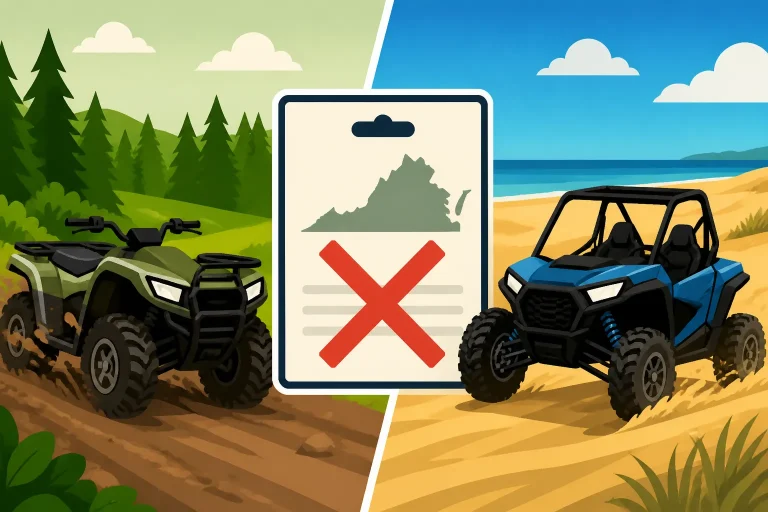
Sunrise-to-sunset hours should not be assumed to govern every place in Virginia where someone can ride an ATV or UTV. The rule needs to be checked for the particular trail system, land manager, or private park. A machine’s location, its permit, and the posted operating rules all matter.
For Spearhead trails, the daylight limit is part of the system’s trail rules. But Virginia also has national forest riding areas, private off-road parks, and other properties with their own conditions. Their operating schedules may differ, and a trail can have seasonal or temporary closures even when the general property is open. Check the rules for the specific area rather than relying on a rule from another trail network.
| Riding area or setting | What to use as the operating-hours rule | What to check before riding |
|---|---|---|
| Spearhead trail system | Plan to ride only from sunrise to sunset | Current system notices, permitted routes, and the trail exit you intend to use |
| National forest OHV area | Follow the forest’s own operating rules and closures | Current season status, permit requirements, equipment rules, and access conditions |
| Private off-road park | Follow the park’s posted schedule and site rules | Opening and closing times, reservation requirements, and any event-specific restrictions |
| Private land | Get the landowner’s permission and follow any conditions they set | Whether the permission covers the intended hours, route, and riders |
| Public road or road crossing | Follow the law and any route-specific rules that apply | Whether the road or crossing is open to ATVs and what conditions govern it |
The table is a starting point, not a substitute for the land manager’s current information. A system may close a trail for weather, maintenance, an event, or another temporary reason. General information about year-round availability does not mean every trail is open every day or that every time of day is permitted. See Virginia Trails Open 365 Days alongside Virginia Trail Closures and Seasons when comparing availability.
The distinction matters for riders who travel between systems. Spearhead rules do not automatically apply to a national forest trail, and a forest permit does not establish permission to ride on a Spearhead route. Check the appropriate rules for each destination. Virginia National Forest OHV Permits explains the separate permit context for forest riding.
Hours also do not change simply because a rider is local, visiting from another state, or has a valid permit. A permit is not a general pass to use a trail whenever it is convenient. It applies to the network and conditions described by that system. For the limits on using a permit across networks, see Virginia Has No Permit Reciprocity and Hatfield-McCoy and Spearhead Still Sell Separate Permits.
Private land needs its own care. Permission to ride is not necessarily permission to ride at any hour. A landowner may set a time window, restrict routes, or withdraw access. If the owner’s permission is written, make sure the hours and boundaries are clear. A public trail’s hours do not grant access to adjacent private property.
How to plan a ride that ends before sunset
A good daylight plan starts with the exit, not the first trail you want to ride. Identify the trailhead or other authorized exit you will use, then work backward. Estimate how long it will take to return from the farthest planned point, and add a margin for slower travel and stops. If the group has no experience on the system, choose a conservative first route.
Check the right information for the day
Before loading, confirm the trail system’s current operating information, not just an old map, a saved social media post, or a friend’s recollection. Look for notices about closures, route changes, weather, and access. Trail conditions can affect how long a route takes, even when the system is open.
Check sunrise and sunset for the actual riding area and date. A forecast or daylight table for a nearby city can provide a rough idea, but local terrain and geography may affect when the sun is visible. The important point is to use the correct local day and not assume sunset is the same throughout the riding season.
If you will ride on Spearhead, review the system’s permit and rider requirements as well as the daylight window. Virginia’s Annual Spearhead Trail Permit is useful background, but purchase or possession of a permit does not remove the need to check current operating notices. If you are going to a forest area instead, check its separate permit rules and season conditions.
Set a turnaround time before the ride
A turnaround time is the latest point at which the group will stop traveling farther from the exit and begin heading back. Set it before the ride, and make sure everyone understands it. Pick a time that leaves a comfortable return margin, not one that depends on every rider maintaining a fast pace.
For instance, if the group is planning a long loop and the return could be delayed by a breakdown, a slow climb, or a wrong turn, the turnaround should be earlier. If the group is behind schedule, shorten the route. Continuing toward a distant destination because it was on the original plan can leave too little daylight for the return.
Groups benefit from agreeing on a simple communication plan:
- Name the person who will watch the time and call the turnaround.
- Tell the group what the turnaround means: stop exploring and take the planned route back.
- Choose a meeting point in case machines become separated.
- Decide what to do if someone needs to stop or a machine cannot continue.
- Make sure no rider assumes that another person is monitoring the time.
A phone can help with maps and timekeeping, but cell coverage may be unreliable in remote or mountainous areas. Carry an offline map or a paper backup when appropriate, and know how to use it. A waterproof map case or basic navigation supplies from Amazon can be useful for keeping printed information readable, but gear is no replacement for checking the official route information before riding.
Include loading and trailhead time
The daylight limit concerns trail use, but a day plan works better when it accounts for the whole outing. If unloading and preparing machines takes longer than expected, the group may start later and have less time on the trails. Decide in advance whether to shorten the route if departure from the trailhead is delayed.
At the end of the day, reaching the parking area before sunset may not be the same as having completed every task before then. The key is not to use a late start or slow loading as a reason to ride past the permitted end of the day. If the group arrives too late for the planned ride, choose a shorter route or make another trip.
Also allow time for fuel, water, protective gear, and a pre-ride check. A loose strap, low tire, or machine issue discovered after reaching the trail can delay departure. Taking care of those items early protects the available riding window.
Give groups and new riders extra margin
A large group usually moves more slowly than a pair of experienced riders. It takes longer to gather after stops, regroup at intersections, and respond to a machine problem. Children and new riders may need more rest and more time on challenging terrain. A route that is reasonable for one group can be too long for another.
For mixed-ability groups, choose routes the least experienced rider can manage comfortably. Don’t plan the whole day around the fastest machine or rider. If a rider becomes tired or uncomfortable, the group may need to stop or change its route. An early return is a sound safety decision, not a failed ride.
Why a permit, lights, or another state’s rules do not extend the hours
A valid permit is necessary where a trail system requires one, but it does not grant unlimited access. It does not override operating hours, closures, route restrictions, or vehicle rules. Treat the permit as authorization to use the specified system under its conditions, not as a guarantee that every trail is open at every time.
This is particularly important for visitors who ride in more than one state. A permit accepted on one network does not automatically work on another. Nor does a rule from a neighboring state replace Virginia’s requirements at a Virginia riding area. Check the destination’s permit and operating conditions before traveling. Virginia Rules for a Visiting West Virginia Rider provides a starting point for cross-border questions, while the individual trail system remains the authority for its access rules.
Lights can make a machine more visible, but visibility equipment does not change a daylight operating limit. A headlight may help a rider see in shade or help others notice the machine; it should not be treated as authorization to continue along a trail after sunset. The same applies to high-visibility clothing, reflective materials, or a phone flashlight. None changes the posted hours.
The daylight limit is also separate from the broader laws governing where ATVs may be ridden. A trail that is open during daylight is not automatically legal to access by riding along a public highway or crossing private property. Check the route itself, including how you reach the trailhead and whether any road crossing is allowed. Virginia ATV Road Rules Under 46.2-915.1 and Virginia Rules for Crossing a Highway cover related restrictions.
Nor does the end of the daylight window turn a closed route into an acceptable shortcut. If the route back is blocked, do not assume that riding onto an unapproved road or crossing a property line is the right solution. Use the trail system’s guidance and emergency procedures. A planned exit and an adequate time buffer are the best ways to avoid being forced into that decision.
For visitors with a digital permit, save the confirmation or make sure you can retrieve it before entering an area with weak service. Digital access and operating hours are separate issues: being able to show a permit does not keep trails open after the allowed time. See Showing a Digital Permit With No Cell Signal for practical preparation.
If the ride is running late
The best response to a late-running ride is usually to stop adding distance and head back on an authorized route. Don’t start another loop, continue to a scenic point, or wait until sunset is nearly over before deciding. Once the group recognizes that it is behind schedule, shorten the plan.
If a machine has a problem, keep the group together and decide whether the machine can safely continue. Avoid splitting riders without a clear plan. If you need help, use the system’s contact or emergency information and provide your location as accurately as possible. In areas with limited cell coverage, tell someone before the ride which system you are using, the planned route, and when you expect to return.
If you reach the trailhead after sunset because of an emergency or an unavoidable delay, prioritize safety. Do not take an unsafe shortcut or enter a road or property where riding is not allowed just to save time. Contact the appropriate trail staff or emergency services if necessary, and follow their instructions. That possibility is a reason to plan a buffer, not a strategy for regularly extending a ride.
A basic backup plan should cover:
- A route back that does not depend on a single optional loop.
- A meeting place in case the group becomes separated.
- A charged phone and offline location information where possible.
- A contact person who knows the destination and expected return.
- A way to handle a disabled machine without leaving a rider alone.
- Enough water, clothing, and basic supplies for a delay.
For longer rides, make sure the group knows the system’s boundaries and can identify the route back on a map. A phone map is convenient, but it may lose signal or battery. A printed map can help when electronics fail, provided it is current and shows the relevant trail network.
Before riding, confirm the exact hours and current closures with the system responsible for the trail. If information conflicts—for example, an older map shows a route as open but a current notice says it is closed—follow the current notice and ask the trail operator for clarification. The safest assumption is not that an online post or an older permit description guarantees access.
Frequently Asked Questions
Do Virginia ATV trails all close at sunset?
No single sunrise-to-sunset rule should be assumed for every Virginia riding area. Spearhead has sunrise-to-sunset trail hours, while national forest areas and private parks have their own operating rules. Check the current requirements for the specific destination.
Can I keep riding after sunset if my ATV has headlights?
Lights do not extend a trail system’s operating hours. If the applicable rule limits riding to sunrise through sunset, plan to be off the trail by sunset rather than using headlights to continue.
Does a valid Spearhead permit let me ride at any time?
No. A permit does not override operating hours, closures, route restrictions, or other trail rules. Check current system information before each visit.
Does a permit from another trail system cover Spearhead?
Do not assume it does. Permit requirements are specific to the network, and there is no general reciprocity between Virginia riding systems. Confirm the permit required for the destination.
What should I do if my group is behind schedule?
Stop adding distance and take the authorized route back. Don’t rely on lights or an unapproved shortcut to make up time. If an emergency or mechanical failure makes a timely return impossible, contact trail staff or emergency services as appropriate.
Disclaimer
This article is for general informational purposes only and does not constitute professional advice. Laws, prices and regulations vary by location and change over time. Consult a qualified professional for guidance on your specific situation.