First Aid on a Long Coalfield Loop
A minor injury can become a serious problem when your group is deep into a coalfield ride, the trail is rough, and cell service has disappeared. A little planning makes it easier to respond calmly, treat basic problems, and get help to the right place. This guide covers what to pack, how to handle common trail injuries, and when to call for emergency help.
Plan for First Aid Before You Reach the Trail
Build a kit for the group and the terrain
A first-aid kit for a short ride near the truck may not be enough for a long loop through steep, rocky terrain. Pack supplies for injuries you could reasonably encounter, plus the small problems that can turn miserable over several hours: blisters, scrapes, ticks, headaches, and cold, wet clothing. Keep the kit in a dry, easy-to-reach bag—not buried beneath tools or tied down where you can’t get to it quickly.
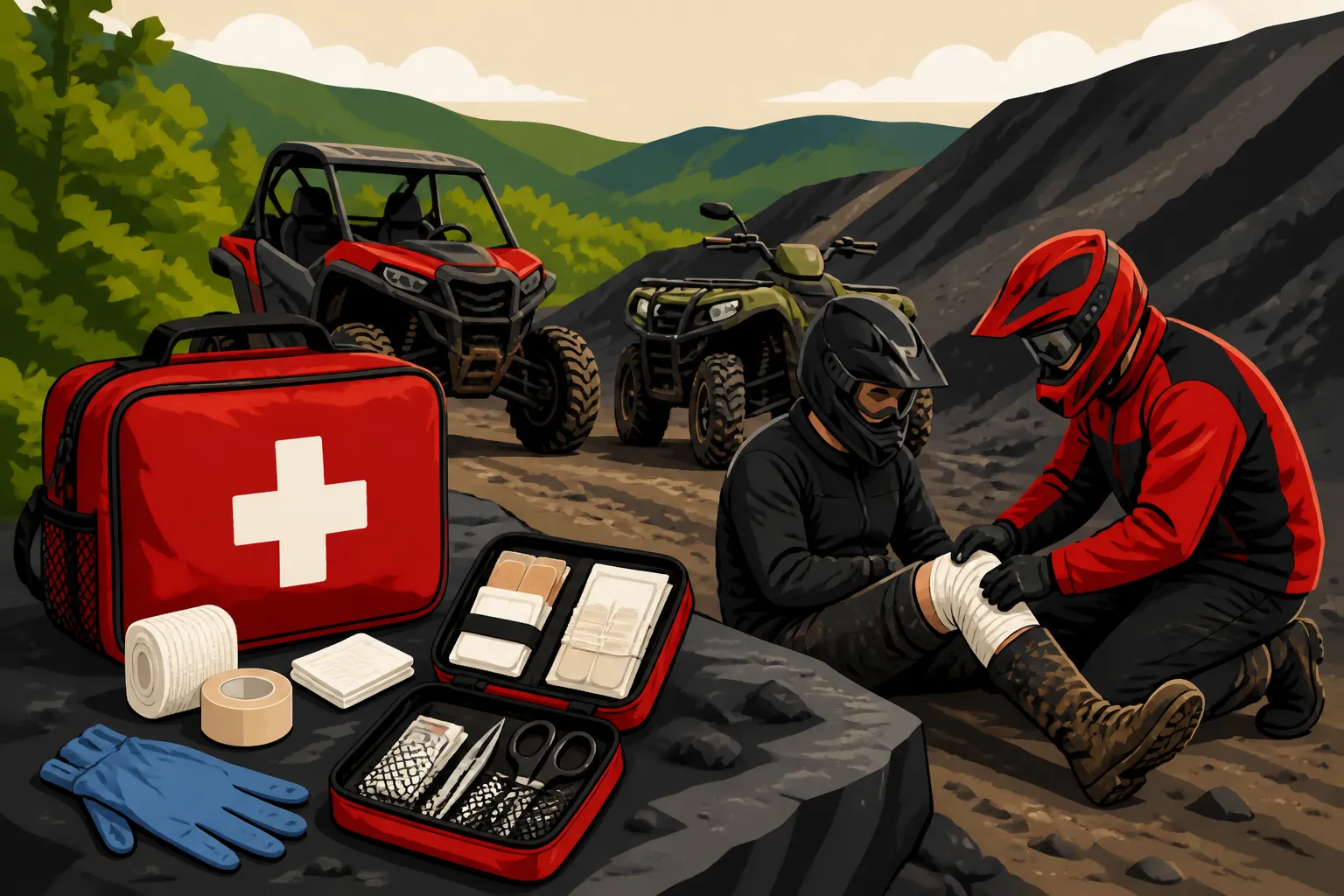
A practical group kit can include disposable gloves, sterile gauze pads, roller gauze, adhesive bandages in several sizes, medical tape, antiseptic wipes, tweezers, a small pair of trauma shears, and a triangular bandage. Add a pressure dressing and a commercial tourniquet if someone in the group knows how and when to use them. Include a CPR face shield, an emergency blanket, and any personal medication that riders may need. Check expiration dates and replace supplies after use.
Think about the ride as well as the injury. A machine may be difficult to reach on foot if it is parked beyond a steep grade or a creek crossing. A kit should be light enough that someone will actually carry it, but complete enough to support a response while the group coordinates help. If you ride in separate machines, consider keeping a basic kit with each machine and a more substantial kit with the designated lead or sweep rider.
Keep personal medications separate from shared supplies, clearly labeled, and accessible to the person who needs them. Don’t assume someone else has an inhaler, allergy medication, or other essential prescription. Riders with known medical conditions should tell a trusted companion what to look for and where their medication is kept.
Make a communication and location plan
Before leaving the trailhead, tell someone outside the ride where you plan to go and when you expect to return. Share the group’s route, the number of riders, and a plan for what that person should do if you miss your check-in. “We’re riding near Grundy” is not a useful location update if a search is needed; a route plan, trail system, and expected return time provide a better starting point.
Agree on who will take charge if someone is hurt. The lead rider may know the route, while another person may be calmer under pressure or have first-aid training. Decide who will stay with the injured rider, who will guide rescuers, and who will manage the rest of the group. On a long loop, confusion can waste time—especially if several people start riding in different directions to look for help.
Cell service can be unreliable in remote terrain, so don’t make a phone your only safety plan. Read Cell Dead Zones in the Coalfields before heading out, and carry a charged phone even if you expect to lose reception. A downloaded map from onX Offroad can help your group follow the planned route when a data connection is unavailable, but confirm the map is downloaded before leaving service and carry a backup. A Carrying a Paper Map in the Coalfields plan can still be useful if a phone battery dies, the device is damaged, or riders are unfamiliar with the area.
Respond to an Injury Without Making It Worse
Start with scene safety and a quick assessment
When a rider is hurt, pause before rushing in. Check for moving machines, unstable ground, traffic, fire, downed branches, or other hazards that could injure someone else. Shut off nearby machines if it is safe to do so, and ask other riders to keep the area clear. A helper who becomes a second casualty makes the situation harder for everyone.
Approach the injured rider calmly and explain what you’re doing. Ask what happened, where it hurts, and whether they can breathe normally and answer clearly. Look for heavy bleeding, trouble breathing, confusion, fainting, severe pain, or signs of a serious head, neck, or back injury. Don’t assume a rider is fine just because they can stand or say they want to continue. Adrenaline and embarrassment can make someone minimize an injury.
If the rider is unresponsive, has trouble breathing, is bleeding heavily, or appears seriously injured, call emergency services as soon as possible. If you suspect a head, neck, or back injury, encourage them to stay still and keep them warm while you wait, unless there is an immediate danger such as fire or another unavoidable hazard. Avoid moving them unnecessarily. If the scene is unsafe, move them only as needed to get away from the danger, and do so as carefully as the circumstances allow.
For heavy bleeding, use firm, steady pressure with gauze or clean cloth. If the bleeding is life-threatening and you have a tourniquet and know how to use it, follow your training. Don’t repeatedly lift the dressing to check whether bleeding has stopped; that can disturb clotting. If you’re unsure what to do, call for emergency guidance and follow the dispatcher’s instructions.
Treat smaller problems and know when to stop riding
For a small scrape, clean visible dirt from the area, cover it with a clean dressing, and keep an eye on it. If a wound is deep, won’t stop bleeding, contains an embedded object, or appears badly contaminated, get medical help rather than trying to manage it as a routine trail scrape. Don’t pull out an object that is deeply embedded; protect the area around it and seek professional care.
For a suspected sprain or fracture, stop the ride and avoid putting weight on the injury. Support the body part in a comfortable position, without trying to straighten a deformity or force movement. A rider who cannot safely walk, has severe pain, or has an obvious deformity needs help getting evaluated. Carrying someone down a steep or uneven trail without enough people or proper equipment can create another injury, so consider the terrain before attempting evacuation.
Watch for signs of heat illness, particularly during strenuous summer rides or when riders have not been drinking enough. Headache, weakness, nausea, dizziness, or unusual confusion are reasons to stop, move to a cooler spot, and begin cooling the person. If symptoms are severe, worsening, or include altered mental status, treat the situation as an emergency. Don’t leave a confused or seriously ill rider alone.
Cold rain, wind, and wet clothing can also become a problem in the mountains, even when the day started comfortably. Shivering, clumsiness, unusual fatigue, and confusion can signal that a rider is getting dangerously cold. Replace wet layers when possible, use dry insulation and an emergency blanket, and arrange a prompt return or evacuation. Packing for Mountain Weather is worth reviewing before a ride where conditions may change quickly.
| Situation | What to do first | When to get urgent help |
|---|---|---|
| Heavy bleeding | Apply firm, steady pressure; use a tourniquet only if trained and appropriate | Bleeding is severe, will not stop, or the person becomes weak or confused |
| Possible head, neck, or back injury | Keep the rider still, warm, and reassured; avoid unnecessary movement | Loss of consciousness, confusion, severe pain, weakness, or worsening symptoms |
| Suspected fracture or serious sprain | Stop riding and support the injured area in a comfortable position | The rider cannot safely move, pain is severe, or there is an obvious deformity |
| Heat illness | Stop activity, move to shade, and begin cooling | Confusion, collapse, severe symptoms, or symptoms that worsen |
| Cold exposure | Get out of wet clothing when possible and add dry insulation | Confusion, poor coordination, or persistent or severe symptoms |
Get Help When the Group Is Far From the Trailhead
Call with clear information
If emergency help is needed, make the call as soon as a safe person can do so. Give the dispatcher the trail system or area, the nearest identifiable access point, the group’s location as clearly as you can describe it, and the nature of the injury. Explain whether the rider is awake and breathing, whether there is heavy bleeding, and whether the group can safely reach a road or trailhead.
A map can help turn a vague report into useful directions. If you use onX Offroad, check the rider’s position against downloaded map details and note nearby junctions or access routes. Share the map location or coordinates if your phone provides them, but also describe recognizable landmarks and the route you took. Don’t assume a coordinate will be easy for every person in the group to interpret, and don’t let map-checking delay an emergency call.
One person should remain with the injured rider whenever possible. Another can meet rescuers at a known access point if the dispatcher or responders ask for it. Send a capable person with a charged phone, clear directions, and any information needed to guide help in. Avoid splitting the group without agreeing on where everyone is going and how they will reconnect.
If you can’t reach emergency services by phone, try moving only far enough to find a signal if the injured person can be safely left with a responsible companion. Do not leave someone alone if they are unconscious, confused, seriously injured, or otherwise need continuous attention. If the whole group must move to contact help, make a clear plan and leave someone with the person whenever possible.
Keep the rest of the group organized
Assign simple roles rather than letting everyone crowd around. One person can provide first aid, another can call, and another can keep machines and bystanders out of the way. A fourth can prepare to guide responders or manage the route back. If the group is small, prioritize calling for help and staying with the injured rider over trying to perform several tasks at once.
Keep the rider warm and reassured while you wait. Note when the injury occurred, what symptoms you observed, and any first aid you provided. If the rider’s condition changes, tell the dispatcher. Don’t give food or drink to someone who is unconscious, confused, or may need urgent treatment; follow professional instructions instead.
After the immediate situation is stable, don’t pressure an injured rider to continue just because the group is far from the start. Decide whether the safest option is to wait for help, use an accessible route back, or have a capable person guide the group out. Conditions, injury severity, daylight, and the terrain all matter. When in doubt about a serious injury, prioritize professional assessment over finishing the loop.
Reduce the Chances of a Trail Emergency
Match the route to the group
A long ride is not the time to discover that a participant is uncomfortable with steep climbs, rough descents, or a route that takes longer than expected. Before setting out, choose a loop that fits the least experienced rider and the capabilities of every machine. Check Virginia Trail Conditions Before You Haul and Virginia Trail Closures and Seasons before you make the drive, then revisit local guidance when you arrive. Trail conditions and access can affect how quickly a group can return or how easily help can reach you.
Build a realistic turnaround point into the ride. If the group is moving more slowly than expected, the weather is deteriorating, or a rider is already tired, shorten the plan rather than pushing onward to complete a loop. Leave enough daylight to return without rushing. A breakdown, wrong turn, or minor injury can add substantial time, even when the original route looked manageable on a map.
Make sure every rider knows the basic plan: who is leading, who is sweeping, where the group will regroup, and what to do if someone gets separated. Keep a sensible distance between machines, slow down where visibility is limited, and stop in a safe place before checking a map or adjusting gear. For more on the local habits that help prevent avoidable trouble, see Virginia Trail Etiquette Locals Expect.
Protect the basics: water, gear, and a backup route
Bring enough water for the conditions and the length of the ride, with some reserve in case you’re delayed. Pack snacks, a charged phone, a portable power bank, and weather-appropriate layers. A helmet and suitable protective gear are essential parts of preparation, but they don’t eliminate the risk of injury. Recheck that straps, gloves, eye protection, and other gear fit properly before leaving the staging area.
Before the trip, make sure everyone knows how to access the first-aid kit and who has relevant training. A short first-aid or CPR course can make it easier to respond confidently, but it is not a substitute for emergency care. Keep the kit in the same known spot on each ride so nobody has to search for it under stress.
Finally, leave a route plan with someone who is not riding and stick to it when possible. If you change plans, update them when you have service. OnX Offroad can be one tool for route planning, and an offline map may help your group orient itself away from cell coverage. Pair it with a paper backup and a clear check-in plan, rather than depending on any single device. If your ride includes a remote staging area, review Virginia Trailheads With Trailer Parking and plan where the group will meet if someone needs to return early.
Disclaimer
This article is for general informational purposes only and does not constitute professional advice. Laws, prices and regulations vary by location and change over time. Consult a qualified professional for guidance on your specific situation.