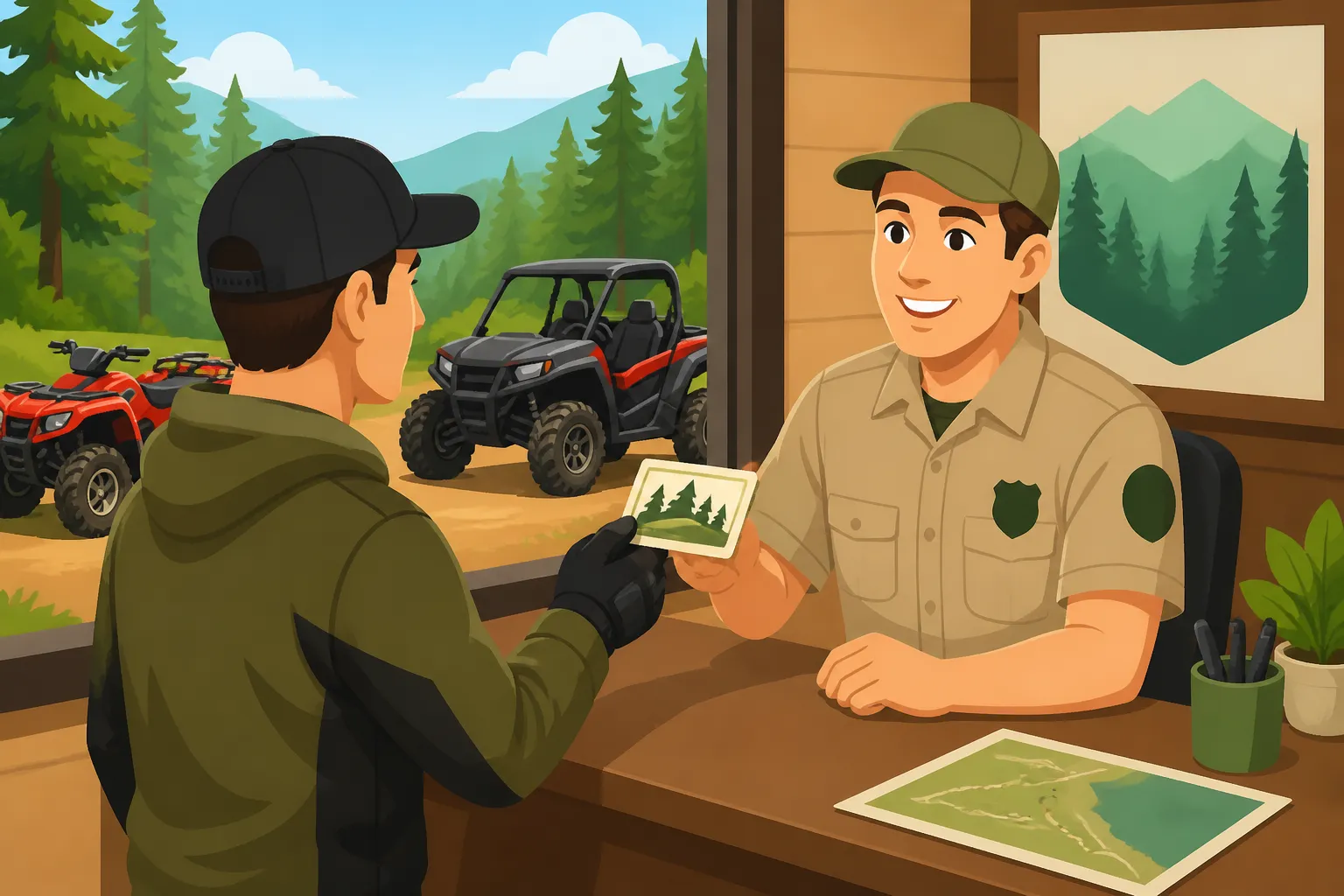
Buying a Forest Permit at the Lee Ranger District Office
A permit problem can derail a Virginia ride before the trailer even reaches the trailhead: some Forest Service OHV areas do not have a kiosk where you can buy one on arrival. This guide explains how to plan a visit to the Lee Ranger District office in Edinburg, what to check before you go, and how to avoid confusing a national forest permit with permits for other Virginia riding areas.
What the Lee Ranger District office can help you with
The office and the riding area are not the same place
The Lee Ranger District office is in Edinburg, in the Shenandoah Valley. It is a place to ask Forest Service questions and, when permit sales are available, buy a national forest OHV permit before heading to the riding area. It is not the Peters Mill Run trailhead, so purchasing a permit there does not mean you are already at the start of the route.
Peters Mill Run and Taskers Gap are national forest OHV riding areas associated with this part of Virginia. The office can be a practical stop if you are traveling through the area, but it is worth confirming the office’s current services and public hours before building your day around a counter visit. A closed office or unavailable permit sale can mean an unplanned detour or a ride that has to wait.
That distinction matters especially for visitors driving in from farther away. Someone coming from Roanoke, Richmond, or outside Virginia may be used to buying a trail pass at a gate. At a forest trailhead without a sales kiosk, that assumption can leave a rider with a machine, trailer, and no valid permit. Read [Virginia Forest Permit Purchase Options] before setting your route.
The permit is for forest OHV access, not every Virginia trail
A national forest OHV permit is not a universal Virginia riding pass. It does not automatically cover Spearhead Trail systems, a private riding park, or the Hatfield-McCoy system in neighboring West Virginia. Each area has its own access rules and permit arrangements, so match the permit to the location you intend to ride.
This is a common source of confusion for riders planning a long weekend with more than one destination. A permit purchased for a Forest Service route should not be assumed to work at a regional trail network just because both are off-road areas. Likewise, a pass for one network may not be accepted at another. See [Virginia Permits Are Digital Only] and [Virginia Hatfield-McCoy Permits Are Separate] for examples of how different systems handle access.
Before you head to the office, identify the exact trail or area you want to use. If you are deciding between forest riding and a managed trail network, compare the route, vehicle requirements, seasonal access, and permit process—not just the drive time. [Virginia National Forest OHV Permits] provides a useful overview of the forest permit topic.
How to buy a permit at the ranger district office
Check availability and office details before leaving
Start by confirming the Lee Ranger District office’s location, public hours, and whether it can sell the permit you need. Do this close enough to your trip that you can adjust your plan if the office is closed, its services have changed, or permit sales are unavailable that day. Do not rely on an old note from a friend or an outdated trip plan.
When you call or check official Forest Service information, be specific: ask whether the office sells the OHV permit for the trail you plan to ride, what forms of payment it accepts, and whether you need to complete anything in advance. If you are bringing a group, ask whether each rider or vehicle needs a separate permit or whether the rules are structured another way. The answer can affect both your budget and how many permits you need to arrange.
It also helps to confirm the ride area’s operating status separately. A permit counter can answer questions about permits, but weather, maintenance, seasonal closures, or other access restrictions can affect the trail itself. For a broader checklist, see [Virginia Trail Conditions Before You Haul].
Make the counter visit straightforward
Before you arrive, have the name of the riding area and your intended visit dates handy. If you are unsure whether your machine qualifies for the route, be ready to describe it clearly: ATV or side-by-side, approximate width, and any relevant equipment. A vague request for “a Virginia ATV pass” may not give staff enough detail to point you toward the correct permit.
At the counter, ask the staff member to confirm the permit’s scope and how you are expected to carry or display it. Procedures can differ by permit type, and a digital confirmation, printed document, or other proof may be handled differently. Do not assume that paying at the office completes every other requirement for your ride.
If you are taking a group, make sure everyone understands the plan before leaving the office. One person buying a permit does not necessarily mean every machine or rider in the group is covered. Clarify the requirement for each vehicle, and keep the permit information accessible for the driver or operator who may be asked to show it.
| Before you go | What to confirm | Why it matters |
|---|---|---|
| Office visit | Public hours and permit availability | Avoid a wasted detour |
| Permit type | That it covers your intended forest riding area | Forest, regional, and private areas may use different permits |
| Group details | Whether each machine or rider needs separate coverage | Prevent an uncovered vehicle in the group |
| Payment | Accepted payment methods and any advance steps | Avoid delays at the counter |
| Trail status | Closures, access limits, or seasonal restrictions | A valid permit does not guarantee the route is open |
| Machine fit | Width and other equipment rules | A machine can be ineligible even when the rider has a permit |
Keep proof of purchase usable on the ride
After you buy the permit, keep its proof in a place you can reach without unpacking the trailer or emptying a storage box. If the permit is digital, save or download the confirmation in advance rather than depending on a strong cell signal at the trail. Some mountain and forest locations have unreliable reception, and a screenshot or other permitted offline record can make a roadside check less stressful.
If the permit is physical, follow the instructions for carrying or displaying it. Avoid leaving paperwork where rain, mud, or a loose drink can ruin it. It is also sensible to keep a second copy of key details in the tow vehicle, especially if several people are sharing driving and riding duties.
A permit is only one part of a prepared ride. Save the trail information, directions, emergency contacts, and any rules you need offline as well. A navigation app such as onX Offroad can help you review routes and orient yourself, but it should not be treated as a substitute for the Forest Service’s current access information or the required permit.
Plan for Peters Mill Run and Taskers Gap
Confirm which trail and vehicle rules apply
Peters Mill Run and Taskers Gap are not interchangeable labels for one identical route. Check which area you intend to ride and whether your vehicle is allowed on the specific trails you plan to use. In particular, side-by-side width limits can matter: Taskers Gap has a width restriction, while Peters Mill Run is described differently in the trail rules. Verify the applicable limit before towing a wide machine across the state.
Do not rely on a trail map alone to settle vehicle eligibility. Maps can help with orientation, but posted notices and official forest information govern access. This is especially important when you are traveling with a mixed group of ATVs and UTVs. One vehicle may fit a route while another does not, even if both are commonly described as off-road machines.
For additional context, read [Virginia's Taskers Gap Width Limit] and [Virginia's 36-Mile Peters Mill Run and Taskers Gap System]. If you are bringing a side-by-side, confirm the vehicle’s actual width as configured for the trip, including any modifications that could affect whether it meets a trail restriction.
Check seasonal closure and trail conditions
A permit does not override a seasonal closure. Peters Mill Run has a winter closure period, and forest routes can also be affected by weather or other temporary restrictions. Check the latest official trail status before leaving home and again before you unload. A route that was open during your last visit may not be open on the weekend you planned to return.
This kind of check matters after heavy rain, snow, or freeze-thaw conditions. A trail can be technically open but muddy, icy, or difficult enough to change what is safe for your group. If you are towing a heavy side-by-side or bringing a young or inexperienced rider, consider whether the conditions suit your equipment and skill level rather than treating “open” as “easy.”
The same advice applies to travel logistics. A storm can affect mountain roads, access points, and parking, not just the trail surface. Keep a backup plan, and do not make a long drive based solely on an old map pin or a social media post. [Peters Mill Run Closes Mid-January Through Mid-March] and [Virginia Trail Closures and Seasons] are useful companion topics when planning around access changes.
Carry the right equipment and follow forest rules
Before the ride, review the equipment requirements for the specific forest route. Peters Mill Run rules include requirements related to sound levels and tires, and other machine or operator requirements may apply. Check the official guidance rather than assuming that a machine legal on private property meets national forest requirements.
A simple pre-trip inspection can prevent a frustrating turn-around. Check brakes, tires, steering, lights where required, and any safety equipment called for by the area. For a UTV, inspect seatbelts and the rollover protective structure; for an ATV, make sure basic controls work properly and that the machine is suitable for the terrain. Bring any required documents and make sure every rider understands the area’s rules before starting.
Respecting these requirements also helps protect access for everyone. Noise, trail damage, and ignoring closures can affect other visitors and future riding opportunities. For a focused checklist, see [Virginia Forest Equipment Requirements] and [Virginia Forest Noise Limits].
Avoid common permit and trip-planning mistakes
Do not assume there is a kiosk at the trailhead
One of the most avoidable mistakes is arriving at a trailhead expecting to buy a permit there. Some Forest Service OHV locations do not have a permit kiosk, so the rider needs to purchase the required permit before arrival. Confirm the purchase options and plan around them; do not leave the permit question until you are parked at the gate.
A kiosk-free trailhead can be especially challenging when a group has driven several hours, the phones have lost reception, and the nearest sales location is not on the way. Make the permit part of your trip checklist, just like checking the trailer lights or packing helmets. If you are uncertain whether a counter or vendor will be open, arrange the permit before your departure whenever possible.
For more on this issue, see [No Kiosk at the Trailhead: Buy the Permit First] and [Where to Buy a Forest Permit Before You Leave Home]. Those topics can help you compare buying at the ranger district office with other available purchase options.
Do not confuse a forest permit with registration or ownership papers
A trail permit, a vehicle title, and proof of ownership serve different purposes. Buying a forest permit does not title an ATV or UTV, register it for public-road use, or make it street legal. Likewise, having a title does not automatically authorize you to ride a machine on a particular trail.
This distinction can trip up new owners who are still sorting out paperwork after a private sale. They may have a bill of sale or a title application in progress and assume that those documents take the place of trail access permission. They do not. For the separate ownership side of the process, read [How to Title an ATV in Virginia].
Keep your paperwork organized by purpose. Store ownership documents safely in the tow vehicle or at home as appropriate, and keep the trail permit proof available in the manner the forest requires. If an officer or ranger asks for a document, you will be less likely to fumble through unrelated paperwork.
Do not rely on a map app as the final authority
Digital maps can be valuable for planning, but route lines, trail names, and access information may not capture a temporary closure or a specific vehicle restriction. Use an app such as onX Offroad to review the route and understand the general layout, then cross-check with official Forest Service information before you travel. The same goes for user-generated comments or saved tracks from a previous visit.
This is particularly important when a route crosses different land-management boundaries or connects to roads that are not open to OHV use. A visible line on a map is not proof that the route is legally open to your machine. Stay on authorized routes, obey signs, and turn around if access is unclear rather than pushing through a gate or posted boundary.
Download maps before leaving reliable service and bring a backup navigation method if your trip depends on precise turns. A paper map can be reassuring when a phone battery dies or an app fails to load. Use navigation as a tool for orientation, not as permission to ride wherever a line appears.
A practical checklist for a low-stress visit
Before driving to Edinburg
Confirm the Lee Ranger District office’s location, public hours, and permit availability. Ask whether the office sells the permit for your chosen riding area and what payment or documentation you need. Check whether the machine you plan to bring meets the trail’s size and equipment rules, and verify that your intended route is open.
Write down your route plan and the relevant permit details. If you are coordinating a group, make sure everyone knows which trail system you are visiting and whether each vehicle needs its own permit. A quick group text with the meeting point, backup plan, and permit responsibilities can prevent the familiar last-minute argument in a gas-station parking lot.
If you are riding forest trails for the first time, build extra time into the schedule. Getting a permit, unloading, checking equipment, and reviewing a map can take longer than expected, especially with children or a large group. A calmer start usually leads to a safer day than trying to make up for a late departure by rushing.
Before leaving the office or heading to the trail
Make sure you understand what the permit covers, how you must carry or display proof, and whether any additional step remains. Check the trail status again if conditions could have changed. Keep your confirmation accessible offline, and confirm that everyone in the group knows who has the permit information.
At the trailhead, read posted notices before unloading. Look for closure signs, route restrictions, and any updated directions. If the information on a sign conflicts with an older map or your saved route, follow the posted restriction and seek clarification from the Forest Service before proceeding.
Finally, respect the riding area as a shared resource. Stay on designated routes, manage speed for visibility and conditions, and pack out everything you brought in. A well-planned permit visit is not only about getting past the access point; it is about being prepared to ride legally and responsibly once you are there.
Disclaimer
This article is for general informational purposes only and does not constitute professional advice. Laws, prices and regulations vary by location and change over time. Consult a qualified professional for guidance on your specific situation.