Why Your County Road Is Closed to ATVs
A quiet gravel road can look like the perfect shortcut between your driveway and a trail, especially when you see little traffic. But in Virginia, a road’s rural appearance does not tell you whether an ATV or UTV may legally use it. This guide explains why county roads are generally closed, which narrow exceptions may apply, and how to check a route before riding.
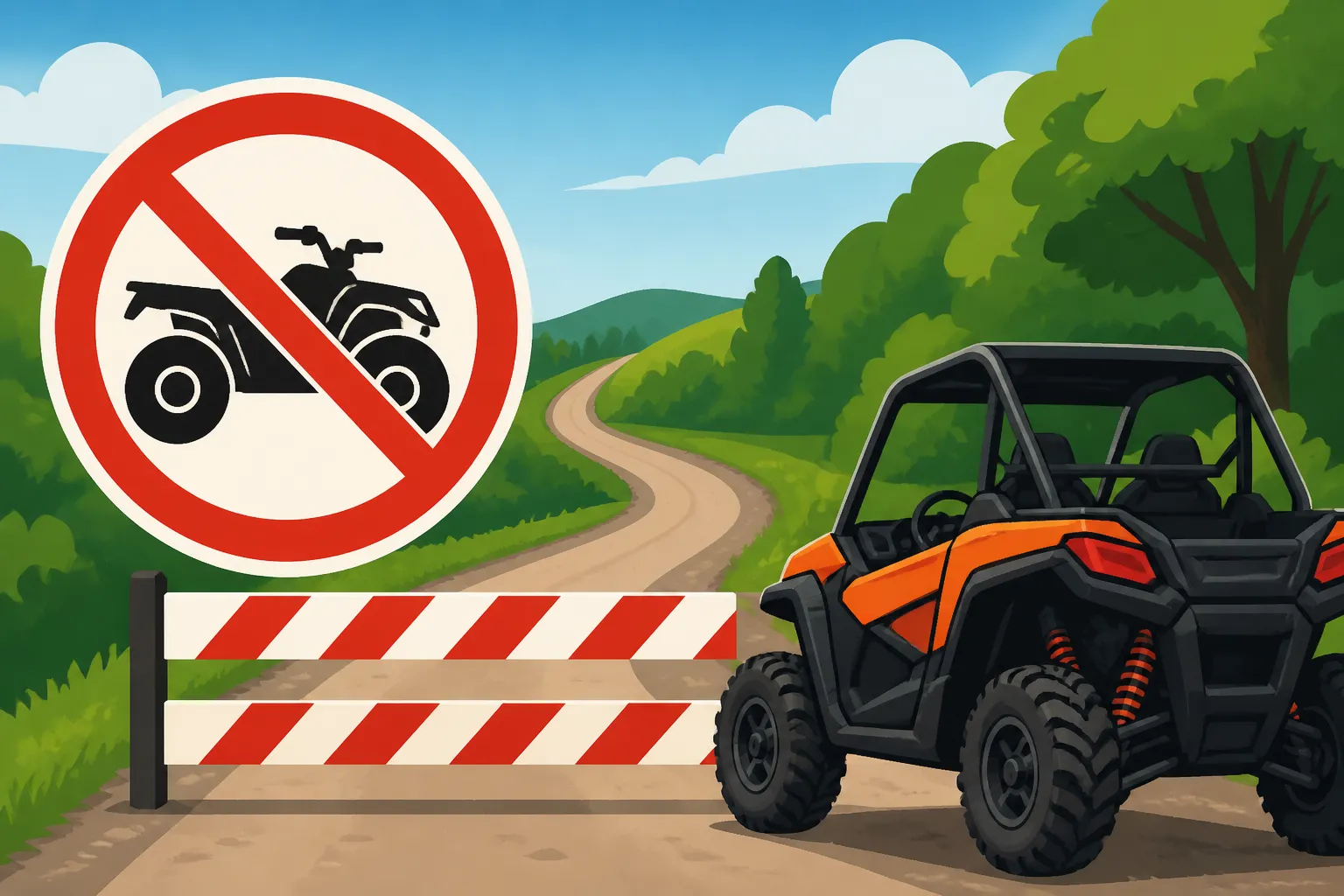
Why a Virginia county road is usually closed to ATVs
A quiet road can still be a public highway
In ordinary conversation, “highway” may sound like a busy, multilane road. In Virginia law, the term can cover public roads well beyond interstates and major state routes. A county road can therefore be a public highway even if it is narrow, unpaved, and used by only a handful of neighbors.
That distinction catches riders off guard. A road that feels like an extension of a farm lane or hunting property may still be maintained for public travel or open to the public under a public easement. Low traffic, a gravel surface, and a lack of streetlights do not, by themselves, make ATV use legal.
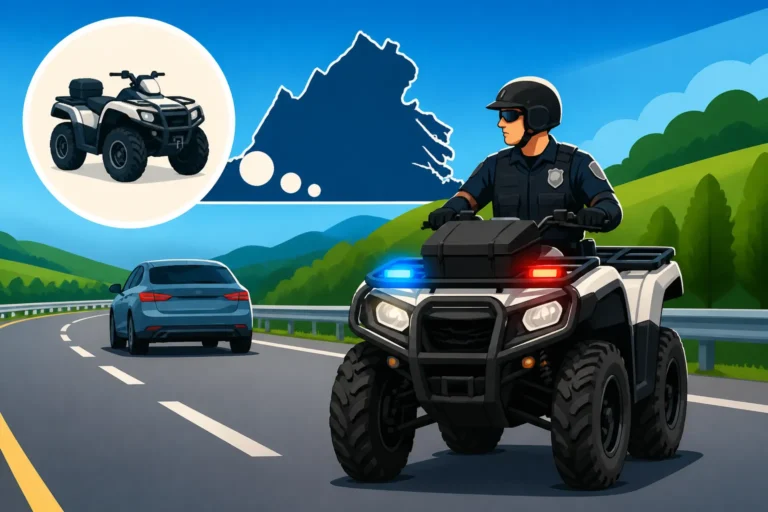
The general rule is that ATVs and similar off-road machines cannot be driven on public highways except where a specific legal exception applies. A side-by-side does not gain permission simply because it has doors, headlights, turn signals, or a windshield. For a broader overview of the restriction and its narrow exceptions, see [Can You Ride an ATV on the Road in Virginia?](Can You Ride an ATV on the Road in Virginia?)
County roads are not automatically open because a county owns them
It is tempting to assume that the county can open any road it owns to off-road vehicles. Virginia’s rules are more limited than that. Local authority, state law, the road’s legal status, and any specific route designation all matter. A county road’s ownership alone does not establish that an ATV or UTV may ride on it.
This is especially important in rural areas, where roads can change character quickly. One stretch may be a public road, another may be a private road shared by several landowners, and a nearby track may be an unpaved access road with restricted entry. They can look nearly identical from the seat of a machine, but have different owners and rules.
Before a ride, identify the exact road and the section you intend to use. Asking whether “the road by the hunting camp” is open is often too vague to get a useful answer. A road name, route number, nearby intersection, or map location gives a county office or law-enforcement agency something specific to check. For a county-focused explanation of the rules, see [Virginia Buchanan and Tazewell County Road Access](Virginia Buchanan and Tazewell County Road Access).
The road rule is different from the title and registration rule
Virginia’s treatment of ATV paperwork can also add to the confusion. A machine may have a title proving ownership without being registered for ordinary public-road travel. A title is not a road-use permit, and having one does not convert an off-highway vehicle into a street-legal vehicle.
Likewise, a lack of a license plate does not tell you whether a particular route is legally open. The controlling question is whether your planned ride is allowed under the road-use rules—not whether the machine is titled, insured, or equipped with road-style accessories. See [Virginia Titles ATVs but Does Not Register Them](Virginia Titles ATVs but Does Not Register Them) for how titling and registration differ.
The exceptions are narrow and route-specific
A few designated routes do not create a general county-road right
Virginia has specific provisions for limited ATV access on named routes in Buchanan and Tazewell counties. These are not blanket permissions to ride any road in either county. Access depends on the applicable route designation and its conditions, so a road’s location in a coalfield county is not enough to make it open.
That narrow setup is easy to misread. Someone may hear that ATVs are allowed on certain roads near a trail system and assume nearby county roads are included. But an approved segment does not automatically extend through the next community, around a detour, or down a road that appears to connect to it. Check the precise route and endpoints rather than relying on a general statement that “ATVs are allowed around here.”
The named-route rules can also include conditions on where and how riders may travel. The relevant local route information is discussed in [Virginia Named Routes Open to ATVs](Virginia Named Routes Open to ATVs) and [Virginia's 25 mph Coalfield Road Limit](Virginia's 25 mph Coalfield Road Limit). Treat those routes as specific exceptions—not as evidence that all county roads are open.
Crossing a road is not the same as riding along it
A permitted crossing, where applicable, is not permission to travel down the road until you reach a trail, a store, or a friend’s property. A crossing means moving across the road by the most direct route, with the necessary care and only where the law allows it.
This difference matters at trail entrances and property boundaries. If your route requires you to travel along a public road for a short distance, it is not automatically lawful just because you are trying to reach an otherwise legal destination. A brief road segment can still count as road use rather than a crossing. Review [Virginia Rules for Crossing a Highway](Virginia Rules for Crossing a Highway) before treating a road crossing as part of your ride.
Plan your route so you do not end up improvising at a junction. A map may show a trail joining a road, but that does not establish that the connecting stretch is open to ATVs. If the authorized trail ends at the road, stop and confirm what access is permitted beyond that point.
Farm use and private access do not mean every nearby road is open
Some riders work with a machine on agricultural or private property and assume that the same purpose allows them to travel along a public road. Do not treat a farm-related exception or property-use rule as a general pass to ride any public road. The details of the exception and the place where the machine is being operated matter.
Permission from a landowner is also different from permission to use a public road. A neighbor may let you cross private land or ride on a private track, but that does not authorize you to continue along a county road. Conversely, a track that looks like a public road may be private, where the owner’s permission and any posted restrictions become important. See [Virginia Written Consent on Private Land](Virginia Written Consent on Private Land) and [What a Landowner's Written Permission Note Should Say](What a Landowner's Written Permission Note Should Say).
| Situation | What it generally means | What to check before riding |
|---|---|---|
| Paved or gravel county road | May be a public highway even if it is quiet or rural | Confirm whether the exact segment is legally open to your machine |
| Road in Buchanan or Tazewell County | County location alone does not make it an ATV route | Verify that the exact segment is part of a designated route |
| Crossing a public road | A limited crossing may be different from riding along it | Confirm the crossing is permitted and use the most direct route |
| Private farm or timber road | It may be privately controlled, even if it looks public | Identify the owner, access rules, and any posted restrictions |
| Road-style lights or accessories | Equipment does not create legal road access | Check route authorization separately from machine equipment |
How to check a road before you ride
Identify the road’s legal status and exact segment
Start by pinning down where you plan to ride. Write down the road name, route number if available, the nearest intersection, and the start and end points of the proposed segment. If the road changes names or crosses a boundary, note that too. “The road behind the campground” may mean different things to a rider, a landowner, and a county official.
Then determine whether the route is public, private, or part of a specifically designated ATV route. A county map or road-maintenance record may help identify the road, but a map alone does not necessarily answer whether ATV travel is permitted. If the road is in an area with designated routes, compare your full planned segment against the official route information rather than stopping at the nearest familiar landmark.
When you call or visit an office, ask a precise question: “May an ATV or UTV travel on this named road from this intersection to this trail entrance?” Also explain whether you mean riding along the road or crossing it. Those are different situations, and being clear can prevent a vague answer from being mistaken for permission.
Confirm the rule with the right local contact
Depending on the road and location, useful contacts may include the county office responsible for roads, the local sheriff’s office, the agency managing the trail system, or the landowner if the road is private. Ask which authority can confirm the route’s legal status and whether there are restrictions such as designated hours, speed limits, or particular vehicle requirements.
Do not rely only on a social-media post, an old trail map, or another rider’s account. Road access can be limited to a particular stretch, changed by a local designation, or affected by property boundaries. A person who legally rode one segment last season may not know whether the road you have in mind is included.
If an office gives you route information, keep the details with your trip plan. Note the road name, endpoints, any conditions, and the date you checked. That record is not a substitute for following the law, but it helps your riding group stay on the same approved route instead of relying on memory at a confusing fork.
Do not confuse equipment with authorization
A common workaround people consider is adding road-style equipment and assuming the machine is then legal on a county road. That is not a safe assumption. Lights, mirrors, turn signals, tires, a horn, or a windshield do not by themselves create permission to ride where ATVs are prohibited. Products from brands such as SuperATV may change a machine’s equipment or comfort, but they do not change the legal status of a road.
The same caution applies to a UTV that resembles a small car. A factory cage, seatbelts, doors, or automotive-style lighting may be useful or required in certain off-road settings, but those features do not automatically make the machine eligible for public-road travel. Virginia’s road-access rules still apply. For the broader distinction, see [Virginia Has No Street-Legal UTV Path](Virginia Has No Street-Legal UTV Path).
It is also worth separating safety preparation from legal access. A bright lighting kit, such as one sold by SuperATV, might help other people see a machine in an authorized riding area, but it cannot turn a closed county road into an open route. Before spending money on road-oriented accessories, confirm whether the road itself is available to your ATV or UTV.
What to do when the road is closed
Reroute instead of treating a short stretch as harmless
If the county road is not open, plan a route that stays on authorized trails and private land where you have permission. A short detour may feel inconvenient when the road is empty, but a brief distance does not automatically create an exception. The practical fix is to plan around the closed segment before unloading the machine or leaving the trailhead.
Check each connection on the route, not just the destination. A legal trail can lead to a road that is closed to ATVs; a legal riding area does not necessarily give you permission to ride on every road around it. If you are traveling with a group, tell everyone where the route ends and agree not to follow a machine that turns onto an unapproved road.
A printed map or saved route notes can be useful in areas where phone service is unreliable. Mark the places where a trail meets a road and note whether the connection is a legal crossing, an approved route, or a dead end for your ride. That small bit of planning can prevent the familiar “we’ll just go a little farther” decision.
Ask before entering a private road or property
If the road appears to lead through private property, identify the owner or manager and obtain permission before riding. Do not assume that an open gate, tire tracks, or a worn path means the public is welcome. A road may serve a timber operation, a residence, or a hunting lease, and access rules can change with work schedules, weather, or land-management needs.
Permission should cover the route and the activity you have in mind. If a landowner allows you to cross a parcel, that does not necessarily mean you can ride the full length of the road, bring a group, or return after dark. Ask plainly, respect any conditions, and turn around if signs or barriers indicate that access is restricted.
If your ride involves a hunting camp or lease, check the lease rules as well as the landowner’s permission. A club or lease manager may set tighter access rules than the property owner’s general permission. Links such as [Virginia Rules for Riding a County Road](Virginia Rules for Riding a County Road) can help frame the question, but confirm the status of your specific road before relying on a general description.
If you receive a citation, take the paperwork seriously
If an officer stops you or issues a citation, stay calm and avoid arguing roadside about whether the road “looked private” or “was only gravel.” Ask what road or rule is involved, and keep any paperwork you receive. Write down the location and circumstances afterward while they are still clear in your mind.
Then review the citation and the route details carefully. If you believe you were on a designated route or that the road was private, gather relevant maps, written permissions, route notices, and other records. A qualified Virginia attorney can help explain your options if you are unsure how to respond. Do not assume that equipment upgrades, a title, or a seller’s assurance will resolve a road-access issue after the fact.
The simplest way to avoid the problem is to confirm the exact road before the ride. In Virginia, a county road can be closed to ATVs even when it is empty, unpaved, and familiar. A few minutes spent checking its legal status can save a frustrating interruption—and help keep access open for riders using routes that are actually authorized.
Disclaimer
This article is for general informational purposes only and does not constitute professional advice. Laws, prices and regulations vary by location and change over time. Consult a qualified professional for guidance on your specific situation.