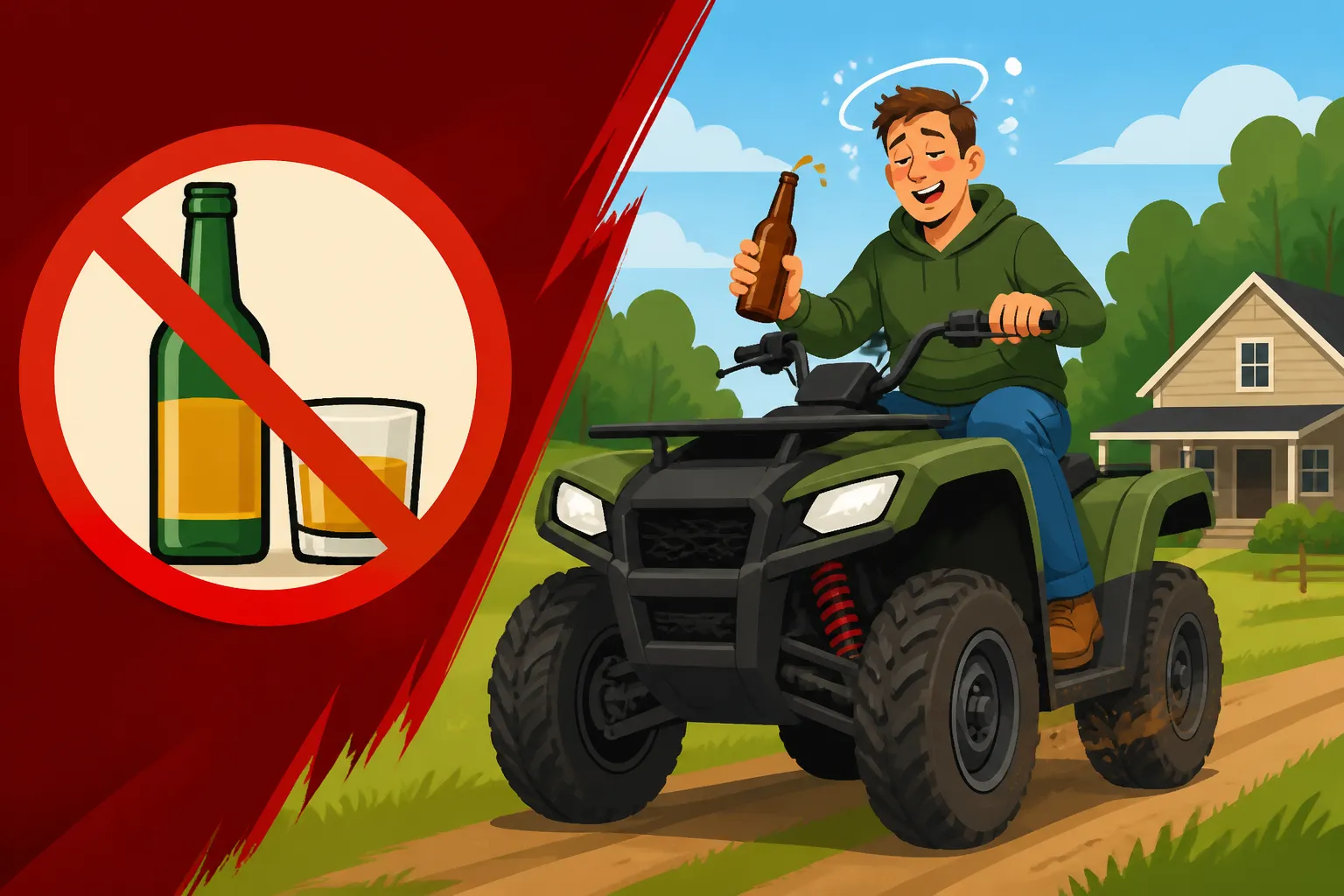
Riding an ATV Drunk on Your Own Property
A ride around your own yard can feel separate from road traffic, but alcohol does not become harmless when the pavement ends. In Virginia, private property is not a guaranteed exemption from a DUI charge involving an ATV or UTV. This guide explains the legal uncertainty, the risks that remain off-road, and practical ways to keep an impaired ride from turning into an emergency.
Can you ride an ATV drunk on your own property in Virginia
The safest answer is no. Do not operate an ATV or UTV after drinking or using drugs, even on land you own. Virginia’s DUI law is not simply a rule about driving on a public street, and being on private property does not automatically prevent a DUI investigation or charge.
Virginia Code § 18.2-266 prohibits operating a motor vehicle while under the influence of alcohol or drugs, or with a blood alcohol concentration of 0.08 percent or more. The law does not create a general “my land, my rules” exception. Whether a particular ATV or UTV and a particular set of facts fit the statute can be a legal question, so an individual case calls for advice from a Virginia attorney rather than assumptions based on where the ride happened.
Private land does not create a blanket DUI exemption
People often picture a DUI as a stop on a public highway, with traffic lights, lane markings, and other cars nearby. But the location alone does not settle whether operating a motor vehicle while impaired can lead to a DUI charge. A private driveway, field, farm lane, or wooded parcel is not automatically beyond the reach of Virginia’s DUI law.
That distinction matters even if you never leave your property. A rider might start on a back lawn, cross a field, and head toward a shed or hunting blind without approaching a public road. The lack of public traffic may reduce certain roadway hazards, but it does not make impaired operation safe or guarantee that the rider cannot face legal consequences.
The details can matter: the machine, how it was being operated, the land and access involved, and the evidence of impairment. If a charge arises, do not rely on a general online answer to decide whether the statute applies. The specific facts and current law need to be reviewed by a qualified Virginia lawyer.
ATV and UTV classification can complicate the answer
An ATV or side-by-side is designed for off-road use, and Virginia has separate rules for these machines in other contexts. That does not necessarily answer whether an impaired-operation law applies. A vehicle’s everyday label, its registration status, and the rules governing public-road use do not by themselves determine every question under DUI law.
A UTV’s size, seatbelts, or roll cage do not give it a special exemption from impaired-driving risks. Nor does the fact that the machine is not registered for road use settle the question. A title, trail permit, or property deed is not permission to ride after drinking.
For broader context, read [Virginia DUI Law and Off-Road Machines] and [Virginia ATV Road Rules Under 46.2-915.1]. They address separate legal issues: impaired operation and the rules governing ATV use. One should not be treated as a substitute for the other.
Why an impaired ride can still go badly off-road
A familiar yard can feel predictable, especially if you have ridden it dozens of times. But an ATV can tip, slide, or strike something in seconds. Alcohol and drugs can make it harder to judge distance, notice a rut, control speed, or react when a passenger shifts their weight.
The risk is not limited to steep mountain trails or unfamiliar terrain. A fence post, drainage ditch, low branch, loose gravel patch, parked vehicle, or uneven patch of ground can cause a crash. In a quiet rural area, help may also be farther away than it would be on a busy road.
A short ride can include serious hazards
Imagine a rider who has had a few drinks and takes a quad across a field to check a gate. The route is familiar, but recent rain has softened the ground. A tire catches in a rut, the rider overcorrects, and the machine rolls. A quick trip can become a serious injury without a public road ever entering the picture.
A passenger adds another layer of risk. Riders may shift position, grab the operator, or be thrown when the machine changes direction. A seat intended for one person is not made safer by riding slowly, and a passenger should never be used as a reason to take an impaired ride.
If you have been drinking, the practical choice is to leave the machine parked. Ask a sober person to move it if it needs to be relocated, or wait until you are sober and rested. Feeling “mostly fine” is not a reliable way to measure reaction time or coordination.
Property ownership does not eliminate responsibility for injuries
A crash on your property can still injure you, a family member, a guest, or someone working on the land. If another person is hurt, questions about who operated the machine, whether the rider was impaired, and whether the property owner took reasonable steps may become important. Those are fact-specific matters, not something ownership alone resolves.
A guest’s permission to ride is also not proof that the guest is safe to operate. If someone has been drinking, do not hand over the keys or assume that a short route is an acceptable compromise. A calm refusal is far easier than dealing with an ambulance call, an injury claim, or a criminal investigation.
Property boundaries matter for other reasons, too. If a machine leaves your land, even briefly, separate road-access and permission rules may come into play. See [Virginia Bans ATVs on Public Highways] and [Virginia Trespass Law for Riders] for those issues. Neither topic changes the basic safety advice: do not ride impaired.
Safety accessories do not make impaired riding safe
A helmet, protective clothing, and properly maintained equipment can reduce some risks, but they cannot restore judgment or reaction time. A windshield, doors, a roll cage, or other accessories do not turn an impaired ride into a safe one or create a legal exception.
Some riders look at products from companies such as SuperATV when thinking about equipment for a UTV. Whatever accessories a machine has, they are not a substitute for a sober operator. SuperATV equipment cannot prevent every rollover, collision, or injury, and an accessory should never be treated as permission to ride after drinking.
That point is easy to lose when a machine feels enclosed or sturdy. A side-by-side may have a steering wheel and seatbelts, but the operator still has to steer, brake, judge the terrain, and respond to sudden changes. A safer machine setup does not make impairment disappear.
What can happen after an impaired ATV ride
The possible consequences are not limited to whether a rider reaches a public road. Depending on the facts, an incident may involve a DUI investigation, another criminal or traffic matter, an injury claim, insurance questions, or more than one of these at once. The precise outcome depends on the law and evidence in the individual case.
| Situation | Why it matters | Safer choice |
|---|---|---|
| You have been drinking and want to ride a short loop | Short distance and private land do not make impairment safe or automatically exempt | Leave the machine parked |
| A friend who has been drinking asks to ride | You can prevent an avoidable crash by not handing over the keys | Arrange a sober ride and secure the machine |
| A rider is injured on private land | Emergency response, liability, and insurance questions may follow | Call for help and give responders accurate information |
| You are unsure whether an ATV rule applies | Classification and circumstances can affect the legal analysis | Ask a Virginia attorney about the specific facts |
A DUI concern is different from a road-use violation
Virginia’s restrictions on where ATVs may be operated are separate from the question of impaired operation. An ATV can be prohibited from a public highway even when its operator is sober, while a private-property setting does not automatically make impaired operation lawful. The two questions should not be blended together.
Likewise, registration, titling, and insurance rules are not a permission slip to ride while impaired. A machine’s paperwork may affect ownership or permitted use, but it does not make a rider fit to operate. If you are planning a road crossing or ride near public access, review the applicable road rules independently.
For information on roadway incidents, [Virginia Accident Reporting for an ATV Crash] may help explain what to consider after a collision. Insurance is another separate issue: [Which Policy Pays After a Virginia ATV Collision] discusses coverage questions that can arise. An insurer’s decision about coverage does not determine whether an impaired ride was lawful.
Do not assume a lack of a traffic stop means there is no legal risk
A rider may believe that no one will know about an incident because it happened behind the house or in a field. But crashes can bring emergency personnel, witnesses, family members, or law enforcement to the scene. Statements, observed behavior, and other evidence may become part of what is examined.
If a crash or investigation has already happened, avoid guessing about legal conclusions or discussing detailed facts publicly. Seek prompt advice from a Virginia attorney. If someone is hurt or in immediate danger, call emergency services first and tell responders what they need to know to provide care.
How to prevent an impaired ride on your property
The most reliable plan is to make the decision before alcohol or drugs are involved. Once a person has been drinking, it is harder to judge impairment honestly or resist the “just one quick trip” argument. A household rule that no one operates an ATV or UTV after drinking removes that negotiation.
Set a clear rule before riding begins
If you are hosting a cookout, hunting weekend, or family gathering, decide in advance who may operate the machines and when. Tell guests that anyone who drinks does not ride, even on private land. Keep the keys with a sober adult rather than leaving them beside the machine or in an unlocked vehicle.
This may feel overly strict when the property is familiar and the trip is only to the barn or gate. But clear rules are easier to follow than improvised exceptions. A sober person can move the machine if necessary, and everyone knows the boundary before anyone has to make a judgment call.
If children or teens are present, make the rule especially clear. A young rider may copy an adult’s decision to ride after drinking, and a powerful machine can be difficult to control even when the operator is sober. [Virginia ATV Helmet Law Explained] covers helmet requirements, but a helmet is only one part of responsible riding.
Park the machine and choose another way to get there
If you have been drinking, do not start the engine “just to move it a little.” A short ride can become a longer one, and a small movement still involves balancing, steering, and controlling a motorized machine. Leave it where it is until you are sober and rested, or ask a sober person to handle it.
If you need to check livestock, a gate, or equipment, walk if the route is safe, ask someone sober to drive, or wait. On a large property, that delay may be inconvenient. It is still a better inconvenience than an impaired rollover or a crash involving another person.
This is also why equipment upgrades should be kept in perspective. SuperATV accessories or other aftermarket additions may be part of a rider’s equipment choices, but they do not replace sober operation. SuperATV products, like any gear, should be considered for their intended function—not as protection against impaired judgment.
Have an emergency plan that does not depend on luck
Keep a phone accessible, know the property’s address or a clear location description, and make sure guests know how to contact help. In areas with weak cell coverage, tell someone outside the riding group where you will be and when you expect to return. A plan cannot prevent every accident, but it can help responders find an injured rider.
Check that the machine is maintained and that appropriate protective gear is available before a sober ride. For a UTV, use the machine’s safety equipment as intended, including seatbelts where fitted. Do not carry more passengers than the machine is designed to hold. These steps reduce some risks; they do not make riding after drinking acceptable.
If you are unsure about a past incident or a specific legal concern, write down the basic facts while they are fresh and speak with a Virginia attorney. Avoid relying on a neighbor’s experience or a forum post. A different machine, property layout, or set of circumstances can change the legal analysis.
The clearest rule is also the easiest to remember: if you have been drinking or using drugs, do not operate an ATV or UTV—even on your own land. Keep the keys away, wait until you are sober, and make a safe plan for anyone who needs to get around the property.
Disclaimer
This article is for general informational purposes only and does not constitute professional advice. Laws, prices and regulations vary by location and change over time. Consult a qualified professional for guidance on your specific situation.