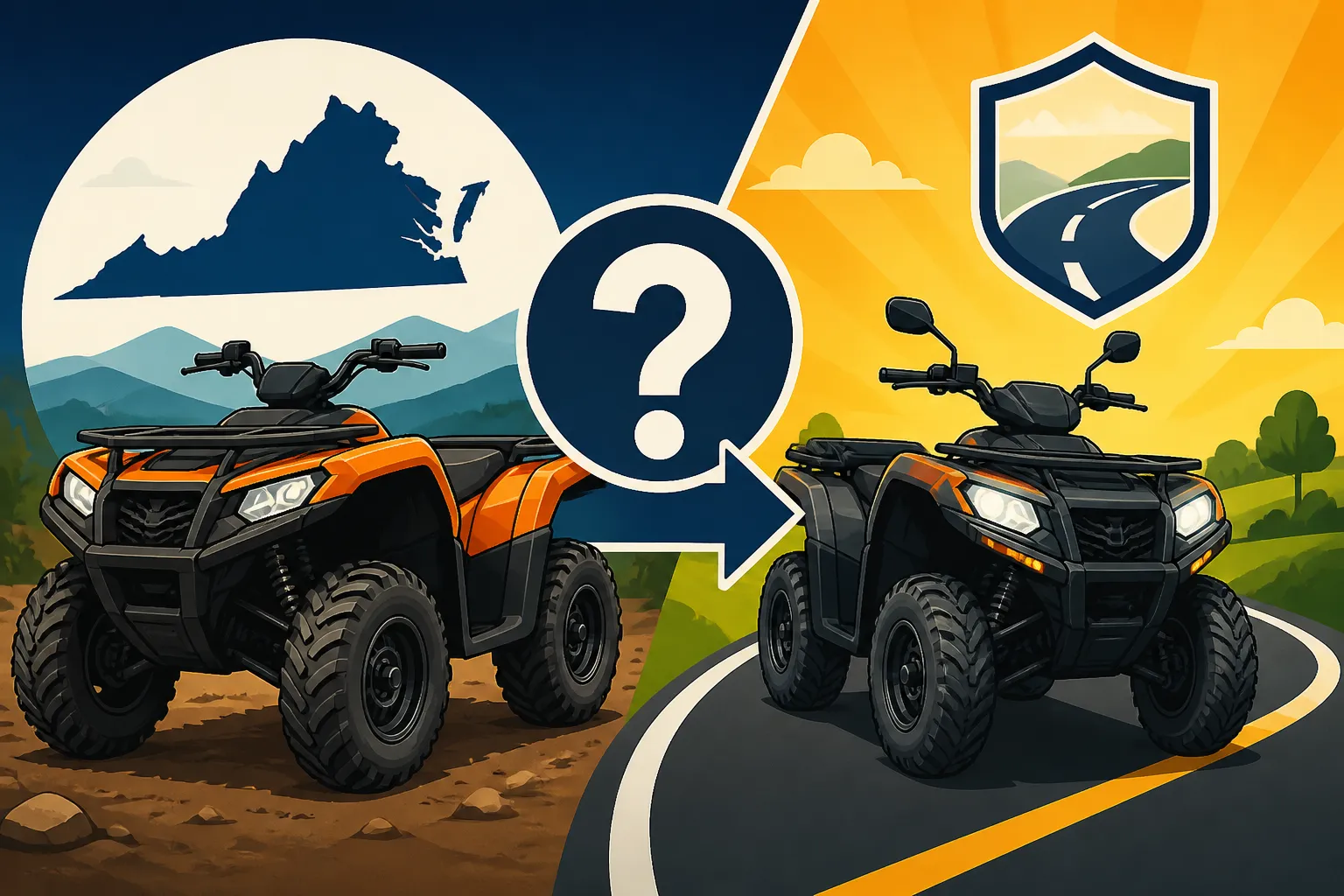
Can a Virginia ATV Be Made Street Legal at All?
It's a common dream for many ATV and UTV owners in Virginia: being able to hop on your machine and cruise down the road from your home to a nearby trail, or even just to a friend's house. The reality, however, can be a frustrating maze of state laws and definitions that often lead to disappointment. This guide is here to untangle the confusion and give you a straightforward answer about whether your Virginia ATV or UTV can truly become street legal.
Understanding Virginia's ATV and UTV Definitions
Before we dive into the nitty-gritty of road legality, it's crucial to understand how Virginia defines these machines in the first place. The legal classifications are what ultimately dictate where and how you can ride them, and they lay the groundwork for why street-legal conversions are so challenging.
What Virginia Considers an ATV (All-Terrain Vehicle)
In Virginia, an all-terrain vehicle, or ATV, has a pretty specific definition. It's generally a motor vehicle designed for off-road use, characterized by having three to four wheels, a seat designed to be straddled by the operator, and handlebars for steering. Think of your classic quad – that's the image the law has in mind. These machines are engineered with capabilities like high ground clearance, aggressive tires, and suspension systems built for rugged terrain, not smooth asphalt.
The very design principles of an ATV lean heavily towards conquering dirt, mud, and rocks, not sharing lanes with cars and trucks. This off-road intent is a fundamental aspect that the state's vehicle code considers when setting rules for their use.
What Virginia Considers a UTV (Utility Terrain Vehicle)
Utility Terrain Vehicles, or UTVs, often get lumped into the same category as ATVs when it comes to road restrictions in Virginia, even though their physical characteristics are quite different. A UTV typically has four or more wheels, side-by-side seating (often for two or more passengers), a steering wheel, and foot pedals for acceleration and braking – much like a small car. They also tend to have a cargo bed, emphasizing their utility aspect for hauling equipment or supplies on farms or job sites.
While UTVs can feel more like traditional cars to operate, Virginia's statutes generally categorize them alongside ATVs for highway use purposes, treating them as off-road recreational or utility vehicles. The distinctions are important for understanding your machine, but the ultimate takeaway for road access is often the same. For a deeper dive into the exact language, you might want to read [Virginia ATV and Utility Vehicle Definitions].
The Core Problem: Virginia's Highway Ban
The biggest hurdle standing between your ATV or UTV and a casual cruise down a public road in Virginia is a very clear and comprehensive ban. This isn't just a suggestion; it's written directly into state law, and it’s the reason so many riders face frustration.
The Statewide Prohibition
Let's not mince words: Virginia law generally prohibits the operation of ATVs and UTVs on public highways. This isn't some obscure loophole or a rule that applies only in certain areas; it's a statewide prohibition that riders need to take very seriously. Whether it's a bustling interstate, a quiet rural paved road, or even a city street, these machines are largely off-limits. You can feel the disappointment, right? You've invested in a fantastic machine, and you want to use it, but the state draws a hard line.
This broad ban means that for the vast majority of riders, the idea of a truly "street legal" ATV or UTV in Virginia is simply not an option. It's designed to keep these vehicles, which aren't built for the demands of road traffic, off thoroughfares where they could pose a risk to themselves or others. To get the full picture, check out [Virginia Bans ATVs on Public Highways].
Why the Ban Exists
The reasons behind Virginia's strict ban on ATVs and UTVs on public roads are primarily rooted in safety and the original design intent of these vehicles. Unlike motorcycles or cars, ATVs and UTVs are not manufactured to meet the rigorous Federal Motor Vehicle Safety Standards (FMVSS) that govern on-road vehicles. This means they often lack crucial safety features common on street-legal vehicles.
Think about it: they typically don't have turn signals, proper rearview mirrors, DOT-approved tires designed for pavement grip, or the kind of crash protection (like crumple zones or airbags) found in automobiles. Their suspensions are built for absorbing off-road impacts, not providing stable handling at higher speeds on hard surfaces. Additionally, their often low top speeds can make them hazards on roads with faster-moving traffic. The law is essentially saying, "These machines are amazing for trails and fields, but they just aren't safe for sharing the road with cars, trucks, and school buses."
Exceptions to the Rule: Limited Road Access
While the general rule in Virginia is a resounding "no" to ATVs and UTVs on public roads, there are a few very specific, limited exceptions. It's vital to understand that these are exceptions for specific operational circumstances, not pathways to making your machine generally "street legal."
Agricultural and Emergency Use
Virginia law carves out specific allowances for ATVs and UTVs when they are being used for legitimate agricultural purposes or by emergency personnel. For example, a farmer might be able to operate their UTV on a public road for short distances to get from one field to another, as long as it's directly related to farm work. Similarly, fire departments, rescue squads, or law enforcement might use ATVs or UTVs on roads during an emergency response or for official duties.
These are not general permits to ride; they are functional allowances tied to the purpose of the operation. You can't just slap a "farm use" sticker on your weekend trail machine and expect to avoid a ticket. The vehicle's use must align precisely with the legal exception. For more details on these specific cases, you can read about [Virginia Farming and Household Exceptions] and [Virginia Emergency Responder Exceptions].
Coalfield Road Access and Designated Routes
Perhaps the most well-known exception for recreational riders in Virginia exists in specific areas of the coalfields. Buchanan and Tazewell counties have special provisions that allow ATVs and UTVs on certain designated county roads to connect to trail systems like the Spearhead Trails. This is a game-changer for riders in those areas, allowing them to ride from trail to trail without having to load up their machines.
However, even these allowances come with strict conditions: there are often specific speed limits (like [Virginia's 25 mph Coalfield Road Limit]), requirements for daylight-only operation, and the rides must be on designated routes, not just any road. This isn't a blanket "street legal" status; it's a carefully managed program to boost tourism and recreation in specific areas. Understanding these nuances is critical to riding legally in the coalfields. More information can be found in [Virginia Buchanan and Tazewell County Road Access].
Short Crossings of Public Highways
Another very narrow exception permits ATVs and UTVs to cross public highways by the most direct route. This means if you're riding on private property or a legal trail and need to get to another section of private property or a trail that's directly across a public road, you can cross it. This isn't an invitation to ride down the road, even for a short distance; it's purely for perpendicular crossings.
The emphasis here is on "most direct route" – you can't weave down the road for a hundred yards to find a better crossing point if a direct one exists. This exception is designed to allow continuity of off-road travel without forcing riders to trailer their machines for a mere few feet. For further clarification on this specific rule, consult [Virginia Crossings by the Most Direct Route].
Why "Converting" an ATV to Street Legal Fails in Virginia
Many riders, fueled by the desire to ride legally on roads, consider adding aftermarket parts to "convert" their ATVs or UTVs. While products exist from companies like SuperATV that offer turn signal kits, mirrors, and other accessories that might seem like steps toward street legality, the reality in Virginia is that these modifications generally won't achieve the desired outcome.
Federal Motor Vehicle Safety Standards (FMVSS)
The core reason why ATVs and UTVs cannot be converted to street legal status in Virginia lies in their original manufacturing designation. ATVs and UTVs are simply not built to meet Federal Motor Vehicle Safety Standards (FMVSS). These are the benchmarks that all vehicles intended for public road use in the United States must meet. They cover everything from crash-worthiness and lighting specifications to braking performance and occupant protection.
Because ATVs and UTVs are initially certified by their manufacturers as "off-road use only" vehicles, they bypass these stringent road safety requirements. No amount of aftermarket modification can change this fundamental designation. This is a key differentiator from dirt bikes, which, in very specific circumstances and with extensive modification and inspection, can sometimes be converted to street legal status in Virginia. For more on this, look up [Virginia Dirt Bike Conversion Rules].
Missing Key Components and Design Flaws
Beyond the FMVSS designation, ATVs and UTVs inherently lack many design features essential for safe and legal road operation. Even if you meticulously add aftermarket parts – say, a robust turn signal kit, mirrors, a horn, and an upgraded lighting system from a brand like SuperATV – you're still working with a chassis and suspension system not designed for asphalt.
Consider the tires: off-road tires, while excellent for grip in mud and dirt, wear quickly and handle poorly on pavement, especially at speed. The suspension, optimized for absorbing impacts, can feel soft and unstable on hard corners at road speeds. Furthermore, most ATVs lack a proper windshield or occupant protection system found in vehicles. The DMV doesn't just look for a checklist of parts; they look at the vehicle's fundamental design and original manufacturer's intent. Because ATVs and UTVs are not built with road safety in mind from the ground up, adding a few accessories simply isn't enough to satisfy the legal requirements for a "motor vehicle" suitable for highways.
The DMV's Stance
When it comes to the Virginia Department of Motor Vehicles (DMV), their role with ATVs is primarily focused on titling for ownership records, not for enabling road use. If you bought a new ATV after July 2006, you likely have a title for it, but this title simply establishes proof of ownership. It doesn't register the vehicle for road use, nor does it imply any street-legal status. The DMV looks at the manufacturer's original certificate of origin (MSO) which clearly states "off-road use only."
They are not in the business of reclassifying an off-road vehicle as a street-legal one based on owner modifications. Their internal policies and interpretation of state law mean that they will almost invariably deny attempts to register an ATV or UTV for highway use. It's a fundamental classification issue that aftermarket parts cannot overcome. For clarity on how your machine is titled, see [Virginia Titles ATVs but Does Not Register Them] and [Why a Side-by-Side Can Never Be Made Street Legal].
The Reality Check: Consequences of Illegal Road Use
Given Virginia's clear stance on ATVs and UTVs on public roads, attempting to ride them illegally can lead to some pretty serious and unpleasant consequences. It's not just a slap on the wrist; the penalties can be significant, impacting your wallet and your ability to enjoy your machine.
Fines and Penalties
If you're caught operating an ATV or UTV illegally on a public highway or property where it's prohibited, you're looking at a civil penalty. Virginia law allows for a significant fine for these types of violations, which can really sting your pocketbook. We're not talking about a minor traffic ticket here; these penalties are designed to be a strong deterrent.
Imagine riding your machine to a gas station just a mile down the road, only to be pulled over and hit with a substantial fine. That quick trip suddenly becomes a very expensive lesson. This isn't just a hypothetical scenario; law enforcement takes these rules seriously, especially with the potential safety hazards involved. Understanding the exact costs can prevent a nasty surprise, so you might want to review [Virginia's Civil Penalty for Illegal Riding].
Impoundment and Legal Troubles
Beyond fines, there's the very real possibility that your beloved machine could be impounded. Many cities and counties have ordinances that allow them to seize and impound ATVs and UTVs found operating illegally on public property, including roads and sidewalks. Getting an impounded machine back is rarely easy or cheap. It involves paying towing fees, storage fees, and any associated fines, which can quickly add up to hundreds, if not thousands, of dollars.
Furthermore, if you were involved in an accident while illegally riding your ATV or UTV on a public road, you could face significant legal liability. Your actions might be deemed negligent by default, regardless of who was at fault in the collision, because you were operating a vehicle illegally. This could lead to lawsuits and demands for compensation for damages or injuries. It's a risk that far outweighs the convenience of a short road ride. For more on impoundment powers, check out [Cities Can Impound an ATV Ridden on a Sidewalk].
Insurance Implications
Another critical consequence of illegal road use relates directly to your insurance. While Virginia does not require ATV insurance, many responsible owners choose to carry it for protection against theft, damage, or liability when riding off-road. However, most standard ATV insurance policies are specifically written for off-road use.
If you have an accident while operating your ATV or UTV on a public road, your insurance company could deny your claim. They might argue that the incident occurred outside the scope of coverage, as your policy is for off-road operation, and you were operating the vehicle in a prohibited manner. This means you'd be solely responsible for the costs of repairing your machine, any medical bills, and any damages to other vehicles or property. It’s a huge financial risk to take. To learn more about Virginia's stance on ATV insurance, see [Why Virginia Sets No Insurance Minimum for ATVs].
Best Practices for Virginia Off-Road Enthusiasts
So, if making your ATV or UTV truly street legal in Virginia is essentially a dead end, what's a dedicated off-road enthusiast to do? The answer lies in embracing legal and safe practices that allow you to enjoy your machine to its fullest without risking fines, impoundment, or worse.
Embracing Designated Trails
The best way to enjoy your ATV or UTV in Virginia is to stick to designated off-road trail systems. Virginia is fortunate to have incredible riding opportunities, particularly the vast Spearhead Trails system in the southwestern part of the state. These trails are specifically designed, maintained, and legally sanctioned for ATV and UTV use, offering hundreds of miles of diverse terrain.
Riding on designated trails means you're operating within the law, you're usually on well-marked paths, and you're surrounded by fellow enthusiasts. It's a much more enjoyable and stress-free experience than constantly worrying about getting pulled over or facing legal consequences. Many of these systems offer stunning scenery and a true taste of Appalachian adventure. For a comprehensive look at one of Virginia's premier systems, explore [Spearhead Trails in Virginia Explained].
Trailering Your Machine
Since you generally can't ride your ATV or UTV on public roads to get to your favorite trails, the practical solution for most riders is trailering their machines. Investing in a suitable trailer allows you to safely and legally transport your ATV or UTV to and from trailheads, private property, or your chosen riding destinations.
When trailering, remember to secure your machine properly, ensure your trailer lights are working, and be mindful of load limits. While your quad itself doesn't need a license plate in Virginia, your trailer certainly does. This might seem like an extra step, but it's the responsible and legal way to enjoy off-roading. For more on trailer requirements, you can check out [Your Trailer Needs a Plate but Your Quad Does Not].
Staying Informed
Laws and regulations can change, and interpretations can vary. It's always a good idea for Virginia ATV and UTV owners to stay informed about local ordinances and state laws. Follow reputable ATV organizations, check the Virginia DMV website, and keep an eye on news from county supervisors, especially in areas with unique road access like the coalfields.
Being proactive about understanding the rules ensures that you're always riding legally and safely. Don't rely on hearsay or outdated information. A few minutes spent researching can save you a world of trouble and keep you on the right side of the law. Keeping up-to-date with current rules is essential, and reading [Virginia Law Behind Every ATV Rule] can be a great place to start.
Virginia Street Legal Options: Dirt Bikes vs. ATVs/UTVs
| Feature / Category | Street-Legal Dirt Bike (Motorcycle) | ATV / UTV (Off-Road Vehicle) |
|---|---|---|
| Original Intent | Designed for off-road, can be converted for road. | Designed only for off-road. |
| Federal Standards | Can be modified to meet FMVSS. | Does not meet FMVSS. |
| Manufacturer Cert. | MSO allows for road conversion. | MSO states "Off-Road Use Only." |
| Key Components | Must add DOT tires, turn signals, mirrors, horn, headlight/taillight, license plate light. | Adding components is insufficient for reclassification. |
| Virginia DMV | Can be titled and registered as a motorcycle after conversion and inspection. | Titled as off-road vehicle; cannot be registered for general road use. |
| Road Access | Legal on public highways after conversion. | Generally prohibited on public highways. Limited exceptions only for specific uses/locations. |
| Safety Equipment | Requires motorcycle helmet, appropriate gear. | Requires ATV helmet, appropriate off-road gear. |
| Legal Path | Requires specific forms (e.g., VSA 130), inspection, and processing in Richmond. | No legal path for general street-legal conversion. |
| Insurance | Required liability insurance for road use. | Not required for off-road use; policies usually exclude road incidents. |
Disclaimer
This article is for general informational purposes only and does not constitute professional advice. Laws, prices and regulations vary by location and change over time. Consult a qualified professional for guidance on your specific situation.