Cities Can Impound an ATV Ridden on a Sidewalk
There's nothing quite like the feeling of hitting the trails on your ATV or UTV, but that excitement can quickly turn to frustration and a major headache if you find yourself on the wrong side of the law. One of the quickest ways to land in hot water, especially within Virginia's city limits, is by taking your machine onto a sidewalk. It might seem like a harmless shortcut or a way to get around traffic, but Virginia cities have clear, strict rules about where these machines can and cannot go, and the consequences for ignoring them are far-reaching, expensive, and frankly, a huge hassle. This guide will walk you through exactly why riding on a sidewalk can lead to impoundment, what it will cost you, and how to avoid such a dire situation in the first place.
The Core Problem: Why Sidewalks Are Off-Limits (and What the Law Says)
It’s easy to think of sidewalks as simply paved paths for walking, a kind of neutral zone in the urban landscape. But when it comes to ATVs and UTVs in Virginia, these seemingly innocuous pathways are very much off-limits. The law is quite clear, and it’s designed to protect pedestrians, maintain public order, and ensure that the right vehicles are on the right surfaces.
Virginia's Broad Prohibition on Public Roads and Property
Virginia law broadly prohibits the operation of ATVs and UTVs on public highways and public property, with very few and specific exceptions. This isn't just about high-speed thoroughfares or busy interstates; it encompasses nearly all publicly maintained roads, streets, and areas not specifically designated for off-road vehicle use. When we talk about "public property," that includes things like parks, school grounds, and, yes, sidewalks. It's a blanket rule that often catches riders off guard because they assume if there's no visible "No ATVs Allowed" sign, it must be okay. That assumption can lead to a world of trouble.
Think about it from a pedestrian's perspective: a sidewalk is their safe haven, a space explicitly designed for foot traffic. Introducing a motorized vehicle, even a relatively slow-moving one like an ATV, creates a significant safety hazard. There's also the noise factor, especially in residential areas, and the potential for damage to the sidewalk itself or landscaping nearby. This is why the state legislature, and by extension, local municipalities, have put these firm rules in place. It’s not about being difficult; it's about public safety and maintaining community standards. You'll find that [Virginia Bans ATVs on Public Highways] is a fundamental principle, and sidewalks fall squarely under this broad prohibition.
Defining a "Sidewalk" in the Eyes of the Law
So, what exactly is a "sidewalk" from a legal standpoint? Generally, a sidewalk is any paved or unpaved portion of a highway primarily intended for the use of pedestrians. This definition is broader than many riders might assume. It's not just the pristine, poured-concrete paths you see in a new subdivision. It can also include gravel paths alongside a road, or even the grassy verge that functions as a pedestrian walkway in older neighborhoods where formal sidewalks haven't been installed. The key is its intended use for foot traffic.
This broad definition means that even if you're just cutting across a short section of a path to get from one private property to another, if that path is designated for pedestrians and publicly maintained, you're likely on a sidewalk in the eyes of the law. Many riders make the mistake of thinking if it’s not a full-blown road, it’s fair game for an ATV, especially if they’re just going a few yards. However, even a short jaunt on a sidewalk can lead to a citation and the very real possibility of your machine being impounded. Ignorance of the definition is rarely, if ever, a valid defense, and officers are trained to identify these spaces as prohibited areas for ATVs and UTVs.
The Specifics of Impoundment: How Cities Enforce the Ban
Getting pulled over is one thing, but having your beloved machine taken away is an entirely different level of distress. Virginia cities don't just issue warnings for riding on sidewalks; they have the power to seize your ATV on the spot. This isn't an arbitrary decision by an individual officer; it's a specific power granted by state law to ensure compliance and public safety.
The Legal Authority for City Impoundment Powers
It’s crucial to understand that cities aren't acting outside their jurisdiction when they impound an ATV. Virginia Code § 46.2-915.1, which outlines where ATVs can and cannot be operated, also grants cities and counties specific authority to enforce these provisions. This includes the power to take possession of a machine that is being operated illegally. The phrase [Cities Can Impound an ATV Ridden on a Sidewalk] isn't just a threat; it's a direct reflection of this legal authority. This power is often invoked not only as a penalty but as a practical measure to immediately stop the illegal operation and prevent further offenses.
The goal behind impoundment is multifaceted. Firstly, it’s a strong deterrent. The financial burden and inconvenience of getting a machine back far outweigh a simple traffic ticket for many. Secondly, it removes the immediate threat. If an ATV is being ridden illegally on a sidewalk, impounding it ensures that it's no longer endangering pedestrians or creating a disturbance. Local law enforcement agencies, whether city police departments or county sheriff’s offices, are well aware of these powers and are often quite proactive in areas where illegal ATV riding is a known issue.
The Impoundment Process: From Stop to Seizure
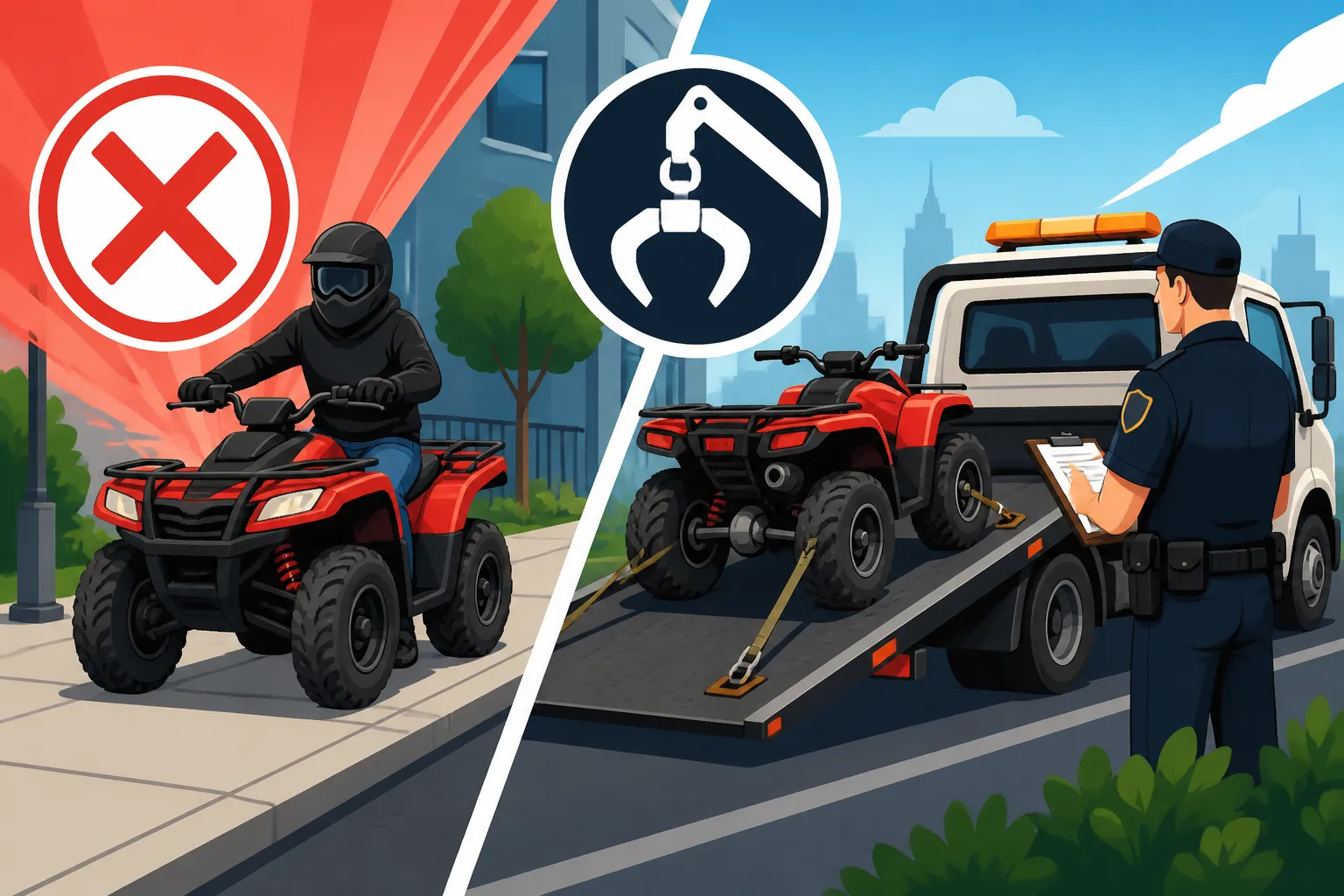
Imagine this scenario: you're riding your quad, maybe just a quick hop down a sidewalk to avoid a busy intersection or to reach a friend's house. Suddenly, blue lights flash behind you. An officer stops you, explains you've violated the code by riding on a sidewalk, and issues a citation. But then, they deliver the crushing news: your ATV is being impounded. This isn't just a matter of getting a ticket; your ride is being taken away, right then and there. You won't be able to just drive it home.
The officer will typically arrange for a tow truck to come and transport your ATV to a designated impound lot. You'll be given paperwork outlining the violation, the impoundment, and instructions on how to retrieve your machine. This can be an incredibly frustrating and helpless feeling, standing there watching your ATV get loaded onto a flatbed. The immediate reality is that your plans for the day are ruined, and you're now facing a significant logistical and financial challenge to get your machine back. This process is designed to be inconvenient and costly, precisely to underscore the seriousness of operating ATVs where they don't belong.
The Financial Hit: Costs Associated with Impoundment
Beyond the sheer inconvenience and embarrassment of having your ATV seized, the financial repercussions can be substantial. It’s not just the penalty for the violation itself; there are a host of other fees that will quickly add up, making a simple ride on a sidewalk a very expensive mistake.
Towing and Storage Fees That Pile Up Fast
When your ATV is impounded, the first thing you'll be hit with is a towing fee. This is the cost for the tow truck to come to your location and transport your machine to the impound lot. These fees vary by locality and the towing company, but they are rarely cheap. Once your ATV is at the impound lot, the clock starts ticking on storage fees. These are typically charged on a daily basis, and they can accumulate rapidly.
For example, a towing fee might be a flat rate, say, over a hundred dollars, and then you could be looking at twenty, thirty, or even more dollars per day for storage. If you’re not able to retrieve your ATV immediately, perhaps due to work, travel, or the need to gather funds, these costs can spiral out of control within a few days or a week. We've heard stories of riders paying hundreds of dollars just in towing and storage, on top of any fines. This makes the statement [Impound Costs After a Machine Is Seized] a stark reality for many. The longer it sits, the more it costs, turning a minor infraction into a major financial drain.
Civil Penalties for Illegal Riding
In addition to the towing and storage fees, you will also be responsible for the civil penalty associated with operating your ATV illegally. In Virginia, riding an ATV or UTV on prohibited public lands, including sidewalks, can result in a civil penalty of up to $500. This is clearly outlined in state law, making [Riding Illegally Costs Up to $500 in Virginia] a very real consequence. This isn't a criminal charge, but it's still a serious fine that will appear on your record as a civil infraction.
It's important to understand that this penalty is separate from any towing or storage fees. You're effectively paying for the violation and for the costs incurred by the city in removing and storing your machine. This combination of fees can easily push the total cost of a brief, illegal ride into the four-figure range, especially if your machine sits in impound for more than a few days. The civil nature of the penalty, as explained in [Why Virginia's $500 ATV Penalty Is Civil, Not Criminal], means you won't face jail time for this specific infraction, but the financial hit is still substantial and can be a hard lesson learned.
Getting Your ATV Back: The Release Process
So, your ATV has been impounded, you've been cited, and you're staring down a pile of fees. What now? The process of getting your machine back from the impound lot can be as frustrating as the impoundment itself, involving bureaucracy, paperwork, and more fees.
Navigating the Impound Lot Bureaucracy
To get your ATV back, you'll first need to settle all outstanding issues. This typically means paying the civil penalty to the court or appropriate city office first. Once that's handled, you'll need to go to the impound lot (or the police department that initiated the impound) and present proof of ownership for your ATV, along with a valid photo ID. This might include your ATV's title, a bill of sale, or other documentation that clearly establishes you as the legal owner. Without this proof, they won't release the machine. Make sure to bring everything you can, as the more documentation you have, the smoother this process tends to be. Think about the kind of documents you'd bring if you were going to the DMV for something important, like [What to Bring to the DMV to Title a Quad], as similar proof of ownership will be required here.
Once ownership is verified, you'll then have to pay all the accumulated towing and storage fees directly to the impound lot. Remember, these fees increase daily, so the sooner you address this, the less you'll have to pay. Many impound lots operate during limited business hours, so make sure to call ahead and confirm their schedule and what forms of payment they accept. You might need to bring cash or a money order, as credit card acceptance isn't always guaranteed at every location.
Potential Roadblocks and What to Expect
Even with all your ducks in a row, you might encounter some roadblocks. One common issue is incomplete or missing paperwork. If your proof of ownership isn't clear, or if your ID doesn't match the ownership documents, you could face delays. It's also possible that the impound lot or police department might have specific requirements you weren't aware of, so always call ahead to confirm exactly what you need to bring.
Another potential hurdle is if there's a lien on your ATV. If it's financed, the impound lot might require notification to the lienholder or even their direct authorization before release, which can add significant time to the process. Moreover, if your ATV was impounded due to multiple or severe violations, there could be additional legal steps required before its release. Patience is key here, and being thoroughly prepared with all necessary documents and funds will greatly increase your chances of a smooth retrieval. Expect that it won't be a quick process, and allocate ample time for phone calls and visits to various offices.
Preventing Impoundment: Knowing Where to Ride Legally
The best way to avoid the headache, expense, and frustration of impoundment is simple: know and respect the rules of the road—or, in this case, the rules of the trail. Virginia offers plenty of fantastic opportunities for ATV and UTV riding, as long as you stick to the designated areas.
Legal Riding Areas and Designated Trails
Virginia boasts some incredible landscapes and a growing network of legal off-road trails designed specifically for ATVs and UTVs. These are the places where you can truly let loose and enjoy your machine without worrying about breaking the law or endangering others. Places like the Spearhead Trails system in Southwest Virginia, which offers hundreds of miles of diverse terrain, are prime examples. Systems like [Virginia ATV Trails: Spearhead and the Forest] provide sanctioned, maintained paths for riders of all skill levels. Similarly, the [Peters Mill Run OHV Trails in Virginia] are another popular destination within the George Washington National Forest, offering a different kind of riding experience.
To ride these trails, you'll typically need a permit. For the Spearhead Trails, you can purchase [Virginia Spearhead Trail Permits], which are essential for access. For national forest trails like Peters Mill Run, you'll need [Virginia National Forest OHV Permits]. These permits not only grant you legal access but also contribute to the maintenance and development of these valuable riding resources. Always check the specific rules and permit requirements for each trail system before you head out, as they can vary regarding machine width, helmet laws, and operating hours.
Obtaining Landowner Permission
Beyond designated trail systems, the only other legal place to ride your ATV or UTV in Virginia is on private property with explicit permission from the landowner. This is not just a polite request; it's a legal requirement. Trespassing, even accidentally, can lead to civil penalties, confrontations, and even impoundment if the landowner involves law enforcement. That's why [Written Consent From a Landowner] is absolutely crucial. A verbal "it's okay" might suffice in some friendly situations, but a written note protects both you and the landowner, clearly stating the terms of your access.
A good written permission note should include the landowner's name, your name, the date, a description of the property, and the duration or specific dates you're allowed to ride. It acts as your proof if questioned by authorities or if there's any misunderstanding. Many property owners, particularly those who have experienced issues with illegal riding in the past, take property security very seriously. They might install sturdy gates, use robust signage (perhaps even from companies like SuperATV, known for their durable off-road accessories and property management solutions), or even employ game cameras to monitor their land. Respecting private property boundaries and always securing permission is not just good etiquette; it's essential for legal and safe riding.
Exceptions and Misconceptions
While the rules about ATV use on sidewalks and public property are generally strict, there are a few very specific exceptions and many common misconceptions that can lead riders astray. Understanding these nuances is critical to avoiding legal trouble.
Farm and Emergency Responder Exceptions
It’s true that there are limited exceptions to Virginia’s general ban on ATVs on public roads and property. The most common and widely recognized exception is for bona fide farming operations. Farmers are often permitted to use their ATVs or UTVs on public roads for short distances between fields or to access parts of their farm, especially if there isn't a practical alternative. This is strictly for agricultural purposes, however, and not for recreational riding. [Virginia Farming and Household Exceptions] covers these specific allowances, but they are very narrow and apply only when the ATV is being used directly for farm work.
Similarly, emergency responders, such as fire departments, rescue squads, and law enforcement, are permitted to use ATVs and UTVs on public roads and property when responding to an emergency or conducting official duties. This is a critical provision that allows these agencies to access remote areas or navigate difficult terrain. [Virginia Emergency Responder Exceptions] ensures that these vital services aren't hindered by general ATV prohibitions. However, these exceptions are exclusively for official use by authorized personnel and do not extend to the general public.
Why Your Neighbor's "Permit" Might Be Different
One of the biggest sources of confusion among ATV riders in Virginia comes from local ordinances and the varying rules across different counties. You might hear a friend in a rural area talk about how they can ride their ATV on certain county roads, and then assume that applies everywhere. This is a dangerous misconception. While some specific counties, particularly in the state's coalfields, have very limited exceptions allowing ATVs on certain named roads, these are highly localized and typically involve specific routes and conditions, as seen in [Virginia Buchanan and Tazewell County Road Access]. These are not blanket permissions that apply to every county road, let alone city sidewalks.
What's allowed in one county (often due to specific economic or historical circumstances, like mining operations that rely on such access) is almost certainly not allowed in a more densely populated or suburban area. Cities, with their higher pedestrian traffic and different infrastructure, almost universally prohibit ATVs on sidewalks and most public roads. There is no such thing as a general "permit" that makes a city sidewalk legal for ATV use. Always verify the rules for the specific locality you are in, and err on the side of caution. If it looks like a sidewalk, and it's in a city, assume it's off-limits for your ATV, regardless of what you might have heard about a different part of the state.
Comparison of ATV Riding Locations and Rules
Understanding where you can and cannot ride is paramount to avoiding impoundment and other legal issues. Here's a quick comparison to help clarify the rules for different types of locations in Virginia:
| Location Type | Legality for ATV/UTV Use in Virginia | Common Consequences of Illegal Use | Permit/Permission Needed |
|---|---|---|---|
| City Sidewalks | Illegal | Civil penalty (up to $500), towing fees, daily impound storage, inconvenience, potential impoundment. | Never permitted |
| Public Highways/Roads | Generally Illegal | Civil penalty (up to $500), towing, impoundment, safety risks. | Special, limited exceptions for farming or emergency use; specific designated coalfield routes only. |
| Designated OHV Trails | Legal | Adherence to trail rules, helmet laws, speed limits. | Trail-specific permit (e.g., Spearhead, National Forest). |
| Private Land | Legal | Adherence to landowner rules, general safety. | Explicit written permission from landowner is mandatory. |
This table highlights the clear distinctions. While designated trails and private land offer legal riding opportunities, city sidewalks are a definite no-go zone, with significant repercussions.
Disclaimer
This article is for general informational purposes only and does not constitute professional advice. Laws, prices and regulations vary by location and change over time. Consult a qualified professional for guidance on your specific situation.