Neighboring States That Do Require a Safety Certificate
Virginia riders planning an ATV or UTV trip across a state line may assume their home-state rules travel with them. They do not always. Safety-course requirements can depend on the state, the rider’s age, and where the machine will be used. The practical answer: check the destination’s rules before you go, especially when a young rider will be on the machine.
Why a Safety Certificate May Be Required in a Neighboring State
Virginia does not have a general ATV safety-course requirement, but that does not settle what applies in another state. A neighboring state can require a course for certain riders even when Virginia does not require one at home. The rule may apply only to young operators, or only on particular public lands or riding areas.
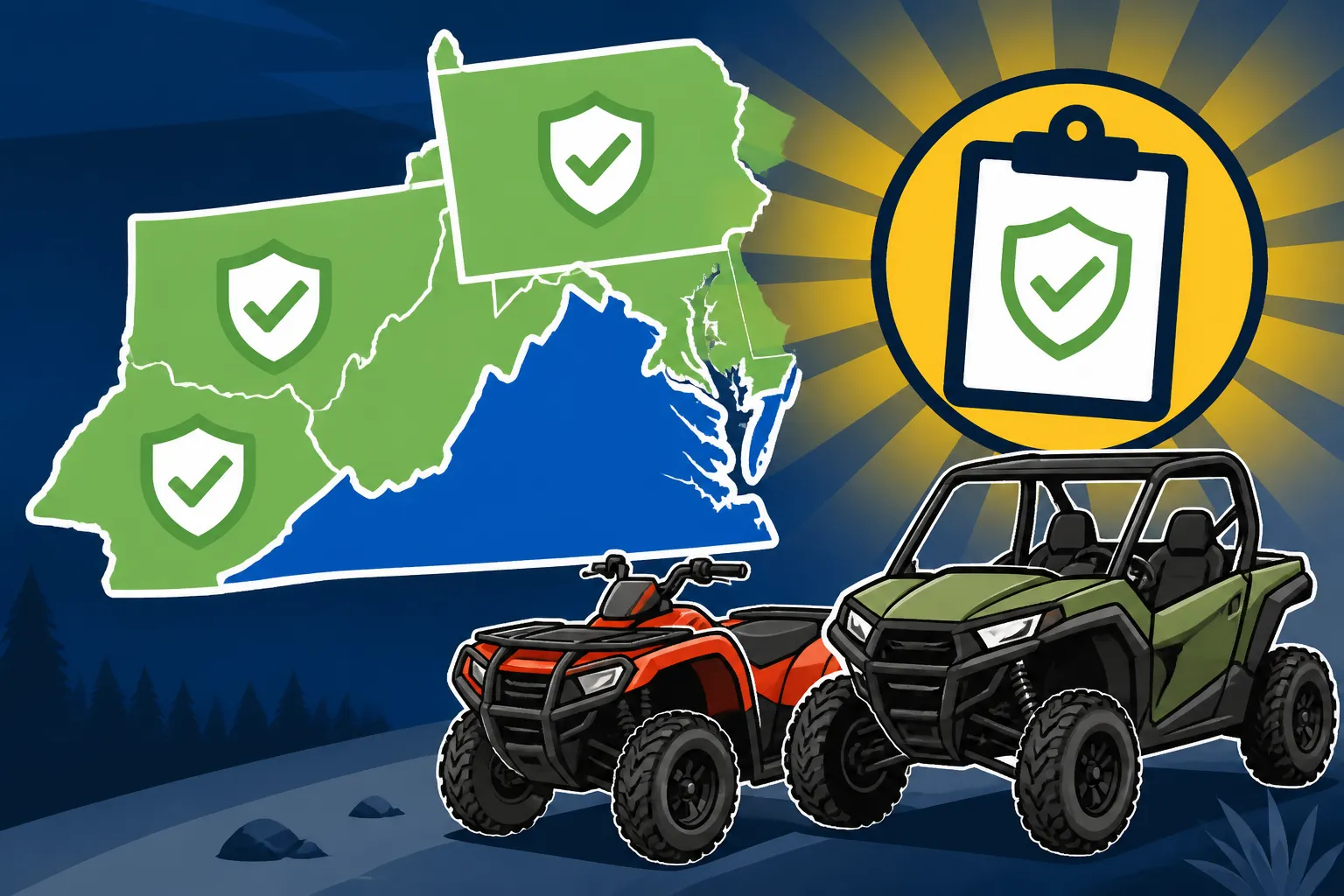
West Virginia and North Carolina are especially important for Virginia riders to check. Both have youth safety-training requirements in some circumstances. The exact age threshold, where the rule applies, and what counts as acceptable proof can depend on the relevant state law and riding location. Do not assume that a course requirement applies to every adult rider—or that every youth rider is covered by the same rule.
The word “certificate” can also be misleading. A state or riding area might accept a completion card, an electronic record, or another form of proof. It may require a particular approved course rather than any general ATV class. Before relying on a certificate, confirm that it meets the destination’s requirements.
| Destination | What Virginia riders should keep in mind |
|---|---|
| West Virginia | Check youth training requirements and the age and riding conditions they cover. |
| North Carolina | Check whether a youth operator needs approved safety training for the planned use and location. |
| Kentucky | Do not assume a Virginia rule or certificate settles the requirements; check state and riding-area rules. |
| Tennessee | Confirm whether age, land type, or a specific riding area triggers a training requirement. |
| Maryland | Check the rules for the specific land or riding facility, particularly for a young operator. |
This table is a planning prompt, not a substitute for the current rules where you intend to ride. Requirements can differ between public land, private property, a state-managed area, and a private off-road park. A park can also set its own entry rules in addition to state law.
For a broader look at what applies to visitors from nearby states riding in Virginia, see Virginia Visitors From West Virginia, Virginia Visitors From Kentucky, Virginia Visitors From Tennessee, and Virginia Visitors From North Carolina. Those questions work in both directions: a rule that applies to a visitor in Virginia may not match the rule for a Virginia resident riding elsewhere.
How Requirements Differ by Age and Riding Location
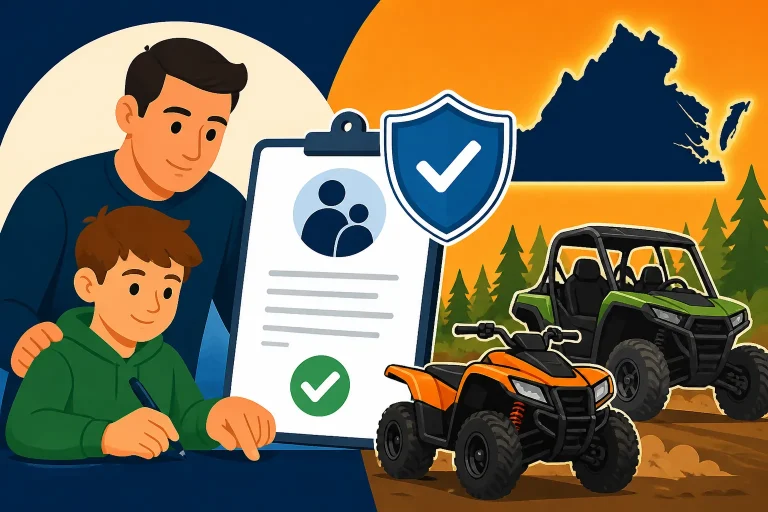
A course requirement is often tied to the operator’s age rather than the machine’s registration, ownership, or home state. That means a parent should check the rule for each rider, not just for the adult who owns or transports the ATV or UTV. A youth may need to complete training even when an adult accompanying them does not.
Age rules and course rules are separate questions. A rider might be old enough to operate a particular machine under one state’s rules but still need to meet a training requirement. Conversely, completing a course does not necessarily make a rider eligible to use a machine that exceeds an age-based engine-size limit or violates a supervision rule. Review both requirements before the trip. Virginia’s age rules are covered in Virginia Rules for a Rider Under 18 and Virginia Trail Rules for Riders Under 18.
Where you ride matters, too. A rule for a state-managed trail or public riding area may not apply in the same way on private land. But private property is not automatically exempt from every safety rule: the property owner, a riding park, or an organized event may impose conditions on entry. Check the specific land manager’s requirements rather than treating “private” and “public” as complete answers.
A useful way to sort the rules is to ask:
- Who is operating the machine? Identify the age of each rider, not only the owner or lead adult.
- What kind of machine is it? A state may use its own definitions for an ATV, UTV, or other off-highway vehicle.
- Where will it be used? Identify whether the trip involves public land, private land, a managed trail system, or a private park.
- Is training required? Confirm whether a course is mandatory for that rider and setting, and whether it must be an approved course.
- What proof must the rider carry? Ask whether a paper card, digital record, or other document is accepted.
This approach avoids a common mistake: finding a general statement about “ATV safety courses” and assuming it covers every rider and every place. The relevant question is narrower: does this rider need this type of training for this machine and this destination?
A Virginia Certificate Is Not Automatically a Regional Pass
There is no reason to assume that a Virginia resident’s status creates an exemption from another state’s rules. A certificate from a course may help show that a rider has completed training, but it does not necessarily satisfy a different state’s requirement. The destination may recognize only certain courses or require a separate permit, registration, or proof of age.
The reverse is also true. A rider who completed a course because another state required it should not assume that the certificate replaces a Virginia trail permit or satisfies a riding area’s other rules. Course completion, land access, trail permits, and machine eligibility are different matters. See Virginia Has No Safety Course Requirement for the Virginia distinction, and Virginia Visitors From West Virginia for the separate issue of visiting-rider rules.
Before you travel, check the official state agency or land manager responsible for the place you plan to ride. If you are going to a private park, check the park’s own rider requirements as well. Ask direct questions: Is a course required for this operator’s age? Does the requirement apply at this location? Which courses count? What proof should the rider have available? A current answer from the authority responsible for the land is more useful than a general statement about the neighboring state.
It is also worth checking the rules close to departure. Trail systems can have their own operating conditions, and a general state-level summary may not describe every site-specific requirement. Keep a copy of any course-completion record with the rider’s other travel documents, but do not treat it as a replacement for a permit or other required paperwork.
A Simple Pre-Trip Check for Families and Groups
For a family trip, handle training and eligibility before loading the machines. Start with the youngest operator, since age-based rules are more likely to affect them. Then check the adult supervision rule, machine limits, and proof requirements for the exact destination. If a group includes riders from several states, confirm the rules for each person instead of assuming that one rider’s paperwork covers everyone.
A quick pre-trip checklist can prevent a wasted drive:
- Write down the state, trail system, park, or parcel where you intend to ride.
- List each operator’s age and the machine each person will use.
- Check whether the destination requires a safety course for any of those riders.
- Confirm that the course is an accepted one and that the rider can show proof of completion.
- Check separately for permits, access rules, supervision requirements, and machine restrictions.
- Recheck the destination’s information before departure if your plans or riders change.
If a rule is unclear, contact the agency or land manager responsible for the riding location. Do not rely solely on a seller, a friend’s recollection, or a certificate from an unrelated course. A short confirmation can clarify whether the rule applies to your rider and what documentation to bring.
The safest takeaway is straightforward: Virginia’s lack of a general course requirement does not guarantee that a Virginia rider can skip training elsewhere. West Virginia and North Carolina warrant particular attention for youth riders, while the rules in every neighboring state should be checked against the planned location and operator. For other common questions about Virginia’s own trail paperwork, see Virginia Permit Questions Riders Ask.
Disclaimer
This article is for general informational purposes only and does not constitute professional advice. Laws, prices and regulations vary by location and change over time. Consult a qualified professional for guidance on your specific situation.