Virginia Insurance Proof at a Trailhead
You’re loading an ATV or UTV for a Virginia ride and want to know whether someone will ask for insurance at the trailhead. The answer depends on where you ride: Virginia does not impose a blanket insurance requirement on off-road machines, but a park, event organizer, landowner, or other operator may set its own entry conditions. Here’s what to check and what to carry.
Does Virginia Require Insurance Proof for an ATV or UTV?
For ordinary off-road use, Virginia does not require ATV insurance as a general statewide condition of riding. That means there is no single statewide rule requiring every rider to show an insurance card at every trailhead. The distinction between a title and insurance can be confusing: titling a machine does not by itself make insurance mandatory. See Virginia Requires No ATV Insurance.
That does not mean every riding location has the same rules. A public trail system, private riding park, landowner, or organized event can have separate conditions for access. Some may require insurance, while others may not ask for it. Before hauling, check the rules for the specific place and type of ride rather than treating the statewide rule as a promise about every gate.
A trail permit also is not the same thing as an insurance policy. A permit gives you permission to use a particular system under its rules; it generally does not insure your machine, pay for damage you cause, or cover injuries. Likewise, a printed or digital permit is not proof of insurance.
| Riding situation | Is insurance proof a statewide requirement? | What to check |
|---|---|---|
| Ordinary off-road ATV or UTV use | No blanket requirement | Rules set by the riding location |
| Spearhead trail system | No blanket statewide requirement | Current permit and system rules |
| National Forest OHV route | No blanket statewide requirement | Current permit, equipment, and access rules |
| Private riding park | Not necessarily | Park admission terms, waiver, and posted rules |
| Organized ride or event | Not necessarily | Registration instructions and organizer requirements |
| A machine used on public roads | Different rules may apply | Whether the machine and use are lawful, and what insurance applies |
The table is a starting point, not a substitute for checking current operator rules. Trail access terms can change, and a particular event may impose requirements that do not apply to casual riding elsewhere.
It is also worth separating insurance from proof of ownership. A trail operator might ask for a permit or identification, or require compliance with equipment rules, without asking for an insurance card. If the question is whether you can prove you own a machine, that is a different issue from whether it is insured. For ownership and riding documents, see Virginia Proof of Ownership on the Trail.
Who Can Ask for Proof at the Trailhead?
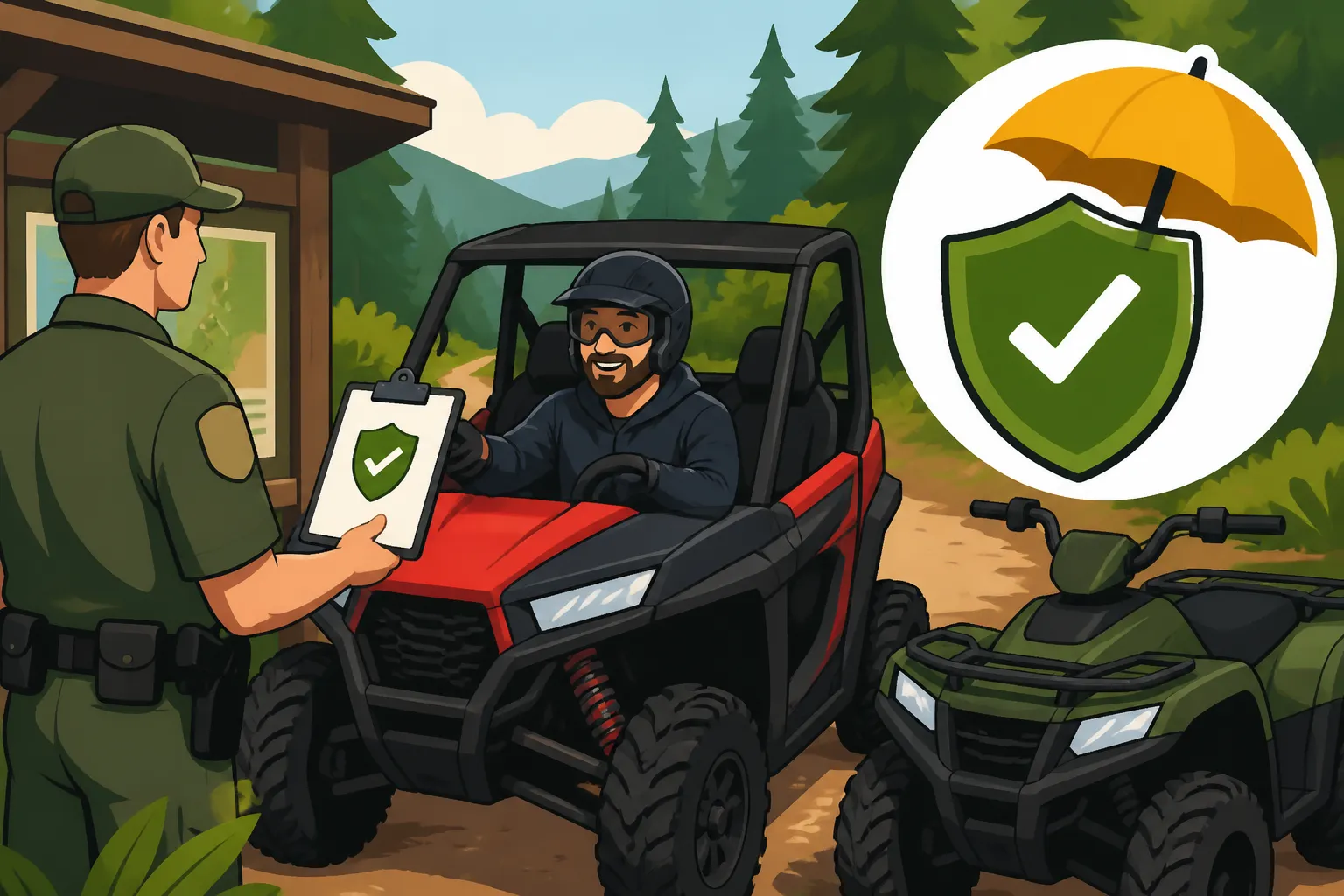
The person checking access may be a trail ranger, park employee, event volunteer, land manager, or private landowner. Their authority and the rules they enforce depend on the location. Do not assume that a check at one trail system tells you what to expect at another.
Public trail systems
For a public trail system, start with the system’s permit and access information. Virginia riders may use different systems with different permit arrangements and operating rules. A Spearhead permit, for example, is tied to that system; it does not automatically cover every riding area. Review Virginia Spearhead Trail Permits and confirm the current instructions for the system you plan to visit.
National Forest riding has its own access and equipment requirements. A forest permit or other required documents should be treated separately from insurance. Check Virginia National Forest OHV Permits and the current rules for the specific route before leaving home. A rule that applies on a National Forest route should not be assumed to apply at a private park, or vice versa.
At a trailhead, a ranger or other staff member may check whether you have the required permit, whether your machine meets access rules, or whether you are following other conditions of entry. Those checks do not necessarily include insurance. For a general overview of what a trail check can involve, see Virginia Permit Checks on the Trail.
Private parks and organized events
Private parks can set terms for entry, including waiver, conduct, machine, age, or insurance requirements. Those conditions may be part of online registration, a posted policy, a waiver, or paperwork completed at the entrance. Read them before you make the trip; a sign or staff member may enforce the park’s conditions even when state law does not require insurance for ordinary off-road riding.
An organized ride can also have conditions that differ from a normal day on the trails. An event organizer may require participants to show proof of coverage, may purchase event coverage, or may set other participation terms. Check the registration materials and ask the organizer directly if the instructions are unclear. A park’s regular entry policy does not automatically answer what an event requires.
For private-property access, written permission and insurance are separate matters. A landowner may allow riding only under specified conditions, and permission to ride does not mean the landowner is providing insurance for you or your machine. If you are riding on private land, confirm the conditions with the person who controls access.
A trailhead request is not the same as a statewide law
If someone asks you for proof of insurance, ask calmly what rule or entry condition applies at that location. It may be a park policy, event term, permit condition, or a misunderstanding. Keep the conversation practical: show any requested documents you have, and ask where the rule is posted or how to confirm it.
If you do not have proof and the operator says it is required for entry, do not assume you can ride anyway because state law does not impose a blanket requirement. The operator may deny access under its own terms. If you believe the request is inconsistent with the posted rules, contact the trail office or park management before riding rather than arguing at the gate.
What to Check Before You Haul
The easiest way to avoid a problem is to verify the exact rules for the planned ride before loading the machine. A quick call or review of the operator’s current information can prevent a long drive that ends with a denied entry.
- Identify the exact riding location. “Virginia trails” is too broad. Note the trail system, park, route, or event name.
- Check the current access and permit rules. Confirm what permit is needed, how it is shown, and whether the rules mention insurance.
- Look for event-specific terms. If you registered for a group ride or special event, read those instructions separately from the ordinary park rules.
- Ask directly if the wording is unclear. Ask whether riders must carry an insurance policy and whether staff require proof at entry.
- Keep the answer with your trip information. Save the relevant email or page offline in case reception is poor at the trailhead.
A useful question is: “For this specific ride, must each rider show proof of insurance to enter, or is insurance only recommended?” That makes it easier to distinguish a mandatory condition from general advice.
Do not rely on an old post, a friend’s experience at another park, or the fact that no one asked to see a card on a previous visit. Rules may differ by location and event, and staff may apply conditions consistently only when they come up. For more about reading and verifying a permit, see What a Trail Ranger Checks When You Are Stopped.
You should also check whether the rule applies to the rider, the machine, or both. A park may ask for proof associated with a specific vehicle, or an event may require every participant to meet a condition. If you ride multiple machines or share a policy with another household member, confirm which names and machines are covered rather than assuming one document answers every question.
What to Carry and What Insurance Can Do
If the operator requires insurance proof, follow its instructions about what counts. It may accept a paper insurance card, a digital card, a policy document, or another form of evidence. Do not assume every location accepts the same format. If you rely on a phone, download the document or save it to your device before you arrive; cellular service can be unreliable in remote areas.
Even if insurance proof is not required, carrying the information for an existing policy can be useful. Keep the insurer’s contact details and policy information accessible, and know whether your policy actually covers off-road use. A policy for a car or truck does not necessarily cover an ATV or UTV. Ask the insurer directly about the machine, the intended riding location, permitted drivers, and the types of loss covered. More on the decision to insure is covered in Buying ATV Insurance When No Law Requires It.
Insurance can be useful for risks that a permit cannot address, such as certain injuries, damage to someone else’s property, or theft, depending on the policy. Coverage varies, and exclusions matter. Ask specifically about riding on trails, private land, organized events, transporting the machine, and use by other household members. Do not assume a policy covers every accident just because the machine is listed.
A small document pouch can keep a paper insurance card, permit details, emergency contacts, and other trip papers together. A waterproof pouch sold by outdoor retailers, including Amazon, can help protect paper copies from rain and mud. Avoid carrying documents that contain more personal information than needed, and do not leave sensitive papers unsecured on the machine.
If you have no insurance, that alone does not create a statewide bar to ordinary off-road riding in Virginia. But you remain responsible for following trail rules, controlling the machine, and considering the financial consequences of a crash, injury, theft, or property damage. The fact that insurance is optional under state law is not a finding that riding without coverage is risk-free.
Before departure, make a simple check:
- Confirm the location’s current insurance and entry rules.
- Carry the required permit and identification.
- Save any required documents offline if using a phone.
- Verify that any policy you carry applies to the machine and use.
- Keep proof of ownership separate from proof of insurance.
That approach avoids two common mistakes: assuming every trailhead requires insurance, and assuming no operator can ever require it. State law provides the baseline; the access terms for the particular ride determine what you need at that gate.
Disclaimer
This article is for general informational purposes only and does not constitute professional advice. Laws, prices and regulations vary by location and change over time. Consult a qualified professional for guidance on your specific situation.