Virginia Title Questions Clerks Hear
Navigating the world of ATV and UTV titling in Virginia can feel like trying to find your way through a dense forest without a map. Many riders, whether seasoned veterans or new enthusiasts, often find themselves scratching their heads over paperwork, regulations, and what exactly the Department of Motor Vehicles (DMV) needs from them. This guide aims to clear up the confusion by tackling the most common questions and scenarios DMV clerks hear every day, helping you title your machine smoothly and get out on the trails faster.
Understanding the Basics: Why Virginia Titles ATVs
It’s a common misconception that because ATVs and UTVs aren’t street-legal in most of Virginia, they don’t need any official paperwork. But Virginia has specific rules, especially for newer machines and certain engine sizes. Many folks pull up to the DMV counter convinced they just need to prove ownership, only to find out there’s a whole process involved. This can be frustrating, especially if you’ve hauled your quad all the way to a customer service center only to be turned away because a crucial document is missing.
Virginia's Titling Mandate for Specific Machines
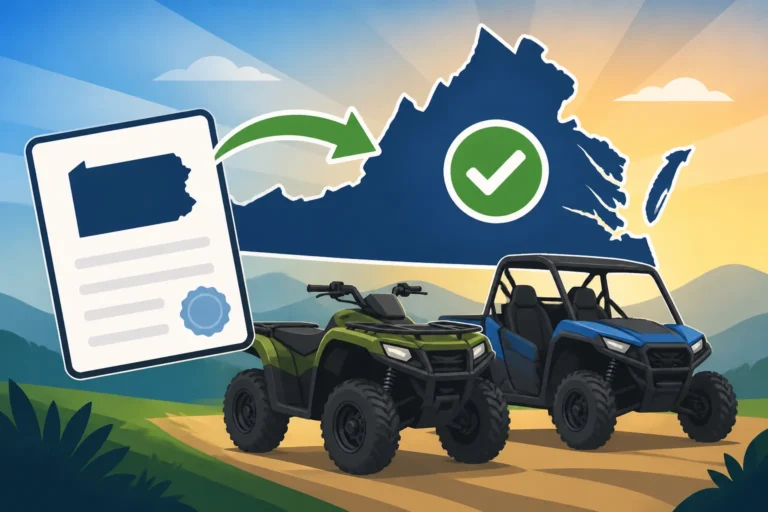
The primary trigger for needing a title in Virginia revolves around when your machine was purchased new and its engine size. If you bought a new ATV or UTV with an engine larger than 50cc after July 1, 2006, then a Virginia title is absolutely required. This isn't an option; it's the law. Imagine buying a brand-new side-by-side in 2007, thinking it's just for the farm, and years later, when you try to sell it, the buyer asks for a title you never obtained. That's a real headache many folks face. The DMV clerks are constantly explaining this [Virginia's July 2006 Titling Cutoff] and [Virginia Titles Required on Machines Over 50cc] to confused owners. They see it all the time: someone brings in a machine bought new just weeks after that cutoff date, unaware of the requirement, and they're sent back to track down old sales records.
For these machines, the manufacturer's statement of origin (MSO) is your golden ticket. It's the birth certificate of your off-road vehicle, proving it's new and hasn't been titled anywhere before. Without it, titling a new machine becomes a much more complicated affair, often requiring additional affidavits or even a court order in extreme cases. So, hold onto that MSO like gold if you're buying new!
Why Titling Matters Even Without Registration
Another head-scratcher for many is why Virginia titles ATVs and UTVs but doesn't register them for road use or issue license plates. This is a crucial distinction that often leads to confusion at the DMV. You'll get a title document, a piece of paper that proves ownership and allows for legal transfer when you sell it, but you won't walk out with a plate or yearly registration stickers. The state wants a clear chain of ownership for these machines, whether for theft prevention, sales tax purposes, or simply to track large assets, but it doesn't want them on public roads. [Virginia Titles ATVs but Never Registers Them] is a topic clerks discuss daily.
Think of it like this: your house has a deed proving ownership, but you don't "register" it annually with the DMV in the same way you do your car. The ATV title serves a similar purpose – a legal document establishing who owns it. This often comes up when people move to Virginia from states with different rules, expecting a full vehicle registration process. They're usually relieved they don't have to deal with yearly inspections or renewed tags, but sometimes disappointed they can't simply take their quad down the street to a friend's house.
Common Titling Scenarios: Private Sales, New Purchases, and More
Most interactions at the DMV regarding ATVs revolve around specific situations, each with its own set of requirements. Knowing these ahead of time can save you a trip or a lengthy wait. From buying a used machine to inheriting one, the nuances can be significant.
Titling After a Private Sale
When you buy an ATV or UTV from a private seller in Virginia, the process depends on whether the machine already has a title. If the seller has a valid Virginia title in their name, it's generally straightforward. The seller simply signs the title over to you, usually in the presence of a notary if there’s an odometer reading section (though ATVs don't typically have them, it’s good practice for clarity). You then take that signed title, along with a bill of sale, to the DMV. [Virginia Titles After a Private Sale] is a common transaction.
However, many used ATVs in Virginia, especially older ones or those bought used, might not have a title. Remember, titling used machines is often optional for the buyer. If you're buying a used quad that was never titled, or was purchased new before the 2006 cutoff, the seller might not have a title to give you. In this case, you'll need a robust bill of sale. Some buyers prefer to create one using a service like LawDepot to ensure all necessary details are included, such as the buyer and seller's names, the machine's VIN, sale price, and date. While Virginia doesn't require you to title a used machine in many cases, if you want one for peace of mind or for financing purposes, you'll need a clear chain of ownership established through a bill of sale or an affidavit. [Virginia Title Without a Bill of Sale] makes things significantly harder, so always insist on solid paperwork.
Titling a New Machine
Bringing a brand-new ATV or UTV home is exciting, but the paperwork is critical. For new machines over 50cc bought after July 1, 2006, you absolutely need to title it. The primary document you'll need is the Manufacturer's Statement of Origin (MSO). This document is issued by the manufacturer and given to the dealer, who then passes it to you. The MSO verifies the machine's origin and that it hasn't been previously titled. It’s like the birth certificate for your vehicle.
Along with the MSO, you'll need a bill of sale from the dealer. This document confirms your purchase, the price, and provides details for calculating Virginia sales tax. If you have a loan on the machine, the lienholder’s information will also be needed so they can be listed on the title. A common mistake clerks see is people showing up with just the sales contract, not realizing the MSO is a separate, vital document. Without that MSO, the DMV cannot issue an initial title for a new machine. It's a key piece of paperwork that dealers are required to provide, so make sure it's in your hands before you leave the dealership. [The MSO You Need to Title a New Quad] is non-negotiable for new purchases.
Titling an Inherited or Gifted Machine
Receiving an ATV or UTV as a gift or through inheritance can be wonderful, but the titling process has its own quirks. If the machine was previously titled, you'll generally need the old title, properly signed over by the executor of the estate or the giver, along with an affidavit of gift or inheritance, such as [Virginia Form VSA 12M Affidavit] or a similar legal document. Many people find templates for these affidavits through legal document services like LawDepot, ensuring they cover all the legal bases. This helps clarify the transfer of ownership without a traditional sale.
When someone shows up with an inherited quad and the original owner passed away without a will, or the title is missing, it becomes a more complex situation. DMV clerks often guide people through the process of obtaining an affidavit from the court or using a specific DMV form for estates. It's not as simple as just saying "my uncle left it to me." You need formal documentation of the transfer of ownership, especially if you intend to title it yourself.
Addressing Specific Challenges: Missing Paperwork and Unique Situations
Life isn't always neat, and sometimes you don't have all the ideal documents. This is where many riders get stuck and turn to the DMV with their unique problems.
When the Title is Missing or Never Existed
One of the most frequent questions DMV clerks hear is, "What if I bought a used quad and the seller didn't have a title?" As mentioned, Virginia makes titling optional for many used ATVs, especially if they were bought before the 2006 cutoff or simply never titled. If you want a title for a used machine that doesn't have one, you'll usually need a bill of sale with the seller's signature and the machine's VIN. If the seller also lost their paperwork, things get tricky. In such cases, a notarized affidavit (like [Virginia Form VSA 12M Affidavit]) attesting to ownership and how the machine was acquired can often serve as a substitute for a missing title or MSO. You can find robust templates for such affidavits on platforms like LawDepot.
Sometimes, people try to title a machine with just a basic handwritten note. While sometimes accepted for very old machines, a detailed bill of sale or affidavit is always better to establish a clear chain of ownership. Clerks often have to explain that simply possessing the ATV isn't enough; the state needs documented proof of how you came to own it. Without a proper paper trail, titling can become nearly impossible, potentially requiring a surety bond or even a court order in complicated situations, which is a path most people want to avoid.
Titling a Side-by-Side or Utility Vehicle
Are side-by-sides (SxS) and utility vehicles (UTVs) treated the same as traditional ATVs for titling purposes? Generally, yes, in Virginia they fall under the same "all-terrain vehicle" definition for titling. This means if your side-by-side or UTV is over 50cc and was purchased new after July 1, 2006, it needs a title, just like a quad. Clerks frequently encounter questions about [Titling a Side-by-Side in Virginia] because their appearance is often more akin to a small car than a traditional ATV, leading to assumptions about different rules.
The main difference lies in how they might be used on private property or for specific agricultural purposes, but for titling purposes, the DMV generally applies the same rules. You'll need the MSO for a new one, or a bill of sale and possibly an affidavit for a used one. It's vital not to confuse the titling rules with potential road-use rules, as UTVs, despite sometimes having features like seatbelts and headlights, are still generally not street-legal in Virginia.
What to Bring and What to Expect at the DMV
Preparing for your DMV visit can make all the difference between a quick transaction and a frustrating ordeal. Knowing exactly what documents to have in hand and what questions to anticipate will save you time and stress.
Essential Documents for Your Visit
To title an ATV or UTV in Virginia, you'll need a collection of specific documents. Regardless of your situation, always bring a valid form of identification, such as your Virginia driver's license. Beyond that, the key documents depend on whether the machine is new or used, and how you acquired it.
For a new machine, always have the Manufacturer's Statement of Origin (MSO) and a detailed bill of sale from the dealer. If you've financed the purchase, bring along your lienholder's information. For a used machine purchased from a private seller, you'll need the properly signed-over previous title (if one exists) or a comprehensive bill of sale. If there's no title and you're applying for one, you might need a notarized affidavit ([Virginia Form VSA 12M Affidavit] is often used for this) detailing how you obtained the machine. Finally, be prepared to pay the [Virginia Title Fee of $15] and any applicable sales tax, which is calculated based on the purchase price or fair market value.
Here’s a quick overview of what you might need:
| Document Type | New Purchase | Private Used (Titled) | Private Used (No Title) | Inherited/Gifted |
|---|---|---|---|---|
| Valid Photo ID | ✅ | ✅ | ✅ | ✅ |
| Manufacturer's Statement of Origin (MSO) | ✅ | ❌ | ❌ | ❌ |
| Bill of Sale | ✅ | ✅ | ✅ | ✅* |
| Signed-Over Title | ❌ | ✅ | ❌ | ✅* |
| Notarized Affidavit (e.g., VSA 12M) | ❌ | ❌ | ✅ | ✅ |
| Proof of Virginia Address | ✅ | ✅ | ✅ | ✅ |
| Lienholder Information | ✅ | ✅* | ✅* | ✅* |
*May be required depending on specifics. For inherited/gifted, a gift affidavit may replace a bill of sale, and the title transfer might be from an estate executor.
Clerks often remind people that having all these documents neatly organized before arriving can significantly speed up the process. A complete folder of paperwork shows you're prepared and helps the clerk process your request efficiently.
Dealing with Virginia Sales Tax
Virginia sales tax is another area that causes questions at the DMV counter. Unlike passenger vehicles, which have a specific vehicle sales tax rate, ATVs and UTVs are generally subject to the standard retail sales tax rate in Virginia. This means if you buy a new machine from a dealer, or title a used machine purchased from a private party, you will typically pay sales tax on the purchase price. The exact percentage can vary slightly by region, so it’s always wise to check the current rates. For example, if you buy a side-by-side from a dealer in Northern Virginia, the sales tax calculation might be slightly different than if you purchased it in a rural part of the state.
DMV clerks are often asked about exemptions, especially for farm use. While there are some [Virginia Agricultural Tax Exemptions] for equipment used directly in agricultural production, it's not a blanket exemption for every utility vehicle used on a farm. You typically need to demonstrate that the machine is primarily and directly used in a farming operation, and specific forms may need to be completed. It's always best to inquire about these exemptions in advance and have supporting documentation ready, rather than assuming your farm machine will automatically bypass sales tax.
What Happens at the Counter
When you present your documents at the DMV, the clerk will review everything meticulously. They'll check your ID, verify the VIN on your paperwork matches the machine (though they don't usually inspect the physical machine), and ensure all signatures are present and correct. If you're applying for a new title, they'll calculate the sales tax due. They'll also record any lienholder information if you have a loan.
Common issues that arise at the counter include incomplete forms, missing signatures, or discrepancies in the bill of sale. For instance, if the VIN on your bill of sale doesn't exactly match the MSO, it can cause a delay. Clerks might also ask you about [Virginia Proof of Address at Titling] to ensure you're a state resident. Once all documentation is approved and fees are paid, you'll usually receive a temporary receipt, and your official title document will be mailed to you within a few weeks. Remember, the goal is to leave the DMV with peace of mind, knowing your ATV or UTV is legally documented in your name.
Disclaimer
This article is for general informational purposes only and does not constitute professional advice. Laws, prices and regulations vary by location and change over time. Consult a qualified professional for guidance on your specific situation.