Trailering Over Appalachian Grades
A trailer that feels manageable on flat roads can behave very differently on a steep Appalachian climb or descent. Tight curves, changing weather, rough access roads, and limited places to turn around can make the drive to a Virginia riding area stressful before the ride even begins. This guide covers how to prepare your tow vehicle, trailer, machine, and route so you can arrive safely and avoid preventable surprises.
Plan the route before you load
Choose a route for the whole rig
A route that works for a car may not work well for a truck towing a long trailer. Mountain roads can narrow without warning, bend sharply around slopes, or lead to a trailhead with little room to turn. Plan for the full length and width of your vehicle-and-trailer combination, not just the road surface.
Start by confirming the exact trailhead entrance and parking area. A route that ends near a trail system may still leave you on the wrong side of a gate, a low clearance, or a steep access road. Look for practical alternatives before setting off, especially if your trailer is wide, long, or heavily loaded.
Apps such as onX Offroad can help you inspect the general area and identify possible roads and trail access points. Treat any digital route as a planning aid, not a guarantee that a road is open, suitable for your trailer, or maintained. Confirm local access information before travel and compare it with official trail-system guidance.
A useful final check is to ask: if the road becomes too narrow or the trailhead lot is full, where can I safely turn around? If you cannot identify a sensible answer, reconsider the approach route before loading.
Check trailhead access and parking
Do not assume that a riding area has room for every type of rig. Some trailheads have limited parking, tight entrances, uneven surfaces, or spaces that work for a truck but not for a truck with a trailer attached. Confirm whether the site allows trailers and whether your machine type is permitted on the trails you plan to ride.
For example, a group heading to a Spearhead system near Grundy may need to think differently about parking and access than a rider using a forest trailhead near Edinburg. The distance from the highway, lot layout, and local road conditions can all change the plan. Check Virginia Trailheads With Trailer Parking and Virginia Trails That Allow Side-by-Sides before committing to a destination.
If you are going with friends, agree on a meeting point that can fit all the trucks and trailers. A small roadside pull-off may look convenient on a map but could be unsafe or unsuitable for a group to gather. Ask the trail office or relevant land manager about parking arrangements when the available information is unclear.
Build a route with a backup
Map the primary route and one reasonable alternative before leaving. Consider where fuel is available, where you can stop without blocking traffic, and whether there is a safe place to take a break after a long climb. Mountain routes can have few convenient options once you are committed to a narrow road.
onX Offroad can be useful for reviewing nearby roads and terrain while you plan. Still, save the information you need before you enter an area with weak service, and avoid making route decisions while driving. A passenger can handle navigation, or you can pull over somewhere safe before checking the map.
Use Virginia ATV Trail Map Downloads as another planning reference when choosing a riding area. Then check Virginia Trail Conditions Before You Haul for the latest practical information available from the trail system. Weather, closures, construction, or seasonal conditions can affect the approach just as much as the trail itself.
Prepare the truck, trailer, and ATV or UTV
Match the trailer to the machine
Before loading, confirm that the trailer is rated for the combined weight of the machines, gear, fuel, and any accessories you are carrying. A UTV can take up more space and weigh more than a compact ATV, particularly when it has a roof, windshield, winch, spare tire, or other equipment installed. Do not rely on appearance or a rough guess when checking capacity.
Also check the tow vehicle’s capacity and the trailer’s tire, axle, and hitch ratings. The weakest component in the towing setup can become the limiting factor. If you are unsure how your loaded rig compares with its ratings, consult the vehicle and trailer documentation or ask a qualified towing professional.
| Item to check | Why it matters on mountain roads | Practical check |
|---|---|---|
| Tow vehicle capacity | Steep climbs and descents put added demands on the vehicle | Compare the loaded trailer weight with the vehicle’s stated limits |
| Trailer tires | Heat, pressure problems, and worn tread can become serious on a long trip | Inspect tread, sidewalls, and pressure before departure |
| Hitch and safety chains | A secure connection matters on rough pavement and uneven access roads | Check attachment points, chain routing, and coupler lock |
| Trailer brakes | Braking demand rises on long or steep descents | Test the brakes and confirm the controller is set correctly |
| Load balance | Poor balance can cause sway or difficult handling | Position machines and gear securely, following trailer guidance |
| Tie-downs | A shifting machine can destabilize the load or damage equipment | Use appropriate restraints and check them again after driving |
Keep the combined load within the ratings for every part of the setup. If you are deciding whether to take a second machine, extra fuel, tools, or camping gear, remember that each addition affects the total. When in doubt, leave unnecessary cargo behind rather than trying to make an overloaded rig work.
Load machines securely and evenly
Load on firm, level ground whenever possible. Use ramps designed for the weight and wheelbase of the machine, secure the ramps against slipping, and have a spotter help if visibility is limited. Keep bystanders clear of the loading path. If the ramp angle is steep or the surface is unstable, stop and find a safer location.
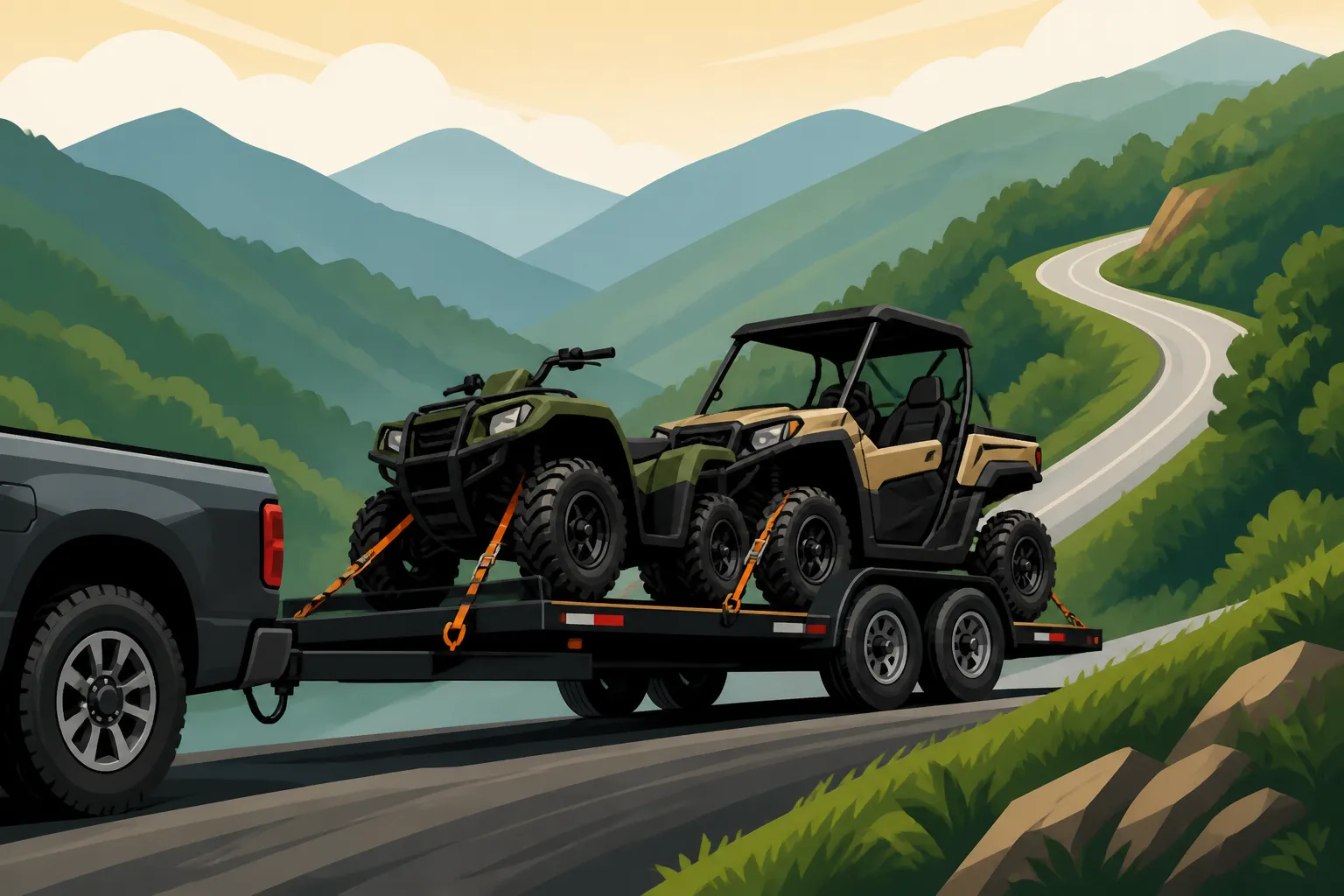
Place machines according to the trailer manufacturer’s guidance and the towing setup’s requirements. Secure each machine at suitable attachment points with restraints intended for hauling. Avoid tying down to parts that can bend, shift, or be damaged under tension. After tightening the straps, check that the suspension and tires are positioned as intended and that the machine cannot roll or rock freely.
Put loose equipment in a secured storage area rather than leaving it on a seat or in an open cargo bed. Helmets, coolers, tools, and spare parts can shift under braking or on rough pavement. Recheck tie-down tension after a short drive, and again during a longer trip when it is safe to stop.
Inspect before a long climb
A careful pre-trip inspection is easier in your driveway than on a narrow mountain shoulder. Check the truck’s tires, lights, mirrors, fluid levels, hitch connection, and trailer plug. Confirm that brake lights and turn signals work on both the tow vehicle and trailer.
Pay special attention to the trailer tires. Look for visible damage, uneven wear, or an underinflated tire, and use the pressure recommended for the tire and load rather than relying on appearance. Make sure the spare is usable and that you have the tools needed to change a tire safely.
Test trailer brakes at low speed in a safe place before joining faster traffic. If the brakes feel uneven, the controller behaves unexpectedly, or the trailer pulls strongly to one side, address the problem before heading into the mountains. A minor issue that is manageable in town can become much harder to handle on a long grade.
Drive mountain grades with control
Climb steadily without forcing the vehicle
On a steep ascent, avoid sudden acceleration and abrupt lane changes. Choose a suitable speed before the climb and leave enough room from the vehicle ahead. If your tow vehicle has a lower gear or a towing mode, use it as described in the vehicle manual.
Do not wait until the engine is struggling to think about your speed or gear. A steady, controlled climb is generally easier to manage than repeatedly speeding up and slowing down. If traffic builds behind you and there is a safe pull-off, use it to let other drivers pass rather than stopping in a place where the rig could be difficult to restart.
Mountain roads in Southwest Virginia can include sharp bends, changing grades, and short stretches where visibility is limited. Keep enough space to react to slow vehicles, road work, fallen debris, or wildlife. On narrow roads, avoid trying to squeeze past another vehicle when the shoulder is soft or drops away.
Control speed on the way down
Long descents can place sustained demand on the vehicle’s brakes. Reduce speed before starting down a steep grade, use an appropriate lower gear when the vehicle manufacturer recommends it, and leave generous following distance. Avoid riding the brakes continuously; if you are unsure how to manage a descent with your particular vehicle, review its towing guidance before the trip.
Watch how the trailer behaves. Sway, unusual pulling, a hot smell, or a change in braking response is a reason to find a safe place to stop and assess the situation. Do not stop on a blind curve or a narrow shoulder simply because it is the nearest spot. If the rig does not feel right, choose the safest available location and get help rather than pushing onward.
On winding roads, keep turns smooth and give the trailer room. A trailer’s wheels track inside the path of the tow vehicle, so a tight turn can bring them close to the edge of the pavement or roadside obstacles. Slow down before the curve rather than braking hard partway through it.
Leave room for mountain conditions
Weather can change quickly in the Appalachian region. Rain may reduce traction on paved roads and make gravel approaches slick; fog can reduce visibility around bends; and colder conditions can affect both road surfaces and tire performance. Give yourself extra time instead of trying to make up time by driving faster.
Pay attention to signs, road work, and local directions. A route that appears straightforward on a screen may include a narrow bridge, a sharp switchback, or a steep unpaved section. If road conditions look unsuitable for your trailer, turn around only where it is safe and legal to do so.
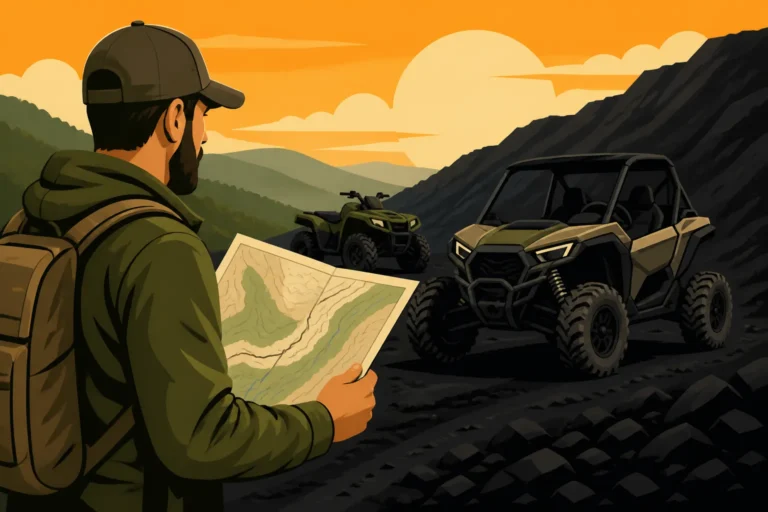
Build the day around daylight when you can. Arriving late can leave you unloading in poor light or trying to find a parking area when other riders are leaving. If you are heading into a remote area, review Cell Dead Zones in the Coalfields and carry useful offline navigation information. A paper backup is also worth considering; Carrying a Paper Map in the Coalfields covers why it can help when a phone loses signal or battery.
Make arrival and unloading part of the plan
Park so you can leave safely
When you reach the trailhead, avoid blocking the entrance, road, emergency access, or other vehicles. Choose a space that allows you to unload without placing ramps or machines in moving traffic. If parking is crowded, ask about another suitable area rather than wedging a trailer into a spot that leaves no room to maneuver.
Whenever possible, park on firm, level ground. A trailer on a slope can be harder to secure and unload safely. Set the parking brake, use wheel chocks when appropriate, and follow your trailer’s instructions before lowering ramps or disconnecting anything.
Agree on an exit plan before the group spreads out. If several trucks and trailers are parked together, identify who needs to leave first and how the vehicles can get out without backing through a crowded lot. A few minutes of coordination can prevent a stressful scramble at the end of the ride.
Unload slowly and deliberately
Clear the area around the trailer before unloading. Check that the ramp is attached and stable, remove anything that could snag a tire, and have a spotter stand where the driver can see them. Do not let people gather behind the machine or stand between the trailer and another vehicle.
Use a controlled speed and avoid sudden steering corrections on the ramp. If the surface is muddy, uneven, or angled, pause and reassess rather than trying to force the machine down. Once unloaded, put ramps and straps away so they do not become trip hazards or get left behind.
Before riding, confirm that every member of the group has the necessary equipment and understands where the group plans to meet if separated. Check the trail system’s rules, permit requirements, and conditions. Virginia Trail Etiquette Locals Expect is a useful reminder that considerate choices at busy trailheads help keep access pleasant for everyone.
Prepare for the return trip
Before loading, look over the machines for mud, loose parts, or damage that could affect transport. Remove or secure anything likely to shake loose, and check that the trailer surface is clear of debris. Load with the same care you used at home, even if everyone is tired and eager to get moving.
Retighten restraints after loading and inspect the hitch, lights, and trailer tires before leaving. Check that the machines and gear are secure, the ramps are stored, and nothing is hanging over the trailer where it could catch wind or strike another vehicle. If the trailer feels different on the road than it did on the trip in, pull over at a safe location and investigate.
Leave extra time for the drive home. Mountain travel can be slower than expected, especially after rain, a busy riding day, or a long stretch of winding road. A calm return plan is part of safe trailering—not an afterthought once the riding is over.
Disclaimer
This article is for general informational purposes only and does not constitute professional advice. Laws, prices and regulations vary by location and change over time. Consult a qualified professional for guidance on your specific situation.