Sharing a Road With Coal Trucks
Riding your ATV or UTV through Virginia's beautiful coalfields offers some of the most exhilarating experiences you can find, but it also brings a unique set of challenges. One of the biggest concerns for many riders is the very real possibility of encountering massive coal trucks on shared mountain roads. These aren't just minor annoyances; they represent a significant safety hazard that demands your full attention and preparation. This guide will walk you through everything you need to know to navigate these encounters safely and confidently, helping you enjoy your ride without unnecessary stress.
Understanding Why You Might Share Roads with Coal Trucks in Virginia
If you've spent any time in the Appalachian regions of Virginia, particularly in the southwest, you know that coal mining is deeply woven into the fabric of these communities. While many trails are purpose-built for off-road recreation, the reality is that the infrastructure often overlaps. What might be a quiet gravel road for you on your quad could also be a vital artery for the local coal industry, especially in counties like Buchanan and Tazewell.
The very nature of these regions means that roads, whether paved or unpaved, often serve multiple purposes. Miners need to get to work, equipment needs to be transported, and, crucially, coal needs to be moved from the mine sites to processing plants or railheads. These are often the same remote, winding, and sometimes unpaved roads that off-road enthusiasts seek out for adventure. It's not uncommon to be on a designated off-road route or a connecting road segment and suddenly find yourself face-to-face with a behemoth hauling a full load. This isn't usually due to illegal riding on your part, but rather the shared landscape of industry and recreation. You'll find that in many of these areas, local ordinances might permit ATV and UTV usage on certain secondary roads, often for short distances to connect trail systems, as outlined in [Virginia ATV Road Rules Under 46.2-915.1].
The Legality and Context of Shared Roads
It's important to understand the legal framework, even if you're not riding directly on a state-maintained highway. Virginia law has very specific provisions for ATV and UTV use on public roads. Generally, these machines are banned from public highways. However, exceptions exist in designated coalfield counties, where local boards of supervisors have the authority to open certain secondary routes. For instance, [Virginia's 25 mph Coalfield Road Limit] applies to these specific sections. These "named routes" are typically well-marked and intended to link parts of larger trail systems like Spearhead Trails. But even on these permitted segments, or on unpaved private roads that allow public access, you're not in an exclusive off-road playground. These are working roads, and large industrial vehicles, including coal trucks, have every right to be there. Understanding this context helps set the right mindset for safe riding. It's not about who should be there, but about safely coexisting with those who are there.
Typical Routes Where Encounters Occur
You're most likely to encounter coal trucks on gravel or unpaved mountain roads that connect larger paved routes to mining operations, or on the designated shared-use roads within and around trail systems like those found within the Spearhead Trails network. Sometimes, these are roads leading to private property where landowners have granted permission for riding. While main roads are primarily for commercial traffic, many secondary routes are not explicitly off-limits to coal trucks just because they're part of an off-road trail system or a general connector route. These trucks operate on tight schedules, often from dawn until dusk, and sometimes even through the night. Riders often assume that if they are on a designated trail or a legal connector, they won't see such heavy traffic. This is a dangerous assumption to make in active mining areas. Even areas like [Virginia Named Routes Open to ATVs] can see coal truck traffic, particularly if the route is also a legitimate access road for a mining operation or timber harvesting.
The Real Dangers of Sharing the Road with Coal Trucks
Let's be blunt: sharing a narrow, winding, and often dusty mountain road with a fully loaded coal truck is incredibly dangerous if you're not prepared. These aren't just big vehicles; they are industrial giants that operate under a very different set of physics than your agile ATV or UTV. The drivers are professional, but they are also navigating challenging terrain with limited visibility and massive inertia.
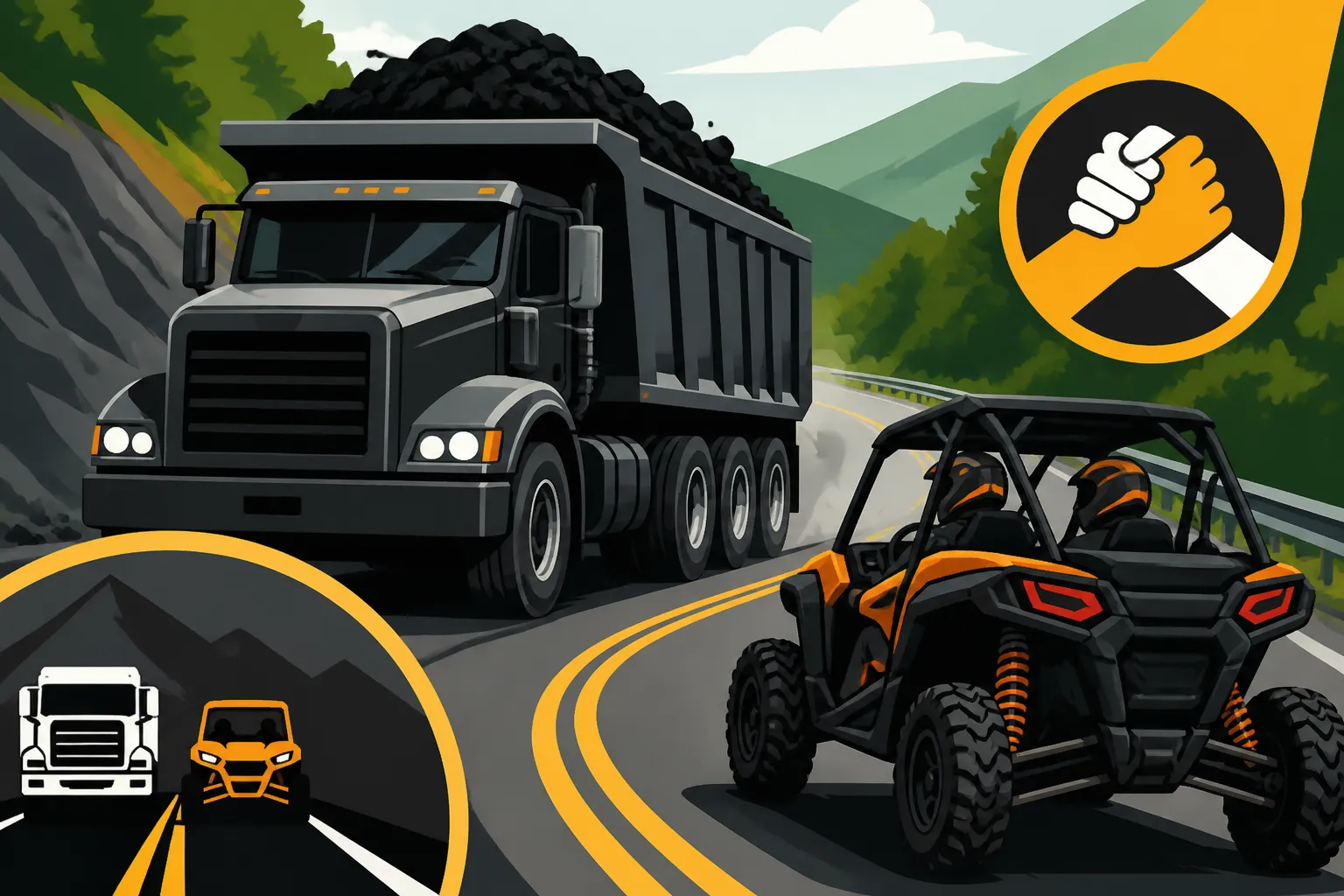
The core problem is the sheer disparity in size, weight, and braking capability. A typical coal truck, loaded, can weigh tens of thousands of pounds, dwarfing even the largest side-by-side. Your ATV or UTV, while capable and fun, is minuscule in comparison. This difference means a coal truck driver might not see you, especially if you're in a blind spot, around a tight curve, or obscured by dust. The consequences of a collision are catastrophic for the ATV or UTV rider.
Size, Weight, and Braking Differences
Consider the physics for a moment. A coal truck, often carrying 40 tons or more, has a massive amount of momentum. It takes a long distance for these trucks to slow down or stop, especially on steep grades or slick surfaces. Your ATV, on the other hand, can stop relatively quickly, but you don't want to rely on that if a truck is coming head-on. If you've ever driven behind a loaded semi-truck on a highway, you know they create substantial air displacement. On a narrow mountain road, that displacement, combined with the sheer bulk of the vehicle, can feel like a gale-force wind pushing your smaller machine around. Even if there's no direct contact, the displaced air can cause a loss of control, particularly for lighter ATVs. This is a critical point that many riders underestimate. It's not just about avoiding a collision; it's about managing the entire environment these trucks create.
Visibility Challenges for Both Drivers and Riders
Visibility is a two-way street, and it's heavily biased against the smaller vehicle. Coal trucks have huge blind spots – to the immediate front, sides, and especially the rear. The driver sits high above the road, which is great for seeing far ahead, but terrible for seeing anything close to the ground, like an ATV or UTV. Add to this the fact that many of these roads are unpaved and produce significant dust, especially in dry conditions. Imagine a coal truck kicking up a cloud of fine, grey dust on a winding road. If you're behind it, your visibility drops to zero instantly. If you're approaching it, the dust cloud can mask your presence until you're dangerously close. [Dust and Blind Corners on a Mountain Gravel Road] are not just scenic challenges; they are serious hazards when sharing the road with heavy machinery. This dust can also get into your machine's air filter and engine, causing wear and tear, but the safety concern is paramount.
Other Environmental Hazards in Coal Country
Beyond the trucks themselves, the roads in coal country often present their own unique dangers. They can be poorly maintained, with deep potholes, washboards, or loose gravel that can challenge your machine's handling. There might be sections of road that are slick with mud or coal dust, especially after rain, making traction unpredictable. The shoulders can be soft or non-existent, leaving little room for error if you need to pull over quickly. Sometimes, heavy machinery other than trucks might be operating adjacent to the road, adding to the industrial feel and the potential for unexpected obstacles. Add in the blind corners that are so common on mountain roads, and you have a recipe for serious trouble if you're not hyper-vigilant. It's crucial to acknowledge that these are not pristine recreational trails; they are active, industrial pathways, and you are a visitor in that environment.
Practical Strategies for Staying Safe Around Coal Trucks
Given the very real dangers, having a solid strategy for encountering coal trucks is not optional; it's essential for your safety. It all boils down to being seen, being prepared, and knowing how to react.
Maximize Your Visibility at All Times
Your number one priority is to make sure you are seen. This means more than just turning on your headlights.
- Wear Bright Colors: Fluorescent or high-visibility clothing (bright orange, yellow, green) can make a huge difference, especially against the natural backdrop of the mountains or in dusty conditions.
- Lights On: Always have your headlights and taillights on, even during the day. Consider adding auxiliary LED lights to the front and rear of your machine, especially if you have an older model or are riding on a particularly dark, shaded road. [Virginia Lighting Rules on a Machine] dictate what's generally accepted.
- Reflective Tape: Apply reflective tape to your helmet, the front, sides, and rear of your ATV or UTV. Products from brands like SuperATV can offer durable and high-visibility options specifically designed for off-road use. This is especially important for [Adding Reflective Tape to a Quad for Road Sections] which can significantly improve your profile to a truck driver, particularly in low light or dusty conditions.
- Flags: A tall, bright orange safety flag, mounted high on your machine, can make you visible over rises and around some corners, giving truck drivers precious extra seconds to react. This is often required in organized riding parks and is a smart move on any shared road.
Defensive Riding Techniques
You need to ride defensively, assuming that every blind corner or rise might have a coal truck coming the other way.
- Slow Down on Blind Corners and Hills: This cannot be stressed enough. Approach every blind corner, crest of a hill, or dip in the road as if a truck is barreling through it. Slow your speed significantly, and be prepared to stop or pull over instantly.
- Stay Right, Stay Alert: Keep as far to the right side of the road as safely possible. Listen for engine braking, air horns, or the rumble of a heavy truck before you see it. These trucks are loud, so use your ears.
- Dust Management: If you see a dust cloud ahead, or a truck passes and kicks up dust, slow down and wait for the dust to settle before proceeding. Riding through thick dust is like riding blindfolded. If you're riding in a group, maintain extra distance to avoid riding in each other's dust.
- Utilize Pull-Offs: If you see or hear a truck approaching from either direction, look for a safe place to pull completely off the road. This might be a wide shoulder, a small clearing, or even just as far off the main track as you can get. Give the truck ample room to pass. Never stop in the middle of the road or on a blind curve.
- Hand Signals: If you're with a group, develop hand signals to communicate an approaching truck quickly.
| Feature | ATV/UTV | Coal Truck | Safety Implication for Shared Roads |
|---|---|---|---|
| Size & Weight | Small, nimble, relatively light | Massive, heavy, high inertia | ATV/UTV is easily overlooked; severe impact risk |
| Visibility (from) | Good forward, limited rear due to gear | Driver high, large blind spots (front, sides) | Truck driver may not see ATV/UTV; ATV/UTV needs to stay out of blind spots |
| Stopping Distance | Short, agile | Very long, especially when loaded or downhill | ATV/UTV must anticipate truck's long stopping distance; avoid sudden moves |
| Speed (on road) | Generally lower, by law often limited (e.g., 25 mph) | Can maintain higher speeds on open stretches; slower on climbs/descents | Truck's speed can close gaps quickly; ATV/UTV needs to yield and give space |
| Dust Generation | Can kick up dust, but less impact | Generates huge, vision-obscuring dust clouds | Dust severely impairs visibility for both; ATV/UTV should stop/wait |
| Road Position | Flexible, can maneuver | Needs full lane width, limited maneuverability | ATV/UTV must hug right side, yield, and find safe pull-offs |
| Noise | Engine noise, but less pervasive | Loud engine, air brakes, rumble | ATV/UTV riders should use ears to detect trucks before seeing them |
Equipment and Maintenance Checks
Your machine's condition directly impacts your safety.
- Brakes: Ensure your brakes are in perfect working order. This is non-negotiable on mountain roads.
- Tires: Check tire pressure and tread. Good tires provide better traction and control, especially on loose gravel or wet surfaces.
- Horn: A working horn is crucial for alerting others to your presence if needed.
- Spark Arrestor: Especially important if riding on forest roads, to prevent fires from sparks, but also indicates a well-maintained exhaust system that won't distract or annoy. You might also encounter [Virginia Equipment Checks by Officers] on certain routes, and having proper gear ensures compliance.
- Fuel: Always carry enough fuel for your intended ride, plus a reserve. Getting stranded in a remote area is dangerous, especially if it's also a truck route.
- Helmet and Eye Protection: While [Virginia Helmet Law Applies to Every Rider] on public roads, it's a basic safety necessity on any trail. Eye protection is critical for keeping dust, rocks, and debris out of your eyes, which can come from passing trucks.
What to Do if an Encounter Goes Wrong
Even with the best preparation, accidents can happen. Knowing what steps to take if something goes wrong is crucial for your safety and for any legal or insurance claims that might follow.
Immediate Actions After an Incident
If you're involved in any kind of incident, whether a near-miss that caused you to lose control or a direct collision, your immediate actions are vital.
- Safety First: First, check yourself and any passengers for injuries. If anyone is hurt, call 911 immediately. Even if you feel fine, report the incident, especially if it involved another vehicle.
- Move to Safety: If possible and safe to do so, move your ATV/UTV off the road to prevent further accidents. If the machine is undrivable, use safety triangles or flares if you have them, and keep clear of the roadway.
- Gather Information: If a coal truck was involved, try to get its company name, truck number, and the driver's name and contact information. Get photos of the scene, your machine, the truck (if applicable), road conditions, and any injuries. Note the time, date, and exact location.
- Do Not Admit Fault: Stick to the facts. Do not apologize or admit fault, even if you think you might have been partly to blame. Let the authorities and insurance companies determine fault.
- Report to Authorities: In Virginia, [Virginia Accident Reporting for an ATV Crash] is crucial, especially if there's injury or significant property damage. Even if it's just a "close call" that scared you or caused minor damage, consider reporting it. This creates a record.
Dealing with Dust and Debris Incidents
Sometimes, an "incident" isn't a collision but rather a dangerous situation caused by a truck, like an enormous dust cloud or thrown rocks.
- Document Everything: If you believe a truck created an unsafe condition (e.g., an excessive dust cloud that caused a whiteout, or throwing significant debris), try to document it safely. This might involve taking a quick photo or video if you can do so without jeopardizing your safety. Note the truck details if possible.
- Report Concerns: If you feel a particular driver or company is consistently creating hazards, you can report it to the company directly or, if it involves a violation of road rules, to local law enforcement or the Virginia Department of Transportation (VDOT) if it's a VDOT-maintained road. Be prepared to provide specific details.
- Check Your Machine: After riding through heavy dust or being hit by debris, inspect your ATV/UTV. Check air filters, engine components, and any visible damage. Regular maintenance and choosing robust aftermarket parts, perhaps from SuperATV, can help your machine withstand the rigors of coalfield riding.
Seeking Help and Understanding Your Rights
Understanding your rights and where to seek help is important.
- Insurance: While [Virginia Requires No ATV Insurance] by law, having a policy that covers property damage and personal injury is incredibly wise, especially when riding in areas where you might encounter large commercial vehicles. Your policy could help cover repairs or medical bills if you're involved in an incident.
- Legal Counsel: If there are injuries or significant damages, consider consulting with an attorney experienced in vehicle accidents. They can help you understand your options and navigate any claims.
- Local Resources: Local ATV clubs and trail organizations often have a wealth of knowledge about specific road conditions, truck routes, and local nuances. They can be invaluable resources for learning about safe riding practices in [Virginia Rules for Riding a County Road] and other shared-use areas.
Sharing the roads with coal trucks in Virginia's mountains is a reality for many off-road enthusiasts. By respecting the power of these industrial machines, maximizing your visibility, riding defensively, and knowing what to do in an emergency, you can significantly reduce your risk and continue to enjoy the incredible riding opportunities the Old Dominion offers. Stay safe out there!
Disclaimer
This article is for general informational purposes only and does not constitute professional advice. Laws, prices and regulations vary by location and change over time. Consult a qualified professional for guidance on your specific situation.