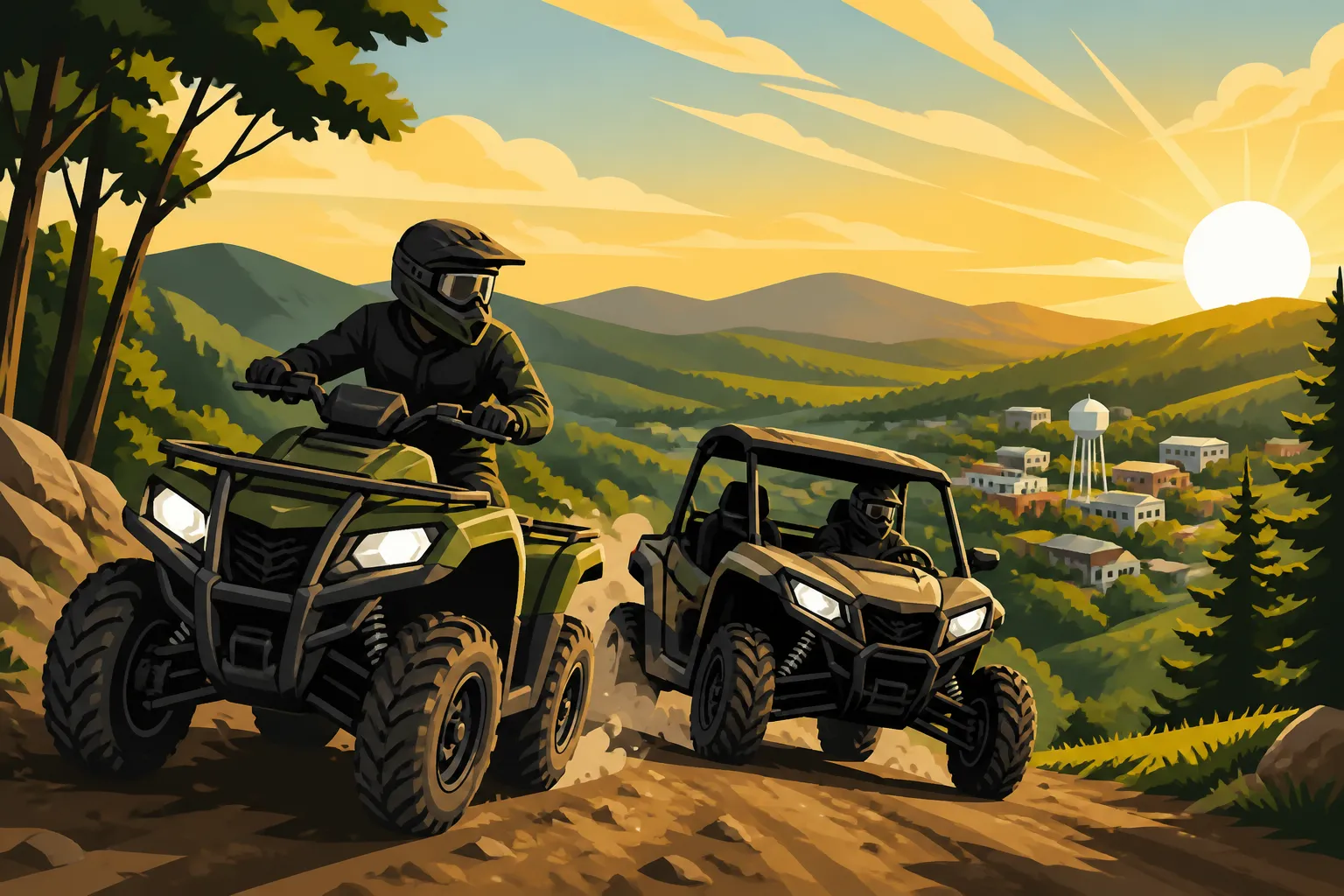
Riding Out of Coeburn
Coeburn makes a useful base for exploring Southwest Virginia’s Spearhead trails, but getting from town to a legal trail entrance is not the same as riding out on public roads. This guide explains how to plan a Coeburn-area ATV or UTV trip, prepare for mountain terrain, check permits and machine rules, and avoid a frustrating arrival with the wrong equipment or paperwork.
Planning an ATV or UTV ride from Coeburn
Know which trail system you are heading to
Coeburn is a practical starting point for riders exploring the Mountain View Trail System, part of the Spearhead Trails network in Southwest Virginia. The system is associated with the Wise and St. Paul area, so plan around the specific trail entrance and route you intend to use—not simply the town name in your navigation app. The broader area includes steep wooded slopes, coalfield terrain, and mountain roads where distances can take longer than they look on a map.
A key detail: “riding out of Coeburn” does not mean you can ride an ATV or UTV from downtown onto the trail network. Virginia generally restricts ATVs from public highways, and a public road that looks like a convenient connector is not automatically open to off-road machines. Arrange to haul your machine to a permitted staging area unless you have confirmed that a particular route is legally open to your vehicle.
Before leaving home, check the current trail-system information for the entrance you plan to use, available routes, closures, machine restrictions, and permit requirements. If your weekend includes a second riding area, confirm that its access rules are separate. For example, Spearhead and Hatfield-McCoy are distinct trail networks, and a permit for one should not be assumed to cover the other. Spearhead Trails in Virginia Explained offers a broader introduction to the network.
Choose a base and plan the logistics
Coeburn can work well as a base for lodging, meals, fuel, and supplies, but build the day around the trailhead rather than assuming everything you need will be available beside it. In the mountains, a short drive on the map can involve winding roads and slower travel. If you are towing, check your route for grades, tight turns, and safe places to maneuver before setting off with a long trailer.
Decide in advance where you will park and unload. Confirm that your chosen staging location allows trailer parking, and make sure your tow vehicle can be left there for the length of your ride. A group arriving in several trucks should settle on a meeting point and arrival time; otherwise, one late trailer can leave everyone waiting in a small lot or roadside pull-off.
For navigation, download or save the route information before you lose reliable service. onX Offroad can help you review off-road routes and keep map information available when cell coverage is spotty, but a mapping app does not determine whether a road is legally open to ATVs. Compare the route on your screen with the trail operator’s current guidance, and bring a backup plan for getting back to your trailer if your phone battery dies.
Get permits, route details, and machine rules sorted out
Confirm permit requirements before the drive
Check the permit rules for the specific Spearhead system you plan to ride, including how permits are purchased, what information you need, and how the permit is shown during a trail check. If permits are digital, save the confirmation where you can access it offline and carry identification that matches the permit details. Don’t wait until you are parked at the trail entrance to find out that you need a login, a waiver, or a working phone signal.
Permit rules can be different at nearby riding areas, even when the trail networks feel like part of the same regional trip. If you are planning multiple days or a cross-border outing, verify each system separately. Virginia Hatfield-McCoy Permits Are Separate explains why riders should not assume one permit works everywhere.
Also check the trail hours and operating rules. Spearhead trail riding is subject to system rules, including posted speed and operating-hour requirements. Those details matter when you are planning a long loop: a route that seems comfortable at midday can become a rushed ride if your group starts late or takes frequent stops. Review 25 mph Across a Network and Sunrise to Sunset on a Coalfield Trail before building your schedule.
Match your machine to the trail
The right ATV or UTV depends on the trails you plan to ride, the passengers you are bringing, and the terrain you are comfortable handling. Mountain routes can include rocky climbs, uneven surfaces, mud, and narrow turns. A larger machine may be comfortable on open sections but harder to maneuver in tight places; a smaller machine may be easier to place precisely but offer less carrying capacity.
For a UTV, check the system’s requirements for its roll cage and seatbelts, and make sure every passenger has a proper seat and working restraint. Do not assume a machine is permitted just because it is sold as an off-road vehicle. Some trail systems restrict self-built machines or impose requirements based on factory equipment. Review Virginia Rules for a Side-by-Side Driver and Spearhead Requires a Factory Cage and Working Seatbelts if you are bringing a UTV.
Use this checklist before loading:
| What to check | Why it matters | What to do |
|---|---|---|
| Trail access and system | Nearby routes may belong to different networks | Confirm the exact trailhead and rules |
| Permit and waiver | Requirements may need to be completed before arrival | Save confirmation offline and bring matching ID |
| Machine eligibility | Width, seating, safety equipment, and machine type can affect access | Check the operator’s current equipment rules |
| Hours and closures | Weather or seasonal conditions may affect a planned loop | Check notices shortly before departure |
| Trailer parking | Not every entrance can accommodate every rig | Confirm parking and unloading arrangements |
| Navigation backup | Cell service can be unreliable in mountain terrain | Save maps and carry a backup plan |
For route research, onX Offroad can be useful for looking over terrain and organizing a ride plan. Still, treat it as a planning aid rather than permission to use every road or trail it displays. If a route’s status is unclear, verify it with the trail operator or the appropriate local office before riding it.
Prepare for mountain terrain and changing conditions
Pack for a longer day than you expect
A ride near Coeburn can take longer than a similar mileage loop on flatter ground. Steep grades, rough surfaces, stops for regrouping, and unfamiliar turns all slow a group down. Start with enough daylight for the route you actually intend to ride, not the fastest time shown by a map. If your group has new riders, children, or passengers, keep the plan flexible and leave room for breaks.
Bring water, snacks, basic first-aid supplies, suitable layers, and rain protection. Weather can feel different on an exposed ridge than it does in town, and a comfortable morning can turn cool or wet during a long outing. Store essentials where they are reachable without unloading half the machine. For a UTV, secure loose items so they do not shift during a climb or spill onto the trail.
Before setting out, inspect tires, brakes, steering, lights, and the machine’s general condition. Carry tools and repair items suited to your vehicle, but do not overload yourself with gear you cannot use. A small group should also agree on what to do if someone has a mechanical issue: who stays with the rider, who contacts help, and whether the rest of the group returns to the trailhead or continues only if it is safe.
Ride within the group’s ability
Mountain trail riding is more enjoyable when riders do not feel pushed to keep up with the most experienced person. Set a pace that works for the least confident rider, and regroup at safe, visible locations rather than around blind corners. On steep or loose sections, leave space between machines so a rider can stop without being crowded from behind.
Be especially cautious when conditions change after rain. Mud can hide rocks and ruts, and water running across a trail can make a familiar section feel different. Avoid damaging soft or saturated ground, and follow any closure notices. If a section looks beyond your group’s skill or your machine’s capability, turning around is a sensible decision—not a failed ride.
Use onX Offroad or another navigation tool to help keep your group oriented, but do not let screen-checking distract the driver. Have a passenger manage navigation where possible, and agree on a simple regroup point if the group gets separated. If a phone is the only map, conserve its battery and consider carrying a portable charger. Virginia Trail Conditions Before You Haul is useful when deciding whether the trip still makes sense after poor weather.
Keep the trip legal and considerate
Do not use public roads as an assumed connector
A common planning mistake is seeing a road between town and a trail area and assuming it is a legal ATV route. Virginia’s rules generally prohibit ATVs on public highways, with only narrow exceptions. A road’s gravel surface, low traffic, or proximity to a trail does not make it open to off-road riding.
Haul your machine to an authorized access point unless you have confirmed that a particular road or segment is legally available to your vehicle. Permission from a private landowner is not a substitute for permission to ride on a public highway, and a route shown on a map does not establish legal access. Virginia Rules for Riding a County Road and Virginia Rules for Riding Private Land explain the distinction between road access and private-land permission.
If you need to cross a road or travel on a named route, check the specific rules and local approvals rather than relying on word of mouth. Conditions can differ by road, county, and trail connector. Virginia Road Access in the Coalfields provides additional context for riders sorting out local access.
Be a good guest in the riding community
Coeburn and the surrounding communities are working towns, not just gateways to the trails. Keep trailers and tow vehicles out of driveways, business entrances, and road shoulders where they could block traffic. Follow posted parking rules, secure your load, and avoid revving or test-driving a machine around residential streets.
On the trail, slow down near other riders, yield where appropriate, and leave room for people to pass safely. Pack out trash, respect closures, and avoid cutting around barriers. Good trail behavior helps protect the riding experience and keeps access from becoming a point of conflict for nearby residents, land managers, and businesses.
Before you leave, check that everyone in the group has the right gear, knows the meeting point, and understands the day’s plan. A little preparation—especially confirming the correct trailhead, permit, and legal route—can prevent the most aggravating kind of trip: arriving in Coeburn ready to ride, only to discover that your machine, paperwork, or access plan does not match the trail system.
Disclaimer
This article is for general informational purposes only and does not constitute professional advice. Laws, prices and regulations vary by location and change over time. Consult a qualified professional for guidance on your specific situation.