Do You Need a License for an ATV in Virginia?
It's a question many of us in the ATV and UTV community in Virginia have pondered, especially if you've moved here from another state or are new to the off-road lifestyle. You might be used to needing a driver's license for just about anything with an engine, so the idea of hopping on a quad without one can feel a bit counterintuitive or even alarming. This guide is here to clear up that confusion, diving deep into Virginia's specific requirements (or lack thereof) when it comes to needing a license to operate your ATV or UTV.
The Core Question: Do You Need a Driver's License for an ATV in Virginia?
Let's cut right to the chase because this is usually the first thing on everyone's mind: no, you do not need a standard driver's license to operate an ATV or UTV in Virginia. This often surprises people, especially those who equate any motorized vehicle with needing a license. The Virginia Department of Motor Vehicles (DMV) defines ATVs and UTVs in a way that separates them from traditional motor vehicles that require street registration and, by extension, a driver's license for operation on public roads.
Think about it this way: your ATV or side-by-side is built for off-road adventures, not for cruising down Main Street. Because they aren't designed or permitted for public highway use (with very, very specific and limited exceptions we'll get into), the state doesn't require you to hold a traditional driver's license to ride them on private land or designated off-road trails. This is a huge relief for many riders, especially younger ones or those who might not have a street-legal driver's license but are perfectly capable and responsible off-road operators. It's a key distinction that shapes much of Virginia's ATV legislation.
Virginia's Vehicle Definitions and Off-Road Status
Virginia's legal framework clearly distinguishes between "motor vehicles" intended for highway use and "all-terrain vehicles" (ATVs) or "utility vehicles" (UTVs). While a car, truck, or motorcycle falls under the motor vehicle category and absolutely requires a licensed driver, ATVs and UTVs are classified as off-road recreational vehicles. This distinction is fundamental to understanding why a driver's license isn't mandated. The state titles ATVs, but they are never registered for road use, meaning no license plate is issued, and therefore, no driver's license is required for their primary intended use.
This legislative carve-out acknowledges the distinct nature of off-road riding. You might use heavy-duty axles or lift kits from a company like SuperATV to tackle more aggressive terrain, which further emphasizes that these machines are built for environments far removed from paved roads. The regulations are tailored to these specific uses, focusing more on rider safety and responsible operation within off-road settings rather than traditional driving credentials. It's about where you're riding, not just what you're riding, that dictates the licensing rules.
Why No Driver's License is Required for Off-Road Use
The simple answer here lies in the core purpose of a driver's license. A driver's license certifies that you have demonstrated proficiency in operating a motor vehicle safely on public roads and understand traffic laws. Since ATVs and UTVs are generally prohibited from public roads in Virginia, the need for a license proving those skills becomes irrelevant for their typical use.
Instead, Virginia's focus shifts to other safety measures when it comes to off-road machines. Think about age restrictions (which we'll discuss in detail shortly) or mandatory helmet laws. These are designed to protect riders in their natural element: the trails, the fields, and the private properties where these machines thrive. If you're on your own private land, for example, the state isn't going to demand you have a driver's license to ride your quad. The emphasis is on safe operation, not licensed driving, because the public road system and its inherent dangers are largely excluded from the ATV experience. It's a practical approach that acknowledges the different risks and environments involved.
Understanding Virginia's ATV Riding Rules
Even though a driver's license isn't generally required, that doesn't mean it's a free-for-all out there. Virginia has a robust set of rules governing ATV and UTV operation, designed to keep riders safe and prevent accidents. These rules cover everything from who can ride what machine to where you can actually take your quad. Ignoring these can lead to fines, impoundment, and even serious injury.
It's tempting to think that since you're off-road, the rules are lax, but that's a dangerous misconception. Virginia takes off-road safety seriously, particularly concerning younger riders and the use of protective gear. These regulations are often found in the Virginia Code under sections related to ATVs and off-road vehicles, distinct from general motor vehicle laws. Knowing these rules is far more important than worrying about a driver's license when you're out on the trails.
Age Limits by Engine Size
This is a critical area where Virginia does impose restrictions, and it's all about rider safety and matching the machine's power to the rider's experience. It's not about a driver's license, but rather an age-based suitability for operating different classes of machines.
- Riders under 12 years old: If you're under the age of 12, you are restricted to operating an ATV with an engine size of 70cc or less. This is a strict rule designed to prevent young children from handling machines that are too heavy or powerful for their developing strength, coordination, and judgment. A child on a machine that's too big is a recipe for disaster, no matter how supervised they are. [Virginia Riders Under 12 and 70cc]
- Riders between 12 and 16 years old: Once a rider reaches 12, they can step up a bit. From 12 up to their 16th birthday, riders can operate ATVs with engine sizes of 90cc or less. This incremental increase acknowledges growing physical capabilities and maturity. It's still a controlled progression, recognizing that teenagers are still learning and developing. [Virginia Riders 12 to 16 and 90cc]
- Riders 16 years old and over: At 16, the engine size restriction is lifted. Riders 16 and older can operate ATVs of any engine size. This aligns with the general age of gaining more independence and, in many cases, obtaining a driver's license for street vehicles, even though that license isn't required for the ATV itself. [Virginia Riders 16 and Over]
These age and engine size rules are non-negotiable and are enforced to ensure a safer riding environment for everyone. It's a common point of citation for law enforcement, so always make sure your young riders are on appropriately sized machines.
The Mandatory Helmet Law
Virginia has a very clear and emphatic helmet law for ATV riders, and it applies to everyone, regardless of age. This isn't a suggestion; it's the law. Whether you're 8 or 80, if you're riding an ATV in Virginia, your head needs to be protected.
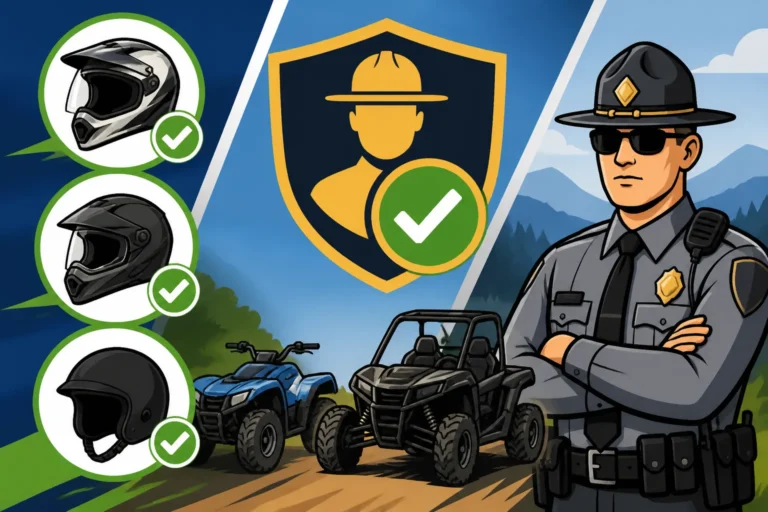
The law states that "any person who operates or rides an all-terrain vehicle shall wear a protective helmet." This includes passengers, too, if the ATV is designed to carry one. This helmet must meet the standards and specifications developed by the Superintendent of State Police. While the law doesn't get into specifics about brands, it generally means helmets that are DOT (Department of Transportation) approved. You can find many great options from reputable brands that meet these standards, ensuring you're both compliant and safe. A quality helmet is one of the best investments you can make, protecting against head injuries that could drastically alter a life. [Virginia ATV Helmet Law Explained]
Many riders, especially adults on private land, sometimes assume this rule doesn't apply to them. That's a dangerous assumption. Even on your own property, a helmet is legally required and, more importantly, a critical piece of safety gear. A simple tip-over can lead to a severe head injury, and a helmet significantly reduces that risk. Don't skip it, even for a short ride.
Rules for Riding on Private Land and Designated Trails
While a driver's license isn't needed, where you ride is heavily regulated. The general rule of thumb in Virginia is that ATVs and UTVs are for private land or designated off-road trail systems.
- Private Land: If you're riding on your own property, you're usually good to go, provided you follow the age and helmet rules. If you're riding on someone else's private property, you absolutely must have written consent from the landowner. Verbal permission isn't enough in the eyes of the law; you need something in writing to prove you're not trespassing. This protects both you and the landowner. [Virginia Written Consent on Private Land]
- Designated Trail Systems: Virginia is home to some fantastic trail systems, like the Spearhead Trails in the coalfields, or the Peters Mill Run OHV Trail in the George Washington National Forest. These are specific, permitted areas where ATVs and UTVs are welcome. You'll often need a permit to ride on these trails, which is different from a driver's license. [Spearhead Trails in Virginia Explained] These trails have their own sets of rules, including speed limits, width restrictions, and even specific equipment requirements (like spark arresters) that you need to be aware of. It's always best to check the specific trail system's rules before you head out.
- Public Highways and Public Property: Here's where it gets tricky and where many riders run into trouble. With extremely limited exceptions (which mainly apply to law enforcement, emergency personnel, or specific agricultural uses), ATVs and UTVs are banned from public highways and roads in Virginia. This includes shoulders, ditches, and any part of the public right-of-way. It also generally extends to other public properties like state parks (which ban ATVs) or school grounds. [Virginia Bans ATVs on Public Highways] This is a crucial rule to remember, as violations can result in significant civil penalties and even impoundment of your machine. There are very specific and rare exceptions for crossing a highway directly, but this must be done by the most direct route and only when safe. [Virginia Crossings by the Most Direct Route]
When Other Licenses or Permits Come Into Play
So, while a driver's license isn't generally on the list, there are other pieces of paper and forms of identification you'll need depending on where and how you ride. These aren't about proving you can drive a car, but about proving you have permission to access specific areas or that you meet certain operational criteria. It's vital to differentiate these from a typical driver's license requirement.
Trail System Permits
If you plan on riding Virginia's fantastic network of public off-road trails, like those managed by the Spearhead Trails authority or in national forests, you will almost certainly need a permit. These permits are essentially your ticket to ride.
- Spearhead Trails Permits: The Spearhead Trails systems, such as Coal Canyon, Mountain View, and Jawbone, require a permit. You can purchase these as annual permits or multi-day permits. They are typically digital, linked to your identity, and trail rangers will check them on the trail. [Virginia Spearhead Trail Permits] These permits are crucial for funding trail maintenance, development, and ensuring rider safety. When you purchase one, you'll likely need a photo ID for verification, and if you're a county resident in one of the participating counties, you might even get a discount. Companies like SuperATV, who supply aftermarket parts and accessories, thrive on the existence of these well-maintained trail systems, highlighting the importance of supporting them through permit purchases.
- National Forest OHV Permits: If you're heading to federal lands, like Peters Mill Run in the George Washington National Forest, you'll need a different type of permit. These are often daily, multi-day, or annual permits specific to the National Forest system. [Virginia National Forest OHV Permits] These permits help cover the costs of maintaining these federal recreation areas. Like Spearhead, these systems will have their own specific rules you'll need to follow, and rangers will be checking for valid permits. It's a good idea to purchase these permits ahead of time, as kiosks at trailheads aren't always available.
These permits are about managing access and resources, not about your driving ability. Think of it like a fishing license – it's permission to do an activity, not proof of driving skill.
Hunter Safety & Fishing Licenses (Contextual Use)
While not directly related to operating the ATV itself, if you're using your ATV for hunting or fishing, you'll need the appropriate licenses for those activities. In many parts of Virginia, especially in the more rural, mountainous regions, ATVs and UTVs are invaluable tools for accessing remote hunting grounds or fishing spots.
You might be using your quad to haul gear, recover game, or simply get to your treestand faster. In these scenarios, while the ATV doesn't require a driver's license, your hunting license or fishing license is absolutely mandatory, and you must adhere to all game laws. Operating an ATV without a driver's license is fine, but hunting without a hunting license is a serious offense. Remember, just because you can legally ride your ATV to a remote area doesn't mean you can legally hunt or fish there without the proper documentation and adherence to season dates and bag limits.
When Your Driver's License Might Matter
There are very specific and rare instances where holding a driver's license could become relevant, even if not directly required for the ATV itself.
- Operating on Limited Public Road Exceptions: As mentioned, Virginia generally bans ATVs from public roads. However, there are extremely narrow exceptions. For instance, in Buchanan and Tazewell counties, specific routes have been designated for ATV use under certain conditions, including time of day, speed limits (25 mph), and a maximum distance (one mile) to connect trails. Even in these limited cases, while the statute doesn't explicitly demand a driver's license for the ATV, an officer might inquire about your general driving eligibility, especially if there's any perceived reckless operation. [Virginia Buchanan and Tazewell County Road Access] Furthermore, if you are driving your truck and trailer, loaded with your SuperATV-modified side-by-side, to a trailhead, you absolutely need a valid driver's license for the truck!
- Proof of Identity: While not a driver's license requirement, you'll almost always need a valid form of photo identification (like a state-issued ID card or a driver's license) when purchasing trail permits, interacting with law enforcement, or proving your age if questioned about machine size restrictions. So, while the license isn't for the ATV, having a government-issued ID is still a practical necessity for many aspects of the sport.
Common Misconceptions and What to Do
The lack of a driver's license requirement for ATVs in Virginia can be confusing, especially with rules varying so much from state to state. Let's tackle some of the common misunderstandings and clarify what you should always do to stay safe and legal.
It's easy to get information from friends, or even online forums, that might not be entirely accurate or apply to Virginia's specific laws. Always refer to official sources like the Virginia Code or the DMV website for the most up-to-date and accurate information. When in doubt, it's better to err on the side of caution.
"If I Have a License, I Can Ride Anywhere"
This is a big misconception. Even if you're a licensed driver, it doesn't grant you permission to ride your ATV or UTV on public roads or private property without consent. Your driver's license is for operating street-legal vehicles on public roads, not for off-road machines.
The rules about where you can ride your ATV are entirely separate from your driving credentials. A valid driver's license won't protect you from a ticket if you're caught riding your quad down a state highway or trespassing on someone's land. The primary legal restriction for ATVs and UTVs in Virginia isn't who's driving, but where they're driving. Always remember the distinction: licensed to drive a car on the road, permitted to ride an ATV off-road.
"It's Just My Backyard, I Don't Need a Helmet or to Follow Age Rules"
Another dangerous assumption! Virginia's helmet law explicitly states "any person who operates or rides an all-terrain vehicle shall wear a protective helmet." It makes no exceptions for private property. The age limits by engine size also apply universally. This isn't about property rights; it's about public safety and preventing injuries.
Even if you're on your own property, a severe injury to a minor on an oversized ATV, or an adult without a helmet, could still lead to legal scrutiny, especially if it involves emergency services or prolonged medical care. The spirit of these laws is to protect riders from themselves and the inherent risks of off-road riding, no matter the location. Equipping your machine with safety accessories, perhaps even an enhanced roll cage from SuperATV if you have a UTV, is great, but it doesn't negate the helmet requirement.
What to Always Carry While Riding
Even without a driver's license requirement, it's smart to carry a few key items whenever you ride:
- Photo Identification: While not always legally required for the ATV itself, having a valid photo ID (like your state ID card or driver's license) is crucial for proving your identity and age, especially if a trail ranger or law enforcement officer stops you.
- Proof of Ownership: Carry a copy of your ATV's title. [Virginia Titles ATVs but Never Registers Them] This proves you're the rightful owner, which can be important if your machine is stolen, impounded, or if you're questioned about its origins. Many riders will keep a laminated copy on the machine or carry it in a waterproof bag.
- Written Landowner Consent: If you're riding on private land that isn't yours, always have the written consent from the landowner with you. This can save you a lot of hassle and potential trespassing charges.
- Trail Permits: If you're on a designated trail system, make sure you have your current permit, whether it's a physical pass or a digital confirmation on your phone. Have it readily accessible.
- Emergency Contact Information: In case of an accident, having your emergency contacts and any critical medical information readily available (perhaps in your helmet or a waterproof pouch) can be life-saving.
| Requirement/Document | Generally Needed for ATV Operation? | Reason | Exceptions/Nuances |
|---|---|---|---|
| Driver's License | No | ATVs are off-road vehicles, not street-legal. | Needed for tow vehicle. May be requested as ID. Very limited road use exceptions (e.g., Buchanan/Tazewell). |
| Protective Helmet | Yes | Mandatory for all riders, all ages, all locations (public/private). | No exceptions. Must meet State Police standards (e.g., DOT approved). |
| Age-Appropriate Machine | Yes | Limits based on engine size (70cc for <12, 90cc for 12-16). | Applies universally. |
| Written Landowner Consent | Yes (on private land not yours) | Required to avoid trespassing charges. Verbal not sufficient. | Not needed on your own land or designated public trails. |
| Trail Permits | Yes (on designated trails) | Funds maintenance, ensures access to Spearhead or National Forest trails. | Not needed on private land or undesignated areas. |
| Proof of Ownership (Title) | Recommended | Proves rightful ownership, useful for law enforcement or disputes. | Virginia titles ATVs but never registers them for road use. [Virginia Titles ATVs but Never Registers Them] |
| Hunting/Fishing Licenses | Yes (if applicable) | Required for legal hunting/fishing activity. | Separate from ATV operation rules. |
This comprehensive look should help clarify the nuances of ATV and UTV operation in Virginia regarding licensing. While a driver's license isn't generally a barrier, understanding and adhering to the other, equally important, regulations is absolutely essential for safe and legal riding.
Disclaimer
This article is for general informational purposes only and does not constitute professional advice. Laws, prices and regulations vary by location and change over time. Consult a qualified professional for guidance on your specific situation.