Virginia Daylight Hours on a Road Trail
There’s nothing quite like the feeling of hitting the trails on your ATV or UTV, especially when those trails weave through the stunning landscapes of Virginia. But if you’ve ever wondered about taking a shortcut or connecting trails via a public road, you’ve likely stumbled into a maze of rules that can leave any rider scratching their head. This guide is here to clear up the confusion, specifically tackling the critical question of when – and for how long – you can legally ride your off-road machine on designated road trails in the Commonwealth, focusing squarely on those crucial daylight hours.
Understanding Virginia's Road Access for ATVs and UTVs
For many riders in Virginia, the dream of seamlessly connecting trails or accessing a convenience store on their ATV or UTV is a common one. However, the reality is far more restrictive than many hope. Virginia law generally keeps off-road machines off public roads, and for good reason: these machines aren't designed for the same safety standards as street-legal vehicles, and mixing them with cars and trucks can be incredibly dangerous.
The General Ban on Public Highways
Let's get this straight from the start: Virginia has a pretty firm stance against ATVs and UTVs on public highways. This isn't just about interstates; it applies to most paved and even unpaved public roads throughout the state. The law is designed to protect both the off-road riders and the general motoring public. Imagine the chaos and danger if powerful, high-clearance machines designed for dirt and rocks were suddenly zipping alongside sedans and tractor-trailers on busy routes. It's a risk Virginia isn't willing to take, which is why [Virginia Bans ATVs on Public Highways] is a fundamental rule here.
This broad prohibition often catches new riders or those visiting from other states by surprise, especially if they're used to more lenient rules elsewhere. It means you can't just hop on your quad and ride it down to the gas station or across town, even if it feels like a short, harmless trip. Violating this rule can lead to significant penalties, not to mention the potential for accidents. Always assume public roads are off-limits unless explicitly stated otherwise by specific, limited exceptions.
Limited Exceptions in Specific Coalfield Counties
While the general ban is strict, Virginia does offer a few very specific and highly localized exceptions, primarily in the southwestern coalfield counties. These exceptions aren't carte blanche for all roads; rather, they apply to specially designated "road trails" or sections of county roads that have been explicitly opened by local county boards of supervisors. These areas are usually part of larger trail systems like Spearhead Trails, designed to enhance recreation and connect communities that rely on off-road tourism.
The counties of Buchanan and Tazewell are the primary examples where you'll find these unique allowances. Their respective boards of supervisors have passed ordinances to open certain secondary highways and designated routes for ATV and UTV use, but under very strict conditions. This isn't just a casual decision; it's a careful balancing act to provide economic benefit while trying to maintain safety. Riders need to be incredibly vigilant about understanding precisely which roads are open and the specific rules that govern them, as these routes are few and far between. You can find more details in [Virginia Buchanan and Tazewell County Road Access].
The Role of Local Ordinances in Opening Roads
It's crucial to understand that these limited road access points aren't statewide mandates; they are the result of local county decisions. The Code of Virginia allows counties to pass ordinances to open these secondary highways, but they must meet specific criteria, including signage requirements and strict operating conditions. This means that a road that's open in Buchanan County might be completely illegal to ride on in a neighboring county that hasn't passed a similar ordinance.
Therefore, before you ever consider riding on what appears to be a public road, you must research the specific local ordinances for that area. Relying on what "looks" like an open road or what someone "told you" is a recipe for trouble. Always check official sources, like the county's government website or the Spearhead Trails system information, to confirm the legality of any road section. This diligent research ensures you're not inadvertently breaking the law and facing fines or even impoundment of your machine.
The Strict Rule: Riding Only During Daylight Hours
Now that we've established where you might be able to ride your ATV or UTV on a public road in Virginia, let's talk about when. This is arguably the most critical restriction for designated road trails: you can only ride during daylight hours. This isn't a suggestion; it's a non-negotiable legal requirement written into the specific allowances for these machines.
Why "Daylight Hours" Are Defined So Strictly
The restriction to "daylight hours" isn't arbitrary. It's a direct safety measure. ATVs and UTVs, even those equipped with robust aftermarket lighting, are generally not designed with the same visibility standards as conventional street-legal vehicles. Their smaller profiles, different headlight beam patterns, and lack of extensive reflective surfaces make them inherently less visible to other motorists, especially at dawn, dusk, or night. Headlights on an ATV might be great for seeing the trail ahead, but they don't always project the wide, unmistakable presence of a car or truck to oncoming traffic.
Furthermore, driving conditions on these designated road trails, particularly in the coalfield regions, can be challenging even during the day. Many of these roads are narrow, winding, unpaved, and shared with heavy industrial traffic like coal trucks, creating dust and limited sightlines. Adding darkness or low light conditions to this mix would dramatically increase the risk of collisions. The rule for [Daylight Only on a Road Trail] is a clear directive aimed at minimizing these dangers for everyone.
Consequences of Riding After Sunset or Before Sunrise
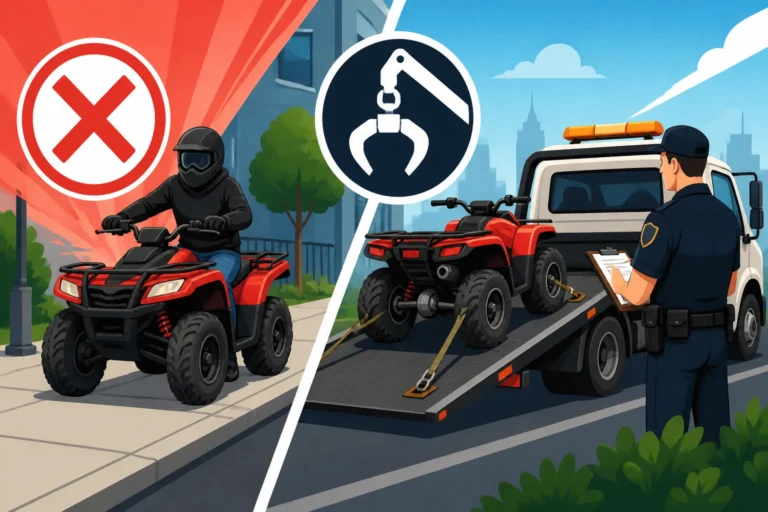
Riding an ATV or UTV on a designated road trail in Virginia outside of daylight hours is a violation of the law, and the consequences can be significant. It's not just a slap on the wrist. You could face a substantial civil penalty, which can reach up to $500 for a single offense. This financial hit doesn't even account for potential court costs, which can quickly add up. Beyond the fine, an officer has the authority to issue a citation, and in some circumstances, your machine could even be impounded, leading to additional fees for towing and storage.
Imagine you're wrapping up a great day of riding on the Spearhead Trails, and you're just a mile from your truck on a designated road trail when the sun dips below the horizon. That last mile, which seemed so harmless, can quickly turn into a costly mistake. Law enforcement officers in these areas are well aware of these rules and will enforce them to ensure public safety. It’s a harsh lesson to learn when your day of fun ends with a ticket and the hassle of retrieving your machine. Learn more about this in [Virginia Penalties for Illegal Riding].
Practical Implications for Planning Your Ride
Understanding the "daylight hours" rule has major practical implications for how you plan your ATV or UTV excursions. First and foremost, you need to be acutely aware of sunrise and sunset times, especially if you're riding in mountainous terrain where light can fade faster as the sun drops behind ridges. Always build in a significant buffer. Don't plan to be on any road section right at sunset; aim to be off those sections well before it, giving yourself ample time to reach your destination or load up your machine.
It also means that those late-night rides or early morning starts, while perhaps appealing for avoiding crowds or enjoying cooler temperatures, are simply not an option on Virginia's designated road trails. Your riding day is strictly bounded by the sun. When mapping out your routes, consider the total mileage and estimated riding time, factor in breaks, and always keep an eye on the clock. It's far better to cut a ride short than to risk a fine by being on a public road after hours. For example, if you know you'll be on a section that has [Virginia's 25 mph Coalfield Road Limit], factor that into your time calculations.
Navigating Approved Road Trails and Designated Routes
Riding legally on any public road in Virginia with an ATV or UTV is a privilege, not a right, and it comes with very specific responsibilities. When you're on these approved road trails, you're sharing the space with other vehicles, local residents, and potentially wildlife. Knowing exactly where you can go and what's expected of you is paramount for a safe and enjoyable experience.
Identifying Legally Opened Roads in Buchanan and Tazewell
As mentioned, the primary locations for legally opened road trails are within Buchanan and Tazewell counties. These are not just any roads; they are specific routes that have been evaluated and designated by local authorities. The best way to identify these is through official sources, such as the Spearhead Trails website or maps provided by the counties themselves. These resources typically highlight the specific segments of roads that are open for ATV/UTV use and often provide important details about operating hours and other regulations.
For example, the [Virginia's Named Route in Buchanan County] or [Virginia's Named Route in Tazewell County] are precise designations. You won't find generic "county road" access; it's always specific to a route number or name. These routes are usually marked with distinct signage, indicating that ATVs and UTVs are permitted. Always look for these official signs, and if you don't see them, assume the road is off-limits. Never rely on unofficial maps or hearsay when it comes to navigating these legal grey areas.
Specific Conditions for Road Trail Use Beyond Time
Beyond the strict daylight hours rule, there are other crucial conditions for riding on these designated road trails. Riders are generally required to obey all traffic laws, just like any other vehicle. This includes observing speed limits, which are often lower for ATVs and UTVs, typically around [Virginia's 25 mph Coalfield Road Limit]. You must also yield to oncoming traffic, use turn signals (if equipped and functional), and stop at stop signs. Remember, these are not private trails; they are shared public thoroughfares.
Additionally, many of these road trails have specific requirements for how you operate your machine. For instance, some may specify that you can only cross numbered state routes by the most direct route and only after stopping and yielding to all traffic. [Virginia Crossings by the Most Direct Route] is a perfect example of such a stipulation. These aren't minor suggestions; they are legal requirements designed to minimize accidents and ensure a smooth flow of traffic for everyone. Always treat these road sections with the utmost respect and caution.
Essential Safety Gear and Lighting for Day Riding
Even though you're limited to daylight hours, wearing appropriate safety gear is non-negotiable. Virginia law requires all ATV and UTV riders, regardless of age or where they are riding, to wear a helmet. This is a fundamental safety rule that applies to every single person on the machine. Beyond a helmet, sturdy eye protection, long sleeves, long pants, gloves, and over-the-ankle boots are highly recommended. This gear protects you from unexpected hazards, whether it's a low-hanging branch on a trail or debris kicked up on a gravel road.
While you're not riding at night, functional lights are still essential. Your machine must have working headlights and taillights, even during the day, as these can significantly improve your visibility to other drivers, especially on dusty or winding roads. If you're looking for upgrades, many riders turn to brands like SuperATV for enhanced lighting options, like LED light bars, that can make your machine more conspicuous during the day. Even in full daylight, the brighter your machine is, the safer you'll be, especially on roads shared with heavy equipment.
What to Do If You Encounter an Officer After Dark
Despite all the planning and precautions, mistakes can happen, or circumstances might lead you to be on a designated road trail just as daylight fades. Knowing how to react if you encounter law enforcement after hours can significantly impact the outcome of the interaction. The key is to remain calm, respectful, and prepared.
Understanding Virginia's Civil Penalty System
It's important to remember that most ATV-related violations in Virginia, particularly those related to road use, are civil penalties, not criminal charges. This means you're generally looking at a fine rather than a criminal record. However, "civil" doesn't mean "minor." As noted, the penalties can be steep, up to $500. When an officer pulls you over, they are not acting maliciously; they are enforcing a law designed for public safety. Your best approach is always cooperation.
If an officer stops you, pull over safely, turn off your engine, and keep your hands visible. Present any required documentation, such as your identification and proof of ownership. Do not argue or become confrontational. Explain your situation calmly and truthfully. While you might still receive a citation, a respectful interaction can sometimes lead to a more understanding discussion, even if the law still needs to be enforced. Being familiar with [Virginia Penalties for Illegal Riding] will also help you understand the gravity of the situation.
Documenting Your Ride and Intentions
While it won't necessarily excuse a violation, having a clear understanding of your planned route and why you were on a particular road can sometimes be helpful. If you genuinely misjudged the time or encountered an unexpected delay, politely explain that to the officer. Having a map, either physical or on your phone (if you have signal), that shows the designated road trails and your intended path, can demonstrate that you were trying to comply with the rules.
Additionally, keeping track of official sunrise/sunset times for the specific day and location can be useful. If you were truly just on the cusp of daylight fading, this information might support your account. However, this is not a guaranteed defense. The law is often quite clear: if it's not daylight, you shouldn't be on the road trail. The emphasis should always be on preventative planning to avoid being in this situation in the first place, rather than trying to explain it away after the fact.
The Importance of Knowing the Local Rules
The absolute best defense against a citation for riding outside daylight hours is comprehensive knowledge of the local rules. Before you ever haul your machine to a new riding area, especially one with designated road access, spend time researching. Understand the specific ordinances for Buchanan and Tazewell counties, know the exact routes that are open, and commit to memory the daylight-only restriction.
If you have questions, contact the Spearhead Trails office or the relevant county's sheriff's department for clarification before you ride. Ignorance of the law is not a valid excuse, and you'll be held accountable for knowing and following the regulations. This diligence is not just about avoiding fines; it’s about ensuring the safety of yourself, other riders, and the public, helping to preserve the limited access that has been granted for off-road enthusiasts in these areas. You can also consult resources like [Virginia Rules for Riding a County Road] for further guidance.
Equipping Your Machine for Virginia's Road Trails
Preparing your ATV or UTV for riding on Virginia’s designated road trails involves more than just filling the gas tank. While these machines are built for rugged terrain, the specific demands of sharing roads with other vehicles, even briefly, require careful attention to legality, safety, and visibility.
Essential Accessories for Legality and Safety
First and foremost, ensure your machine meets basic safety and operational requirements. This includes functional headlights, taillights, and brake lights. While some machines come with basic lighting, consider upgrading, especially if you plan to be on road sections frequently. Aftermarket LED lights from companies like SuperATV can provide significantly brighter illumination, improving both your ability to see and, more importantly, be seen by others. A working horn is also essential for signaling, much like on a street-legal vehicle.
Beyond lighting, effective mirrors are crucial. While not always strictly mandated for off-road use, side mirrors are vital for situational awareness when sharing a road. They allow you to monitor traffic behind and to the sides, preventing sudden lane changes or turns that could lead to an accident. Investing in durable, vibration-resistant mirrors designed for off-road vehicles will pay dividends in safety. Lastly, ensure your tires are in good condition and suitable for mixed-surface riding, offering adequate grip on both dirt and gravel roads.
Maintenance Checks Before Hitting a Road Section
Before every ride that includes designated road trails, perform a thorough pre-ride inspection. This goes beyond a quick glance. Check your brakes: ensure they are responsive and have adequate pad life. Verify that all your lights – headlights, taillights, brake lights, and turn signals (if you have them) – are working correctly. Inspect your tires for proper inflation and any signs of damage or excessive wear. A flat tire on a remote trail is one thing; a flat on a shared gravel road is a much more significant hazard.
Additionally, check your steering and suspension components for any looseness or damage. Riding on roads puts different stresses on these parts compared to pure off-road trails. Ensure your engine oil and coolant levels are correct, and that there are no leaks. A breakdown on a road trail not only strands you but can also create a hazard for other vehicles. Regular maintenance and a meticulous pre-ride check reduce risks and ensure your machine performs reliably.
Upgrades That Enhance Visibility and Control
Beyond the essentials, several upgrades can significantly enhance your visibility and control when navigating Virginia's road trails. Adding reflective tape to strategic points on your machine, especially the rear and sides, can dramatically increase its visibility to other drivers, even during daylight hours. This is especially true on roads that might have shaded sections or dust clouds. [Adding Reflective Tape to a Quad for Road Sections] is a simple yet effective way to boost safety.
For UTVs, a full windshield can provide better protection from dust and debris, improving your visibility and comfort. Power steering upgrades, while not strictly necessary, can reduce rider fatigue and improve control, which is particularly beneficial on longer stretches of winding, gravel roads. While the primary purpose of these machines is off-road fun, making them as safe and visible as possible when briefly sharing public spaces is a responsible choice for any rider.
Virginia ATV Road Trail Conditions Summary
To help clarify the various rules and conditions for riding ATVs and UTVs on designated road trails in Virginia, here's a helpful summary:
| Condition | Public Highways (General) | Designated Road Trails (Buchanan/Tazewell) | Private Land (With Permission) |
|---|---|---|---|
| ATV/UTV Use | Generally Banned | Permitted (Specific Routes Only) | Permitted |
| Operating Hours | N/A (Banned) | Daylight Hours Only | Any Time (Owner's Rules) |
| Helmet Requirement | N/A (Banned) | Yes (All Riders) | Yes (All Riders) |
| Road Signage | No ATV/UTV Signs | Specific "ATV Permitted" Signs | N/A (No Public Road) |
| Speed Limit | N/A (Banned) | 25 mph or Posted Road Limit | Depends on Owner/Safety |
| Traffic Laws | N/A (Banned) | Must Obey All Traffic Laws | N/A |
| Civil Penalty | Up to $500 | Up to $500 | N/A (Unless Trespassing) |
| Local Ordinances | No (General State Law) | Yes (County Board Approval) | N/A |
| Purpose | N/A | Connecting Trails, Local Access | Recreation, Farm Work |
| Required Lighting | N/A | Headlights, Taillights (Functional) | Recommended |
Remember, this table summarizes the key aspects, but it's essential to always consult the most current and specific local regulations for the precise area you plan to ride. Your diligence ensures a safe and legal riding experience.
Disclaimer
This article is for general informational purposes only and does not constitute professional advice. Laws, prices and regulations vary by location and change over time. Consult a qualified professional for guidance on your specific situation.