What an Insurer Asks for on an Untitled Virginia Quad
It’s a scenario many Virginia ATV and UTV owners find themselves in: you love your machine, you ride it responsibly, but when it comes to getting insurance, you hit a snag. The big question often arises, "What do I tell my insurance company when my quad isn't even titled in Virginia?" This can be a real head-scratcher, especially since Virginia has some pretty unique rules about off-road vehicle titles. Don't sweat it; this guide will walk you through exactly what insurers typically ask for and how to ensure you're covered, even if your machine doesn't have a formal state title.
Understanding Virginia's Unique ATV Titling Rules
Virginia's approach to titling ATVs and UTVs can feel a bit like a patchwork quilt compared to other states, and it often leads to confusion. Many riders are surprised to learn that not all off-road machines are required to be titled by the state. This isn't a loophole; it's simply how the law is structured for these specific types of vehicles.
For instance, if you bought a used ATV or UTV, you might have found that getting a state title was completely optional. The Virginia DMV offers a title for used machines, but it's not mandatory unless a lender insists on it. This means there are countless privately bought used quads out there that have never seen a Virginia title. Similarly, if your machine was purchased brand new before July 1, 2006, the state didn't even require a title for it at all. This historical cutoff means many older, perfectly legitimate machines are out there without any state title ever having been issued. It's a key distinction that sometimes catches insurance companies off guard if they're not familiar with Virginia's specific statutes. Knowing this background is your first step in confidently discussing your machine with an insurance agent. It helps you explain why your quad might not have the traditional paperwork they expect for a motor vehicle. You can read more about why [Virginia Titles Are Optional on Used Machines] and the specific date of [Virginia's July 2006 Titling Cutoff].
Why an Untitled Quad Isn't Automatically a Problem for Insurers
Despite the common assumption that an insurance company will immediately balk at an untitled machine, the reality for Virginia ATV and UTV owners is often quite different. Many insurance providers, especially those with experience in recreational vehicles or a strong presence in states with less stringent titling laws, understand that a state-issued title isn't always the only, or even the primary, form of proof of ownership. Their main concern isn't the title itself, but rather establishing clear evidence that you are the rightful owner of the machine you're trying to insure.
Think about it from their perspective: they need to confirm that if they pay out a claim for theft or damage, they're compensating the actual owner and not someone trying to pull a fast one. As long as you can provide a robust paper trail demonstrating your ownership, many insurers are perfectly willing to move forward with a policy. They're more interested in the veracity of your claim of ownership than they are in a specific piece of paper from the DMV. They know that in Virginia, a bill of sale can often hold just as much weight, if not more, for certain types of off-road vehicles.
The Core Information Insurers Need from You
When you're looking to insure your ATV or UTV, titled or not, the insurance company will always start by gathering some fundamental details about the machine itself. This is standard procedure for any vehicle, whether it's a car, a motorcycle, or an off-road quad. Having this information readily available will make the quoting process much smoother and faster.
First and foremost, they'll need the Vehicle Identification Number (VIN). This unique 17-character code is like your machine's fingerprint; it identifies its manufacturer, model year, and specific features. You can usually find the VIN stamped on the frame, often near the front wheels, handlebars, or under the seat. Next, be prepared to provide the make (e.g., Honda, Polaris, Can-Am), the specific model (e.g., Foreman, RZR, Outlander), and the exact year it was manufactured. The engine size, usually expressed in cubic centimeters (cc), is also crucial, as it often factors into the machine's value and risk assessment. Providing accurate details here is paramount. Don't guess; double-check all these numbers against any existing paperwork or the machine itself. This information forms the bedrock of your insurance policy, ensuring that the coverage you get matches the machine you own.
Proving Ownership Without a State-Issued Title
This is where many Virginia ATV owners get hung up. If your machine isn't titled, how do you actually prove to an insurance company that it's yours? The good news is there are several widely accepted documents that can serve as excellent proof of ownership, allowing you to secure that all-important insurance policy. The key is to have a clear and consistent paper trail.
Insurance companies are used to seeing a variety of ownership documents, especially for items that aren't typically registered like a car. For an ATV or UTV, they just want to be confident that you're the rightful owner. This means assembling all the documents you have from the moment you acquired the machine. While a state title is often preferred for road vehicles, for off-road machines in Virginia, other documents can be equally, if not more, important. Think of it as building a robust case for your ownership, piece by piece. Providing multiple forms of documentation can strengthen your position, leaving no doubt about your claim to the quad. If you're wondering how to navigate the process without a traditional title, it often involves relying on a solid [Virginia Title Without a Bill of Sale] if you don't have other documentation.
The All-Important Bill of Sale
For many untitled ATVs and UTVs in Virginia, the bill of sale is your golden ticket to proving ownership to an insurer. This document, if properly completed, serves as a legal record of the transaction between you and the previous owner. It should contain several key pieces of information to be considered robust proof.
A strong bill of sale needs to clearly state the full names and addresses of both the buyer and the seller, the date of the sale, and a detailed description of the ATV or UTV, including its make, model, year, and, most critically, the full Vehicle Identification Number (VIN). The purchase price should also be noted. Both the buyer and seller should sign and date the document. To add an extra layer of authenticity and legal weight, especially when dealing with a private sale, having the bill of sale notarized is highly recommended. A notary public verifies the identities of the signers, which greatly reduces the chance of fraud and makes the document much more credible to an insurance company. You can find templates for comprehensive bills of sale online through services like LawDepot, which can help ensure all the necessary legal language and fields are included, giving you a professional-looking and legally sound document. If you bought your machine from a private seller, and they simply scribbled something on a piece of paper, it might be worth going back to them to get a more formal bill of sale, especially if it was a recent transaction.
Manufacturer's Statement of Origin MSO for Newer Machines
If you purchased your ATV or UTV brand new from a dealership but opted not to title it in Virginia – perhaps because you primarily use it on private land and didn't see the need – then the Manufacturer's Statement of Origin (MSO) is your primary proof of ownership. The MSO is essentially the birth certificate of your machine. It's issued by the manufacturer and indicates that the machine is new and has never been titled or registered in any state.
When you buy a new ATV or UTV, the MSO is typically given to you at the time of purchase or sent to you shortly thereafter. It contains all the vital information about the machine, including its VIN, make, model, year, and often engine size. It also identifies the original dealer who sold it to you. For an insurance company, an MSO is irrefutable proof that you are the first retail owner of that specific machine. It confirms that the vehicle is legitimate and belongs to you. If you have an MSO, keep it in a safe place, as it's an invaluable document for proving ownership, applying for a title later if you change your mind, and, of course, obtaining insurance. Knowing [The MSO You Need to Title a New Quad] is a critical piece of information for any new machine owner.
Past Registration or Old Titles Even if from Out-of-State
Sometimes, the machine you own might have a history that predates your ownership or even its time in Virginia. If your ATV or UTV was previously titled or registered in another state, even if that title or registration has since expired or you chose not to transfer it to Virginia, those documents can still be incredibly useful as proof of ownership for an insurance company.
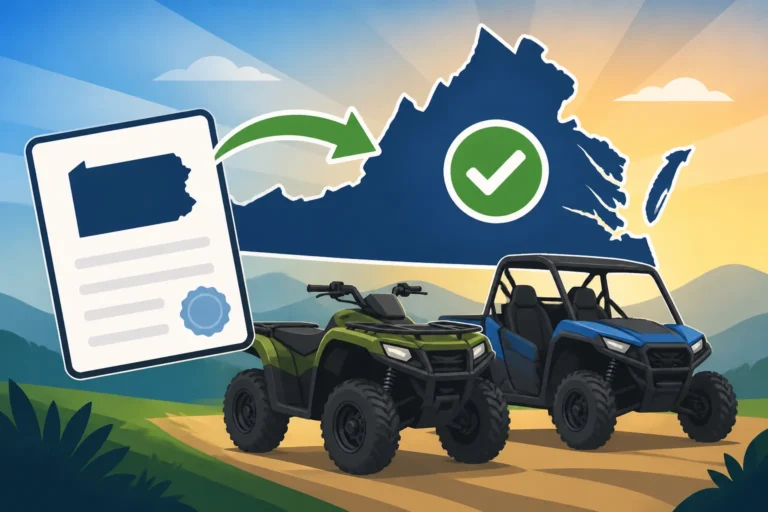
An out-of-state title, even if it's not a current Virginia title, provides a clear chain of ownership. It shows that the machine was legally recognized as belonging to someone at some point, and if you have the bill of sale from that previous owner, it helps connect the dots to your current ownership. Similarly, an old registration card, even from a non-titling state for off-road vehicles, can serve as supplementary evidence. These documents might not be enough on their own, but when combined with a bill of sale, they paint a much clearer picture for an insurer. They demonstrate a historical record of the machine and its ownership, which adds credibility to your claim. If you've moved to Virginia with a machine you already owned, remember that [Virginia Accepts an Out-of-State Title] if you decide to title it later, but for insurance purposes, the old paperwork can work wonders.
What to Expect When Getting a Quote for an Untitled Machine
When you're ready to get an insurance quote for your Virginia ATV or UTV, whether it's titled or not, the process itself is generally straightforward. However, there are a few specific questions and scenarios you might encounter, especially if your machine is untitled. Being prepared for these can save you time and potential frustration.
The insurance agent will ask for all the basic information we discussed earlier: the VIN, make, model, year, and engine size. They'll also inquire about how you use the machine – for recreational riding on trails, for farm work, or a mix of both. They'll ask about where the machine is primarily stored, as this can affect theft risk. When the topic of titling comes up, it's essential to be honest and clear about your machine's status. Don't try to obscure the fact that it's untitled if it genuinely isn't; instead, be ready to explain Virginia's specific rules and have your alternative proof of ownership documents at hand. Many insurers are familiar with Virginia's specific situation, especially if they operate locally. Remember, you're looking for [Virginia ATV Insurance Is Optional] so you're not legally mandated to have it, but it's a smart choice.
The "Untitled" Question and Your Answers
This is usually the moment that gives Virginia ATV owners the most pause. When the insurance agent asks, "Is the machine titled?" or "Do you have a state title for it?", it's perfectly acceptable to answer truthfully. If your machine is untitled, simply state that. Then, be ready to follow up with an explanation.
You can say something like, "My ATV is not currently titled with the Virginia DMV. In Virginia, titling for used ATVs is optional, and mine falls under that category," or "My machine was purchased new before the 2006 cutoff, so a title was never required by the state." The key is to provide context. Immediately reassure the agent that you have ample proof of ownership, such as a bill of sale or the MSO, and that you can provide it to them. Frame it as a matter of Virginia's specific regulations rather than a lack of proper documentation on your part. Most agents will understand and simply shift their focus to verifying your ownership through alternative documents. If they seem confused, politely educate them on Virginia's rules for off-road vehicles, as sometimes even experienced agents might generalize from car titling rules.
Providing Supporting Documentation to Your Agent
Once you've explained the untitled status of your machine, the next crucial step is to quickly and efficiently provide the supporting documentation to your insurance agent. Don't wait for them to ask multiple times; offer it upfront. This shows you are prepared, organized, and have nothing to hide.
Gather all your relevant documents – your detailed bill of sale, the MSO if applicable, any old registrations, or even an out-of-state title. Make copies to send to the insurer and keep the originals safe. If you used a service like LawDepot to create a formal bill of sale, you'll have a clear, professional document to present. The more comprehensive and clear your documentation, the smoother the process will be. Some agents might be satisfied with just seeing the VIN and a basic description, but others will require copies of the actual ownership documents for their records. Being proactive with these documents demonstrates your legitimacy and helps the insurer complete their due diligence without delay.
Here's a quick comparison of common ownership documents:
| Document Type | Best For | Key Information Provided | Accepted By Insurers? |
|---|---|---|---|
| Virginia Title (Current) | Titled machines (mandatory for new post-2006) | VIN, make, model, year, owner name, lienholder | Always |
| Manufacturer's Statement of Origin (MSO) | New machines never titled | VIN, make, model, year, first retail owner, dealer | Yes, for first owners |
| Detailed Bill of Sale | Private used sales, any untitled machine | Buyer/seller info, date, VIN, make, model, price, signatures | Yes, critical |
| Notarized Bill of Sale | Enhancing credibility of private sales | Same as above, with notary seal and signature | Highly valued |
| Old Out-of-State Title | Machines brought from another state | VIN, previous owner, registration details | Yes, often with bill of sale |
| Expired Out-of-State Registration | Supplemental proof for historical ownership | VIN, previous owner, registration period | Sometimes, as support |
Why Insurance is Still a Smart Move, Even if Not Legally Required
It's true: Virginia doesn't legally require you to carry insurance on your ATV or UTV. This can be a tempting reason for some riders to skip it, especially if they're trying to keep costs down. However, just because it's not mandated by law doesn't mean it's not a critically important investment. In fact, choosing to ride without insurance leaves you incredibly vulnerable to significant financial losses and legal headaches that could easily outweigh the cost of a policy.
Think of it this way: your ATV or UTV represents a substantial investment, often thousands of dollars. Leaving that investment unprotected is a huge gamble. Accidents happen, theft is a real threat, and even the most careful rider can be involved in a mishap that causes injury or property damage to others. Without insurance, you'd be solely responsible for covering these costs out of your own pocket. This is why, despite [Why Virginia Riders Can Legally Skip Insurance], many responsible riders choose to secure coverage. It provides peace of mind and a safety net against the unexpected, allowing you to enjoy your off-road adventures without constantly worrying about "what if."
Protecting Your Investment from Theft and Damage
One of the most immediate and tangible benefits of insuring your untitled Virginia quad is the protection it offers against theft and physical damage. These machines are highly desirable targets for thieves, and unfortunately, they're often stored in places that might not have the same level of security as a garage for a car. Imagine coming out one morning to find your shed door forced open and your pride and joy gone. Without comprehensive coverage, that loss is entirely yours to bear.
Beyond theft, off-road riding, by its very nature, carries risks. Whether it's an accidental rollover on a tricky trail, hitting an unseen obstacle, or even damage from a falling tree limb while parked, repairs can be incredibly expensive. Collision coverage can help cover the costs of repairing your machine if it's damaged in an accident, and comprehensive coverage steps in for non-collision incidents like fire, vandalism, or theft. Even if your machine is technically untitled, a good policy will still cover it as long as you can prove ownership. This means your hard-earned money isn't just sitting there, vulnerable to the unforeseen.
Liability Coverage for Accidents
While protecting your own machine is crucial, perhaps even more vital is securing liability coverage. This is where the real financial risk often lies when it comes to operating any vehicle, off-road or otherwise. If you're involved in an accident where you are at fault and someone else is injured or their property is damaged, liability insurance is what protects you from potentially ruinous out-of-pocket expenses.
Consider a scenario: you're riding on a designated trail system like Spearhead and accidentally veer off course, striking a parked vehicle or injuring another rider. Without liability coverage, you would be personally responsible for their medical bills, property repairs, and any associated legal fees. These costs can quickly skyrocket into tens or even hundreds of thousands of dollars, a burden few individuals can comfortably absorb. Even if you only ride on private land, liability is important; an accident involving a guest or a structure on someone else's property could still lead to a lawsuit. Some private landowners or organized trail systems may even require proof of liability insurance to ride on their property. So, while Virginia might not mandate it, getting [Buying ATV Insurance When No Law Requires It] is a responsible choice that safeguards your financial future and ensures you're prepared for any unfortunate incident. You could even use resources like LawDepot to draft waivers for anyone riding on your property, adding another layer of protection.
Disclaimer
This article is for general informational purposes only and does not constitute professional advice. Laws, prices and regulations vary by location and change over time. Consult a qualified professional for guidance on your specific situation.