Virginia Title Compared to Tennessee
Navigating the world of ATV and UTV ownership can be tricky enough within one state, but when you start looking across state lines, like from Virginia to Tennessee, the differences in titling and registration rules can feel like trying to compare apples to very different oranges. It’s frustrating when you just want to understand what paperwork you need to legally own and ride your machine, especially when one state titles but doesn’t register, and another does both! This guide will break down the distinct requirements in Virginia and Tennessee, highlighting the key differences to help you avoid headaches and ensure you're squared away, no matter where your wheels might roam.
The Virginia Approach to ATV and UTV Titling
Here in Virginia, our system for ATVs and UTVs is often a source of confusion because it doesn't align with how we handle cars and trucks. For most off-road enthusiasts, the biggest head-scratcher is that while the Commonwealth titles these machines, it absolutely does not register them in the traditional sense, which means no license plates or annual decals for your quad or side-by-side. This is a critical distinction that trips up a lot of folks, especially those coming from states with more conventional motor vehicle laws.
Titling Requirements in the Commonwealth
Let's talk about getting that piece of paper that proves ownership. If you've purchased a brand-new ATV or UTV in Virginia since July 1, 2006, the law is pretty clear: it needs to be titled. This requirement applies to any machine over 50cc. If you’re bringing a new machine home from a dealer, they'll usually handle the initial title application for you, along with collecting any sales tax. They’re required to give you an MSO, or Manufacturer's Statement of Origin, which is crucial for that first title. [Virginia Titles Machines Bought New Since 2006] and [Virginia Requires an MSO for a New Machine] are good places to learn more about this. Now, if you're buying a used ATV or UTV, things get a bit more flexible. Titling a used machine in Virginia is actually optional unless a lienholder (like a bank or credit union) requires it. Many riders choose to title their used machines anyway, simply to have that official proof of ownership, which can be invaluable if the machine is ever stolen or if you decide to sell it down the line. It's about protecting your investment, even if the state doesn't force your hand.
What Virginia Doesn't Require
So, what's missing from the Virginia picture? As mentioned, you won't find traditional registration in Virginia for ATVs and UTVs. This means no annual fees, no trips to the DMV for new stickers, and certainly no license plates. While this might seem convenient, it can also lead to misconceptions, particularly for riders who are new to the state or those who are used to street-legal vehicles. Because there's no registration, there's also no state-mandated insurance requirement for ATVs and UTVs. [Virginia Requires No ATV Insurance] dives deeper into why this is the case. However, that doesn't mean you shouldn't carry insurance! Many riders opt for comprehensive coverage for theft or damage, especially when financing their machine or when riding on organized trails that might require it. The lack of a plate also means that Virginia ATVs and UTVs are generally prohibited from public roads, with only very specific, limited exceptions in certain coalfield counties.
Tennessee's Distinctive Titling and Registration Requirements
Now, let's venture southwest to Tennessee, where the rules for ATVs and UTVs take a different turn. Unlike Virginia's title-only approach, Tennessee generally requires both titling and registration for most off-highway vehicles (OHVs), which include ATVs and UTVs. This distinction is significant and has practical implications for owners in the Volunteer State. If you're used to Virginia's more relaxed stance, Tennessee's requirements will definitely feel like a step up in terms of bureaucracy.
Titling and Registration in the Volunteer State
In Tennessee, the state considers most ATVs and UTVs to be motor vehicles, albeit off-highway ones. This means they fall under a more comprehensive regulatory framework. If your ATV or UTV has an engine size of 50cc or greater, you're generally going to need to get it titled through the Tennessee Department of Revenue. This process is similar to titling a car: you’ll present a Manufacturer's Statement of Origin (MSO) for new machines or a properly endorsed title from the previous owner for used ones. The title establishes legal ownership.
But that's not where it ends. Beyond titling, Tennessee also requires these machines to be registered. Registration involves an annual fee and, importantly, the issuance of a small, distinctive decal or sticker that must be displayed on the OHV. This decal serves as proof that the machine is legally registered for off-highway use within the state. This is a crucial difference from Virginia, where no such registration or decal exists. The purpose of this registration is often to help fund trail systems and provide a clearer framework for law enforcement to identify legally operating machines on designated trails.
What Tennessee Does Require Beyond Titling
The registration decal is the most visible difference, but Tennessee's system also comes with a few other requirements that Virginia typically doesn't impose. For instance, while Virginia has no state-mandated insurance for ATVs, Tennessee may have specific provisions for certain types of OHVs or for those operating on particular state-managed lands. It's always best to check the latest regulations directly with the Tennessee Department of Revenue or their specific OHV regulatory body, as these rules can evolve. The state also has clear guidelines for where and how these registered machines can be operated, often tying into a network of designated trails and OHV parks. Unlike Virginia's near-total ban on public road use, Tennessee might have specific, limited circumstances or designated connectors where registered OHVs are permitted for short distances, typically at slow speeds. For both states, a strong bill of sale is crucial for any private transaction, and resources like LawDepot can provide customizable templates to ensure you have all the necessary information, protecting both buyer and seller.
Key Differences Between Virginia and Tennessee ATV/UTV Laws
When you lay out the rules side-by-side, the contrast between Virginia and Tennessee regarding ATV and UTV ownership becomes stark. It's not just a minor variation; it's a fundamental difference in how each state views and regulates these powerful off-highway machines. Understanding these distinctions is paramount, whether you're a long-time rider or just considering your first quad.
The Titling-Only vs. Titling-and-Registration Divide
The absolute biggest difference, the one that causes the most confusion, is the presence or absence of a registration requirement. Virginia operates under a "title-only" model for most ATVs and UTVs, especially used ones. You get a title (or it's optional for older used machines), and that's it. No plates, no annual stickers, no recurring fees for the state's coffers related to annual registration. [Virginia Titles ATVs but Never Registers Them] explains this in detail. This means less administrative burden for owners, but it also means there's no visible state indicator of current legal permission to operate (beyond the title itself).
Tennessee, on the other hand, embraces a more traditional "titling-and-registration" model. Not only do you need a title to prove ownership, but you also have to register your ATV or UTV annually and display a decal. This provides a clear, visible sign that the machine is current with state requirements. While it adds an extra step and an annual fee, this system often helps fund and manage public OHV trail systems and provides a more direct mechanism for oversight. For legal documents like a bill of sale or an affidavit in lieu of title, having access to reputable online resources like LawDepot can make a huge difference in ensuring your paperwork is compliant, no matter which state you're dealing with.
Impact on Fees, Proof of Ownership, and Enforcement
These differing approaches have ripple effects across various aspects of ownership.
- Fees: In Virginia, you pay a one-time title fee (currently a modest amount like [Virginia Title Fee of $15]) and that's usually the extent of your state-level titling costs. Sales tax is paid at the time of purchase. There are no annual registration fees. In Tennessee, you'll pay a titling fee and an annual registration fee, plus sales tax at purchase. These recurring costs contribute to the state's OHV programs.
- Proof of Ownership: Both states issue a title as definitive proof of ownership. However, in Tennessee, the current registration decal serves as an additional, easily visible form of proof that the machine is legally allowed on designated trails. In Virginia, you'd typically carry your paper title or a copy, but there's no external marker. [What You Get for the $15 ATV Title Fee] covers the Virginia side.
- Enforcement: For law enforcement, a Tennessee registration decal makes it straightforward to quickly verify if an OHV is properly registered. In Virginia, officers might need to ask for the paper title or run VIN checks to confirm legitimate ownership, which can take more time. This also has implications for trail systems. Many public and private trail systems require proof of ownership and often registration to ride. While a Virginia title suffices in Virginia, a Tennessee rider would need both title and current registration.
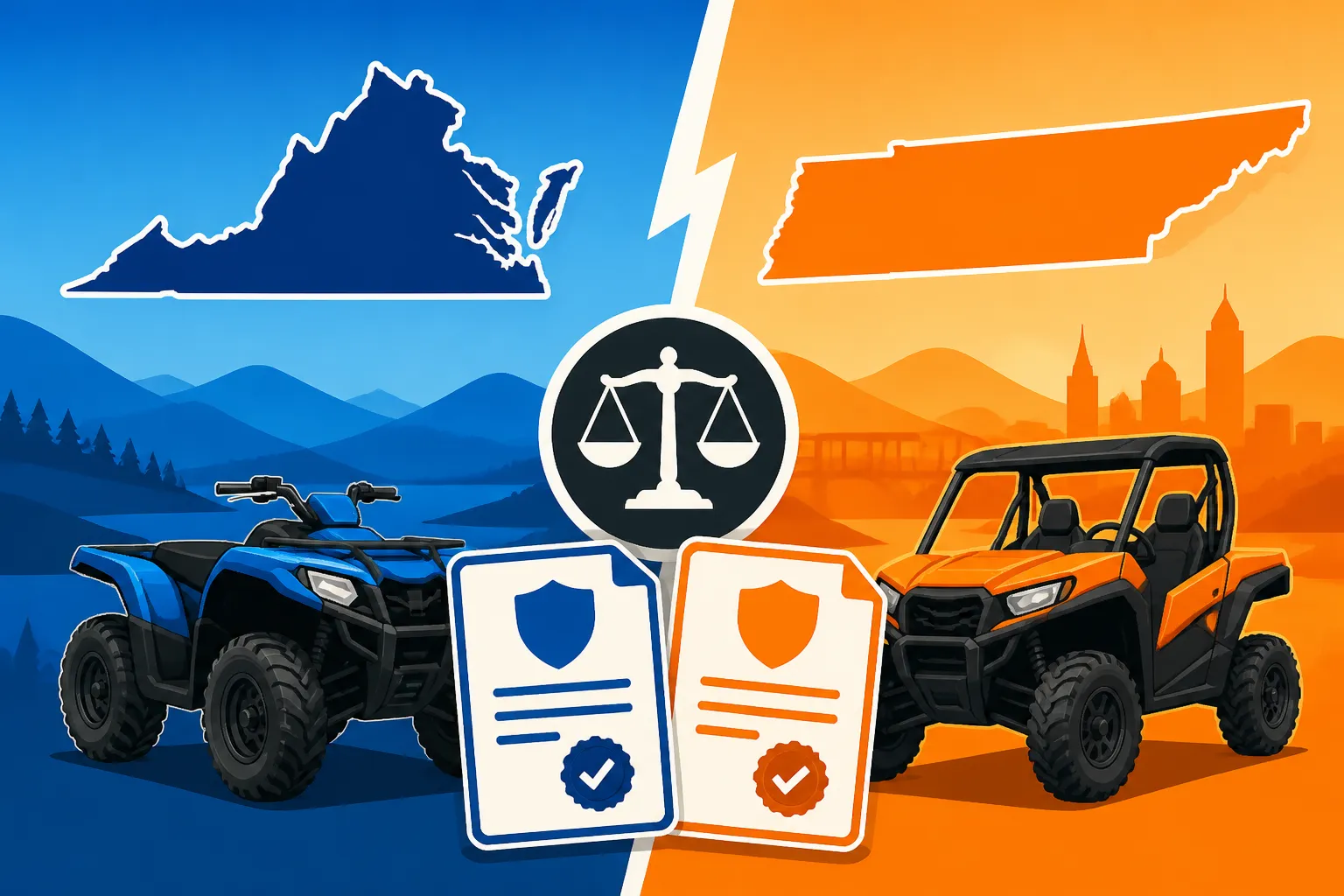
Let's look at a quick comparison:
| Feature | Virginia (ATV/UTV >50cc) | Tennessee (OHV >50cc) |
|---|---|---|
| Titling | Required for new, optional for used | Required for most |
| Registration | No | Yes, annual renewal & decal |
| License Plate/Decal | No | Yes, decal must be displayed |
| Annual State Fee | No (only initial title fee) | Yes (annual registration fee) |
| MSO Required for New | Yes | Yes |
| Mandatory Insurance | No | May have specific requirements |
| Road Use | Generally prohibited, very limited exceptions | Generally prohibited, specific exceptions for designated routes |
Practical Considerations for Cross-State ATV/UTV Ownership
The differing ATV and UTV laws between Virginia and Tennessee aren't just academic; they have real-world implications for riders who live near the state line, are considering a move, or even just plan to ride in the other state. It's not uncommon for someone in Bristol, Virginia, to ride trails near Johnson City, Tennessee, and vice-versa. Understanding how to legally navigate these boundaries is crucial.
Buying or Selling Across State Lines
Let's say you're a Virginia resident eyeing a great deal on a used side-by-side from a private seller in Tennessee. Or maybe you're in Tennessee and found the perfect quad in Southwest Virginia. This is where the differences really hit home.
- Buying in Tennessee as a Virginia Resident: If you buy a titled and registered OHV in Tennessee, you'll need the seller to properly sign over their Tennessee title. When you bring it back to Virginia, you'll apply for a Virginia title, treating it as an out-of-state purchase. You won't apply for Tennessee registration, as you'll be operating under Virginia's "title-only" rules. Ensure you get a solid bill of sale, which you can easily generate using a service like LawDepot, to protect yourself during the transaction. [Virginia Titles for a Machine Bought Out of State] is a great resource here.
- Buying in Virginia as a Tennessee Resident: If you purchase a machine in Virginia, especially a used one that might not have a current Virginia title (remember, it's optional for used), you'll need to secure a Virginia title in your name first, or at least have a robust bill of sale and possibly an affidavit of ownership if the title is missing. Then, you'll take that paperwork to Tennessee to apply for both a Tennessee title and registration. You'll definitely need strong proof of ownership to satisfy Tennessee's requirements, and this is where documented forms from LawDepot can be immensely helpful.
Moving with Your Machine
Relocating from one state to the other means adapting to the new state's rules.
- Moving from Virginia to Tennessee: If you're packing up your Virginia-titled ATV and heading to Tennessee, you'll need to re-title it in Tennessee and, critically, get it registered. Your Virginia title will be presented to the Tennessee Department of Revenue, and you'll then be subject to their annual registration fees and decal requirements. Don't assume your Virginia title is enough to ride legally in Tennessee without further action.
- Moving from Tennessee to Virginia: Conversely, if you're bringing your Tennessee-titled and registered OHV to Virginia, the process is generally simpler. You'll apply for a Virginia title, surrendering your Tennessee title. Since Virginia doesn't register ATVs and UTVs, you won't need to worry about annual decals or fees once your Virginia title is issued. [Virginia Title for a New Resident] covers the basics of this transition. Just remember, while it simplifies the paperwork, it doesn't change Virginia's strict rules about where you can legally ride your machine.
It’s always a smart move to consult the official DMV or Department of Revenue websites for the most current information for both states before making any major purchases or moves. Laws and fees can change, and being proactive will save you a lot of grief.
Disclaimer
This article is for general informational purposes only and does not constitute professional advice. Laws, prices and regulations vary by location and change over time. Consult a qualified professional for guidance on your specific situation.