No Studded Tires on a Federal Trail
Studded tires can seem useful on icy ground, but they can also make a planned ride in Virginia’s national forest off-limits. The key is to distinguish a local federal-trail restriction from rules that apply everywhere, then check the tires and trail conditions before loading your machine.
What the studded-tire restriction means
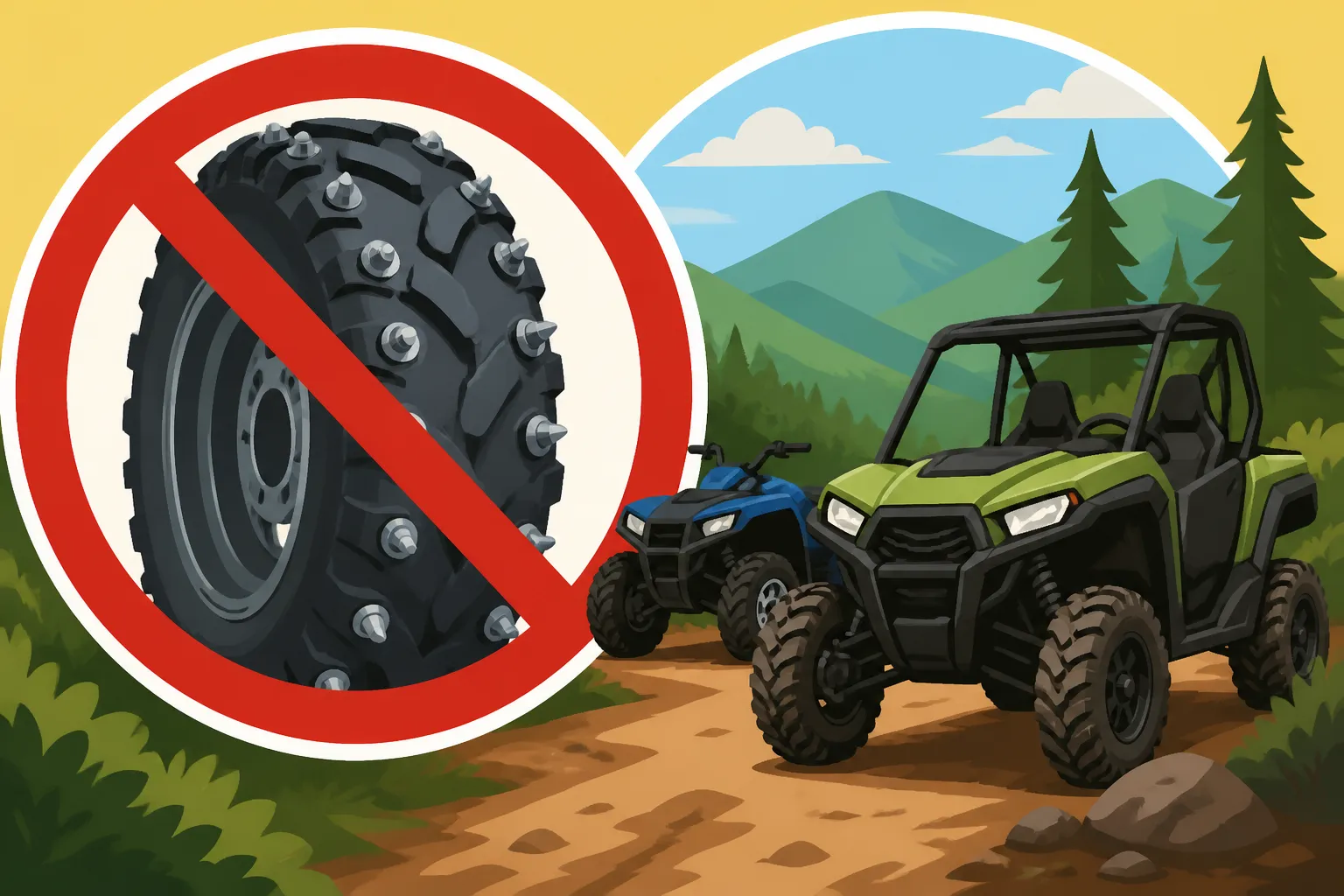
The relevant rule for riders heading to Peters Mill Run and Taskers Gap is straightforward: metal-studded tires are not allowed on the federal trail system. This is a trail-equipment restriction, not a general statement that every federal trail in the country has the same rule. Always confirm the requirements for the specific riding area you plan to visit.
A studded tire has metal points or studs that protrude from the tread. They are intended to improve grip on ice, but the hard points can damage a riding surface and create problems for other trail users. A tire with ordinary rubber knobs is not a studded tire merely because its tread looks aggressive.
The restriction matters even if the studs are small, factory-installed, or fitted only to one axle. Don’t assume that a few studs, a particular vehicle type, or riding slowly makes the equipment acceptable. If a tire has metal studs, treat it as prohibited for this trail until the responsible forest office confirms otherwise.
There can be uncertainty about equipment that is not plainly a studded tire. Tire chains, removable traction devices, and unusual tread inserts may not be described by the rule in the same terms as metal-studded tires. Don’t infer that they are allowed—or forbidden—based on appearance alone. Ask the managing office about the specific setup before traveling.
| Tire or equipment | What to do before riding |
|---|---|
| Tire with visible metal studs | Do not take it onto Peters Mill Run or Taskers Gap |
| Conventional rubber-knobby tire | Check the trail’s current equipment and operating rules |
| Tire with an unusual insert or traction device | Ask the managing office whether it is allowed |
| Tire with an unclear or partly hidden feature | Inspect it closely and get confirmation before hauling |
The equipment restriction is separate from the permit requirement. Having a valid permit does not make prohibited tires acceptable, and changing tires does not replace any permit or other trail requirement. For the broader checklist, see Virginia Forest Equipment Requirements and Virginia National Forest Permits.
How to check your tires before you haul
A quick inspection at home is easier than discovering a problem at the trailhead. It also gives you time to arrange a tire change or choose another riding area rather than losing a trip after towing to the forest.
Inspect all four tires
Check each tire, not just the ones that look most likely to have been modified. Metal studs may be visible as small points set into the tread blocks. Look across the center and shoulders of the tread, and check both sides of the tire where accessible. If the machine has replacement tires or removable traction equipment, look for added hardware as well as features molded into the tire.
Don’t rely only on a product description, old receipt, or what a previous owner said. A machine may have changed tires since it was purchased, and a tire’s appearance can be hard to judge from a photo. If you cannot tell whether a feature is a metal stud, take a clear picture and contact the forest office before departure.
Online listings can help identify a tire’s model, but they are not a substitute for checking the actual tire fitted to your machine. If shopping through Amazon or another retailer, confirm the product specification and make sure the tire you order is the one that will be installed. A listing may show a similar-looking model or omit details relevant to trail use.
Check the complete setup
Tires are only one part of the equipment check. Confirm that the machine meets the other requirements for the trail system, and make sure any trailer or towing setup is ready for the trip. Review Virginia Forest Noise Limits if you have questions about machine noise, and check Peters Mill Run Requires a Valid Driver’s License for the operator requirement specific to that riding area.
If a shop is changing the tires, tell the staff where you intend to ride and ask them to verify that the replacement setup does not include metal studs. Keep the tire model information or a photo available in case you need to explain the equipment to a trail official. Do not assume that a tire described as suitable for winter riding is automatically suitable for every off-highway trail.
A checklist can keep the inspection practical:
- Look at every tire for metal points, inserted studs, or attached traction equipment.
- Check the tire model and product details if the tread features are not clear.
- Ask the managing office about anything the written rule does not plainly cover.
- Confirm the other equipment rules and permit requirements.
- Recheck the tires after a repair or swap before loading the machine.
If the machine is found with prohibited tires after you arrive, don’t ride it onto the trail while you look for an answer. Contact the responsible office and ask what options are available. You may need to replace the tires, postpone the ride, or choose a different destination whose rules you have confirmed. Do not expect a permit, a waiver, or a promise to stay on a particular section to override the equipment restriction.
Plan around permits, seasons, and conditions
Tire compliance does not establish that the trail is open or that you are ready to ride. Peters Mill Run and Taskers Gap have separate operating requirements that can affect a trip, including permits, seasonal closures, and conditions that change with weather. Check the current details close to departure rather than relying on an old trip report or a map saved on your phone.
Start with the permit rules for the specific federal riding area. A permit for another Virginia trail network does not necessarily cover a national forest route. Review Virginia National Forest OHV Permits and Virginia Forest Permit Purchase Options to understand what to confirm and how to arrange the required permit before you leave. Keep any required proof accessible even if you expect to have poor cell service.
Then check whether the trail is open for your planned date. Winter operating restrictions can close forest routes for a period, and poor conditions may cause closures outside a scheduled season. See Virginia Forest Season Closures and Virginia Trail Conditions Before You Haul. A tire that is allowed on an open trail does not make riding permissible during a closure.
When contacting the managing office, ask direct, specific questions:
- Are the routes you plan to ride open on your travel dates?
- Does the metal-studded-tire prohibition apply to the exact tire or traction device on your machine?
- Are there additional equipment requirements for your vehicle type?
- What permit do you need, and how should you carry or show proof?
- Have weather, trail damage, or other conditions changed access?
These questions are more useful than asking only whether “ATVs are allowed.” Access can depend on the route, the equipment, the permit, and current conditions. If the office gives guidance about an unusual tire setup, make a note of the date and the details you provided.
Make a separate plan for what you will do if the trail is closed or the tire setup is not accepted. That may mean arranging non-studded tires before the trip, postponing the ride, or choosing another trail system after checking its own rules. Do not assume another trail has the same equipment policy just because it is also on public land.
Avoid common assumptions at the trailhead
The most common mistake is treating a local restriction as either universal or irrelevant. The rule for these forest trails should not be presented as a ban that automatically covers every federal trail, but it also should not be dismissed because a rider has seen studded tires elsewhere. Requirements belong to specific riding areas, and the managing office’s current instructions are the best place to resolve uncertainty.
A few other assumptions can lead to a wasted trip:
- “The studs are small.” The rule concerns metal-studded tires; size alone is not a reason to assume an exception.
- “The tires came on the machine.” Factory installation does not by itself establish that the tires meet a trail’s rules.
- “I have a permit.” A permit does not cancel an equipment restriction.
- “The trail is open, so my setup is fine.” Open status and equipment compliance are separate checks.
- “The studs are only on the front tires.” Don’t assume that partial installation is acceptable.
- “A different public trail must use the same rule.” Confirm the rules for each destination.
- “I can find out at the gate.” A trailhead may not have staff available to inspect tires or answer a detailed equipment question.
If your machine has metal-studded tires, the practical choice is to change to an allowed setup before the trip or select another destination where the equipment is expressly permitted. If you are uncertain about chains or another traction device, get a clear answer before hauling. The cost and inconvenience of checking in advance are generally much smaller than arriving with a machine you cannot legally or safely ride on your intended trail.
Disclaimer
This article is for general informational purposes only and does not constitute professional advice. Laws, prices and regulations vary by location and change over time. Consult a qualified professional for guidance on your specific situation.