Virginia State Parks Ban ATVs
A common Virginia weekend plan goes sideways when you tow a quad to a state park expecting marked off-road trails and discover the park is not open to public ATV riding. This guide explains what the restriction means, how to check a specific park’s rules, and where to look instead so you can plan a legal ride before loading the trailer.
What the Virginia State Park ATV Restriction Means
State parks are not public ATV trail systems
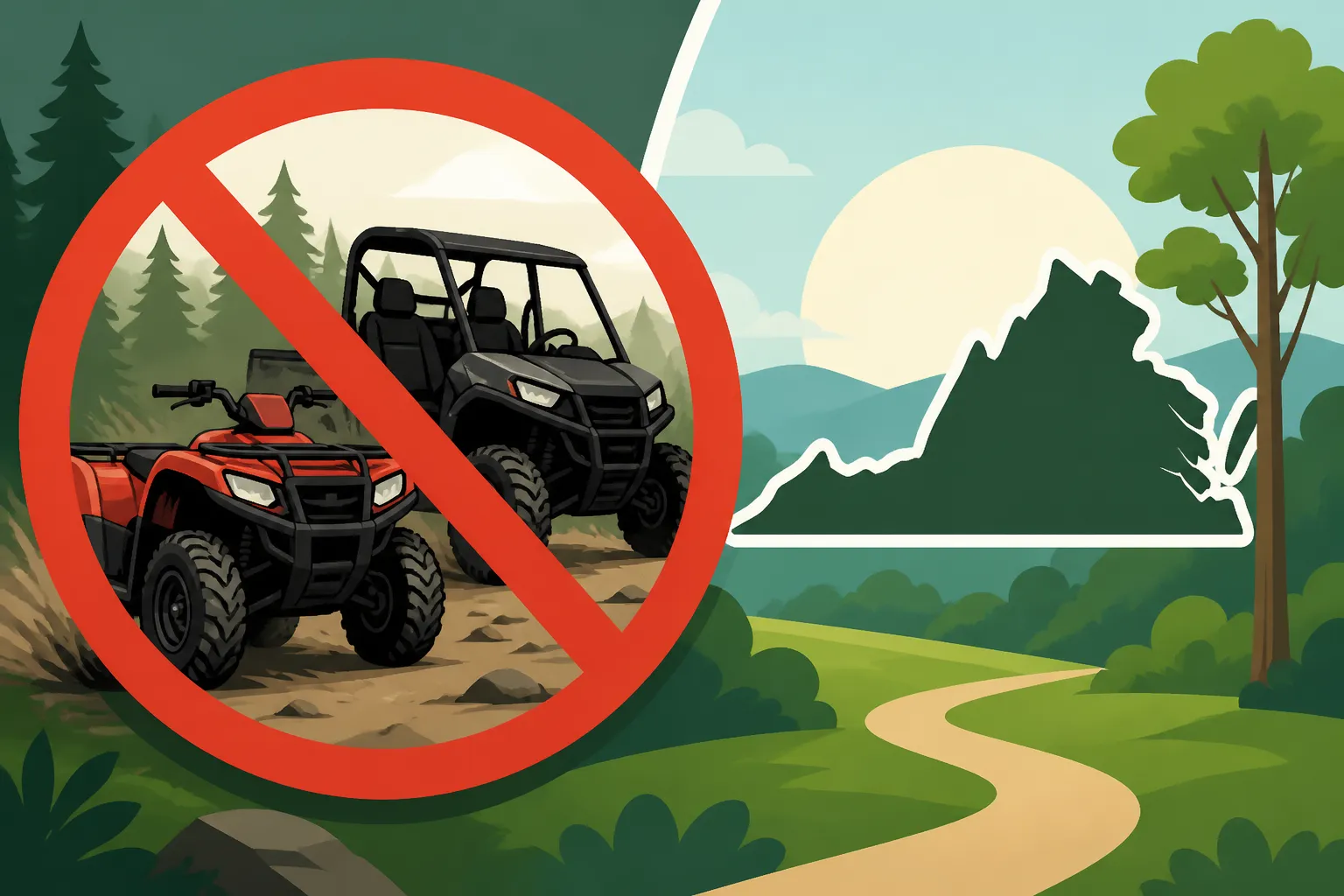
Virginia’s state parks are generally not places to ride your ATV or UTV recreationally. Their hiking, biking, and equestrian trails are not ATV routes, and bringing a machine into a park does not give you permission to use those trails. If you’re picturing unloading in a park parking area and following a nearby path into the woods, don’t assume that is allowed.
The practical rule is to treat a state park as closed to recreational ATV riding unless the park has specifically confirmed an authorized route or use. Permission to visit the park, camp there, or use a boat launch is not the same as permission to ride a motorized off-road vehicle on its grounds.
This distinction matters because Virginia parks can contain different kinds of roads and paths. A paved road used by visitors, a service road used by park staff, and a hiking trail may all look passable to a machine, but their appearance does not establish that public ATV use is permitted. For a broader look at where machines fit under Virginia park rules, see [Virginia State Park Rules for Machines](Virginia State Park Rules for Machines).
A park road is not automatically an ATV route
It’s easy to confuse “there is a road” with “I can ride my quad there.” A road inside a park may be intended for ordinary street-legal vehicles, park employees, emergency responders, or maintenance crews. A gate, gravel surface, or unpaved shoulder does not turn it into a public OHV trail.
Virginia generally prohibits ATV use on public highways, subject to limited exceptions. So even if a park entrance road connects to another road or trailhead, don’t plan to ride your machine along it unless the relevant authority confirms that the route is lawful for your vehicle. Read [Virginia Bans ATVs on Public Highways] before treating a road connection as part of your route.
The same caution applies to short “just this once” trips: riding from a campsite to a trailhead, moving between two sections of a park, or taking a shortcut around a gate. A route that looks convenient can cross land or roadways where ATV use is not authorized. The safest choice is to transport the machine on a trailer between approved riding areas rather than ride it through a park to get there.
Rules may differ for authorized work or emergencies
A public riding restriction does not mean a park can never have an ATV or UTV on its property. Park staff, contractors, law enforcement, or emergency responders may use motorized equipment for work or response when authorized. That is different from a visitor using the same kind of machine for recreation.
Visitors should not treat visible staff activity as evidence that a route is open. A maintenance crew may be operating on a restricted service road, with permission and for a specific job. A ranger or rescue worker may need to reach a location that is not open to public vehicles. Those exceptions do not create a general public riding privilege.
If a park employee gives you specific information about an unusual event, permitted activity, or access arrangement, ask what area and conditions the permission covers. Make sure you understand whether it applies to your vehicle, the date of your visit, and the route you intend to use. If anything is unclear, contact the park before unloading.
Why State Parks and ATV Riding Areas Are Different
Parks are managed for multiple kinds of recreation
A state park is designed to serve a wide range of visitors, often in a relatively compact area. Hikers, cyclists, families with young children, campers, anglers, and people using accessible facilities may all share the same park landscape. Keeping motorized recreation on designated routes can help reduce conflicts between those uses.
Think about a narrow wooded path near a campground. Hikers may be walking around a blind bend, a child may be stepping off the trail, and a cyclist may be moving downhill. Even a careful ATV rider can create a different level of noise, speed, and trail impact than the path was designed to accommodate. A park’s restrictions help establish predictable spaces for visitors.
That does not mean one recreation type is more valuable than another. It means different activities need different places and management. A trail system built for off-highway vehicles can be designed around machine width, turning space, surface durability, maintenance access, and rider safety. A hiking trail in a state park may not have those features.
Natural and built features need protection
Motorized riding can create concentrated wear, especially when a trail is wet or steep. Tires may loosen soil, deepen ruts, or widen a route as riders go around muddy sections. On a hillside, that disturbed soil can move downhill during rain and affect nearby drainage, streams, or vegetation.
State parks also contain places where a route may pass close to sensitive habitats, historic features, or visitor facilities. A trail that appears sturdy in dry weather might cross a soft stream edge or an area that becomes vulnerable after heavy rain. Restricting public ATV use helps park managers protect resources while maintaining the areas for the activities the park supports.
For riders, this is also a reminder that a machine-friendly route is not necessarily a durable route. Trails intended for off-road vehicles have their own operating rules and closures, too. Follow signs and seasonal restrictions rather than assuming that a wide path or old tire tracks mean a route is open.
Visitor expectations and noise are part of the decision
Many people choose a state park because they expect a quieter setting for a walk, picnic, camping trip, or visit to the water. ATV engines can carry a long way through a wooded hollow or across an open campground, especially when the surrounding area is otherwise quiet.
That sound can also affect other visitors’ sense of safety. Someone hiking with a dog or walking with children may not expect a motorized vehicle on a footpath. Clear restrictions reduce the chance that visitors and riders will meet in a place where neither expects the other.
If your group includes both ATV riders and people who want a traditional park visit, it may help to split the day between destinations. One part of the group can visit a state park for walking or camping while riders use a designated OHV area nearby. Just confirm the travel time and access arrangements rather than assuming the park itself provides a riding connection.
What Counts as an ATV or UTV for Park Planning
ATVs and side-by-sides are not made legal by their size
People use different names for off-road machines: quad, four-wheeler, utility quad, UTV, side-by-side, or recreational vehicle. Those labels can be useful in conversation, but they do not determine whether you may ride in a particular park. The park’s rules and the vehicle’s legal classification matter more than whether the machine feels small enough to fit on a path.
A side-by-side does not gain permission simply because it has a steering wheel, roll cage, seat belts, or room for passengers. Those features may matter at a permitted riding area, but they do not convert a restricted park road into a public ATV route. Check the destination’s vehicle rules for width limits, passenger requirements, and any other machine-specific conditions.
Virginia’s classification and use rules can be more detailed than everyday language suggests. For background on the terminology, see [Virginia ATV and Utility Vehicle Definitions]. When planning a park visit, though, the key question is simple: has the park authorized your specific kind of vehicle on a specific route?
Dirt bikes and other motorized machines need their own check
A trail or service road that is closed to ATVs should not be assumed open to dirt bikes, motorcycles, or other off-road vehicles. A rule may cover several categories of motorized vehicle, or it may distinguish among them. Don’t rely on a friend’s description of a route as “motorcycle friendly” without checking the current rules for the land you plan to enter.
Likewise, the fact that a machine can be registered or made street-legal does not automatically allow it on every park trail. A street-legal vehicle may be able to use certain roads under ordinary road rules, but that does not grant permission to leave the road and ride on a park path. Public-road access and off-road access are separate questions.
When your group has different machine types, check each one separately. A trail operator’s rules for a UTV may differ from its ATV rules, and a park’s vehicle policy may not match the requirements of a nearby forest or private riding park. It is better to settle that detail at home than at a gate after a long drive.
Transporting a machine is different from riding it
You may be able to tow a machine to a park-adjacent parking area or campsite, but transporting it on a trailer is not the same as operating it on park land. Keep the ATV secured to the trailer until you are at a confirmed riding destination and have checked that the route is open to your machine.
Even unloading for a short distance can create a problem if the location is not designated for machine use. A parking lot is for parking unless the park has explicitly provided a different arrangement. Don’t use a lawn, shoulder, campground loop, or service lane as a staging area without permission.
If your trip includes both a state park and an OHV area, plan the transition as a vehicle trip. Allow time to secure the machine, check straps and tie-downs, and drive to the approved trailhead. That extra step is less frustrating than discovering that the apparent connector is closed to public motorized use.
Where to Ride Instead of a Virginia State Park
Look at designated Spearhead trail systems in Southwest Virginia
For a more purpose-built ATV or UTV outing, look into Virginia’s Spearhead trail systems in the southwest part of the state. These systems are designed for motorized recreation, with individual rules that may cover permits, machine types, speed, age, safety equipment, and where a route begins and ends. They are not interchangeable with state parks, and each system has its own operating details.
Before you commit to a destination, check which network you plan to visit and what its current requirements are. A permit for one riding network may not cover another, and a machine that fits one system’s rules may not fit another’s. Start with [Spearhead Trails in Virginia Explained] and [Virginia ATV Trails: Spearhead and the Forest] to compare the general types of riding options.
The region’s mountain setting also makes practical planning important. A trailhead may be some distance from services, cellular coverage can be unreliable in remote areas, and weather can change the character of a route. Check the system’s official information before leaving, carry the information you need offline or on paper, and make sure your group knows where it will meet if vehicles become separated.
Check National Forest OHV areas and their specific limits
Virginia’s national forest riding areas offer another option, but “national forest” does not mean every forest road or trail is open to ATVs. Access may be limited to designated routes, subject to seasonal closures, permits, equipment standards, or vehicle-size rules. The forest’s land manager—not a general map label—determines what is open.
Peters Mill Run and Taskers Gap are examples of places where riders need to pay attention to route-specific requirements and closures. Don’t assume that a trail open to one kind of vehicle is open to another, or that a road shown on a map is an OHV route. Review [Virginia National Forest OHV Permits] and [Virginia Trail Closures and Seasons] before towing there.
These areas can be especially sensitive to timing. Seasonal shutdowns, weather-related closures, and other temporary restrictions can affect whether a route is available on your chosen day. Check the relevant forest information shortly before departure, and have a backup plan in case a trail is closed or conditions are unsuitable.
Consider private off-road parks and explicitly permitted private land
Virginia also has private off-road riding opportunities. Private parks set their own admission, waiver, vehicle, age, safety, camping, and operating rules. Read the park’s details before you go rather than assuming that a private property operates like a state-managed trail system. [Virginia Private Off-Road Parks] is a useful starting point for understanding this option.
Private land can be another possibility, but ownership alone does not equal permission. Get explicit authorization from the landowner or the person who controls access, and clarify where you may ride, when you may be there, and whether passengers or guests are included. A verbal “you can ride here sometime” may leave important questions unanswered.
Do not treat a private logging road, hunting property, or farm track as open riding territory because there are tire marks or no gate. The owner may allow only certain users, vehicles, or activities. For help thinking through access permission, see [Virginia Rules for Riding Private Land]. When access is uncertain, ask before unloading.
| Destination type | What to expect | What to verify before you go |
|---|---|---|
| Virginia state park | Primarily park recreation such as hiking, camping, and other designated activities; not a general ATV riding destination | Whether any specific motorized use is expressly authorized |
| Spearhead trail system | A designated motorized riding area with system-specific rules | Permit, vehicle eligibility, route access, operating hours, and current conditions |
| National Forest OHV area | Designated routes that may have closures and equipment or permit requirements | Open routes, vehicle limits, permit requirements, and seasonal or weather restrictions |
| Private off-road park | Privately managed riding with property-specific rules | Admission process, waivers, permitted machines, age rules, and available facilities |
| Private land by permission | Access depends on the landowner’s authorization | Exact boundaries, permitted routes, dates, machine types, and any guest conditions |
How to Check Park and Trail Rules Before You Haul
Contact the specific park or land manager
A broad search result or an old trip report may not answer the question you actually have: can your machine ride on the route you plan to use, on the day you plan to arrive? Park boundaries, access points, and trail names can be confusing, particularly when a public road, private parcel, forest route, and state park are close together.
Contact the park or land manager responsible for the property. Ask plainly whether public recreational ATV or UTV riding is permitted, whether there are any designated routes, and whether your vehicle type is allowed. If you are asking about a particular road or trail, give its name or location rather than asking only, “Can I ride in the area?”
Record the answer and any conditions. If a staff member says an area is open only during an event or only for a particular class of vehicle, note that distinction. If the answer is unclear, ask who manages the route or which office can confirm it. A little phone time can prevent a wasted trip and an uncomfortable conversation at the entrance.
Use maps as planning tools, not permission slips
Digital mapping apps can help you understand where roads, trails, and riding areas appear to be. Some riders use onX Offroad to plan routes, review terrain, and keep track of a proposed trip. That can be useful for orientation, especially when you’re comparing a park visit with a separate OHV destination.
But a mapped line is not proof that an ATV route is legally open. Maps may show roads or trails without explaining current vehicle restrictions, land ownership changes, temporary closures, or whether public access is allowed. Treat onX Offroad and any other map as a planning aid, then confirm access with the land manager or riding-area operator.
This is especially important near boundaries. A route can begin on an open forest road and continue onto private property, or pass close to a park without entering an authorized riding area. Review the route from start to finish, and verify every section rather than relying on a single trail label.
Confirm permits, dates, and vehicle requirements
Once you identify a legitimate riding destination, check its operating requirements. A permit, reservation, waiver, or vehicle inspection may be required. Rules may also vary by machine width, passenger seating, age of rider, protective equipment, sound level, or operating hours.
Do not assume that a permit purchased for another state or trail network will be accepted. Permit reciprocity is not universal, and access rules can differ even among nearby riding areas. Check the destination’s own instructions and make sure every rider in your group meets the requirements.
Finally, check for changes close to your travel date. A route that was open during a previous trip may be closed because of weather, maintenance, seasonal restrictions, or an event. Planning around those possibilities is part of the trip, not an unnecessary extra task. For a broader planning checklist, see [Virginia Trail Conditions Before You Haul].
Riding Legally and Respectfully Outside State Parks
Separate road access from off-road access
A trail ride often involves a mixture of surfaces: private roads, public roads, forest roads, designated trails, and parking areas. Each section can have a different access rule. A machine that is permitted on one designated trail is not automatically permitted on the public road needed to reach another trail.
Do not ride an ATV along a public highway simply because the distance is short or the shoulder looks wide. Virginia’s public-road restrictions have limited exceptions, not a general “close to the trailhead” allowance. If a legal route requires crossing or using a road, verify the conditions that apply to that particular crossing or road.
When in doubt, trailer the machine between separated riding areas. It may take longer, but it avoids turning a planned recreation day into a dispute over road access. For general route planning and road restrictions, consult [Virginia Bans ATVs on Public Highways].
Get landowner permission before entering private property
A route can look public and still cross private land. Gates, signs, fences, and posted notices deserve attention, but the absence of a sign does not establish permission. If you are unsure who controls access, stop and find out before entering.
Ask the landowner or authorized manager about the exact area you may use. Clarify whether the permission includes your whole group, whether guests may ride, and whether there are limits on dates, hours, noise, or proximity to buildings and livestock. A clear agreement helps protect both the rider and the person allowing access.
Respect a changed answer. A landowner who permitted access in the past may close a route because of logging, hunting, repairs, erosion, or a change in family circumstances. Do not rely on an old invitation as permanent access. The principles in [Virginia Rules for Riding Private Land] apply even when a route is familiar.
Protect the trail and the people sharing it
On an authorized route, ride at a pace that gives you room to react. Blind corners, loose gravel, steep grades, water crossings, and dust can hide people or obstacles. Leave enough space between machines that riders can see and stop without running into the person ahead.
Stay on the designated route. Going around a puddle or rut can widen the trail and damage nearby vegetation. Avoid spinning tires, cutting switchbacks, or riding through areas that are marked closed. If a route is too wet or difficult for your machine, turning back is usually the better choice than trying to force your way through.
Carry out what you bring in, secure loose gear, and keep noise considerate around homes and campgrounds. A friendly wave and a slower approach can go a long way when you meet hikers, cyclists, equestrians, or other riders. Good trail behavior helps preserve access for everyone.
Common Planning Questions About ATVs and State Parks
Can I unload an ATV at a state park and ride only a short distance?
Do not assume that a short ride is allowed. A brief trip from a trailer, campsite, or parking area still counts as operating the machine on park property. Unless the park has expressly authorized that use and route, keep the ATV secured and transport it to a designated riding area.
If you need to move the machine for a park-related reason, ask staff first and follow their instructions. Don’t interpret a convenient path, empty service lane, or open gate as permission. A route may be available to park employees without being open to visitors.
If the state park is only a stop on a larger trip, plan to tow between the park and the OHV destination. A map may show the areas close together, but that does not mean a legal riding connection exists.
Can I ride an ATV through a state park to reach a nearby trail?
Not unless the park or the authority responsible for the route specifically confirms that the connection is permitted for your vehicle. A trailhead’s proximity to a park does not make the land between them open. The connector could cross a restricted park area, private property, or a public road where ATV use is not allowed.
Check every segment of the proposed route. Ask who manages the trail, road, and any connector, and whether public ATV access is authorized from the point where you plan to start. If there is no clear answer, use a trailer or another confirmed access point.
This is a common source of confusion in rural and mountainous areas, where trails and roads may appear to join on a map. A short gap can involve a different landowner or a different set of rules. Confirm before your group rides into it.
What if I see tracks or another ATV inside a park?
Tracks are not proof of legal access. They could have been left by authorized staff, emergency personnel, a contractor, or someone who was riding without permission. Similarly, seeing a machine in a park does not establish that visitors may ride there.
If you are already at the park and uncertain, stop rather than following tracks. Ask a ranger or park employee about the area. If staff tell you the route is closed to public ATV use, turn around and leave the machine secured.
It can feel frustrating to backtrack after you have unloaded, especially when other tracks make the route look established. But the sensible response is to get a clear answer, not to assume that previous use created public access.
How can I plan a trip for riders and non-riders together?
Choose separate activities that fit each person’s interests. Non-riders might spend the day hiking, visiting a park, or enjoying a campground, while the riders travel to a designated OHV system or private park. Set a clear meeting time and location, and make sure everyone knows how the group will communicate if cell service is poor.
If you use onX Offroad to help organize the riding portion, share the route plan with the group and still verify access with the trail operator. Save essential directions and contact details before leaving service. Agree on a turnaround time so riders are not left trying to navigate back after dark.
For a weekend trip, avoid assuming that nearby attractions share a boundary or access road. A state park and a riding system can both be excellent destinations without being connected for ATV use. Treat them as separate stops unless the land managers confirm otherwise.
Disclaimer
This article is for general informational purposes only and does not constitute professional advice. Laws, prices and regulations vary by location and change over time. Consult a qualified professional for guidance on your specific situation.