Jawbone at Richlands Lets Jeeps on the Trail
A Jeep owner heading toward Richlands can easily assume that “Jeeps allowed” means every route at Jawbone is open to full-size vehicles. It does not. This guide explains what the access means, how to plan a suitable route, what to check before hauling your rig, and how to ride responsibly on a shared trail system.
What Jeep access at Jawbone means
Access applies to designated routes, not every trail
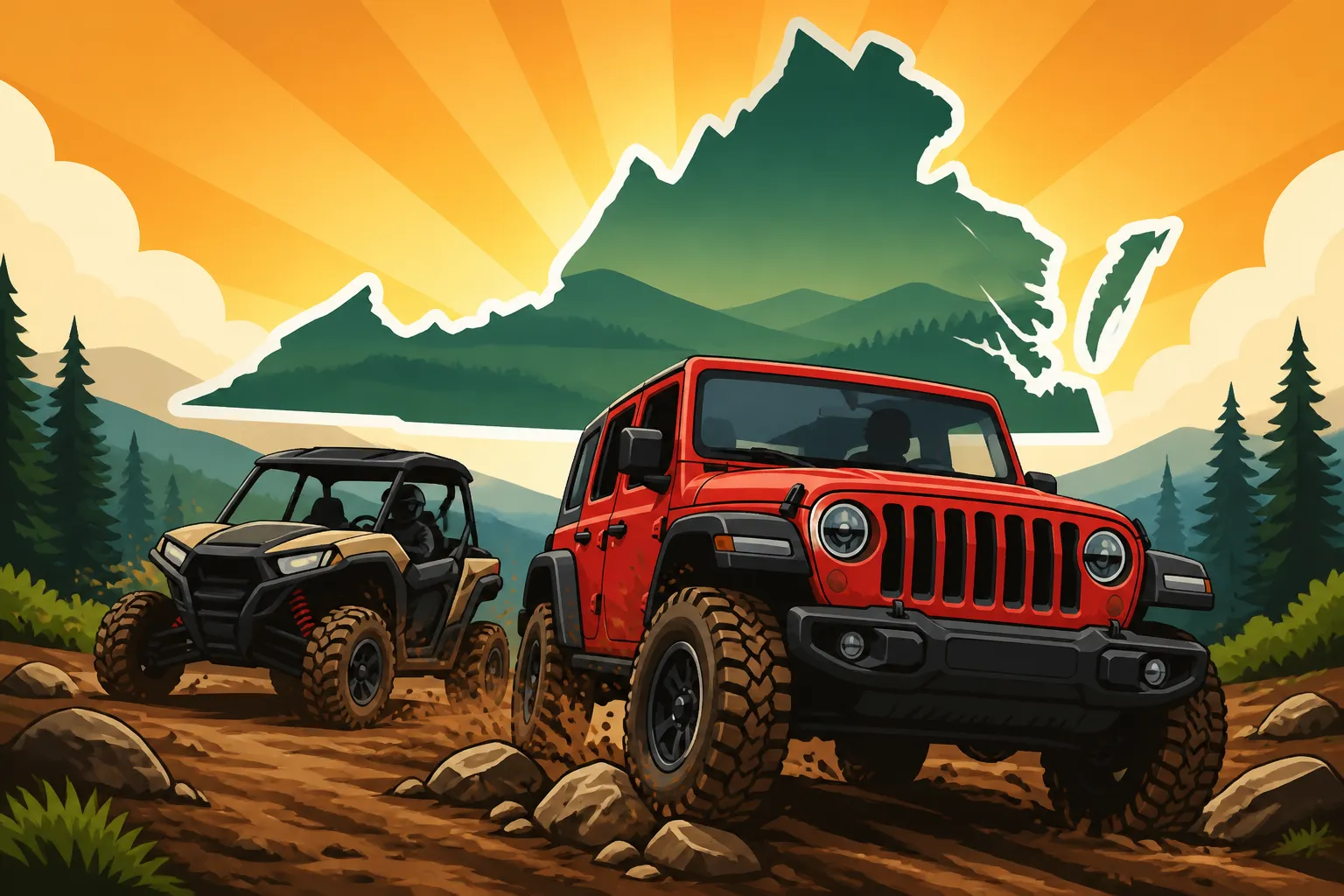
Jawbone, near Richlands, is part of the Spearhead Trails network. The important distinction is that some designated routes are open to registered four-wheel-drive vehicles such as Jeeps. That is not the same as saying every trail, connector, or spur is suitable or authorized for a full-size vehicle.
A trail system can include routes designed for different vehicle types. A narrow, rocky trail that works for a smaller ATV may be a poor fit for a wide Jeep, even if another route nearby welcomes full-size rigs. Look for route-specific vehicle rules, width restrictions, closures, and access notices before you commit to a loop. The overview in [Spearhead Trails in Virginia Explained] can help you understand how the network is organized, while [Virginia Trails That Allow Full-Size Rigs] is useful when comparing destinations.
It is also worth separating managed trail access from ordinary road access. Permission to use a designated route at Jawbone does not create permission to drive a Jeep on any nearby public road, private property, or unmarked trail. If a route ends at a property boundary or a public road, follow the posted signs and the trail operator’s directions rather than assuming you can continue.
Confirm your specific vehicle and route
“Jeep” covers a wide range of vehicle sizes and configurations. A two-door model with a modest setup may fit where a wider four-door rig with oversized tires, a roof rack, or other added equipment does not. Even where a route allows full-size vehicles, check any vehicle-width limits and other equipment requirements that apply to the trail you plan to ride.
A useful pre-trip question is not simply, “Are Jeeps allowed?” Ask, “Which routes are open to my vehicle, and what restrictions apply to those routes?” That wording encourages a more practical answer. If you are traveling with a mix of Jeeps, UTVs, and ATVs, check whether the group can use the same route together. A system may allow all those vehicle types overall without every route being open to every machine. [Virginia Trails That Allow Side-by-Sides] offers a useful comparison for UTV riders planning alongside full-size vehicles.
| Before you go | What to confirm |
|---|---|
| Vehicle eligibility | Whether your specific type of Jeep or four-wheel-drive vehicle is allowed |
| Route access | Which named routes are open to full-size rigs |
| Restrictions | Width, equipment, hours, closures, or other posted conditions |
| Permit and entry rules | Which permit or authorization applies to your group |
| Trail conditions | Whether recent weather or maintenance has affected access |
| Group compatibility | Whether every vehicle in your party can use the planned route |
How to plan a Jawbone route
Build the route around your vehicle, not just the map
Start by identifying routes that are explicitly open to full-size vehicles, then plan a loop or out-and-back route that stays on those routes. Avoid building a plan from a broad trail-system map alone. A line on a map can show that a trail exists without telling you whether your particular vehicle is allowed there today.
If you use a digital mapping tool such as onX Offroad, treat it as a planning aid. It can help you review terrain, orient yourself, and discuss possible routes with your group, but don’t let a map layer replace posted signs or official trail information. Before departure, compare your proposed route with current access rules and any notices from the trail operator. Download or save information you may need before entering areas where phone service could be weak.
When you find a route that looks promising, check how it connects to the rest of the system. A legal route may meet a connector that is restricted, closed, or unsuitable for your vehicle. A route that seems like a short detour on a screen can become a frustrating dead end on the ground. [Virginia Trail Difficulty Ratings] can also help you think beyond distance and consider the kind of terrain your group is prepared to handle.
Check permits, notices, and trail conditions
Find out which permit or entry requirements apply to your visit before leaving home. Permit rules are not necessarily interchangeable between nearby riding networks, and an authorization for one system may not cover another. Review [Virginia Spearhead Trail Permits] for context, then confirm the requirements that apply specifically to your planned Jawbone visit.
Check for closures and other access changes shortly before you travel. Heavy rain, maintenance work, damaged trail surfaces, or other conditions can affect which routes are usable. This matters especially for full-size vehicles: a narrow or washed-out section can be much harder to turn around in than it looks on a screen. [Virginia Trail Conditions Before You Haul] is a helpful reminder to check the practical details before making a long drive with a trailer.
If your group is unfamiliar with the area, keep the first ride flexible. Set a turnaround time, agree on a meeting point, and leave room to shorten the route if the terrain or weather is different from what you expected. Don’t plan a full day around squeezing every available mile into one outing. A relaxed first trip gives you time to learn the trail layout and notice where different vehicle types share space.
Prepare your Jeep and group for shared trails
Check the rig before the trip
Give your Jeep a basic inspection before loading it onto the trailer or driving to the trailhead. Check the tires, brakes, steering, lights, fluids, recovery gear, and any equipment you rely on for the terrain. Secure loose items inside and outside the vehicle. A tool or cooler that seems harmless on a smooth road can shift on rough ground.
Bring recovery equipment suited to your vehicle and make sure someone in the group knows how it works. A winch is not a substitute for choosing an appropriate route, and recovery gear should be used carefully to avoid injuring people or damaging equipment. If you are traveling with ATVs or UTVs, consider whether your group has the tools, spare supplies, and experience to support the smallest and largest vehicles in the party.
Pack for a mountain outing rather than assuming the vehicle itself solves every problem. Water, food, weather-appropriate layers, a first-aid kit, and a way to communicate your plan can make a long delay more manageable. Save your route details in advance, and tell someone who is not riding with you where you expect to go and when you plan to return. onX Offroad may be useful for organizing a route before the trip, but keep a backup plan in case your phone battery runs low or you lose reception.
Ride with other trail users in mind
Jawbone is a shared riding environment, so expect to encounter vehicles moving at different speeds and with different sightlines. A Jeep may take up more room on the trail than an ATV, and a driver may not see a smaller machine around a bend. Slow down where visibility is limited, stay alert for approaching traffic, and use designated pull-offs or wider areas when you need to let others pass.
Avoid creating a new route around mud, obstacles, or a blocked section. Driving off the marked trail can damage vegetation, widen the route, or take you onto land that is not open for riding. If a section seems unsafe or impassable, turn back when you can do so safely and report the problem through the appropriate trail channel. [Virginia Trail Etiquette Locals Expect] covers the kind of considerate habits that make shared trail days better for everyone.
A group should agree on simple communication rules before setting out. Decide where the lead and final vehicles will be, how you will handle a separation, and what everyone should do if a vehicle has a mechanical problem. If your group includes less experienced drivers, keep the pace comfortable and choose routes that match the least experienced person’s ability—not just the most capable Jeep in the convoy.
Common mistakes to avoid at Jawbone
Assuming nearby routes share the same rules
One of the most common planning errors is treating an entire trail system as if it has a single vehicle rule. A route that is open to Jeeps does not automatically make every connecting trail open to Jeeps. Check each planned segment, and don’t follow another driver simply because their vehicle appears to be going the same way. They may have permission, local knowledge, or a route plan you do not.
Another mistake is assuming that a route shown on an app is open, maintained, or appropriate for your vehicle. Digital mapping can be valuable for orientation, and onX Offroad can help you review a proposed route, but the app should not be your final authority on access. Match your map to posted signs and the trail operator’s current information. If the situation on the ground conflicts with your plan, follow the official direction.
It can also be tempting to take an unmarked spur to avoid turning around. Resist that urge. An unmarked track may be private, closed, or unsuitable for a full-size vehicle. Turning back is sometimes inconvenient, but it is usually better than getting stuck or causing damage in a place you were not authorized to drive.
Arriving without checking the details
A long drive to Richlands can make a last-minute surprise especially frustrating: a closed route, a permit requirement you did not account for, or a vehicle restriction that rules out your planned loop. Before you leave, confirm the access information, permit rules, route eligibility, and conditions. Keep the trail operator’s contact information available if you need clarification.
Use a short checklist the night before:
- Confirm that your intended routes are open to your vehicle.
- Review permit and entry requirements for the specific trail system.
- Check for closures, maintenance notices, and weather-related changes.
- Inspect your Jeep and secure your cargo.
- Save route information and share your plan with someone at home.
- Agree on group communication, turnaround points, and an emergency plan.
If you are comparing Jawbone with other nearby riding options, look at vehicle access and route character rather than mileage alone. A system with more trails is not necessarily a better choice for a particular Jeep, group, or riding day. onX Offroad can help you sketch and discuss options, but verify access before you haul.
Jawbone’s appeal to Jeep drivers is that designated routes can accommodate full-size four-wheel-drive vehicles in a network also used by other off-road riders. The key is to plan for the specific routes open to your rig, verify the rules before the trip, and treat signs and trail conditions as part of the route—not as details to sort out after you arrive.
Disclaimer
This article is for general informational purposes only and does not constitute professional advice. Laws, prices and regulations vary by location and change over time. Consult a qualified professional for guidance on your specific situation.