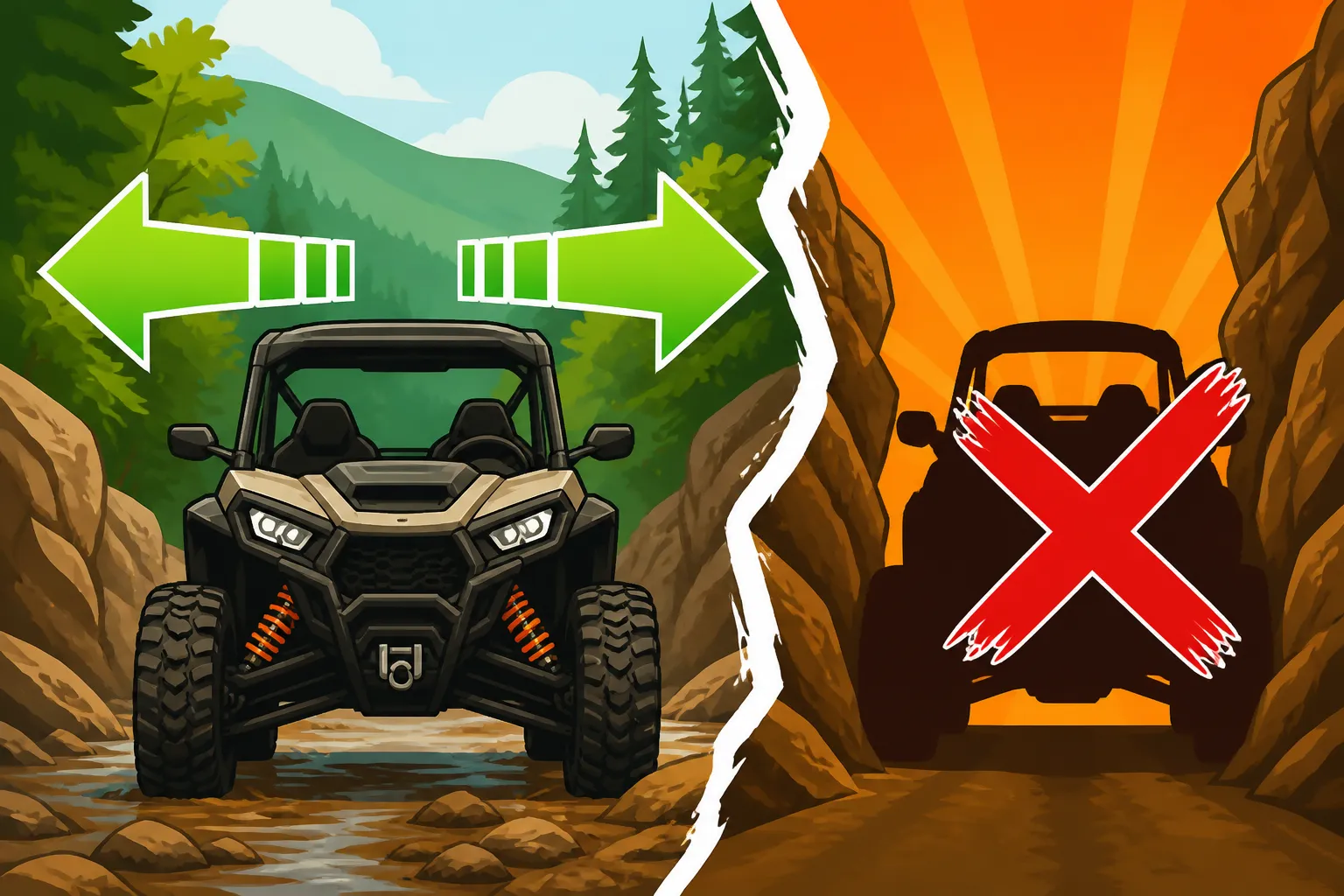
Why Peters Mill Run Has No Width Limit
A wide UTV can make trip planning feel harder than the ride itself, especially when one nearby trail has a 50-inch cap and another appears not to. Peters Mill Run has no published maximum width limit, but that does not mean every machine or setup is suitable. This guide explains the distinction, what to check before hauling, and how to avoid confusing Peters Mill Run with Taskers Gap.
What “no width limit” means at Peters Mill Run
A missing cap is not a promise that every vehicle will fit
When riders say Peters Mill Run has no width limit, they mean the route does not have the same stated maximum-width restriction associated with Taskers Gap. That is a specific rule distinction, not a guarantee that any vehicle can use the trail safely or legally.
A machine still needs to meet the applicable Forest Service rules and the route’s access requirements. Its overall width also matters in practical ways: a vehicle may be allowed on a route but still be awkward between trees, difficult around a tight bend, or vulnerable to body damage on a rocky section. A wide machine with oversized tires, wheel spacers, or accessories may be harder to maneuver than its factory dimensions suggest.
It helps to think of width in two ways: the published rule and the real-world fit. The first tells you whether a stated width cap applies. The second is about whether your particular machine, with its current setup and passengers, can negotiate the route comfortably.
Peters Mill Run and Taskers Gap have different restrictions
Peters Mill Run and Taskers Gap are often discussed together because they belong to the same broader riding area in the George Washington National Forest. That can make it easy to assume they share all the same rules. They do not necessarily have identical access limits, so check the restrictions for the specific route you plan to ride.
The difference matters especially for riders hauling side-by-sides or other wider machines. A vehicle that is appropriate for Peters Mill Run may not be allowed on a narrower route in the same system. The [Virginia's 36-Mile Peters Mill Run and Taskers Gap System] overview helps explain why planning for the named route—not just the general riding area—is important. For the separate cap, see [Virginia's Taskers Gap Width Limit].
Before setting out, confirm the route on an official Forest Service map or with the responsible ranger district. Don’t rely only on an old trail map, a forum post, or a friend’s recollection. Rules and access details can change, and a trail network can include connected routes with different restrictions.
A wide machine still needs room to maneuver
A width rule is only one part of the decision. Peters Mill Run is a forest route, not a wide, smooth road designed to make every turn easy for a large vehicle. Trees, rocks, ruts, drainage features, and other trail users can affect how much room you actually have.
Imagine arriving with a wider UTV after a long tow from the Shenandoah Valley. The posted rule may not set a maximum width, but a narrow turn or a rough, off-camber section can still make the route uncomfortable for an inexperienced driver. If you are unsure about your machine’s fit, consider starting with a short section, riding slowly, and turning around rather than pressing ahead into terrain that feels beyond your comfort level.
Why Peters Mill Run is treated differently
Route design and access are not the same as a vehicle guarantee
The absence of a stated width cap reflects a difference in how Peters Mill Run is managed compared with the narrower Taskers Gap route. It does not mean the trail is a blank cheque for any size or type of rig. Forest routes have specific designations, and those designations determine which kinds of vehicles may use them.
Some full-size, registered four-wheel-drive vehicles may be permitted on Peters Mill Run under the applicable rules, while access on other parts of the system is more limited. That distinction helps explain why you may hear that “trucks are allowed” in one conversation and “there’s a 50-inch limit” in another. Both statements can refer to different routes. The [Registered Trucks on One Side Only] guide is useful context when you are sorting out which side of the system a vehicle may use.
Use the official route designation rather than assuming that an unrestricted width means unrestricted vehicle access. A machine’s registration status, equipment, permit, and the current route order may all matter. If a detail is unclear, ask the ranger district before you load up.
The terrain still sets practical limits
Even without a posted maximum width, the trail itself determines what feels manageable. A wider vehicle may need more room to avoid rocks or ruts, and it may have less margin when passing another rider in a confined place. The challenge can be greater when several vehicles are travelling together, because the lead driver has to consider not only their own turning space but also where the rest of the group can safely stop.
Conditions can change the feel of the route, too. A dry stretch may offer predictable traction, while rain can leave mud, slick rock, or soft shoulders that make careful line choice more important. A recently fallen branch or trail work may also affect passage. For a fuller picture of difficulty and changing surfaces, review [Virginia Trail Difficulty Ratings] and [Virginia Trail Conditions Before You Haul].
If you are new to the area, ride with someone who knows the route or choose a conservative pace. A width rule tells you about a regulatory limit; it cannot tell you whether a particular obstacle is a good match for your experience, tires, ground clearance, or passenger comfort.
Check the system’s other rules separately
Width is not the only requirement to sort out before a ride. Peters Mill Run is in a national forest riding area, so riders should confirm the current permit, operating, equipment, and seasonal rules that apply. Forest OHV permits are a separate planning item from trail access itself; see [Virginia Forest OHV Permits] for what to check before leaving home.
Also confirm whether the route is open on the day you intend to ride. Peters Mill Run has a winter closure period, and dates can matter if you are planning around a holiday or a narrow weekend window. Check [Peters Mill Run Closes Mid-January Through Mid-March] and verify the closure information with the responsible forest office before towing.
| Planning question | What to check | Why it matters |
|---|---|---|
| Is there a maximum width? | The rule for the specific route, especially Peters Mill Run versus Taskers Gap | A restriction on one route may not apply to another |
| Is my vehicle allowed? | Route designation and vehicle-access rules | No width cap does not automatically mean all vehicles are authorized |
| Is the trail open? | Seasonal closures and temporary notices | A legal route can still be closed on your planned date |
| Do I have the required permit? | Forest OHV permit requirements | A width-compliant vehicle may still need a permit |
| Can my machine manage the terrain? | Current conditions, clearance, tires, and driver experience | Legal access is not the same as a comfortable or safe ride |
How to plan for a wide UTV
Measure the machine as it sits today
Start with the actual width of your vehicle in its riding configuration. Check the manufacturer’s specifications, then account for changes made after purchase. Wider tires, wheel spacers, aftermarket arms, mirrors, bumpers, or other accessories may alter the machine’s effective width or how it moves through tight spaces.
For example, a stock UTV can become noticeably wider after an owner adds a wheel-and-tire package. If you are comparing your machine to a restriction on another route, use the relevant measurement method specified by the authority rather than guessing from the brochure. A tape measure can help you understand your setup, but it cannot replace the official route rule.
It is also worth thinking about the trailer separately. A machine that suits the trail may be difficult to load, secure, or unload if the trailer is too narrow or the tie-down arrangement is awkward. Make those checks at home, when there is room to adjust, instead of discovering a problem at a crowded trailhead.
Check maps, access, and conditions before the drive
A mapping app can be helpful for trip planning, locating access roads, and understanding how routes connect. Some riders use onX Offroad to review a planned ride and keep track of where they are, but treat any app as a planning aid—not as the final authority on legal access or temporary closures. Confirm route rules with the Forest Service or the relevant ranger district.
The same caution applies to downloaded maps and saved tracks. An old track can continue to appear on a screen even if access has changed. Before you leave, compare your planned route against current official information, especially if you intend to connect Peters Mill Run with other routes in the area.
If your phone may lose service, download the map area ahead of time and bring a second way to orient yourself. onX Offroad can be useful for viewing a planned route offline when the map is saved beforehand, but make sure you know how to use it before you are standing at a fork without a signal. A paper map is a sensible backup for a long day in the forest.
Make a cautious first run
If you have a wide UTV or have not ridden Peters Mill Run before, avoid treating the lack of a width cap as a reason to push quickly. Begin at a manageable pace, leave room for other trail users, and pause where it is safe if you need to assess an obstacle. If the route becomes uncomfortable, turning back is a sound decision—not a failed ride.
For group trips, talk through the route before the first vehicle moves. Agree on a turnaround point, keep enough space between machines to avoid dust and sudden stops, and make sure everyone knows which route is permitted for their vehicle. A leader should not assume that every rider has the same width, tires, clearance, or experience.
One more practical use for onX Offroad is keeping the group oriented at trail junctions, particularly when several routes appear to connect. Still, check posted signs and official notices as you go. Digital maps are useful, but the signed route and current land-management rules should guide the decision.
Common mistakes riders make
Assuming “no width limit” means “no restrictions”
The most common mistake is treating a missing maximum-width number as proof that the route has no meaningful limits. It only answers one question. Vehicle eligibility, permits, closures, equipment rules, and the physical character of the trail remain separate considerations.
A buyer might hear that Peters Mill Run has no width cap and purchase a wider machine specifically for the trip, only to find that a planned connector route has a different restriction. Avoid that frustration by mapping the exact route you expect to ride and checking each segment. If your plan includes Taskers Gap, do not apply Peters Mill Run’s width rule to it.
Relying on old posts or word of mouth
Trail information is often repeated without its original context. Someone may accurately describe their ride but leave out the date, the route, the vehicle type, or a temporary access condition. Another rider may repeat the story as a general rule for the entire riding area.
Use local reports as helpful background, not the final answer. If a post says a particular UTV passed through, that does not necessarily establish that every vehicle of similar size is permitted today. Confirm the relevant details before making a long drive from places such as Winchester, Harrisonburg, or farther away.
Forgetting the season and the return trip
A route may be open when you start planning but closed during a seasonal period or affected by conditions that make travel unsuitable. The closure can also disrupt a larger itinerary if you planned to ride several connected sections. Check the opening information early, then verify it again close to departure.
Plan for the ride back to the trailer, too. Leave enough time to exit before dark, keep fuel and basic recovery supplies in mind, and avoid assuming that a route will be easier on the return simply because you have already seen it once. A careful plan makes the lack of a width cap useful information—not a substitute for preparation.
Disclaimer
This article is for general informational purposes only and does not constitute professional advice. Laws, prices and regulations vary by location and change over time. Consult a qualified professional for guidance on your specific situation.